






"South America" region includes following countries:
 Argentina
 Bolivia
 Brazil
 Chile
Chile Colombia
 Ecuador
 Falkland Islands (Malvinas)
 French Guiana
 Guyana
 Paraguay
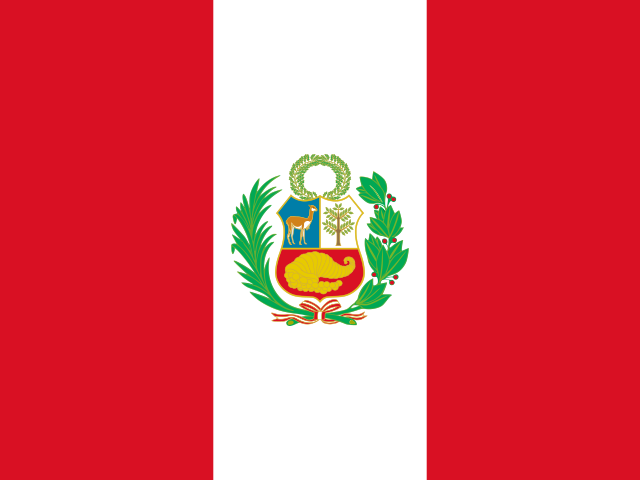 Peru
Peru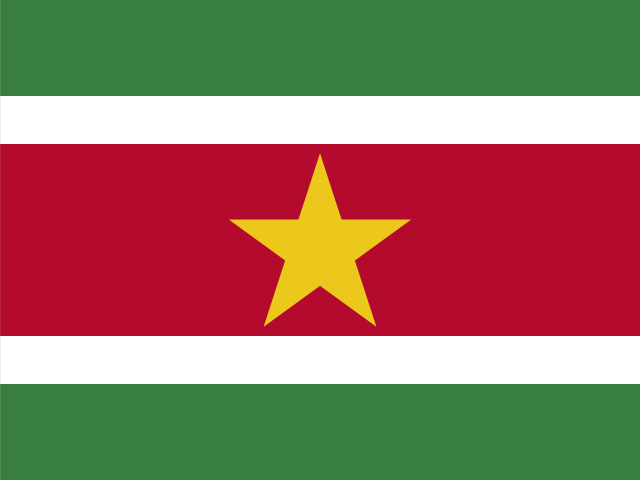 Suriname
 Uruguay
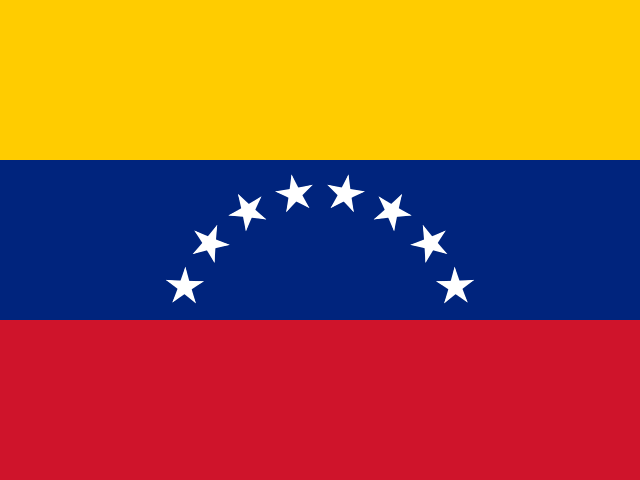 Venezuela
Earlier Report Observations
The market for cottonseed oil in South America, primarily Brazil, expanded from 271.6 thousand tonnes in 2018 to 398.4 thousand tonnes in 2023, though not without fluctuations. Initial growth was supported by the established use of cottonseed oil in biodiesel production, where it serves as a key feedstock especially during the soybean off-season, and by its recognition as a healthier alternative to traditional edible oils.
Market volume dipped in 2020 due to increased competition from soybean and sunflower oils in both the food and biofuel sectors, which pressured prices and demand. It recovered in 2021 as greater availability of cottonseed from the domestic crop lowered input costs for processors, but contracted slightly in 2022 when oil production fell amid high pest control costs in cotton farming.
A sharp surge in 2023, with the market reaching 398.4 thousand tonnes, was directly driven by Brazil's record cotton production and its emergence as the world's top cotton exporter. Expanded planting areas in states like Mato Grosso and Bahia significantly increased the supply of cottonseed, the raw material for oil, boosting domestic processing capacity to meet demand from both the food and biodiesel industries.
Table of content
- 1. Disclaimer
- 2. Terms of use of the report
- 3. Product codes in the statistical classifications used in the report
-
4. Key Market Indicators and Trends
-
4.1. Key Market Indicators
-
4.1.1. In kind
- 4.1.1.1. Production, 2018-2023
- 4.1.1.2. Imports, 2018-2024
- 4.1.1.3. Exports, 2018-2024
- 4.1.1.4. Market size, 2018-2023
-
4.1.1. In kind
- 4.2. Market Trends and Factors
-
4.1. Key Market Indicators
-
5. Production
-
5.1. Production in South America
- 5.1.1. Annual dynamics of production in South America in kind, 2018-2023, K t
-
5.2. Global production by Country, 2018-2023
- 5.2.1. Annual dynamics of production by macroregions in kind, 2018-2023, K t
- 5.2.2. Dynamics of production structure by macroregions in kind, 2018-2023
- 5.2.3. Annual dynamics of production by country in kind, 2018-2023, K t
- 5.2.4. Structure of production by countries in kind, 2018-2023
- 5.2.5. Dynamics of peoduction structure by countries in kind, 2018-2023
-
5.1. Production in South America
-
6. Exports
-
6.1. Exports (Direct Data*)
- 6.1.1. Exports - Total information
-
6.1.2. Exports in kind, t
- 6.1.2.1. Annual dynamics of product's exports from Argentina in kind, 2018-2024, t
- 6.1.2.2. Dynamics of product's exports in kind from Argentina by countries, 2018-2024, t
- 6.1.2.3. Structure of product's exports in kind by countries, 2018-2024
-
6.1.3. Exports in value, K $ US
- 6.1.3.1. Annual dynamics of product's exports from Argentina in value, 2018-2024, K $ US
- 6.1.3.2. Dynamics of product's exports in value from Argentina by countries, 2018-2024, K $ US
- 6.1.3.3. Structure of product's exports in value by countries, 2018-2024
-
6.1.4. Average price of product's exports, $ US/kg
- 6.1.4.1. Annual dynamics of average price of product's exports from Argentina, 2018-2024, $ US/kg
- 6.1.4.2. Dynamics of average price of product's exports from Argentina by countries, 2018-2024, $ US/kg
-
6.2. Exports (Mirror Data)
- 6.2.1. Exports - Total information
-
6.2.2. Exports in kind, t
- 6.2.2.1. Annual dynamics of product's exports from Argentina in kind, 2018-2024, t
- 6.2.2.2. Dynamics of product's exports in kind from Argentina by countries, 2018-2024, t
- 6.2.2.3. Structure of product's exports in kind by countries, 2018-2024
-
6.2.3. Exports in value, K $ US
- 6.2.3.1. Annual dynamics of product's exports from Argentina in value, 2018-2024, K $ US
- 6.2.3.2. Dynamics of product's exports in value from Argentina by countries, 2018-2024, K $ US
- 6.2.3.3. Structure of product's exports in value by countries, 2018-2024
-
6.2.4. Average price of product's exports, $ US/kg
- 6.2.4.1. Annual dynamics of average price of product's exports from Argentina, 2018-2024, $ US/kg
- 6.2.4.2. Dynamics of average price of product's exports from Argentina by countries, 2018-2024, $ US/kg
-
6.1. Exports (Direct Data*)
-
7. Imports
-
7.1. Imports (Direct Data*)
- 7.1.1. Imports - Total information
-
7.1.2. Imports in kind, t
- 7.1.2.1. Annual dynamics of product's imports to Argentina in kind, 2018-2024, t
- 7.1.2.2. Dynamics of product's imports in kind to Argentina by countries, 2018-2024, t
- 7.1.2.3. Structure of product's imports in kind by countries, 2018-2024
-
7.1.3. Imports in value, K $ US
- 7.1.3.1. Annual dynamics of product's imports to Argentina in value, 2018-2024, K $ US
- 7.1.3.2. Dynamics of product's imports in value to Argentina by countries, 2018-2024, K $ US
- 7.1.3.3. Structure of product's imports in value by countries, 2018-2024
-
7.1.4. Average price of product's imports, $ US/kg
- 7.1.4.1. Annual dynamics of average price of product's imports to Argentina, 2018-2024, $ US/kg
- 7.1.4.2. Dynamics of average price of product's imports to Argentina by countries, 2018-2024, $ US/kg
-
7.2. Imports (Mirror Data)
- 7.2.1. Imports - Total information
-
7.2.2. Imports in kind, t
- 7.2.2.1. Annual dynamics of product's imports to Argentina in kind, 2018-2024, t
- 7.2.2.2. Dynamics of product's imports in kind to Argentina by countries, 2018-2024, t
- 7.2.2.3. Structure of product's imports in kind by countries, 2018-2024
-
7.2.3. Imports in value, K $ US
- 7.2.3.1. Annual dynamics of product's imports to Argentina in value, 2018-2024, K $ US
- 7.2.3.2. Dynamics of product's imports in value to Argentina by countries, 2018-2024, K $ US
- 7.2.3.3. Structure of product's imports in value by countries, 2018-2024
-
7.2.4. Average price of product's imports, $ US/kg
- 7.2.4.1. Annual dynamics of average price of product's imports to Argentina, 2018-2024, $ US/kg
- 7.2.4.2. Dynamics of average price of product's imports to Argentina by countries, 2018-2024, $ US/kg
-
7.1. Imports (Direct Data*)
-
8. Trade balance
-
8.1. Trade balance (Direct Data)
- 8.1.1. In kind, t
- 8.1.2. In value, K $ US
-
8.2. Trade balance (Mirror Data)
- 8.2.1. In kind, t
- 8.2.2. In value, K $ US
-
8.1. Trade balance (Direct Data)
-
9. Top buying and selling countries, 2018-2024
-
9.1. Direct Data
- 9.1.1. Import in Value by Countries-buyers
- 9.1.2. Export in Value by Countries-suppliers
-
9.2. Mirror Data
- 9.2.1. Import in Value by Countries-buyers
- 9.2.2. Export in Value by Countries-suppliers
-
9.1. Direct Data
Production cottonseed oil and fractions in South America
In kind, 2017-2020, K t
Top producers of cottonseed oil and fractions, 2017-2020
World map of production of cottonseed oil and fractions, 2017-2020
After two years of growth, cottonseed oil and fractions production in South America experienced a decline. In 2020, production reached 298.8 K t, representing a 3.0% decrease compared to the previous year. Looking at the broader period from 2017 to 2020, production increased by 54.3%, which translates to an average annual growth rate of 15.6%. The highest production level was recorded in 2019 at 308.0 K t, while the most significant year-over-year increase occurred in 2018 with a 40.3% rise.
Annual dynamics of production in South America in kind, 2017-2020, K t
| Parameter | 2018 | 2019 | 2020 | CAGR | |
|---|---|---|---|---|---|
| 1 | Change from last year | 40.3% | 13.3% | (3.0%) | 15.6% |
Exports cottonseed oil and fractions from South America
Exports in kind, t
The export market for cottonseed oil and fractions from South America showed considerable volatility during this period. Exports reached their lowest point in 2018 at 558 t, then surged dramatically in 2019 with a 447.9% increase, and continued to grow in 2020 to 4 724 t, marking a 54.4% rise compared to 2019. The difference between the peak in 2017 and the trough in 2018 was substantial, with exports varying by 14.4-fold. The most significant decline occurred in 2018 with a 93.1% drop.
Annual dynamics of product's exports from South America in kind, 2017-2020, t
| Parameter | 2018 | 2019 | 2020 | CAGR | |
|---|---|---|---|---|---|
| 1 | Change from last year | (93.1%) | 447.9% | 54.4% | (16.3%) |
Between 2017 and 2020, three countries dominated South America's cottonseed oil and fractions exports in volume terms. South Africa accounted for 36.8% of exports, Malaysia for 31.2%, and Australia for 17.2%. Together, these three markets represented 85.2% of total export flows.
Structure of product's exports in kind by countries, 2017-2020
World map of product's exports from South America in kind, 2017-2020
Exports in value, K $ US
Export values for cottonseed oil and fractions from South America followed an unstable pattern throughout the period. The market hit its lowest point in 2018 at 711 K $ US, then rebounded strongly in 2019 with a 297.0% increase, and continued to grow in 2020 to 4 079 K $ US, representing a 44.6% rise compared to 2019. The difference between the 2017 peak and 2018 trough was significant, with values varying by 10.5 times. The most substantial decline occurred in 2018 with a 90.5% drop.
Annual dynamics of product's exports from South America in value, 2017-2020, K $ US
| Parameter | 2018 | 2019 | 2020 | CAGR | |
|---|---|---|---|---|---|
| 1 | Change from last year | (90.5%) | 297.0% | 44.6% | (18.3%) |
From 2017 to 2020, three key markets accounted for the majority of South America's cottonseed oil and fractions export value. South Africa, Malaysia, and Australia together absorbed 81.6% of total export revenues.
Structure of product's exports in value by countries, 2017-2020
World map of product's exports from South America in value, 2017-2020
Imports cottonseed oil and fractions to South America
Imports in kind, t
South America's imports of cottonseed oil and fractions continued to grow for the third consecutive year. In 2020, imports reached 2 655 t, showing a substantial 14.4% increase compared to 2019. Over the four-year period from 2017 to 2020, imports expanded dramatically by 1005.2%, which corresponds to an impressive compound annual growth rate of 122.8%.
Annual dynamics of product's imports to South America in kind, 2017-2020, t
| Parameter | 2018 | 2019 | 2020 | CAGR | |
|---|---|---|---|---|---|
| 1 | Change from last year | 71.7% | 462.7% | 14.4% | 122.8% |
During the 2017-2020 period, the United States and Indonesia together accounted for the main share of South America's cottonseed oil and fractions imports in volume terms, representing 3.2% of total import flows.
Structure of product's imports in kind by countries, 2017-2020
World map of product's imports to South America in kind, 2017-2020
Imports in value, K $ US
South America's import values for cottonseed oil and fractions grew for the third year in a row. In 2020, imports totaled 3 477 K $ US, showing a modest 1.0% increase compared to the previous year. Between 2017 and 2020, import values surged by 655.6%, equating to an average annual growth rate of 96.2%.
Annual dynamics of product's imports to South America in value, 2017-2020, K $ US
| Parameter | 2018 | 2019 | 2020 | CAGR | |
|---|---|---|---|---|---|
| 1 | Change from last year | 45.0% | 415.8% | 1.0% | 96.2% |
Throughout the 2017-2020 period, three countries served as the primary sources for South America's cottonseed oil and fractions imports in value terms. The United States accounted for 6.2% of import value, the Netherlands for 1.0%, and Indonesia for 0.7%. Together, these three markets represented 7.9% of total import flows.
Structure of product's imports in value by countries, 2017-2020
World map of product's imports to South America in value, 2017-2020
Related Reports

Cottonseed oil and fractions market in SADC
2026-03-28
Cottonseed oil and fractions market in Togo
2026-03-28




In-depth market research on this product
Global Cottonseed Oil Market 2021–2031: Size, Share, Trends and Forecast
Global market report: size, trends and forecast to 2031 · 186 pages
Why Choose Us?
Only Verified Data
No Hidden Costs or Separate Fees
Smarter Subscription Pricing
Contact Our Team
Submit your inquiry using the form below — our team will get back to you within 24 hours.