






"South America" region includes following countries:
 Argentina
 Bolivia
 Brazil
 Chile
Chile Colombia
 Ecuador
 Falkland Islands (Malvinas)
 French Guiana
 Guyana
 Paraguay
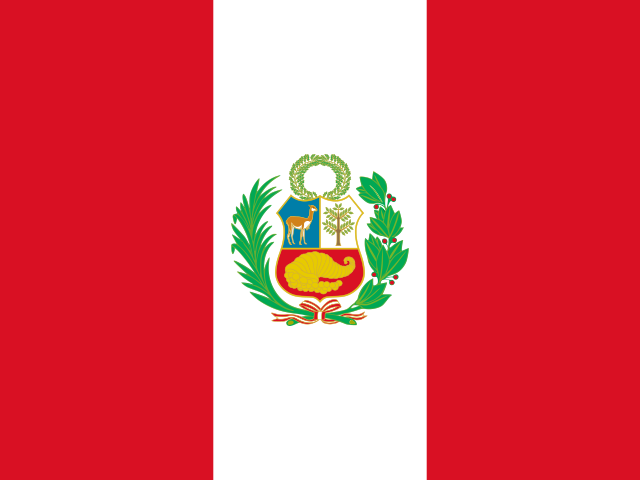 Peru
Peru Suriname
 Uruguay
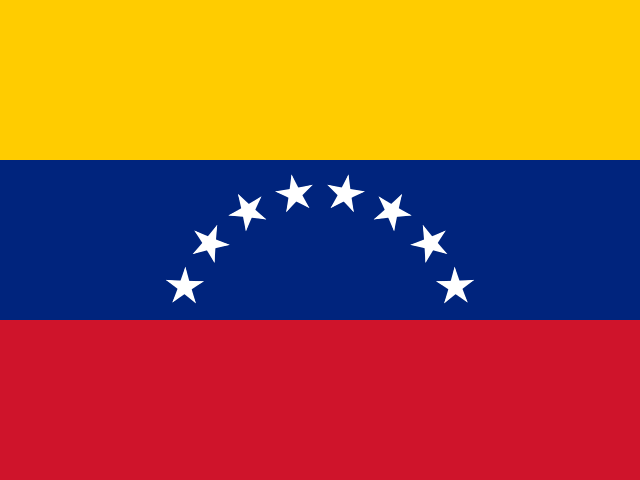 Venezuela
Earlier Report Observations
From 2018 to 2021, the South American virgin olive oil market volume grew from 97 660 t to 128 910 t. This expansion was supported by a 27% drop in Mediterranean harvests in 2020, which tightened global supply and increased reliance on imports and local output. Concurrently, rising consumer preference for high-quality and organic extra virgin oils boosted premium segment demand throughout the period.
A sharp reversal occurred in 2022 as market volume plummeted to 48 420 t. Severe droughts in Andalusia cut olive yields by more than half, driving world prices to record highs and drastically reducing imports into the region. New EU labeling and quality‑control rules further complicated international trade. Meanwhile, Brazil significantly scaled up its own production, notably in Rio Grande do Sul, helping to cushion the decline in overall output.
In 2023 the market contracted further to 29 210 t, as imports remained minimal due to persistent global price pressures and tighter regulatory requirements on quality and labeling. Fiscal incentives for local industry in Brazil supported domestic producers, stabilizing production around 56 500 t.
Table of content
- 1. Disclaimer
- 2. Terms of use of the report
- 3. Product codes in the statistical classifications used in the report
-
4. Key Market Indicators and Trends
-
4.1. Key Market Indicators
-
4.1.1. In kind
- 4.1.1.1. Production, 2018-2023
- 4.1.1.2. Imports, 2018-2024
- 4.1.1.3. Exports, 2018-2024
- 4.1.1.4. Market size, 2018-2023
-
4.1.1. In kind
- 4.2. Market Trends and Factors
-
4.1. Key Market Indicators
-
5. Production
-
5.1. Production in South America
- 5.1.1. Annual dynamics of production in South America in kind, 2018-2023, t
-
5.2. Global production by Country, 2018-2023
- 5.2.1. Annual dynamics of production by macroregions in kind, 2018-2023, t
- 5.2.2. Dynamics of production structure by macroregions in kind, 2018-2023
- 5.2.3. Annual dynamics of production by country in kind, 2018-2023, t
- 5.2.4. Structure of production by countries in kind, 2018-2023
- 5.2.5. Dynamics of peoduction structure by countries in kind, 2018-2023
-
5.1. Production in South America
-
6. Exports
-
6.1. Exports (Direct Data*)
- 6.1.1. Exports - Total information
-
6.1.2. Exports in kind, t
- 6.1.2.1. Annual dynamics of product's exports from Argentina in kind, 2018-2024, t
- 6.1.2.2. Dynamics of product's exports in kind from Argentina by countries, 2018-2024, t
- 6.1.2.3. Structure of product's exports in kind by countries, 2018-2024
-
6.1.3. Exports in value, M $ US
- 6.1.3.1. Annual dynamics of product's exports from Argentina in value, 2018-2024, M $ US
- 6.1.3.2. Dynamics of product's exports in value from Argentina by countries, 2018-2024, M $ US
- 6.1.3.3. Structure of product's exports in value by countries, 2018-2024
-
6.1.4. Average price of product's exports, $ US/t
- 6.1.4.1. Annual dynamics of average price of product's exports from Argentina, 2018-2024, $ US/t
- 6.1.4.2. Dynamics of average price of product's exports from Argentina by countries, 2018-2024, $ US/t
-
6.2. Exports (Mirror Data)
- 6.2.1. Exports - Total information
-
6.2.2. Exports in kind, t
- 6.2.2.1. Annual dynamics of product's exports from Argentina in kind, 2018-2024, t
- 6.2.2.2. Dynamics of product's exports in kind from Argentina by countries, 2018-2024, t
- 6.2.2.3. Structure of product's exports in kind by countries, 2018-2024
-
6.2.3. Exports in value, M $ US
- 6.2.3.1. Annual dynamics of product's exports from Argentina in value, 2018-2024, M $ US
- 6.2.3.2. Dynamics of product's exports in value from Argentina by countries, 2018-2024, M $ US
- 6.2.3.3. Structure of product's exports in value by countries, 2018-2024
-
6.2.4. Average price of product's exports, $ US/t
- 6.2.4.1. Annual dynamics of average price of product's exports from Argentina, 2018-2024, $ US/t
- 6.2.4.2. Dynamics of average price of product's exports from Argentina by countries, 2018-2024, $ US/t
-
6.1. Exports (Direct Data*)
-
7. Imports
-
7.1. Imports (Direct Data*)
- 7.1.1. Imports - Total information
-
7.1.2. Imports in kind, t
- 7.1.2.1. Annual dynamics of product's imports to Argentina in kind, 2018-2024, t
- 7.1.2.2. Dynamics of product's imports in kind to Argentina by countries, 2018-2024, t
- 7.1.2.3. Structure of product's imports in kind by countries, 2018-2024
-
7.1.3. Imports in value, M $ US
- 7.1.3.1. Annual dynamics of product's imports to Argentina in value, 2018-2024, M $ US
- 7.1.3.2. Dynamics of product's imports in value to Argentina by countries, 2018-2024, M $ US
- 7.1.3.3. Structure of product's imports in value by countries, 2018-2024
-
7.1.4. Average price of product's imports, $ US/t
- 7.1.4.1. Annual dynamics of average price of product's imports to Argentina, 2018-2024, $ US/t
- 7.1.4.2. Dynamics of average price of product's imports to Argentina by countries, 2018-2024, $ US/t
-
7.2. Imports (Mirror Data)
- 7.2.1. Imports - Total information
-
7.2.2. Imports in kind, t
- 7.2.2.1. Annual dynamics of product's imports to Argentina in kind, 2018-2024, t
- 7.2.2.2. Dynamics of product's imports in kind to Argentina by countries, 2018-2024, t
- 7.2.2.3. Structure of product's imports in kind by countries, 2018-2024
-
7.2.3. Imports in value, M $ US
- 7.2.3.1. Annual dynamics of product's imports to Argentina in value, 2018-2024, M $ US
- 7.2.3.2. Dynamics of product's imports in value to Argentina by countries, 2018-2024, M $ US
- 7.2.3.3. Structure of product's imports in value by countries, 2018-2024
-
7.2.4. Average price of product's imports, $ US/t
- 7.2.4.1. Annual dynamics of average price of product's imports to Argentina, 2018-2024, $ US/t
- 7.2.4.2. Dynamics of average price of product's imports to Argentina by countries, 2018-2024, $ US/t
-
7.1. Imports (Direct Data*)
-
8. Trade balance
-
8.1. Trade balance (Direct Data)
- 8.1.1. In kind, t
- 8.1.2. In value, M $ US
-
8.2. Trade balance (Mirror Data)
- 8.2.1. In kind, t
- 8.2.2. In value, M $ US
-
8.1. Trade balance (Direct Data)
-
9. Top buying and selling countries, 2018-2024
-
9.1. Direct Data
- 9.1.1. Import in Value by Countries-buyers
- 9.1.2. Export in Value by Countries-suppliers
-
9.2. Mirror Data
- 9.2.1. Import in Value by Countries-buyers
- 9.2.2. Export in Value by Countries-suppliers
-
9.1. Direct Data
Production virgin olive oil and fractions in South America
In kind, 2017-2020, t
Top producers of virgin olive oil and fractions, 2017-2020
World map of production of virgin olive oil and fractions, 2017-2020
South America's production of virgin olive oil and fractions has increased for the second year in a row. In 2020, the region produced 52 991 tonnes, marking a 2.5% gain over 2019. However, looking at the broader period from 2017 to 2020, production actually fell by 21.6%, which translates to an average annual decline of 7.8%. The lowest point was in 2018, with output dropping to 51 100 tonnes, and that year also saw the sharpest decrease of 24.4%.
Annual dynamics of production in South America in kind, 2017-2020, t
| Parameter | 2018 | 2019 | 2020 | CAGR | |
|---|---|---|---|---|---|
| 1 | Change from last year | (24.4%) | 1.1% | 2.5% | (7.8%) |
In value, 2017-2020, M $ US
In terms of value, South America's production of virgin olive oil and fractions has declined for three consecutive years. In 2020, the output was valued at 230.8 million US dollars, down 10.6% from 2019. Over the 2017-2020 period, production value decreased by 37.7%, with a compound annual growth rate of -14.6%.
Annual dynamics of production in South America in value, 2017-2020, M $ US
| Parameter | 2018 | 2019 | 2020 | CAGR | |
|---|---|---|---|---|---|
| 1 | Change from last year | (7.4%) | (24.7%) | (10.6%) | (14.6%) |
Exports virgin olive oil and fractions from South America
Exports in kind, t
South America's exports of virgin olive oil and fractions in volume terms reached 27 323 tonnes in 2020, representing a significant drop of 12.1% compared to 2019. From 2017 to 2020, exports decreased by 29.2%, averaging an annual decline of 10.9%. The lowest export volume was recorded in 2018 at 21 963 tonnes, which also saw the largest decline of 43.1%. In contrast, 2019 experienced the biggest increase of 41.5%.
Annual dynamics of product's exports from South America in kind, 2017-2020, t
| Parameter | 2018 | 2019 | 2020 | CAGR | |
|---|---|---|---|---|---|
| 1 | Change from last year | (43.1%) | 41.5% | (12.1%) | (10.9%) |
Between 2017 and 2020, the United States, Spain, and Canada were the key destinations for South America's exports of virgin olive oil and fractions in volume terms. The United States accounted for 38.0% of exports, Spain for 26.7%, and Canada for 1.2%, together making up 66.0% of total export flows.
Structure of product's exports in kind by countries, 2017-2020
World map of product's exports from South America in kind, 2017-2020
Exports in value, M $ US
South America's exports of virgin olive oil and fractions in value terms have also declined for three years in a row. In 2020, exports amounted to 118.3 million US dollars, a moderate decrease of 5.7% from the previous year. Over the 2017-2020 period, export value fell by 43.9%, with an average annual rate of decline of 17.5%.
Annual dynamics of product's exports from South America in value, 2017-2020, M $ US
| Parameter | 2018 | 2019 | 2020 | CAGR | |
|---|---|---|---|---|---|
| 1 | Change from last year | (30.2%) | (14.7%) | (5.7%) | (17.5%) |
From 2017 to 2020, the United States, Spain, and Canada were the top contributors to South America's export value for virgin olive oil and fractions. The United States held 37.6% of exports in value terms, Spain 19.8%, and Canada 1.7%, collectively accounting for 59.1% of total export flows.
Structure of product's exports in value by countries, 2017-2020
World map of product's exports from South America in value, 2017-2020
Imports virgin olive oil and fractions to South America
Imports in kind, t
South America's imports of virgin olive oil and fractions in volume terms have risen for the third consecutive year. In 2020, imports totalled 99 059 tonnes, up 9.5% from 2019. Between 2017 and 2020, import volume increased by 63.4%, averaging an annual growth rate of 17.8%.
Annual dynamics of product's imports to South America in kind, 2017-2020, t
| Parameter | 2018 | 2019 | 2020 | CAGR | |
|---|---|---|---|---|---|
| 1 | Change from last year | 13.0% | 32.0% | 9.5% | 17.8% |
During 2017-2020, Portugal, Spain, and Italy were the leading sources for South America's imports of virgin olive oil and fractions in volume terms. Portugal accounted for 53.6% of imports, Spain for 22.1%, and Italy for 5.9%, together comprising 81.6% of total import flows.
Structure of product's imports in kind by countries, 2017-2020
World map of product's imports to South America in kind, 2017-2020
Imports in value, M $ US
In value terms, South America's imports of virgin olive oil and fractions reached 418.2 million US dollars in 2020, a 3.5% increase over 2019. Over the 2017-2020 period, import value grew by 23.6%, with a compound annual growth rate of 7.3%. The highest value was recorded in 2018 at 442.8 million US dollars, which also saw the largest increase of 30.8%. In 2019, there was a decline of 8.8%.
Annual dynamics of product's imports to South America in value, 2017-2020, M $ US
| Parameter | 2018 | 2019 | 2020 | CAGR | |
|---|---|---|---|---|---|
| 1 | Change from last year | 30.8% | (8.8%) | 3.5% | 7.3% |
From 2017 to 2020, Portugal, Spain, and Italy dominated South America's imports of virgin olive oil and fractions in value terms, together accounting for 82.4% of total import flows.
Structure of product's imports in value by countries, 2017-2020
World map of product's imports to South America in value, 2017-2020
Related Reports





Why Choose Us?
Only Verified Data
No Hidden Costs or Separate Fees
Smarter Subscription Pricing
Contact Our Team
Submit your inquiry using the form below — our team will get back to you within 24 hours.