






"Middle Africa" region includes following countries:
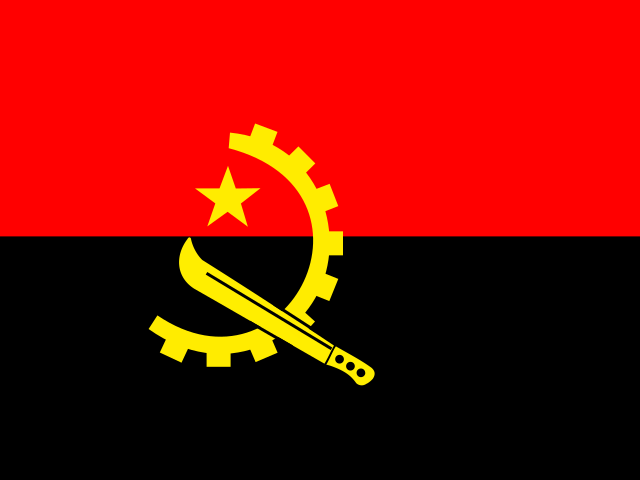 Angola
 Cameroon
 Central African Republic
 Chad
Chad Congo
Congo Democratic Republic of the Congo
 Equatorial Guinea
 Gabon
Gabon Sao Tome and Principe
Earlier Report Observations
The market volume for coconuts, Brazil nuts and cashews in Middle Africa increased from 13 122 t in 2018 to 15 771 t in 2020, representing significant growth over the period. Domestic production rose steadily, reaching over 15 300 t by 2020.
From 2020 to 2023, the market volume stabilized between 15 762 t and 15 874 t. Production levels remained consistently high, maintaining the overall market size above 15 700 t throughout these years.
Table of content
- 1. Disclaimer
- 2. Terms of use of the report
- 3. Product codes in the statistical classifications used in the report
-
4. Key Market Indicators and Trends
-
4.1. Key Market Indicators
-
4.1.1. In kind
- 4.1.1.1. Production, 2018-2023
- 4.1.1.2. Imports, 2018-2024
- 4.1.1.3. Exports, 2018-2024
- 4.1.1.4. Market size, 2018-2023
-
4.1.1. In kind
- 4.2. Market Trends and Factors
-
4.1. Key Market Indicators
-
5. Production
-
5.1. Production in Middle Africa
- 5.1.1. Annual dynamics of production in Middle Africa in kind, 2018-2023, t
-
5.2. Global production by Country, 2018-2023
- 5.2.1. Annual dynamics of production by macroregions in kind, 2018-2023, t
- 5.2.2. Dynamics of production structure by macroregions in kind, 2018-2023
- 5.2.3. Annual dynamics of production by country in kind, 2018-2023, t
- 5.2.4. Structure of production by countries in kind, 2018-2023
- 5.2.5. Dynamics of peoduction structure by countries in kind, 2018-2023
-
5.1. Production in Middle Africa
-
6. Imports
-
6.1. Imports (Direct Data*)
- 6.1.1. Imports - Total information
-
6.1.2. Imports in kind, t
- 6.1.2.1. Annual dynamics of product's imports to Angola in kind, 2018-2024, t
- 6.1.2.2. Dynamics of product's imports in kind to Angola by countries, 2018-2024, t
- 6.1.2.3. Structure of product's imports in kind by countries, 2018-2024
-
6.1.3. Imports in value, K $ US
- 6.1.3.1. Annual dynamics of product's imports to Angola in value, 2018-2024, K $ US
- 6.1.3.2. Dynamics of product's imports in value to Angola by countries, 2018-2024, K $ US
- 6.1.3.3. Structure of product's imports in value by countries, 2018-2024
-
6.1.4. Average price of product's imports, $ US/t
- 6.1.4.1. Annual dynamics of average price of product's imports to Angola, 2018-2024, $ US/t
- 6.1.4.2. Dynamics of average price of product's imports to Angola by countries, 2018-2024, $ US/t
-
6.2. Imports (Mirror Data)
- 6.2.1. Imports - Total information
-
6.2.2. Imports in kind, t
- 6.2.2.1. Annual dynamics of product's imports to Angola in kind, 2018-2024, t
- 6.2.2.2. Dynamics of product's imports in kind to Angola by countries, 2018-2024, t
- 6.2.2.3. Structure of product's imports in kind by countries, 2018-2024
-
6.2.3. Imports in value, K $ US
- 6.2.3.1. Annual dynamics of product's imports to Angola in value, 2018-2024, K $ US
- 6.2.3.2. Dynamics of product's imports in value to Angola by countries, 2018-2024, K $ US
- 6.2.3.3. Structure of product's imports in value by countries, 2018-2024
-
6.2.4. Average price of product's imports, $ US/t
- 6.2.4.1. Annual dynamics of average price of product's imports to Angola, 2018-2024, $ US/t
- 6.2.4.2. Dynamics of average price of product's imports to Angola by countries, 2018-2024, $ US/t
-
6.1. Imports (Direct Data*)
-
7. Exports
-
7.1. Exports (Direct Data*)
- 7.1.1. Exports - Total information
-
7.1.2. Exports in kind, t
- 7.1.2.1. Annual dynamics of product's exports from Angola in kind, 2018-2024, t
- 7.1.2.2. Dynamics of product's exports in kind from Angola by countries, 2018-2024, t
- 7.1.2.3. Structure of product's exports in kind by countries, 2018-2024
-
7.1.3. Exports in value, K $ US
- 7.1.3.1. Annual dynamics of product's exports from Angola in value, 2018-2024, K $ US
- 7.1.3.2. Dynamics of product's exports in value from Angola by countries, 2018-2024, K $ US
- 7.1.3.3. Structure of product's exports in value by countries, 2018-2024
-
7.1.4. Average price of product's exports, $ US/t
- 7.1.4.1. Annual dynamics of average price of product's exports from Angola, 2018-2024, $ US/t
- 7.1.4.2. Dynamics of average price of product's exports from Angola by countries, 2018-2024, $ US/t
-
7.2. Exports (Mirror Data)
- 7.2.1. Exports - Total information
-
7.2.2. Exports in kind, t
- 7.2.2.1. Annual dynamics of product's exports from Angola in kind, 2018-2024, t
- 7.2.2.2. Dynamics of product's exports in kind from Angola by countries, 2018-2024, t
- 7.2.2.3. Structure of product's exports in kind by countries, 2018-2024
-
7.2.3. Exports in value, K $ US
- 7.2.3.1. Annual dynamics of product's exports from Angola in value, 2018-2024, K $ US
- 7.2.3.2. Dynamics of product's exports in value from Angola by countries, 2018-2024, K $ US
- 7.2.3.3. Structure of product's exports in value by countries, 2018-2024
-
7.2.4. Average price of product's exports, $ US/t
- 7.2.4.1. Annual dynamics of average price of product's exports from Angola, 2018-2024, $ US/t
- 7.2.4.2. Dynamics of average price of product's exports from Angola by countries, 2018-2024, $ US/t
-
7.1. Exports (Direct Data*)
-
8. Trade balance
-
8.1. Trade balance (Direct Data)
- 8.1.1. In kind, t
- 8.1.2. In value, K $ US
-
8.2. Trade balance (Mirror Data)
- 8.2.1. In kind, t
- 8.2.2. In value, K $ US
-
8.1. Trade balance (Direct Data)
-
9. Top buying and selling countries, 2018-2024
-
9.1. Direct Data
- 9.1.1. Import in Value by Countries-buyers
- 9.1.2. Export in Value by Countries-suppliers
-
9.2. Mirror Data
- 9.2.1. Import in Value by Countries-buyers
- 9.2.2. Export in Value by Countries-suppliers
-
9.1. Direct Data
Production coconuts, Brazil nuts and cashews in Middle Africa
In kind, 2017-2020, t
Top producers of coconuts, Brazil nuts and cashews, 2017-2020
World map of production of coconuts, Brazil nuts and cashews, 2017-2020
In 2020, Middle Africa produced 15 344 tonnes of coconuts, Brazil nuts, and cashews, showing minimal change from the previous year. Over the period from 2017 to 2020, production increased by 19.1%, with a compound annual growth rate of 6.0%. The lowest production level was recorded in 2018 at 12 484 tonnes, while the highest was in 2019 at 15 390 tonnes. The largest decline occurred in 2018, with a drop of 3.1%, and the largest increase was in 2019, with a rise of 23.3%.
Annual dynamics of production in Middle Africa in kind, 2017-2020, t
| Parameter | 2018 | 2019 | 2020 | CAGR | |
|---|---|---|---|---|---|
| 1 | Change from last year | (3.1%) | 23.3% | (0.3%) | 6.0% |
Exports coconuts, Brazil nuts and cashews from Middle Africa
Exports in kind, t
The export market for these nuts in Middle Africa showed an unstable trend throughout the timeframe. In 2019, exports peaked at 1 053 tonnes, but in 2020, they dropped sharply to 82 tonnes, marking a 12.9-fold difference between these years. This represented an abrupt contraction of 92.2% compared to 2019. The largest increase was recorded in 2019, with a surge of 594.8%.
Annual dynamics of product's exports from Middle Africa in kind, 2017-2020, t
| Parameter | 2018 | 2019 | 2020 | CAGR | |
|---|---|---|---|---|---|
| 1 | Change from last year | (31.8%) | 594.8% | (92.2%) | (28.3%) |
From 2017 to 2020, there was no single dominant market for Middle Africa's exports of coconuts, Brazil nuts, and cashews. The top three destinations—Portugal (5.8% of exports in kind), Nigeria (2.8%), and India (2.0%)—together accounted for only 10.6% of total exports. Many smaller partners each held modest individual shares, contributing to a highly diversified export structure.
Structure of product's exports in kind by countries, 2017-2020
World map of product's exports from Middle Africa in kind, 2017-2020
Exports in value, K $ US
In 2020, Middle Africa exported 127 thousand US dollars worth of coconuts, Brazil nuts, and cashews, indicating a decrease of 40.1% compared to 2019. Between 2017 and 2020, exports fell by 49.7%, equating to an annualized decline of 20.5%. The largest increase was recorded in 2019, with a rise of 10.7%.
Annual dynamics of product's exports from Middle Africa in value, 2017-2020, K $ US
| Parameter | 2018 | 2019 | 2020 | CAGR | |
|---|---|---|---|---|---|
| 1 | Change from last year | (24.1%) | 10.7% | (40.1%) | (20.5%) |
During 2017–2020, Middle Africa supplied these nuts to many different markets. Even the largest destinations—India, Vietnam, and Portugal—together represented only 20.7% of total exports in value terms, highlighting a fragmented market with numerous smaller partners.
Structure of product's exports in value by countries, 2017-2020
World map of product's exports from Middle Africa in value, 2017-2020
Imports coconuts, Brazil nuts and cashews to Middle Africa
Imports in kind, t
In 2020, Middle Africa's imports of coconuts, Brazil nuts, and cashews reached 510 tonnes, marking a sharp fall of 40.7% year-over-year. Over the period from 2017 to 2020, imports decreased by 49.5%, with a compound annual decline of 20.3%. The largest increase was recorded in 2019, with an 8.9% rise.
Annual dynamics of product's imports to Middle Africa in kind, 2017-2020, t
| Parameter | 2018 | 2019 | 2020 | CAGR | |
|---|---|---|---|---|---|
| 1 | Change from last year | (21.7%) | 8.9% | (40.7%) | (20.3%) |
From 2017 to 2020, the country structure of imports in kind remained highly diversified. The top three sources—Vietnam (15.2% of imports in kind), Portugal (9.0%), and Indonesia (5.7%)—together accounted for only 30.0% of total flows. A long tail of smaller markets made up the remaining 70.0%, indicating a broad and varied import base.
Structure of product's imports in kind by countries, 2017-2020
World map of product's imports to Middle Africa in kind, 2017-2020
Imports in value, K $ US
Middle Africa's imports of coconuts, Brazil nuts, and cashews declined for the second consecutive year. In 2020, imports amounted to 697 thousand US dollars, representing a 40.3% decrease compared to 2019. Between 2017 and 2020, imports fell by 53.3%, equating to an annualized decline of 22.4%. The highest value was recorded in 2018 at 1 787 thousand US dollars, with the largest increase that year at 19.8%.
Annual dynamics of product's imports to Middle Africa in value, 2017-2020, K $ US
| Parameter | 2018 | 2019 | 2020 | CAGR | |
|---|---|---|---|---|---|
| 1 | Change from last year | 19.8% | (34.7%) | (40.3%) | (22.4%) |
In 2017–2020, the main group of sources for imports in value terms to Middle Africa consisted of Portugal (30.2% of imports in value terms), Vietnam (18.5%), and Mozambique (11.2%). Together, they accounted for 59.9% of total flows, forming a more concentrated import structure compared to other trade aspects.
Structure of product's imports in value by countries, 2017-2020
World map of product's imports to Middle Africa in value, 2017-2020
Related Reports


In-shell hazelnuts market in Middle Africa
2026-03-28

Watermelons market in Middle Africa
2026-03-28

Melons market in Middle Africa
2026-03-28

In-depth market research on this product
Global Cashew Market 2021–2031: Size, Share, Trends and Forecast
Global market report: size, trends and forecast to 2031 · 184 pages
Global Brazil Nut Market 2021–2031: Size, Share, Trends and Forecast
Global market report: size, trends and forecast to 2031 · 184 pages
Why Choose Us?
Only Verified Data
No Hidden Costs or Separate Fees
Smarter Subscription Pricing
Contact Our Team
Submit your inquiry using the form below — our team will get back to you within 24 hours.