






"SADC" region includes following countries:
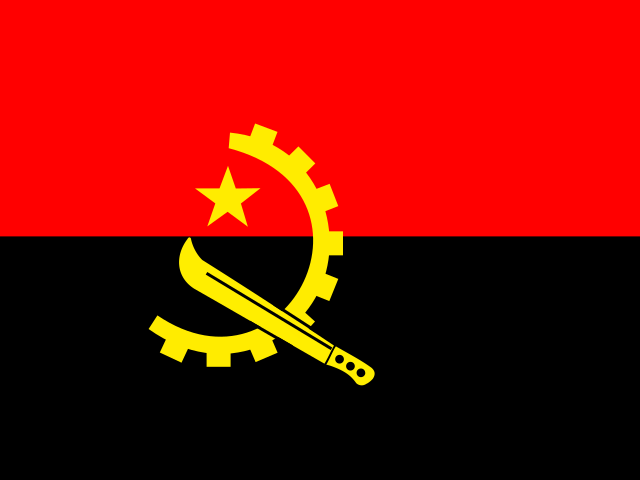 Angola
 Botswana
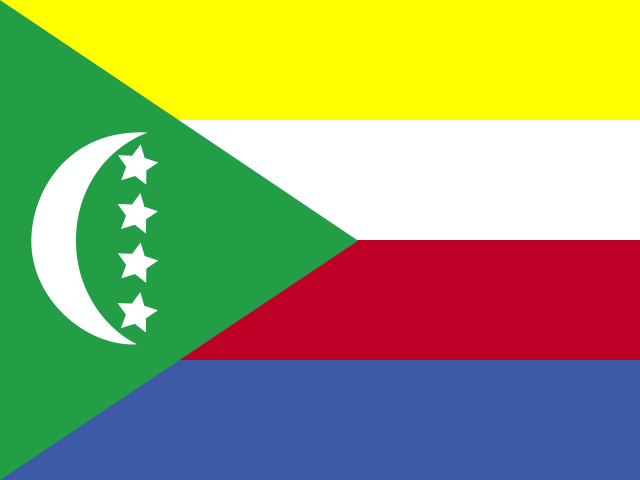 Comoros
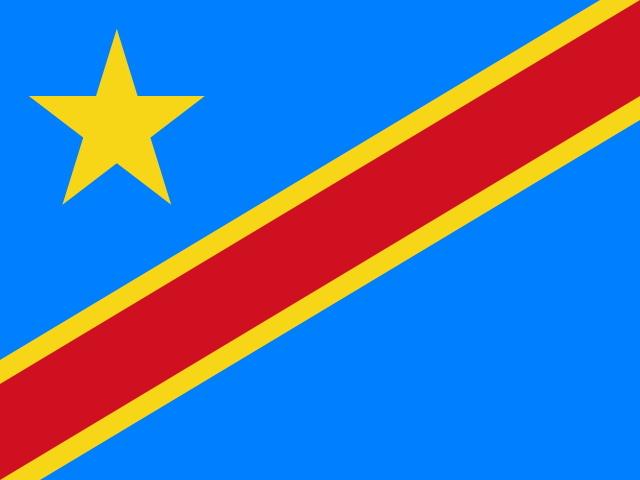 Democratic Republic of the Congo
 Eswatini
 Lesotho
 Madagascar
 Malawi
 Mauritius
 Mozambique
 Namibia
 Seychelles
 South Africa
 Tanzania
 Zambia
 Zimbabwe
Earlier Report Observations
In 2018, South Africa's implementation of R638 food safety regulations established new hygiene standards for chocolate manufacturers. The following year, growing ethical concerns led local chocolatiers to reject cocoa linked to child labor, shifting consumer demand towards responsibly sourced products. These developments, alongside a sustained consumer trend towards premium and healthy chocolate, supported market expansion.
Market volume reached a peak of 63 571 t in 2021 after a temporary dip in 2020. The market's value also recovered strongly to 574.9 million US dollars in 2021, reflecting resilient demand despite broader economic challenges.
After 2021, market volume fell to 46 225 t in 2023, while its value rose to 414.5 million US dollars, indicating significant price increases. By 2024, severe cocoa bean shortages in West Africa due to adverse weather and disease led to a sharp global price surge. Major African processing facilities reduced capacity, and companies like Mondelez International and Nestlé reported supply challenges, while manufacturers responded with premium limited editions and a greater focus on transparent, healthy ingredients.
Table of content
- 1. Disclaimer
- 2. Terms of use of the report
- 3. Product codes in the statistical classifications used in the report
-
4. Key Market Indicators and Trends
-
4.1. Key Market Indicators
-
4.1.1. In kind
- 4.1.1.1. Production, 2018-2023
- 4.1.1.2. Imports, 2018-2024
- 4.1.1.3. Exports, 2018-2024
- 4.1.1.4. Market size, 2018-2023
-
4.1.2. In value
- 4.1.2.1. Production, 2018-2023
- 4.1.2.2. Imports, 2018-2024
- 4.1.2.3. Exports, 2018-2024
- 4.1.2.4. Market size, 2018-2023
-
4.1.1. In kind
- 4.2. Market Trends and Factors
-
4.1. Key Market Indicators
-
5. Production
-
5.1. Production in SADC
- 5.1.1. Annual dynamics of production in SADC in kind, 2018-2023, t
-
5.2. Global production by Country, 2018-2023
- 5.2.1. Annual dynamics of production by macroregions in kind, 2018-2023, t
- 5.2.2. Dynamics of production structure by macroregions in kind, 2018-2023
- 5.2.3. Annual dynamics of production by country in kind, 2018-2023, t
- 5.2.4. Structure of production by countries in kind, 2018-2023
- 5.2.5. Dynamics of peoduction structure by countries in kind, 2018-2023
-
5.1. Production in SADC
-
6. Imports
-
6.1. Imports (Direct Data*)
- 6.1.1. Imports - Total information
-
6.1.2. Imports in kind, t
- 6.1.2.1. Annual dynamics of product's imports to Angola in kind, 2018-2024, t
- 6.1.2.2. Dynamics of product's imports in kind to Angola by countries, 2018-2024, t
- 6.1.2.3. Structure of product's imports in kind by countries, 2018-2024
-
6.1.3. Imports in value, M $ US
- 6.1.3.1. Annual dynamics of product's imports to Angola in value, 2018-2024, M $ US
- 6.1.3.2. Dynamics of product's imports in value to Angola by countries, 2018-2024, M $ US
- 6.1.3.3. Structure of product's imports in value by countries, 2018-2024
-
6.1.4. Average price of product's imports, $ US/kg
- 6.1.4.1. Annual dynamics of average price of product's imports to Angola, 2018-2024, $ US/kg
- 6.1.4.2. Dynamics of average price of product's imports to Angola by countries, 2018-2024, $ US/kg
-
6.2. Imports (Mirror Data)
- 6.2.1. Imports - Total information
-
6.2.2. Imports in kind, t
- 6.2.2.1. Annual dynamics of product's imports to Angola in kind, 2018-2024, t
- 6.2.2.2. Dynamics of product's imports in kind to Angola by countries, 2018-2024, t
- 6.2.2.3. Structure of product's imports in kind by countries, 2018-2024
-
6.2.3. Imports in value, M $ US
- 6.2.3.1. Annual dynamics of product's imports to Angola in value, 2018-2024, M $ US
- 6.2.3.2. Dynamics of product's imports in value to Angola by countries, 2018-2024, M $ US
- 6.2.3.3. Structure of product's imports in value by countries, 2018-2024
-
6.2.4. Average price of product's imports, $ US/kg
- 6.2.4.1. Annual dynamics of average price of product's imports to Angola, 2018-2024, $ US/kg
- 6.2.4.2. Dynamics of average price of product's imports to Angola by countries, 2018-2024, $ US/kg
-
6.1. Imports (Direct Data*)
-
7. Exports
-
7.1. Exports (Direct Data*)
- 7.1.1. Exports - Total information
-
7.1.2. Exports in kind, t
- 7.1.2.1. Annual dynamics of product's exports from Angola in kind, 2018-2024, t
- 7.1.2.2. Dynamics of product's exports in kind from Angola by countries, 2018-2024, t
- 7.1.2.3. Structure of product's exports in kind by countries, 2018-2024
-
7.1.3. Exports in value, M $ US
- 7.1.3.1. Annual dynamics of product's exports from Angola in value, 2018-2024, M $ US
- 7.1.3.2. Dynamics of product's exports in value from Angola by countries, 2018-2024, M $ US
- 7.1.3.3. Structure of product's exports in value by countries, 2018-2024
-
7.1.4. Average price of product's exports, $ US/kg
- 7.1.4.1. Annual dynamics of average price of product's exports from Angola, 2018-2024, $ US/kg
- 7.1.4.2. Dynamics of average price of product's exports from Angola by countries, 2018-2024, $ US/kg
-
7.2. Exports (Mirror Data)
- 7.2.1. Exports - Total information
-
7.2.2. Exports in kind, t
- 7.2.2.1. Annual dynamics of product's exports from Angola in kind, 2018-2024, t
- 7.2.2.2. Dynamics of product's exports in kind from Angola by countries, 2018-2024, t
- 7.2.2.3. Structure of product's exports in kind by countries, 2018-2024
-
7.2.3. Exports in value, M $ US
- 7.2.3.1. Annual dynamics of product's exports from Angola in value, 2018-2024, M $ US
- 7.2.3.2. Dynamics of product's exports in value from Angola by countries, 2018-2024, M $ US
- 7.2.3.3. Structure of product's exports in value by countries, 2018-2024
-
7.2.4. Average price of product's exports, $ US/kg
- 7.2.4.1. Annual dynamics of average price of product's exports from Angola, 2018-2024, $ US/kg
- 7.2.4.2. Dynamics of average price of product's exports from Angola by countries, 2018-2024, $ US/kg
-
7.1. Exports (Direct Data*)
-
8. Trade balance
-
8.1. Trade balance (Direct Data)
- 8.1.1. In kind, t
- 8.1.2. In value, M $ US
-
8.2. Trade balance (Mirror Data)
- 8.2.1. In kind, t
- 8.2.2. In value, M $ US
-
8.1. Trade balance (Direct Data)
-
9. Top buying and selling countries, 2018-2024
-
9.1. Direct Data
- 9.1.1. Import in Value by Countries-buyers
- 9.1.2. Export in Value by Countries-suppliers
-
9.2. Mirror Data
- 9.2.1. Import in Value by Countries-buyers
- 9.2.2. Export in Value by Countries-suppliers
-
9.1. Direct Data
Production chocolate and cocoa products in SADC
In kind, 2017-2020, t
Top producers of chocolate and cocoa products, 2017-2020
World map of production of chocolate and cocoa products, 2017-2020
Chocolate and cocoa products production in SADC has increased for the third consecutive year. In 2020, SADC produced 15,136 tonnes of these products, marking a significant 10.8% increase compared to 2019. Over the period from 2017 to 2020, production grew by 13.7%, with an average annual growth rate of 4.4%.
Annual dynamics of production in SADC in kind, 2017-2020, t
| Parameter | 2018 | 2019 | 2020 | CAGR | |
|---|---|---|---|---|---|
| 1 | Change from last year | 0.8% | 1.9% | 10.8% | 4.4% |
Exports chocolate and cocoa products from SADC
Exports in kind, t
The market showed considerable volatility during these years. In 2018, exports reached their highest point at 14,185 tonnes, but then fell sharply by 72.4% in 2019 to 3,915 tonnes. This created a peak-to-trough amplitude of 3.6 times between 2018 and 2019. In 2020, exports rebounded strongly, increasing by 72.8% to 6,766 tonnes compared to 2019. The largest increase occurred in 2018, with a 105.6% rise.
Annual dynamics of product's exports from SADC in kind, 2017-2020, t
| Parameter | 2018 | 2019 | 2020 | CAGR | |
|---|---|---|---|---|---|
| 1 | Change from last year | 105.6% | (72.4%) | 72.8% | (0.7%) |
From 2017 to 2020, the geographical structure of SADC's chocolate and cocoa products exports was highly diversified. Kenya accounted for 5.0% of exports in kind, Israel for 3.6%, and Hong Kong for 2.5%. Together, these three countries represented only 11.1% of total export flows, while the remaining 88.9% was distributed among numerous smaller partner countries.
Structure of product's exports in kind by countries, 2017-2020
World map of product's exports from SADC in kind, 2017-2020
Exports in value, M $ US
Chocolate and cocoa products exports from SADC declined for the second consecutive year. In 2020, exports reached $78.8 million, down by 0.8% compared to 2019. The highest value was recorded in 2018 at $104.1 million, which saw a 30.0% increase. However, exports then fell by 23.7% in 2019.
Annual dynamics of product's exports from SADC in value, 2017-2020, M $ US
| Parameter | 2018 | 2019 | 2020 | CAGR | |
|---|---|---|---|---|---|
| 1 | Change from last year | 30.0% | (23.7%) | (0.8%) | (0.5%) |
Between 2017 and 2020, SADC's chocolate and cocoa products exports in value terms were not heavily concentrated. The British Virgin Islands accounted for 6.6% of exports in value terms, Israel for 6.1%, and Kenya for 5.2%. Combined, these three partners captured only 17.8% of total export flows.
Structure of product's exports in value by countries, 2017-2020
World map of product's exports from SADC in value, 2017-2020
Imports chocolate and cocoa products to SADC
Imports in kind, t
SADC's imports of chocolate and cocoa products declined for the second consecutive year. In 2020, imports reached 39,967 tonnes, representing an 8.0% decrease compared to the previous year. The highest import volume was recorded in 2018 at 50,221 tonnes, which saw an 8.8% increase. However, imports then fell by 13.5% in 2019. Over the period from 2017 to 2020, imports decreased by 13.4%, with an average annual decline of 4.7%.
Annual dynamics of product's imports to SADC in kind, 2017-2020, t
| Parameter | 2018 | 2019 | 2020 | CAGR | |
|---|---|---|---|---|---|
| 1 | Change from last year | 8.8% | (13.5%) | (8.0%) | (4.7%) |
From 2017 to 2020, imports of chocolate and cocoa products to SADC were widely dispersed across partner countries. Turkey accounted for 12.0% of imports in kind, Italy for 8.0%, and Belgium for 6.4%. Together, these three countries represented only 26.4% of total import flows.
Structure of product's imports in kind by countries, 2017-2020
World map of product's imports to SADC in kind, 2017-2020
Imports in value, M $ US
SADC's imports of chocolate and cocoa products declined for the second consecutive year. In 2020, imports amounted to $179.9 million, which is 6.3% less than the previous year. The highest value was recorded in 2018 at $215.1 million, with a 10.6% increase. However, imports then fell by 10.8% in 2019. Between 2017 and 2020, imports decreased by 7.5%, equating to an average annual decline of 2.6%.
Annual dynamics of product's imports to SADC in value, 2017-2020, M $ US
| Parameter | 2018 | 2019 | 2020 | CAGR | |
|---|---|---|---|---|---|
| 1 | Change from last year | 10.6% | (10.8%) | (6.3%) | (2.6%) |
From 2017 to 2020, Italy, Germany, and Belgium were among the largest suppliers of chocolate and cocoa products to SADC in value terms. Italy accounted for 13.9% of imports in value terms, Germany for 8.2%, and Belgium for 7.5%. Even combined, these three countries represented just 29.6% of total imports, indicating a broadly diversified partner base.
Structure of product's imports in value by countries, 2017-2020
World map of product's imports to SADC in value, 2017-2020
Related Reports
Cocoa powder and cake market in SADC
2026-03-30
2026-03-29

Soybean oilcake market in SADC
2026-03-29

Sucrose in solid form market in SADC
2026-03-28
Why Choose Us?
Only Verified Data
No Hidden Costs or Separate Fees
Smarter Subscription Pricing
Contact Our Team
Submit your inquiry using the form below — our team will get back to you within 24 hours.