






"SADC" region includes following countries:
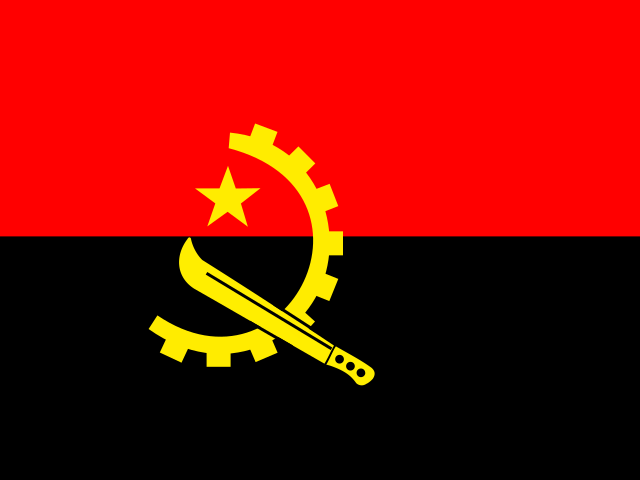 Angola
 Botswana
 Comoros
 Democratic Republic of the Congo
 Eswatini
 Lesotho
 Madagascar
 Malawi
 Mauritius
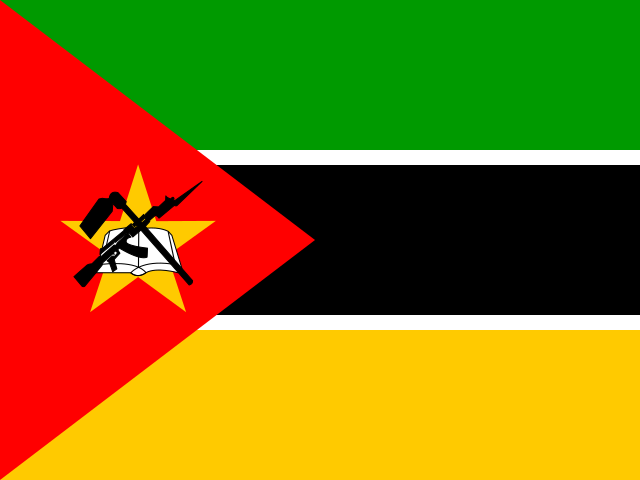 Mozambique
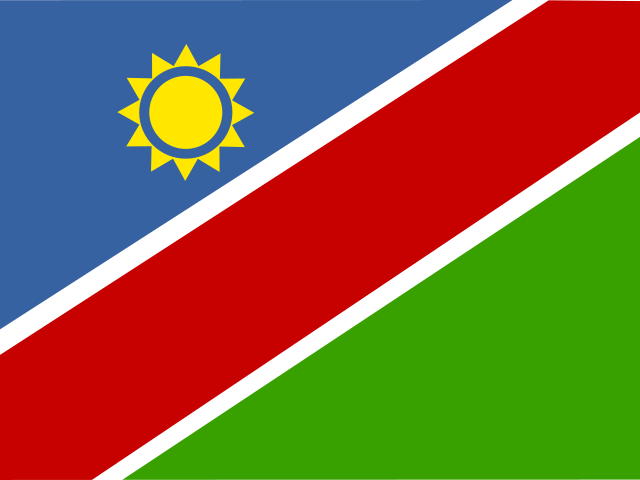 Namibia
 Seychelles
 South Africa
 Tanzania
 Zambia
 Zimbabwe
Earlier Report Observations
The market volume for chemically pure sucrose in solid form within SADC showed considerable variation between 2018 and 2023. It began at 3 949 thousand tons in 2018, fell to 3 263 thousand tons in 2019, then rose sharply to 4 127 thousand tons in 2020. Growth continued to 4 317 thousand tons in 2021, followed by a modest decline to 4 104 thousand tons in 2022, before stabilizing at 4 121 thousand tons in 2023.
In 2024, sucrose imports into the region increased significantly to 702 thousand tons, up from 495 thousand tons the previous year, while exports edged down to 199 thousand tons. This import surge was linked to a crisis in South Africa's domestic sugar industry, where imports more than doubled within a year, putting pressure on local producers and rural employment. Global supply chain disruptions and adverse weather in major sugar-producing regions contributed to market volatility and greater dependence on international supplies. Shifting consumer preferences in South Africa toward natural and organic products also began influencing sugar consumption patterns.
Table of content
- 1. Disclaimer
- 2. Terms of use of the report
- 3. Product codes in the statistical classifications used in the report
-
4. Key Market Indicators and Trends
-
4.1. Key Market Indicators
-
4.1.1. In kind
- 4.1.1.1. Production, 2018-2023
- 4.1.1.2. Imports, 2018-2024
- 4.1.1.3. Exports, 2018-2024
- 4.1.1.4. Market size, 2018-2023
-
4.1.1. In kind
- 4.2. Market Trends and Factors
-
4.1. Key Market Indicators
-
5. Production
-
5.1. Production in SADC
- 5.1.1. Annual dynamics of production in SADC in kind, 2018-2023, K t
-
5.2. Global production by Country, 2018-2023
- 5.2.1. Annual dynamics of production by macroregions in kind, 2018-2023, K t
- 5.2.2. Dynamics of production structure by macroregions in kind, 2018-2023
- 5.2.3. Annual dynamics of production by country in kind, 2018-2023, K t
- 5.2.4. Structure of production by countries in kind, 2018-2023
- 5.2.5. Dynamics of peoduction structure by countries in kind, 2018-2023
-
5.1. Production in SADC
-
6. Imports
-
6.1. Imports (Direct Data*)
- 6.1.1. Imports - Total information
-
6.1.2. Imports in kind, K t
- 6.1.2.1. Annual dynamics of product's imports to Angola in kind, 2018-2024, K t
- 6.1.2.2. Dynamics of product's imports in kind to Angola by countries, 2018-2024, K t
- 6.1.2.3. Structure of product's imports in kind by countries, 2018-2024
-
6.1.3. Imports in value, M $ US
- 6.1.3.1. Annual dynamics of product's imports to Angola in value, 2018-2024, M $ US
- 6.1.3.2. Dynamics of product's imports in value to Angola by countries, 2018-2024, M $ US
- 6.1.3.3. Structure of product's imports in value by countries, 2018-2024
-
6.1.4. Average price of product's imports, $ US/t
- 6.1.4.1. Annual dynamics of average price of product's imports to Angola, 2018-2024, $ US/t
- 6.1.4.2. Dynamics of average price of product's imports to Angola by countries, 2018-2024, $ US/t
-
6.2. Imports (Mirror Data)
- 6.2.1. Imports - Total information
-
6.2.2. Imports in kind, K t
- 6.2.2.1. Annual dynamics of product's imports to Angola in kind, 2018-2024, K t
- 6.2.2.2. Dynamics of product's imports in kind to Angola by countries, 2018-2024, K t
- 6.2.2.3. Structure of product's imports in kind by countries, 2018-2024
-
6.2.3. Imports in value, M $ US
- 6.2.3.1. Annual dynamics of product's imports to Angola in value, 2018-2024, M $ US
- 6.2.3.2. Dynamics of product's imports in value to Angola by countries, 2018-2024, M $ US
- 6.2.3.3. Structure of product's imports in value by countries, 2018-2024
-
6.2.4. Average price of product's imports, $ US/t
- 6.2.4.1. Annual dynamics of average price of product's imports to Angola, 2018-2024, $ US/t
- 6.2.4.2. Dynamics of average price of product's imports to Angola by countries, 2018-2024, $ US/t
-
6.1. Imports (Direct Data*)
-
7. Exports
-
7.1. Exports (Direct Data*)
- 7.1.1. Exports - Total information
-
7.1.2. Exports in kind, K t
- 7.1.2.1. Annual dynamics of product's exports from Angola in kind, 2018-2024, K t
- 7.1.2.2. Dynamics of product's exports in kind from Angola by countries, 2018-2024, K t
- 7.1.2.3. Structure of product's exports in kind by countries, 2018-2024
-
7.1.3. Exports in value, M $ US
- 7.1.3.1. Annual dynamics of product's exports from Angola in value, 2018-2024, M $ US
- 7.1.3.2. Dynamics of product's exports in value from Angola by countries, 2018-2024, M $ US
- 7.1.3.3. Structure of product's exports in value by countries, 2018-2024
-
7.1.4. Average price of product's exports, $ US/t
- 7.1.4.1. Annual dynamics of average price of product's exports from Angola, 2018-2024, $ US/t
- 7.1.4.2. Dynamics of average price of product's exports from Angola by countries, 2018-2024, $ US/t
-
7.2. Exports (Mirror Data)
- 7.2.1. Exports - Total information
-
7.2.2. Exports in kind, K t
- 7.2.2.1. Annual dynamics of product's exports from Angola in kind, 2018-2024, K t
- 7.2.2.2. Dynamics of product's exports in kind from Angola by countries, 2018-2024, K t
- 7.2.2.3. Structure of product's exports in kind by countries, 2018-2024
-
7.2.3. Exports in value, M $ US
- 7.2.3.1. Annual dynamics of product's exports from Angola in value, 2018-2024, M $ US
- 7.2.3.2. Dynamics of product's exports in value from Angola by countries, 2018-2024, M $ US
- 7.2.3.3. Structure of product's exports in value by countries, 2018-2024
-
7.2.4. Average price of product's exports, $ US/t
- 7.2.4.1. Annual dynamics of average price of product's exports from Angola, 2018-2024, $ US/t
- 7.2.4.2. Dynamics of average price of product's exports from Angola by countries, 2018-2024, $ US/t
-
7.1. Exports (Direct Data*)
-
8. Trade balance
-
8.1. Trade balance (Direct Data)
- 8.1.1. In kind, K t
- 8.1.2. In value, M $ US
-
8.2. Trade balance (Mirror Data)
- 8.2.1. In kind, K t
- 8.2.2. In value, M $ US
-
8.1. Trade balance (Direct Data)
-
9. Top buying and selling countries, 2018-2024
-
9.1. Direct Data
- 9.1.1. Import in Value by Countries-buyers
- 9.1.2. Export in Value by Countries-suppliers
-
9.2. Mirror Data
- 9.2.1. Import in Value by Countries-buyers
- 9.2.2. Export in Value by Countries-suppliers
-
9.1. Direct Data
Production sucrose in solid form in SADC
In kind, 2017-2020, K t
Top producers of sucrose in solid form, 2017-2020
World map of production of sucrose in solid form, 2017-2020
SADC's production of sucrose in solid form increased after two consecutive years of decline. In 2020, the region produced 3 793 K t, representing a 14.2% increase compared to 2019. Over the period from 2017 to 2020, production decreased by 4%, which translates to an annualized decline rate of 1.4%. The lowest production level was recorded in 2019 at 3 320 K t, with the largest year-over-year decline of 13.6% also occurring that year.
Annual dynamics of production in SADC in kind, 2017-2020, K t
| Parameter | 2018 | 2019 | 2020 | CAGR | |
|---|---|---|---|---|---|
| 1 | Change from last year | (2.7%) | (13.6%) | 14.2% | (1.4%) |
Exports sucrose in solid form from SADC
Exports in kind, K t
The market exhibited significant volatility during these years. Export volumes varied 2.2 times from the peak in 2019 to the low in 2020. In 2020, SADC exported 406.3 K t of sucrose in solid form, a sharp decrease of 55.3% compared to the previous year. The highest export volume was recorded in 2019 at 909.7 K t, while the largest year-over-year increase occurred in 2018 at 80.7%.
Annual dynamics of product's exports from SADC in kind, 2017-2020, K t
| Parameter | 2018 | 2019 | 2020 | CAGR | |
|---|---|---|---|---|---|
| 1 | Change from last year | 80.7% | 21.4% | (55.3%) | (0.7%) |
From 2017 to 2020, exports in kind were distributed across a diverse range of partner countries. Spain accounted for 9.8% of exports, Italy for 8.3%, and Kenya for 7.8%. Together, these three countries represented just 25.8% of total export flows.
Structure of product's exports in kind by countries, 2017-2020
World map of product's exports from SADC in kind, 2017-2020
Exports in value, M $ US
After increasing for two years, SADC's exports of sucrose in solid form declined in value terms. In 2020, exports amounted to 263.7 M $ US, a decrease of 33.7% from the previous year. Over the 2017-2020 period, exports decreased by 24%, with a compound annual growth rate (CAGR) of -8.7%. The peak value was recorded in 2019 at 397.7 M $ US, which also saw the largest year-over-year increase of 12.2%.
Annual dynamics of product's exports from SADC in value, 2017-2020, M $ US
| Parameter | 2018 | 2019 | 2020 | CAGR | |
|---|---|---|---|---|---|
| 1 | Change from last year | 2.2% | 12.2% | (33.7%) | (8.7%) |
The partner structure for exports in value terms remained fragmented from 2017 to 2020. Spain accounted for 8.8% of exports, Italy for 8.5%, and Kenya for 7.4%. Combined, these three countries represented only 24.8% of total flows, with no single country achieving a dominant share.
Structure of product's exports in value by countries, 2017-2020
World map of product's exports from SADC in value, 2017-2020
Imports sucrose in solid form to SADC
Imports in kind, K t
In 2020, SADC's imports of sucrose in solid form totaled 740.7 K t, a substantial contraction of 13.2% compared to the previous year. Over the 2017-2020 period, imports decreased by 23.5%, with a CAGR of -8.5%. The largest year-over-year increase was recorded in 2019 at 0.0%.
Annual dynamics of product's imports to SADC in kind, 2017-2020, K t
| Parameter | 2018 | 2019 | 2020 | CAGR | |
|---|---|---|---|---|---|
| 1 | Change from last year | (11.9%) | (0.0%) | (13.2%) | (8.5%) |
From 2017 to 2020, Brazil was the leading source for imports in kind, accounting for 42.3% of the total. The United Arab Emirates contributed 7.7%, and India 7.5%. Together, these three markets formed the main cluster, representing 57.5% of total import flows.
Structure of product's imports in kind by countries, 2017-2020
World map of product's imports to SADC in kind, 2017-2020
Imports in value, M $ US
In 2020, SADC's imports of sucrose in solid form amounted to 372.8 M $ US, marking an abrupt drop of 27.3% compared to the previous year. Between 2017 and 2020, imports decreased by 27.6%, equating to an annualized decline rate of 10.2%. The largest year-over-year increase occurred in 2019 at 3.5%.
Annual dynamics of product's imports to SADC in value, 2017-2020, M $ US
| Parameter | 2018 | 2019 | 2020 | CAGR | |
|---|---|---|---|---|---|
| 1 | Change from last year | (3.9%) | 3.5% | (27.3%) | (10.2%) |
From 2017 to 2020, three principal markets—Brazil, the United Arab Emirates, and India—together accounted for 55.5% of the total value of sucrose in solid form imports to SADC.
Structure of product's imports in value by countries, 2017-2020
World map of product's imports to SADC in value, 2017-2020
Related Reports

Sucrose in solid form market in Chile
2026-03-28
Sucrose in solid form market in Europe
2026-03-28


Why Choose Us?
Only Verified Data
No Hidden Costs or Separate Fees
Smarter Subscription Pricing
Contact Our Team
Submit your inquiry using the form below — our team will get back to you within 24 hours.