






"South America" region includes following countries:
 Argentina
 Bolivia
 Brazil
 Chile
Chile Colombia
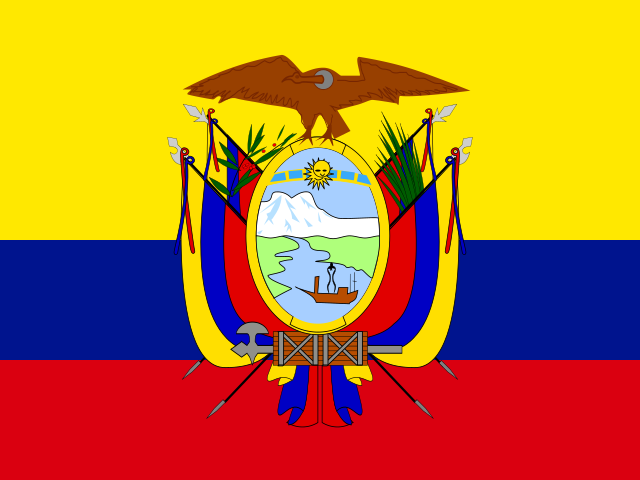 Ecuador
 Falkland Islands (Malvinas)
 French Guiana
 Guyana
 Paraguay
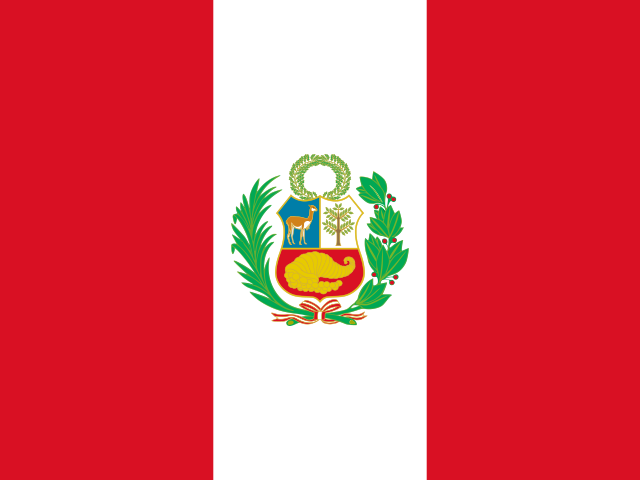 Peru
Peru Suriname
 Uruguay
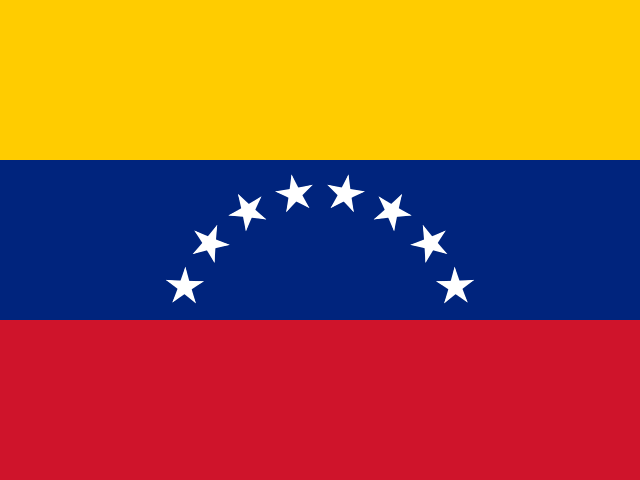 Venezuela
Earlier Report Observations
From 2018 to 2020, the cassava starch market in South America experienced a decline in volume from 104.7 thousand tons to 80.5 thousand tons. The initial high level in 2018 was supported by growing demand for both food and non-food applications, as well as expanded cassava planting areas in Colombia. However, in 2019, market volume dropped sharply due to reduced demand for processed cassava starch in Colombia. The market stabilized in 2020 despite supply chain disruptions caused by the COVID-19 pandemic, which highlighted the need for improved production quality and efficiency.
Between 2021 and 2023, the market saw significant shifts. In 2021, despite a 33% surge in production to 122.6 thousand tons, market volume fell to 72.3 thousand tons because a large portion of the output was exported, with Brazilian exports jumping to 68.4 thousand tons following a 20% increase in native starch production. By 2022, market volume recovered to 89.5 thousand tons as imports rose and exports slightly eased, even though Brazil faced a 4.6% drop in cassava processing for starch and over 50% idle industrial capacity. The market expanded dramatically to 131.8 thousand tons in 2023, driven by a steep decline in exports to 28.1 thousand tons and sustained imports. This was partly due to record Brazilian starch production, which grew 29%, but also because inventories accumulated by 26% as demand cooled. Additionally, in Colombia, an oversupply of cassava occurred as new, inexperienced producers entered the market, increasing domestic availability.
Table of content
- 1. Disclaimer
- 2. Terms of use of the report
- 3. Product codes in the statistical classifications used in the report
-
4. Key Market Indicators and Trends
-
4.1. Key Market Indicators
-
4.1.1. In kind
- 4.1.1.1. Production, 2018-2023
- 4.1.1.2. Imports, 2018-2024
- 4.1.1.3. Exports, 2018-2024
- 4.1.1.4. Market size, 2018-2023
-
4.1.1. In kind
- 4.2. Market Trends and Factors
-
4.1. Key Market Indicators
-
5. Production
-
5.1. Production in South America
- 5.1.1. Annual dynamics of production in South America in kind, 2018-2023, K t
-
5.2. Global production by Country, 2018-2023
- 5.2.1. Annual dynamics of production by macroregions in kind, 2018-2023, K t
- 5.2.2. Dynamics of production structure by macroregions in kind, 2018-2023
- 5.2.3. Annual dynamics of production by country in kind, 2018-2023, K t
- 5.2.4. Structure of production by countries in kind, 2018-2023
- 5.2.5. Dynamics of peoduction structure by countries in kind, 2018-2023
-
5.1. Production in South America
-
6. Imports
-
6.1. Imports (Direct Data*)
- 6.1.1. Imports - Total information
-
6.1.2. Imports in kind, t
- 6.1.2.1. Annual dynamics of product's imports to Argentina in kind, 2018-2024, t
- 6.1.2.2. Dynamics of product's imports in kind to Argentina by countries, 2018-2024, t
- 6.1.2.3. Structure of product's imports in kind by countries, 2018-2024
-
6.1.3. Imports in value, K $ US
- 6.1.3.1. Annual dynamics of product's imports to Argentina in value, 2018-2024, K $ US
- 6.1.3.2. Dynamics of product's imports in value to Argentina by countries, 2018-2024, K $ US
- 6.1.3.3. Structure of product's imports in value by countries, 2018-2024
-
6.1.4. Average price of product's imports, $ US/t
- 6.1.4.1. Annual dynamics of average price of product's imports to Argentina, 2018-2024, $ US/t
- 6.1.4.2. Dynamics of average price of product's imports to Argentina by countries, 2018-2024, $ US/t
-
6.2. Imports (Mirror Data)
- 6.2.1. Imports - Total information
-
6.2.2. Imports in kind, t
- 6.2.2.1. Annual dynamics of product's imports to Argentina in kind, 2018-2024, t
- 6.2.2.2. Dynamics of product's imports in kind to Argentina by countries, 2018-2024, t
- 6.2.2.3. Structure of product's imports in kind by countries, 2018-2024
-
6.2.3. Imports in value, K $ US
- 6.2.3.1. Annual dynamics of product's imports to Argentina in value, 2018-2024, K $ US
- 6.2.3.2. Dynamics of product's imports in value to Argentina by countries, 2018-2024, K $ US
- 6.2.3.3. Structure of product's imports in value by countries, 2018-2024
-
6.2.4. Average price of product's imports, $ US/t
- 6.2.4.1. Annual dynamics of average price of product's imports to Argentina, 2018-2024, $ US/t
- 6.2.4.2. Dynamics of average price of product's imports to Argentina by countries, 2018-2024, $ US/t
-
6.1. Imports (Direct Data*)
-
7. Exports
-
7.1. Exports (Direct Data*)
- 7.1.1. Exports - Total information
-
7.1.2. Exports in kind, t
- 7.1.2.1. Annual dynamics of product's exports from Argentina in kind, 2018-2024, t
- 7.1.2.2. Dynamics of product's exports in kind from Argentina by countries, 2018-2024, t
- 7.1.2.3. Structure of product's exports in kind by countries, 2018-2024
-
7.1.3. Exports in value, K $ US
- 7.1.3.1. Annual dynamics of product's exports from Argentina in value, 2018-2024, K $ US
- 7.1.3.2. Dynamics of product's exports in value from Argentina by countries, 2018-2024, K $ US
- 7.1.3.3. Structure of product's exports in value by countries, 2018-2024
-
7.1.4. Average price of product's exports, $ US/t
- 7.1.4.1. Annual dynamics of average price of product's exports from Argentina, 2018-2024, $ US/t
- 7.1.4.2. Dynamics of average price of product's exports from Argentina by countries, 2018-2024, $ US/t
-
7.2. Exports (Mirror Data)
- 7.2.1. Exports - Total information
-
7.2.2. Exports in kind, t
- 7.2.2.1. Annual dynamics of product's exports from Argentina in kind, 2018-2024, t
- 7.2.2.2. Dynamics of product's exports in kind from Argentina by countries, 2018-2024, t
- 7.2.2.3. Structure of product's exports in kind by countries, 2018-2024
-
7.2.3. Exports in value, K $ US
- 7.2.3.1. Annual dynamics of product's exports from Argentina in value, 2018-2024, K $ US
- 7.2.3.2. Dynamics of product's exports in value from Argentina by countries, 2018-2024, K $ US
- 7.2.3.3. Structure of product's exports in value by countries, 2018-2024
-
7.2.4. Average price of product's exports, $ US/t
- 7.2.4.1. Annual dynamics of average price of product's exports from Argentina, 2018-2024, $ US/t
- 7.2.4.2. Dynamics of average price of product's exports from Argentina by countries, 2018-2024, $ US/t
-
7.1. Exports (Direct Data*)
-
8. Trade balance
-
8.1. Trade balance (Direct Data)
- 8.1.1. In kind, t
- 8.1.2. In value, K $ US
-
8.2. Trade balance (Mirror Data)
- 8.2.1. In kind, t
- 8.2.2. In value, K $ US
-
8.1. Trade balance (Direct Data)
-
9. Top buying and selling countries, 2018-2024
-
9.1. Direct Data
- 9.1.1. Import in Value by Countries-buyers
- 9.1.2. Export in Value by Countries-suppliers
-
9.2. Mirror Data
- 9.2.1. Import in Value by Countries-buyers
- 9.2.2. Export in Value by Countries-suppliers
-
9.1. Direct Data
Production cassava starch in South America
In kind, 2017-2020, t
Top producers of cassava starch, 2017-2020
World map of production of cassava starch, 2017-2020
In 2020, South America produced 92 091 tons of cassava starch, representing a modest 0.9% increase from the previous year. Over the 2017-2020 period, production grew by 3.4%, with an average annual growth rate of 1.1%. The highest production level was achieved in 2018 at 92 295 tons, which marked a 3.7% increase that year. In contrast, 2019 saw the most significant decline, with production dropping by 1.1%.
Annual dynamics of production in South America in kind, 2017-2020, t
| Parameter | 2018 | 2019 | 2020 | CAGR | |
|---|---|---|---|---|---|
| 1 | Change from last year | 3.7% | (1.1%) | 0.9% | 1.1% |
In value, 2017-2020, K $ US
South America's cassava starch production value declined for the second consecutive year. In 2020, output was valued at 75 202 thousand US dollars, down 1.5% from the previous year. Between 2017 and 2020, however, production value increased by 12%, equivalent to an annualized growth rate of 3.9%. The peak value occurred in 2018 at 80 149 thousand US dollars, reflecting a substantial 19.4% increase that year. The most notable decline came in 2019, when production value fell by 4.7%.
Annual dynamics of production in South America in value, 2017-2020, K $ US
| Parameter | 2018 | 2019 | 2020 | CAGR | |
|---|---|---|---|---|---|
| 1 | Change from last year | 19.4% | (4.7%) | (1.5%) | 3.9% |
Exports cassava starch from South America
Exports in kind, t
Cassava starch exports from South America increased for the second year in a row. In 2020, exports reached 30 211 tons, representing a 14.7% year-over-year growth. Over the 2017-2020 period, exports grew by 14.7%, with an average annual increase of 4.7%. The lowest export volume was recorded in 2018 at 21 860 tons, which marked a 17.0% decline that year. The strongest growth occurred in 2019, with exports surging by 20.5%.
Annual dynamics of product's exports from South America in kind, 2017-2020, t
| Parameter | 2018 | 2019 | 2020 | CAGR | |
|---|---|---|---|---|---|
| 1 | Change from last year | (17.0%) | 20.5% | 14.7% | 4.7% |
Between 2017 and 2020, South America's cassava starch exports in volume terms were distributed across numerous partner countries. The United States accounted for 9.9% of exports, while Spain and Portugal each represented 1.5%. Together, these three countries accounted for just 12.9% of total export flows.
Structure of product's exports in kind by countries, 2017-2020
World map of product's exports from South America in kind, 2017-2020
Exports in value, K $ US
Cassava starch export values from South America rose for the second consecutive year. In 2020, exports totaled 24 671 thousand US dollars, showing a significant 11.9% increase compared to the previous year. Between 2017 and 2020, export values grew by 24.2%, equivalent to an annualized rate of 7.5%. The lowest value was recorded in 2018 at 18 983 thousand US dollars, which represented a 4.4% decline that year. The most substantial increase occurred in 2019, with export values jumping by 16.2%.
Annual dynamics of product's exports from South America in value, 2017-2020, K $ US
| Parameter | 2018 | 2019 | 2020 | CAGR | |
|---|---|---|---|---|---|
| 1 | Change from last year | (4.4%) | 16.2% | 11.9% | 7.5% |
From 2017 to 2020, South America's cassava starch export values were widely distributed among partner countries. The United States accounted for 16.2% of export value, Portugal for 2.9%, and Spain for 2.3%. Collectively, these three countries represented only 21.4% of total export flows.
Structure of product's exports in value by countries, 2017-2020
World map of product's exports from South America in value, 2017-2020
Imports cassava starch to South America
Imports in kind, t
Following a two-year decline, cassava starch imports into South America increased in 2020. Import volume reached 18 664 tons, marking a 16.3% year-over-year rise. Over the 2017-2020 period, however, imports decreased by 59.9%, with an average annual decline of 26.3%. The lowest import volume was recorded in 2019 at 16 052 tons, which represented a sharp 53.1% decline that year.
Annual dynamics of product's imports to South America in kind, 2017-2020, t
| Parameter | 2018 | 2019 | 2020 | CAGR | |
|---|---|---|---|---|---|
| 1 | Change from last year | (26.5%) | (53.1%) | 16.3% | (26.3%) |
Between 2017 and 2020, the main sources for cassava starch imports into South America by volume were Thailand (20.2% of imports), Vietnam (8.6%), and Nicaragua (2.1%). Together, these three countries accounted for 30.9% of total import flows.
Structure of product's imports in kind by countries, 2017-2020
World map of product's imports to South America in kind, 2017-2020
Imports in value, K $ US
After declining for two years, cassava starch import values into South America increased in 2020. Imports totaled 20 852 thousand US dollars, showing a measured 3.6% increase from the previous year. Between 2017 and 2020, however, import values decreased by 23.9%, equivalent to an annualized decline of 8.7%. The lowest value was recorded in 2019 at 20 132 thousand US dollars, which marked a 24.7% decline that year.
Annual dynamics of product's imports to South America in value, 2017-2020, K $ US
| Parameter | 2018 | 2019 | 2020 | CAGR | |
|---|---|---|---|---|---|
| 1 | Change from last year | (2.5%) | (24.7%) | 3.6% | (8.7%) |
Throughout 2017-2020, Thailand (19.1% of import value), Vietnam (7.3%), and Nicaragua (2.0%) remained the key partners for cassava starch imports into South America by value. Together, these three countries accounted for 28.4% of total import flows.
Structure of product's imports in value by countries, 2017-2020
World map of product's imports to South America in value, 2017-2020
Related Reports

Cassava starch market in the Philippines
2026-03-28
Cassava starch market in Eastern Africa
2026-03-28
Cassava starch market in Eastern Asia
2026-03-28
Cassava starch market in Madagascar
2026-03-28



Maize starch market in South America
2026-03-28

Starches market in South America
2026-03-28
Why Choose Us?
Only Verified Data
No Hidden Costs or Separate Fees
Smarter Subscription Pricing
Contact Our Team
Submit your inquiry using the form below — our team will get back to you within 24 hours.