






"South America" region includes following countries:
 Argentina
 Bolivia
 Brazil
 Chile
Chile Colombia
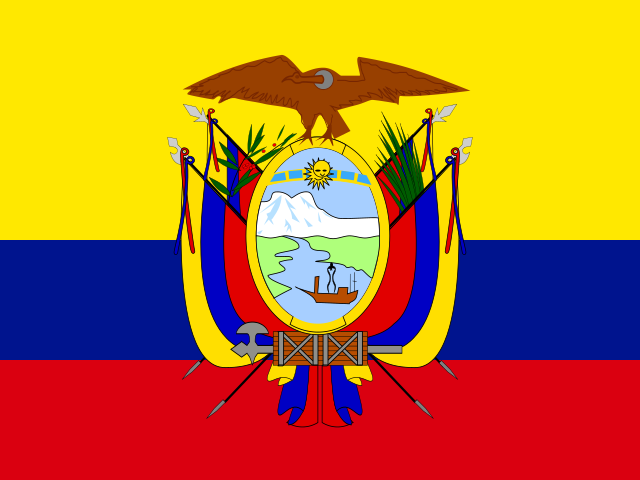 Ecuador
 Falkland Islands (Malvinas)
 French Guiana
 Guyana
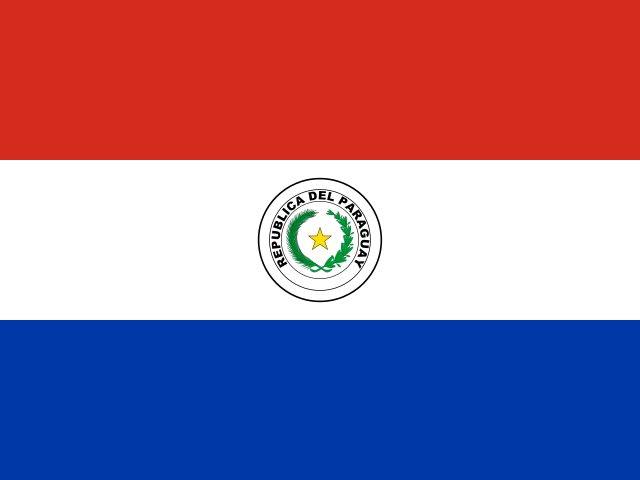 Paraguay
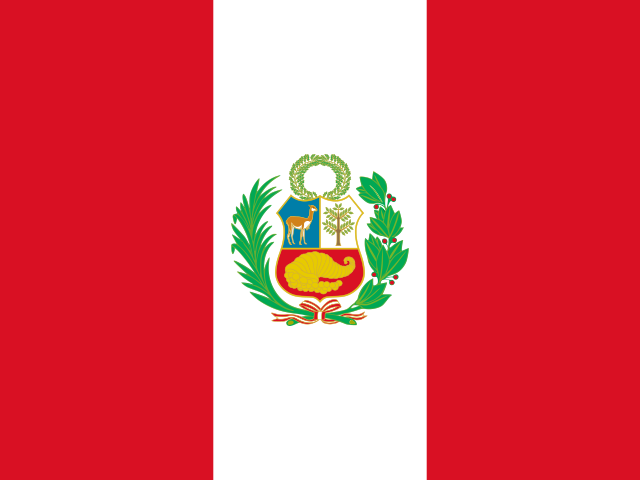 Peru
Peru Suriname
 Uruguay
 Venezuela
Earlier Report Observations
South America's starch market opened the period with strong production of 2 167 thousand tons and market volume of 2 200 thousand tons in 2018, supported by volume growth from major players like Cargill Brasil and the launch of new clean-label products such as Ingredion's organically certified corn starch. The following two years saw a contraction, with production falling to 1 715 thousand tons and market volume to 1 696 thousand tons by 2020. This decline coincided with the disruptive impact of the COVID-19 pandemic on demand and company operations, despite a noted increase in demand for hydrolyzed starches within the food industry.
A recovery unfolded in 2021, lifting production to 2 004 thousand tons and market volume to 1 985 thousand tons. This rebound was facilitated by shifting consumption patterns in Brazil favoring starch-based convenience foods and the underlying potential of cassava starch production in Colombia. Market conditions stabilized in 2022, with production at 2 013 thousand tons, as significant capacity investments came to fruition. Ingredion completed a major expansion for specialty and clean-label starches, while the conflict in Ukraine elevated raw material costs. Simultaneously, capacity for industrial cassava milling was expanded in Colombia to address supply shortages.
In 2023, production declined to 1 825 thousand tons and market volume to 1 836 thousand tons. The market landscape continued to evolve through consolidation, exemplified in Brazil by Lorenz's acquisition of Amidos Novo Mundo, strengthening its leadership in the domestic starch market. Concurrent growth in the bioinputs sector in Brazil indicated broader agricultural trends that could indirectly influence raw material availability for starch production.
Table of content
- 1. Disclaimer
- 2. Terms of use of the report
- 3. Product codes in the statistical classifications used in the report
-
4. Key Market Indicators and Trends
-
4.1. Key Market Indicators
-
4.1.1. In kind
- 4.1.1.1. Production, 2018-2023
- 4.1.1.2. Imports, 2018-2024
- 4.1.1.3. Exports, 2018-2024
- 4.1.1.4. Market size, 2018-2023
-
4.1.1. In kind
- 4.2. Market Trends and Factors
-
4.1. Key Market Indicators
-
5. Production
-
5.1. Production in South America
- 5.1.1. Annual dynamics of production in South America in kind, 2018-2023, K t
-
5.2. Global production by Country, 2018-2023
- 5.2.1. Annual dynamics of production by macroregions in kind, 2018-2023, K t
- 5.2.2. Dynamics of production structure by macroregions in kind, 2018-2023
- 5.2.3. Annual dynamics of production by country in kind, 2018-2023, K t
- 5.2.4. Structure of production by countries in kind, 2018-2023
- 5.2.5. Dynamics of peoduction structure by countries in kind, 2018-2023
-
5.1. Production in South America
-
6. Exports
-
6.1. Exports (Direct Data*)
- 6.1.1. Exports - Total information
-
6.1.2. Exports in kind, K t
- 6.1.2.1. Annual dynamics of product's exports from Argentina in kind, 2018-2024, K t
- 6.1.2.2. Dynamics of product's exports in kind from Argentina by countries, 2018-2024, K t
- 6.1.2.3. Structure of product's exports in kind by countries, 2018-2024
-
6.1.3. Exports in value, M $ US
- 6.1.3.1. Annual dynamics of product's exports from Argentina in value, 2018-2024, M $ US
- 6.1.3.2. Dynamics of product's exports in value from Argentina by countries, 2018-2024, M $ US
- 6.1.3.3. Structure of product's exports in value by countries, 2018-2024
-
6.1.4. Average price of product's exports, $ US/t
- 6.1.4.1. Annual dynamics of average price of product's exports from Argentina, 2018-2024, $ US/t
- 6.1.4.2. Dynamics of average price of product's exports from Argentina by countries, 2018-2024, $ US/t
-
6.2. Exports (Mirror Data)
- 6.2.1. Exports - Total information
-
6.2.2. Exports in kind, K t
- 6.2.2.1. Annual dynamics of product's exports from Argentina in kind, 2018-2024, K t
- 6.2.2.2. Dynamics of product's exports in kind from Argentina by countries, 2018-2024, K t
- 6.2.2.3. Structure of product's exports in kind by countries, 2018-2024
-
6.2.3. Exports in value, M $ US
- 6.2.3.1. Annual dynamics of product's exports from Argentina in value, 2018-2024, M $ US
- 6.2.3.2. Dynamics of product's exports in value from Argentina by countries, 2018-2024, M $ US
- 6.2.3.3. Structure of product's exports in value by countries, 2018-2024
-
6.2.4. Average price of product's exports, $ US/t
- 6.2.4.1. Annual dynamics of average price of product's exports from Argentina, 2018-2024, $ US/t
- 6.2.4.2. Dynamics of average price of product's exports from Argentina by countries, 2018-2024, $ US/t
-
6.1. Exports (Direct Data*)
-
7. Imports
-
7.1. Imports (Direct Data*)
- 7.1.1. Imports - Total information
-
7.1.2. Imports in kind, K t
- 7.1.2.1. Annual dynamics of product's imports to Argentina in kind, 2018-2024, K t
- 7.1.2.2. Dynamics of product's imports in kind to Argentina by countries, 2018-2024, K t
- 7.1.2.3. Structure of product's imports in kind by countries, 2018-2024
-
7.1.3. Imports in value, M $ US
- 7.1.3.1. Annual dynamics of product's imports to Argentina in value, 2018-2024, M $ US
- 7.1.3.2. Dynamics of product's imports in value to Argentina by countries, 2018-2024, M $ US
- 7.1.3.3. Structure of product's imports in value by countries, 2018-2024
-
7.1.4. Average price of product's imports, $ US/t
- 7.1.4.1. Annual dynamics of average price of product's imports to Argentina, 2018-2024, $ US/t
- 7.1.4.2. Dynamics of average price of product's imports to Argentina by countries, 2018-2024, $ US/t
-
7.2. Imports (Mirror Data)
- 7.2.1. Imports - Total information
-
7.2.2. Imports in kind, K t
- 7.2.2.1. Annual dynamics of product's imports to Argentina in kind, 2018-2024, K t
- 7.2.2.2. Dynamics of product's imports in kind to Argentina by countries, 2018-2024, K t
- 7.2.2.3. Structure of product's imports in kind by countries, 2018-2024
-
7.2.3. Imports in value, M $ US
- 7.2.3.1. Annual dynamics of product's imports to Argentina in value, 2018-2024, M $ US
- 7.2.3.2. Dynamics of product's imports in value to Argentina by countries, 2018-2024, M $ US
- 7.2.3.3. Structure of product's imports in value by countries, 2018-2024
-
7.2.4. Average price of product's imports, $ US/t
- 7.2.4.1. Annual dynamics of average price of product's imports to Argentina, 2018-2024, $ US/t
- 7.2.4.2. Dynamics of average price of product's imports to Argentina by countries, 2018-2024, $ US/t
-
7.1. Imports (Direct Data*)
-
8. Trade balance
-
8.1. Trade balance (Direct Data)
- 8.1.1. In kind, K t
- 8.1.2. In value, M $ US
-
8.2. Trade balance (Mirror Data)
- 8.2.1. In kind, K t
- 8.2.2. In value, M $ US
-
8.1. Trade balance (Direct Data)
-
9. Top buying and selling countries, 2018-2024
-
9.1. Direct Data
- 9.1.1. Import in Value by Countries-buyers
- 9.1.2. Export in Value by Countries-suppliers
-
9.2. Mirror Data
- 9.2.1. Import in Value by Countries-buyers
- 9.2.2. Export in Value by Countries-suppliers
-
9.1. Direct Data
Production starches in South America
In kind, 2017-2020, K t
Top producers of starches, 2017-2020
World map of production of starches, 2017-2020
Starch production in South America has declined for the second year in a row. In 2020, the region produced 1,715 thousand tons of starch, marking a 1.7% decrease from the previous year. Looking at the period from 2017 to 2020, production fell by 20.2%, which translates to an average annual decline of 7.2%. The highest production level was recorded in 2018 at 2,167 thousand tons. The most significant drop occurred in 2019, with a 19.4% decrease, while the largest increase was seen in 2018 at 0.8%.
Annual dynamics of production in South America in kind, 2017-2020, K t
| Parameter | 2018 | 2019 | 2020 | CAGR | |
|---|---|---|---|---|---|
| 1 | Change from last year | 0.8% | (19.4%) | (1.7%) | (7.2%) |
In value, 2017-2020, M $ US
In 2020, the value of starch production in South America reached 1,045 million US dollars, representing a 10.3% increase compared to 2019. Over the 2017-2020 period, production value decreased by 21.6%, with a compound annual growth rate (CAGR) of -7.8%. The lowest value was recorded in 2019 at 948 million US dollars, while the peak was in 2018 at 1,524 million US dollars. The sharpest decline occurred in 2019 with a 37.8% drop, and the largest increase was in 2018 at 14.3%.
Annual dynamics of production in South America in value, 2017-2020, M $ US
| Parameter | 2018 | 2019 | 2020 | CAGR | |
|---|---|---|---|---|---|
| 1 | Change from last year | 14.3% | (37.8%) | 10.3% | (7.8%) |
Exports starches from South America
Exports in kind, K t
Starch exports from South America have grown for the second consecutive year. In 2020, export volumes totaled 119.5 thousand tons, up 7.1% from 2019. Between 2017 and 2020, exports increased by 10.4%, averaging an annual growth rate of 3.4%. The lowest export volume was in 2018 at 71.8 thousand tons. The most substantial decline happened in 2018 with a 33.6% drop, while the largest increase was recorded in 2019 at 55.2%.
Annual dynamics of product's exports from South America in kind, 2017-2020, K t
| Parameter | 2018 | 2019 | 2020 | CAGR | |
|---|---|---|---|---|---|
| 1 | Change from last year | (33.6%) | 55.2% | 7.1% | 3.4% |
From 2017 to 2020, the geographical distribution of starch exports in volume terms was highly diversified. The Dominican Republic (4.0% of exports), Costa Rica (3.5%), and Mexico (3.4%) together accounted for only 11.0% of total flows. The remaining 89.0% was spread across numerous smaller trading partners.
Structure of product's exports in kind by countries, 2017-2020
World map of product's exports from South America in kind, 2017-2020
Exports in value, M $ US
Cross-border shipments of starch from South America have increased for the second year in a row. In 2020, export value reached 72.8 million US dollars, reflecting a 20.2% rise compared to the previous year. Over the 2017-2020 period, exports grew by 8.5%, with an average annual rate of 2.7%. The lowest value was recorded in 2018 at 50.5 million US dollars. The most significant decline occurred in 2018 with a 24.7% drop.
Annual dynamics of product's exports from South America in value, 2017-2020, M $ US
| Parameter | 2018 | 2019 | 2020 | CAGR | |
|---|---|---|---|---|---|
| 1 | Change from last year | (24.7%) | 19.8% | 20.2% | 2.7% |
During 2017-2020, the United States (7.7% of export value), the Dominican Republic (3.0%), and Costa Rica (2.7%) were among the largest buyers of South American starch. However, even combined, they represented just 13.4% of total export value, highlighting a broadly diversified partner base.
Structure of product's exports in value by countries, 2017-2020
World map of product's exports from South America in value, 2017-2020
Imports starches to South America
Imports in kind, K t
After two years of decline, starch imports into South America have increased. In 2020, imports amounted to 99.8 thousand tons, showing a moderate gain of 3.6% from the previous year. Between 2017 and 2020, imports decreased by 34.9%, averaging an annual decline of 13.3%. The lowest import volume was in 2019 at 96.3 thousand tons. The largest drop was recorded in 2018 with a 31.6% decrease.
Annual dynamics of product's imports to South America in kind, 2017-2020, K t
| Parameter | 2018 | 2019 | 2020 | CAGR | |
|---|---|---|---|---|---|
| 1 | Change from last year | (31.6%) | (8.1%) | 3.6% | (13.3%) |
The import market for starch in volume terms was wide-ranging from 2017 to 2020. Germany (7.3% of imports), Denmark (5.1%), and Thailand (4.9%) together accounted for only 17.3% of total flows, with the remaining 82.7% distributed among numerous other countries.
Structure of product's imports in kind by countries, 2017-2020
World map of product's imports to South America in kind, 2017-2020
Imports in value, M $ US
In 2020, the value of starch imports into South America was 94.5 million US dollars, up 0.6% year-over-year. Over the 2017-2020 period, imports decreased by 4.1%, with an average annual decline of 1.4%. The lowest value was in 2019 at 94.0 million US dollars, while the peak was in 2018 at 102.9 million US dollars. The most significant decline occurred in 2019 with an 8.7% drop, and the largest increase was in 2018 at 4.4%.
Annual dynamics of product's imports to South America in value, 2017-2020, M $ US
| Parameter | 2018 | 2019 | 2020 | CAGR | |
|---|---|---|---|---|---|
| 1 | Change from last year | 4.4% | (8.7%) | 0.6% | (1.4%) |
The structure of starch imports in value terms from 2017 to 2020 can be described as diversified. Germany (12.1% of import value), Denmark (6.8%), and the Netherlands (5.5%) together made up just 24.4% of total flows, with no single country holding a clearly dominant position.
Structure of product's imports in value by countries, 2017-2020
World map of product's imports to South America in value, 2017-2020
Related Reports



Why Choose Us?
Only Verified Data
No Hidden Costs or Separate Fees
Smarter Subscription Pricing
Contact Our Team
Submit your inquiry using the form below — our team will get back to you within 24 hours.