






"Middle Africa" region includes following countries:
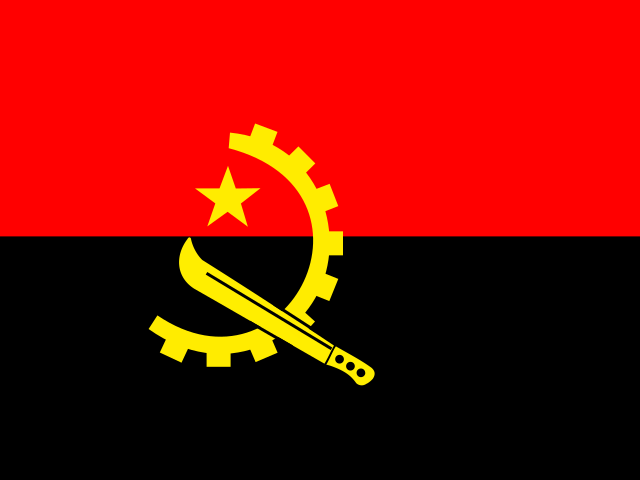 Angola
 Cameroon
 Central African Republic
 Chad
Chad Congo
Congo Democratic Republic of the Congo
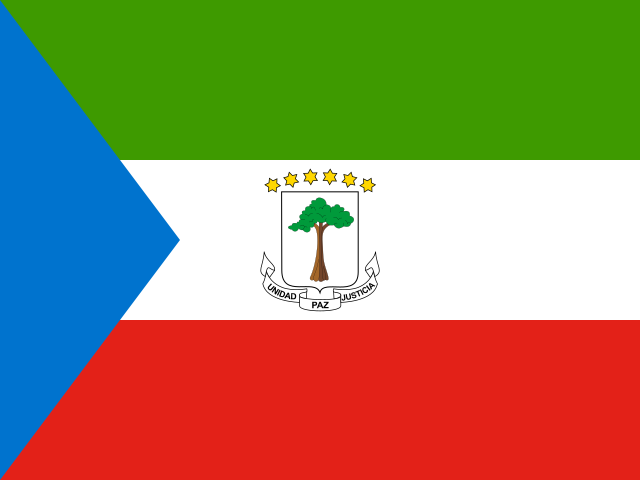 Equatorial Guinea
 Gabon
Gabon Sao Tome and Principe
Earlier Report Observations
The market for frozen vegetables in Middle Africa expanded slightly from 3 948 t in 2018 to 4 054 t in 2019, then stabilized at 3 936 t in 2020.
A pronounced downturn began in 2021, with the market volume falling sharply to 2 949 t and then to 2 197 t in 2022. The contraction continued into 2023, with volume reaching 1 922 t, a decline linked to lower sales of frozen vegetables and the effect of inflation on consumer spending for processed vegetables.
Table of content
- 1. Disclaimer
- 2. Terms of use of the report
- 3. Product codes in the statistical classifications used in the report
-
4. Key Market Indicators and Trends
-
4.1. Key Market Indicators
-
4.1.1. In kind
- 4.1.1.1. Production, 2018-2023
- 4.1.1.2. Imports, 2018-2024
- 4.1.1.3. Exports, 2018-2024
- 4.1.1.4. Market size, 2018-2023
-
4.1.1. In kind
- 4.2. Market Trends and Factors
-
4.1. Key Market Indicators
-
5. Production
-
5.1. Production in Middle Africa
- 5.1.1. Annual dynamics of production in Middle Africa in kind, 2018-2023, t
-
5.2. Global production by Country, 2018-2023
- 5.2.1. Annual dynamics of production by macroregions in kind, 2018-2023, t
- 5.2.2. Dynamics of production structure by macroregions in kind, 2018-2023
- 5.2.3. Annual dynamics of production by country in kind, 2018-2023, t
- 5.2.4. Structure of production by countries in kind, 2018-2023
- 5.2.5. Dynamics of peoduction structure by countries in kind, 2018-2023
-
5.1. Production in Middle Africa
-
6. Imports
-
6.1. Imports (Direct Data*)
- 6.1.1. Imports - Total information
-
6.1.2. Imports in kind, t
- 6.1.2.1. Annual dynamics of product's imports to Angola in kind, 2018-2024, t
- 6.1.2.2. Dynamics of product's imports in kind to Angola by countries, 2018-2024, t
- 6.1.2.3. Structure of product's imports in kind by countries, 2018-2024
-
6.1.3. Imports in value, K $ US
- 6.1.3.1. Annual dynamics of product's imports to Angola in value, 2018-2024, K $ US
- 6.1.3.2. Dynamics of product's imports in value to Angola by countries, 2018-2024, K $ US
- 6.1.3.3. Structure of product's imports in value by countries, 2018-2024
-
6.1.4. Average price of product's imports, $ US/t
- 6.1.4.1. Annual dynamics of average price of product's imports to Angola, 2018-2024, $ US/t
- 6.1.4.2. Dynamics of average price of product's imports to Angola by countries, 2018-2024, $ US/t
-
6.2. Imports (Mirror Data)
- 6.2.1. Imports - Total information
-
6.2.2. Imports in kind, t
- 6.2.2.1. Annual dynamics of product's imports to Angola in kind, 2018-2024, t
- 6.2.2.2. Dynamics of product's imports in kind to Angola by countries, 2018-2024, t
- 6.2.2.3. Structure of product's imports in kind by countries, 2018-2024
-
6.2.3. Imports in value, K $ US
- 6.2.3.1. Annual dynamics of product's imports to Angola in value, 2018-2024, K $ US
- 6.2.3.2. Dynamics of product's imports in value to Angola by countries, 2018-2024, K $ US
- 6.2.3.3. Structure of product's imports in value by countries, 2018-2024
-
6.2.4. Average price of product's imports, $ US/t
- 6.2.4.1. Annual dynamics of average price of product's imports to Angola, 2018-2024, $ US/t
- 6.2.4.2. Dynamics of average price of product's imports to Angola by countries, 2018-2024, $ US/t
-
6.1. Imports (Direct Data*)
-
7. Exports
-
7.1. Exports (Direct Data*)
- 7.1.1. Exports - Total information
-
7.1.2. Exports in kind, t
- 7.1.2.1. Annual dynamics of product's exports from Angola in kind, 2018-2024, t
- 7.1.2.2. Dynamics of product's exports in kind from Angola by countries, 2018-2024, t
- 7.1.2.3. Structure of product's exports in kind by countries, 2018-2024
-
7.1.3. Exports in value, K $ US
- 7.1.3.1. Annual dynamics of product's exports from Angola in value, 2018-2024, K $ US
- 7.1.3.2. Dynamics of product's exports in value from Angola by countries, 2018-2024, K $ US
- 7.1.3.3. Structure of product's exports in value by countries, 2018-2024
-
7.1.4. Average price of product's exports, $ US/t
- 7.1.4.1. Annual dynamics of average price of product's exports from Angola, 2018-2024, $ US/t
- 7.1.4.2. Dynamics of average price of product's exports from Angola by countries, 2018-2024, $ US/t
-
7.2. Exports (Mirror Data)
- 7.2.1. Exports - Total information
-
7.2.2. Exports in kind, t
- 7.2.2.1. Annual dynamics of product's exports from Angola in kind, 2018-2024, t
- 7.2.2.2. Dynamics of product's exports in kind from Angola by countries, 2018-2024, t
- 7.2.2.3. Structure of product's exports in kind by countries, 2018-2024
-
7.2.3. Exports in value, K $ US
- 7.2.3.1. Annual dynamics of product's exports from Angola in value, 2018-2024, K $ US
- 7.2.3.2. Dynamics of product's exports in value from Angola by countries, 2018-2024, K $ US
- 7.2.3.3. Structure of product's exports in value by countries, 2018-2024
-
7.2.4. Average price of product's exports, $ US/t
- 7.2.4.1. Annual dynamics of average price of product's exports from Angola, 2018-2024, $ US/t
- 7.2.4.2. Dynamics of average price of product's exports from Angola by countries, 2018-2024, $ US/t
-
7.1. Exports (Direct Data*)
-
8. Trade balance
-
8.1. Trade balance (Direct Data)
- 8.1.1. In kind, t
- 8.1.2. In value, K $ US
-
8.2. Trade balance (Mirror Data)
- 8.2.1. In kind, t
- 8.2.2. In value, K $ US
-
8.1. Trade balance (Direct Data)
-
9. Top buying and selling countries, 2018-2024
-
9.1. Direct Data
- 9.1.1. Import in Value by Countries-buyers
- 9.1.2. Export in Value by Countries-suppliers
-
9.2. Mirror Data
- 9.2.1. Import in Value by Countries-buyers
- 9.2.2. Export in Value by Countries-suppliers
-
9.1. Direct Data
Production frozen vegetables excluding potatoes, legumes and maize in Middle Africa
In kind, 2017-2020, t
Top producers of frozen vegetables excluding potatoes, legumes and maize, 2017-2020
World map of production of frozen vegetables excluding potatoes, legumes and maize, 2017-2020
In 2020, Middle Africa produced 2,793 tonnes of frozen vegetables, excluding potatoes, legumes, and maize. This marked a solid 10.1% increase compared to the previous year. Looking at the period from 2017 to 2020, production grew by 11%, which translates to an average annual growth rate of 3.5%. The largest decline occurred in 2019, when production fell by 0.4%.
Annual dynamics of production in Middle Africa in kind, 2017-2020, t
| Parameter | 2018 | 2019 | 2020 | CAGR | |
|---|---|---|---|---|---|
| 1 | Change from last year | 1.1% | (0.4%) | 10.1% | 3.5% |
Exports frozen vegetables excluding potatoes, legumes and maize from Middle Africa
Exports in kind, t
Middle Africa's export volume of frozen vegetables, excluding potatoes, legumes, and maize, increased for the third consecutive year in 2020. That year, exports reached 1,277 tonnes, a dramatic surge of 703.6% from the previous year. Over the 2017-2020 period, exports soared by 1,124.6%, with a compound annual growth rate of 130.5%.
Annual dynamics of product's exports from Middle Africa in kind, 2017-2020, t
| Parameter | 2018 | 2019 | 2020 | CAGR | |
|---|---|---|---|---|---|
| 1 | Change from last year | 24.9% | 22.1% | 703.6% | 130.5% |
From 2017 to 2020, the principal destinations for Middle Africa's exports in kind were Belgium, the United States, and Canada. Belgium accounted for 47.2% of exports, the United States for 17.6%, and Canada for 15.9%. Together, these three countries made up 80.8% of total export flows.
Structure of product's exports in kind by countries, 2017-2020
World map of product's exports from Middle Africa in kind, 2017-2020
Exports in value, K $ US
The market exhibited volatility during the observed period. Export volumes varied significantly, with an 8-fold difference between the low in 2019 and the high in 2020. In 2020, Middle Africa exported frozen vegetables, excluding potatoes, legumes, and maize, valued at 279,000 US dollars, representing a gain of 698.5% year-over-year. The minimum value was recorded in 2019 at 35,000 US dollars, and the largest decline occurred that same year, with a drop of 35.5%.
Annual dynamics of product's exports from Middle Africa in value, 2017-2020, K $ US
| Parameter | 2018 | 2019 | 2020 | CAGR | |
|---|---|---|---|---|---|
| 1 | Change from last year | 16.2% | (35.5%) | 698.5% | 81.6% |
Between 2017 and 2020, the main buyers of frozen vegetables, excluding potatoes, legumes, and maize, from Middle Africa in value terms were Belgium, the United States, and Canada. Belgium accounted for 33.8% of exports, the United States for 19.2%, and Canada for 18.9%. Collectively, these three markets comprised 71.9% of total export value.
Structure of product's exports in value by countries, 2017-2020
World map of product's exports from Middle Africa in value, 2017-2020
Imports frozen vegetables excluding potatoes, legumes and maize to Middle Africa
Imports in kind, t
Middle Africa's import volume of frozen vegetables, excluding potatoes, legumes, and maize, increased for the second consecutive year in 2020. Imports totalled 2,420 tonnes that year, showing a steep rise of 44.4% from the previous year. Over the 2017-2020 period, imports grew by 31.7%, equating to an annualized rate of 9.6%. The minimum volume was recorded in 2018 at 1,533 tonnes, and the largest decline occurred that year, with a drop of 16.6%.
Annual dynamics of product's imports to Middle Africa in kind, 2017-2020, t
| Parameter | 2018 | 2019 | 2020 | CAGR | |
|---|---|---|---|---|---|
| 1 | Change from last year | (16.6%) | 9.4% | 44.4% | 9.6% |
From 2017 to 2020, the biggest contributors to Middle Africa's imports in kind were Belgium, Portugal, and France. Belgium accounted for 33.5% of imports, Portugal for 15.1%, and France for 9.0%. Together, these three countries accounted for 57.6% of total import flows.
Structure of product's imports in kind by countries, 2017-2020
World map of product's imports to Middle Africa in kind, 2017-2020
Imports in value, K $ US
The volume of frozen vegetable imports, excluding potatoes, legumes, and maize, into Middle Africa increased for the second consecutive year in 2020. Import volume stood at 3,092,000 US dollars that year, representing a significant rise of 23.4% compared to the previous year. However, over the 2017-2020 period, imports decreased by 2.8%, which translates to an average annual decline of 1.0%. The minimum value was recorded in 2018 at 2,377,000 US dollars, and the largest decline occurred that year, with a drop of 25.3%.
Annual dynamics of product's imports to Middle Africa in value, 2017-2020, K $ US
| Parameter | 2018 | 2019 | 2020 | CAGR | |
|---|---|---|---|---|---|
| 1 | Change from last year | (25.3%) | 5.4% | 23.4% | (1.0%) |
In the period from 2017 to 2020, three main markets—Belgium, Portugal, and France—together absorbed 60.9% of the total import value of frozen vegetables, excluding potatoes, legumes, and maize, into Middle Africa.
Structure of product's imports in value by countries, 2017-2020
World map of product's imports to Middle Africa in value, 2017-2020
Related Reports


Dried shelled beans market in Middle Africa
2026-03-27

Spinach market in Middle Africa
2026-03-27

Cabbages market in Middle Africa
2026-03-30

Lettuce and chicory market in Middle Africa
2026-03-27
Why Choose Us?
Only Verified Data
No Hidden Costs or Separate Fees
Smarter Subscription Pricing
Contact Our Team
Submit your inquiry using the form below — our team will get back to you within 24 hours.