






"ECOWAS" region includes following countries:
 Benin
Benin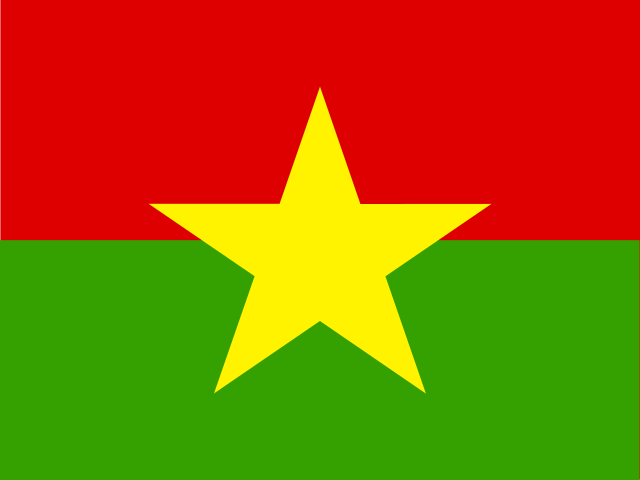 Burkina Faso
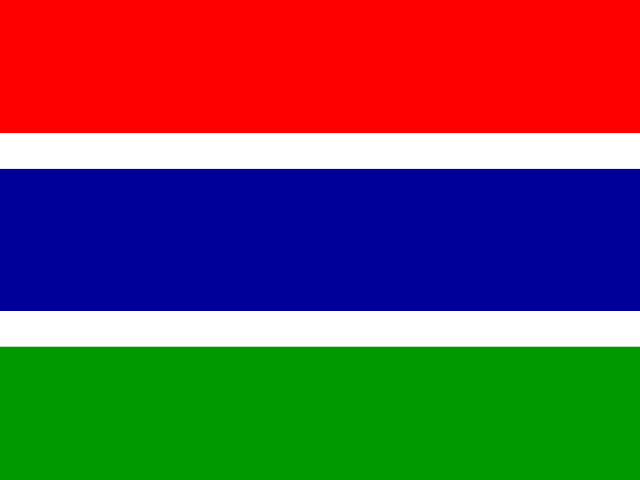 Gambia
 Ghana
Ghana Guinea
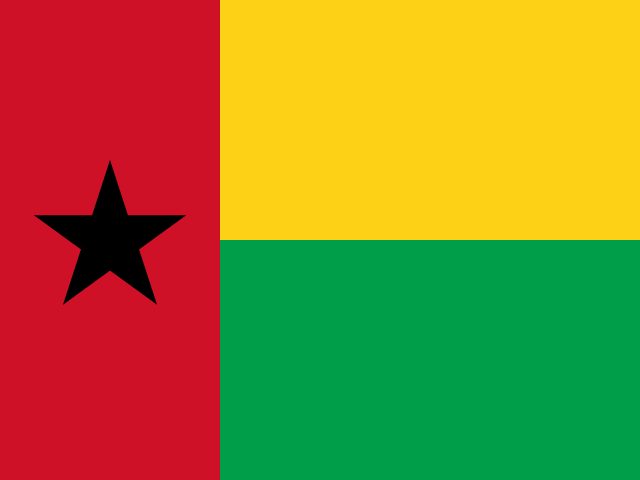 Guinea-Bissau
 Côte d'Ivoire
 Cabo Verde
 Liberia
 Mali
Mali Niger
Niger Nigeria
 Senegal
 Sierra Leone
 Togo
TogoEarlier Report Observations
Between 2018 and 2020, camel meat production in ECOWAS showed a fluctuating trend, starting at 13 817 tons. During this period, the market benefited from a long-term shift in consumption patterns across West Africa, as trade disruptions in the Sahel region redirected camel meat flows towards new consumer countries like Côte d'Ivoire, Cameroon, Nigeria, and Senegal. Additionally, the camel's resilience to high temperatures and ease of feeding made it an increasingly attractive protein source in the context of climate change. After a dip to 12 970 tons in 2019, output rebounded to 15 145 tons in 2020, supported by growing consumer interest in the meat's purported medicinal benefits and lean nutritional profile, as well as the adoption of international quality specifications that facilitated trade.
Production accelerated sharply from 2021 onward, reaching 18 085 tons in 2021 and 21 551 tons in 2022 – a near 20% annual growth. This surge was underpinned by government-led initiatives in several countries to enhance camel productivity through better pasture management, veterinary care, and herd identification systems. At the same time, consumer demand expanded significantly in both rural and urban areas, driven by dietary diversification and an improved perception of camel meat's health advantages over traditional red meats.
In 2023, production moderated to 19 941 tons, a 7.5% decrease from the previous year, marking a correction after several years of rapid expansion. Despite this dip, the overall market volume remained well above the levels seen at the start of the period.
Table of content
- 1. Disclaimer
- 2. Terms of use of the report
- 3. Product codes in the statistical classifications used in the report
-
4. Key Market Indicators and Trends
-
4.1. Key Market Indicators
-
4.1.1. In kind
- 4.1.1.1. Production, 2018-2023
- 4.1.1.2. Imports, 2018-2024
- 4.1.1.3. Exports, 2018-2024
- 4.1.1.4. Market size, 2018-2023
-
4.1.1. In kind
- 4.2. Market Trends and Factors
-
4.1. Key Market Indicators
-
5. Production
-
5.1. Production in ECOWAS
- 5.1.1. Annual dynamics of production in ECOWAS in kind, 2018-2023, t
-
5.2. Global production by Country, 2018-2023
- 5.2.1. Annual dynamics of production by macroregions in kind, 2018-2023, t
- 5.2.2. Dynamics of production structure by macroregions in kind, 2018-2023
- 5.2.3. Annual dynamics of production by country in kind, 2018-2023, t
- 5.2.4. Structure of production by countries in kind, 2018-2023
- 5.2.5. Dynamics of peoduction structure by countries in kind, 2018-2023
-
5.1. Production in ECOWAS
-
6. Imports
-
6.1. Imports (Direct Data*)
- 6.1.1. Imports - Total information
-
6.1.2. Imports in kind, kg
- 6.1.2.1. Annual dynamics of product's imports to Benin in kind, 2018-2024, kg
- 6.1.2.2. Dynamics of product's imports in kind to Benin by countries, 2018-2024, kg
- 6.1.2.3. Structure of product's imports in kind by countries, 2018-2024
-
6.1.3. Imports in value, $ US
- 6.1.3.1. Annual dynamics of product's imports to Benin in value, 2018-2024, $ US
- 6.1.3.2. Dynamics of product's imports in value to Benin by countries, 2018-2024, $ US
- 6.1.3.3. Structure of product's imports in value by countries, 2018-2024
-
6.1.4. Average price of product's imports, $ US/kg
- 6.1.4.1. Annual dynamics of average price of product's imports to Benin, 2018-2024, $ US/kg
- 6.1.4.2. Dynamics of average price of product's imports to Benin by countries, 2018-2024, $ US/kg
-
6.2. Imports (Mirror Data)
- 6.2.1. Imports - Total information
-
6.2.2. Imports in kind, kg
- 6.2.2.1. Annual dynamics of product's imports to Benin in kind, 2018-2024, kg
- 6.2.2.2. Dynamics of product's imports in kind to Benin by countries, 2018-2024, kg
- 6.2.2.3. Structure of product's imports in kind by countries, 2018-2024
-
6.2.3. Imports in value, $ US
- 6.2.3.1. Annual dynamics of product's imports to Benin in value, 2018-2024, $ US
- 6.2.3.2. Dynamics of product's imports in value to Benin by countries, 2018-2024, $ US
- 6.2.3.3. Structure of product's imports in value by countries, 2018-2024
-
6.2.4. Average price of product's imports, $ US/kg
- 6.2.4.1. Annual dynamics of average price of product's imports to Benin, 2018-2024, $ US/kg
- 6.2.4.2. Dynamics of average price of product's imports to Benin by countries, 2018-2024, $ US/kg
-
6.1. Imports (Direct Data*)
-
7. Trade balance
-
7.1. Trade balance (Direct Data)
- 7.1.1. In kind, kg
- 7.1.2. In value, $ US
-
7.2. Trade balance (Mirror Data)
- 7.2.1. In kind, kg
- 7.2.2. In value, $ US
-
7.1. Trade balance (Direct Data)
-
8. Top buying and selling countries, 2018-2024
-
8.1. Direct Data
- 8.1.1. Import in Value by Countries-buyers
- 8.1.2. Export in Value by Countries-suppliers
-
8.2. Mirror Data
- 8.2.1. Import in Value by Countries-buyers
- 8.2.2. Export in Value by Countries-suppliers
-
8.1. Direct Data
Production camel meat and offal in ECOWAS
In kind, 2017-2020, t
Top producers of camel meat and offal, 2017-2020
World map of production of camel meat and offal, 2017-2020
In 2019, ECOWAS produced 12,970 tonnes of camel meat and offal, which was the lowest level recorded during the period. However, production rebounded in 2020, reaching 15,145 tonnes—a significant 16.8% increase compared to the previous year. Looking at the broader 2017-2020 timeframe, overall production grew by 10.2%, translating to an average annual growth rate of 3.3%. The most notable decline occurred in 2019, when production fell by 6.1%.
Annual dynamics of production in ECOWAS in kind, 2017-2020, t
| Parameter | 2018 | 2019 | 2020 | CAGR | |
|---|---|---|---|---|---|
| 1 | Change from last year | 0.5% | (6.1%) | 16.8% | 3.3% |
Exports camel meat and offal from ECOWAS
Based on desk research findings, there were no exports of camel meat and offal from ECOWAS between 2017 and 2020.
Imports camel meat and offal to ECOWAS
Imports in kind, kg
In 2019, imports of camel meat and offal into ECOWAS totaled 24.51 kilograms, marking a substantial 63.4% increase from the previous year.
Annual dynamics of product's imports to ECOWAS in kind, 2017-2020, kg
| Parameter | 2018 | 2019 | 2020 | CAGR | |
|---|---|---|---|---|---|
| 1 | Change from last year | n/a | 63.4% | n/a | - |
From 2017 to 2020, China consistently led as the top source for imports of camel meat and offal into ECOWAS, accounting for 60.0% of the total volume.
Structure of product's imports in kind by countries, 2017-2020
World map of product's imports to ECOWAS in kind, 2017-2020
Imports in value, $ US
In 2019, the value of camel meat and offal imports into ECOWAS reached $175.1, reflecting an 8.7% rise compared to 2018.
Annual dynamics of product's imports to ECOWAS in value, 2017-2020, $ US
| Parameter | 2018 | 2019 | 2020 | CAGR | |
|---|---|---|---|---|---|
| 1 | Change from last year | n/a | 8.7% | n/a | - |
Throughout the 2017-2020 period, China remained the primary partner for imports in value terms, holding a 47.9% share of the total flows.
Structure of product's imports in value by countries, 2017-2020
World map of product's imports to ECOWAS in value, 2017-2020
Related Reports

Camel meat and offal market in Central Asia
2026-03-27
Camel meat and offal market in Iran
2026-03-27

Horse, donkey and mule meat market in ECOWAS
2026-03-27

2026-03-27

Sheep and goat meat market in ECOWAS
2026-03-27

Poultry meat and offal market in ECOWAS
2026-03-27
Why Choose Us?
Only Verified Data
No Hidden Costs or Separate Fees
Smarter Subscription Pricing
Contact Our Team
Submit your inquiry using the form below — our team will get back to you within 24 hours.