






"SADC" region includes following countries:
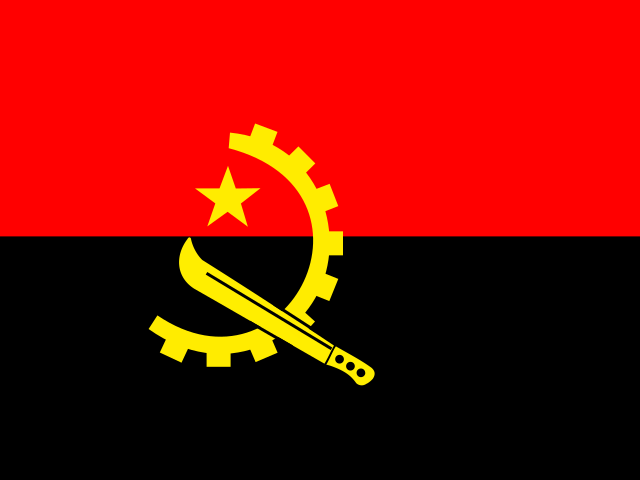 Angola
 Botswana
 Comoros
 Democratic Republic of the Congo
 Eswatini
 Lesotho
 Madagascar
 Malawi
 Mauritius
 Mozambique
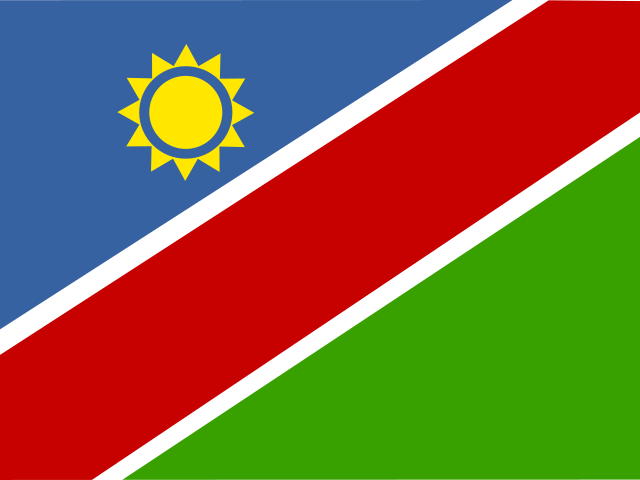 Namibia
 Seychelles
 South Africa
 Tanzania
 Zambia
 Zimbabwe
Earlier Report Observations
Between 2018 and 2020, the market volume for bran, sharps and residues from cereal processing in South Africa expanded from 2.8 million tons to 3.4 million tons. This growth was primarily driven by increased maize production, supported by capital availability for millers, and a deregulated market with zero import tariffs. The COVID-19 pandemic in 2020 further boosted demand for staple foods like maize meal, leading to a surge in market volume as mills adapted to supply chain disruptions.
After a temporary contraction in 2021, the market volume resumed its upward trajectory, climbing to 3.7 million tons by 2023. This recovery was supported by government initiatives for agricultural innovation and global maize market conditions, which encouraged efficient production practices. Ongoing regulatory emphasis on traceability and quality control, along with industry innovation in value-added products, underpinned the market's expansion.
Table of content
- 1. Disclaimer
- 2. Terms of use of the report
- 3. Product codes in the statistical classifications used in the report
-
4. Key Market Indicators and Trends
-
4.1. Key Market Indicators
-
4.1.1. In kind
- 4.1.1.1. Production, 2018-2023
- 4.1.1.2. Imports, 2018-2024
- 4.1.1.3. Exports, 2018-2024
- 4.1.1.4. Market size, 2018-2023
-
4.1.1. In kind
- 4.2. Market Trends and Factors
-
4.1. Key Market Indicators
-
5. Production
-
5.1. Production in SADC
- 5.1.1. Annual dynamics of production in SADC in kind, 2018-2023, K t
-
5.2. Global production by Country, 2018-2023
- 5.2.1. Annual dynamics of production by macroregions in kind, 2018-2023, K t
- 5.2.2. Dynamics of production structure by macroregions in kind, 2018-2023
- 5.2.3. Annual dynamics of production by country in kind, 2018-2023, K t
- 5.2.4. Structure of production by countries in kind, 2018-2023
- 5.2.5. Dynamics of peoduction structure by countries in kind, 2018-2023
-
5.1. Production in SADC
-
6. Imports
-
6.1. Imports (Direct Data*)
- 6.1.1. Imports - Total information
-
6.1.2. Imports in kind, K t
- 6.1.2.1. Annual dynamics of product's imports to Angola in kind, 2018-2024, K t
- 6.1.2.2. Dynamics of product's imports in kind to Angola by countries, 2018-2024, K t
- 6.1.2.3. Structure of product's imports in kind by countries, 2018-2024
-
6.1.3. Imports in value, M $ US
- 6.1.3.1. Annual dynamics of product's imports to Angola in value, 2018-2024, M $ US
- 6.1.3.2. Dynamics of product's imports in value to Angola by countries, 2018-2024, M $ US
- 6.1.3.3. Structure of product's imports in value by countries, 2018-2024
-
6.1.4. Average price of product's imports, $ US/t
- 6.1.4.1. Annual dynamics of average price of product's imports to Angola, 2018-2024, $ US/t
- 6.1.4.2. Dynamics of average price of product's imports to Angola by countries, 2018-2024, $ US/t
-
6.2. Imports (Mirror Data)
- 6.2.1. Imports - Total information
-
6.2.2. Imports in kind, K t
- 6.2.2.1. Annual dynamics of product's imports to Angola in kind, 2018-2024, K t
- 6.2.2.2. Dynamics of product's imports in kind to Angola by countries, 2018-2024, K t
- 6.2.2.3. Structure of product's imports in kind by countries, 2018-2024
-
6.2.3. Imports in value, M $ US
- 6.2.3.1. Annual dynamics of product's imports to Angola in value, 2018-2024, M $ US
- 6.2.3.2. Dynamics of product's imports in value to Angola by countries, 2018-2024, M $ US
- 6.2.3.3. Structure of product's imports in value by countries, 2018-2024
-
6.2.4. Average price of product's imports, $ US/t
- 6.2.4.1. Annual dynamics of average price of product's imports to Angola, 2018-2024, $ US/t
- 6.2.4.2. Dynamics of average price of product's imports to Angola by countries, 2018-2024, $ US/t
-
6.1. Imports (Direct Data*)
-
7. Exports
-
7.1. Exports (Direct Data*)
- 7.1.1. Exports - Total information
-
7.1.2. Exports in kind, K t
- 7.1.2.1. Annual dynamics of product's exports from Angola in kind, 2018-2024, K t
- 7.1.2.2. Dynamics of product's exports in kind from Angola by countries, 2018-2024, K t
- 7.1.2.3. Structure of product's exports in kind by countries, 2018-2024
-
7.1.3. Exports in value, M $ US
- 7.1.3.1. Annual dynamics of product's exports from Angola in value, 2018-2024, M $ US
- 7.1.3.2. Dynamics of product's exports in value from Angola by countries, 2018-2024, M $ US
- 7.1.3.3. Structure of product's exports in value by countries, 2018-2024
-
7.1.4. Average price of product's exports, $ US/t
- 7.1.4.1. Annual dynamics of average price of product's exports from Angola, 2018-2024, $ US/t
- 7.1.4.2. Dynamics of average price of product's exports from Angola by countries, 2018-2024, $ US/t
-
7.2. Exports (Mirror Data)
- 7.2.1. Exports - Total information
-
7.2.2. Exports in kind, K t
- 7.2.2.1. Annual dynamics of product's exports from Angola in kind, 2018-2024, K t
- 7.2.2.2. Dynamics of product's exports in kind from Angola by countries, 2018-2024, K t
- 7.2.2.3. Structure of product's exports in kind by countries, 2018-2024
-
7.2.3. Exports in value, M $ US
- 7.2.3.1. Annual dynamics of product's exports from Angola in value, 2018-2024, M $ US
- 7.2.3.2. Dynamics of product's exports in value from Angola by countries, 2018-2024, M $ US
- 7.2.3.3. Structure of product's exports in value by countries, 2018-2024
-
7.2.4. Average price of product's exports, $ US/t
- 7.2.4.1. Annual dynamics of average price of product's exports from Angola, 2018-2024, $ US/t
- 7.2.4.2. Dynamics of average price of product's exports from Angola by countries, 2018-2024, $ US/t
-
7.1. Exports (Direct Data*)
-
8. Trade balance
-
8.1. Trade balance (Direct Data)
- 8.1.1. In kind, K t
- 8.1.2. In value, M $ US
-
8.2. Trade balance (Mirror Data)
- 8.2.1. In kind, K t
- 8.2.2. In value, M $ US
-
8.1. Trade balance (Direct Data)
-
9. Top buying and selling countries, 2018-2024
-
9.1. Direct Data
- 9.1.1. Import in Value by Countries-buyers
- 9.1.2. Export in Value by Countries-suppliers
-
9.2. Mirror Data
- 9.2.1. Import in Value by Countries-buyers
- 9.2.2. Export in Value by Countries-suppliers
-
9.1. Direct Data
Production bran, sharps and residues from cereal or legume processing in SADC
In kind, 2017-2020, K t
Top producers of bran, sharps and residues from cereal or legume processing, 2017-2020
World map of production of bran, sharps and residues from cereal or legume processing, 2017-2020
Production of bran, sharps, and residues from cereal or legume processing in SADC has increased for the third consecutive year. In 2020, SADC produced 3 873 K t of these products, marking a significant year-over-year rise of 24.5%. Over the period from 2017 to 2020, production grew by 32.6%, with a compound annual growth rate of 9.9%.
Annual dynamics of production in SADC in kind, 2017-2020, K t
| Parameter | 2018 | 2019 | 2020 | CAGR | |
|---|---|---|---|---|---|
| 1 | Change from last year | 4.9% | 1.5% | 24.5% | 9.9% |
Exports bran, sharps and residues from cereal or legume processing from SADC
Exports in kind, K t
In 2020, SADC's exports of bran, sharps, and residues from cereal or legume processing totaled 534.5 K t, showing a modest decline of 3.1% compared to the previous year. Over the 2017-2020 period, exports increased by 50.6%, with a compound annual growth rate of 14.6%. The lowest export volume was recorded in 2018 at 341.8 K t, while the highest was in 2019 at 551.6 K t. The largest decline occurred in 2018, with a drop of 3.7%, and the largest increase was in 2019, with a rise of 61.4%.
Annual dynamics of product's exports from SADC in kind, 2017-2020, K t
| Parameter | 2018 | 2019 | 2020 | CAGR | |
|---|---|---|---|---|---|
| 1 | Change from last year | (3.7%) | 61.4% | (3.1%) | 14.6% |
From 2017 to 2020, SADC traded bran, sharps, and residues from cereal or legume processing with numerous countries. Even the top destinations—Morocco, Vietnam, and Qatar—collectively accounted for only 46.0% of total exports in kind.
Structure of product's exports in kind by countries, 2017-2020
World map of product's exports from SADC in kind, 2017-2020
Exports in value, M $ US
The market exhibited volatility during these years. Exports reached their peak in 2018 and fell to their lowest point in 2017, with a 2.8-fold difference between these years. In 2020, SADC's exports of bran, sharps, and residues from cereal or legume processing amounted to 77.7 M $ US, showing a modest reduction of 8.8% from 2019. The highest value was recorded in 2018 at 132.6 M $ US. The largest decline occurred in 2019, with a drop of 35.8%, while the largest increase was in 2018, with a rise of 179.2%.
Annual dynamics of product's exports from SADC in value, 2017-2020, M $ US
| Parameter | 2018 | 2019 | 2020 | CAGR | |
|---|---|---|---|---|---|
| 1 | Change from last year | 179.2% | (35.8%) | (8.8%) | 17.8% |
Throughout 2017-2020, Vietnam, Qatar, and Morocco played leading roles in the value-based exports of bran, sharps, and residues from cereal or legume processing from SADC. Vietnam accounted for 35.5% of exports in value terms, Qatar for 9.9%, and Morocco for 6.2%, together representing 51.6% of total flows.
Structure of product's exports in value by countries, 2017-2020
World map of product's exports from SADC in value, 2017-2020
Imports bran, sharps and residues from cereal or legume processing to SADC
Imports in kind, K t
Market performance showed noticeable fluctuations during this period. From 2017 to 2018, there was a 2.2-fold difference between the peak and trough. In 2020, SADC imported 43.9 K t of bran, sharps, and residues from cereal or legume processing, corresponding to a dramatic fall of 45.6% compared to the previous year. The minimum import volume was recorded in 2018 at 38.5 K t. The largest decline occurred in 2018, with a drop of 55.1%, while the largest increase was in 2019, with a rise of 109.3%.
Annual dynamics of product's imports to SADC in kind, 2017-2020, K t
| Parameter | 2018 | 2019 | 2020 | CAGR | |
|---|---|---|---|---|---|
| 1 | Change from last year | (55.1%) | 109.3% | (45.6%) | (20.1%) |
In 2017-2020, Uruguay and Argentina were the primary sources in the geographical structure of imports in kind for SADC, together accounting for 2.0% of total flows.
Structure of product's imports in kind by countries, 2017-2020
World map of product's imports to SADC in kind, 2017-2020
Imports in value, M $ US
In 2020, SADC's imports of bran, sharps, and residues from cereal or legume processing came to 31.2 M $ US, which is 25.7% lower than the previous year. Between 2017 and 2020, imports decreased by 6.7%, equating to an annualized rate of 2.3%. The minimum value was recorded in 2018 at 30.3 M $ US, while the maximum was in 2019 at 42.0 M $ US. The largest increase occurred in 2019, with a rise of 38.7%.
Annual dynamics of product's imports to SADC in value, 2017-2020, M $ US
| Parameter | 2018 | 2019 | 2020 | CAGR | |
|---|---|---|---|---|---|
| 1 | Change from last year | (9.5%) | 38.7% | (25.7%) | (2.3%) |
In 2017-2020, Argentina, Brazil, and Paraguay were the main sources in the geographical breakdown of imports in value terms for bran, sharps, and residues from cereal or legume processing to SADC. Argentina accounted for 1.3% of imports in value terms, Brazil for 0.8%, and Paraguay for 0.5%, with a combined share of 2.7% of total flows.
Structure of product's imports in value by countries, 2017-2020
World map of product's imports to SADC in value, 2017-2020
Related Reports




Why Choose Us?
Only Verified Data
No Hidden Costs or Separate Fees
Smarter Subscription Pricing
Contact Our Team
Submit your inquiry using the form below — our team will get back to you within 24 hours.