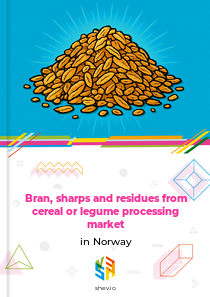







Earlier Report Observations
Between 2018 and 2023, the Norwegian market for bran and residues from cereal and legume processing more than doubled in volume, growing from 135.9 thousand tons to 268.6 thousand tons. This expansion was not steady, with a significant surge in 2020 when market size jumped by over 34% to 190.2 thousand tons, followed by continued growth in 2021 and a temporary dip in 2022.
The market's trajectory was primarily shaped by trade flows. Domestic production fluctuated between 95.0 and 118.9 thousand tons, while imports skyrocketed from 24.7 thousand tons in 2018 to 165.3 thousand tons in 2023. This import growth, particularly the sharp increase in 2020, was the main driver of market expansion. Exports, though rising from a low base, reached 31.6 thousand tons in 2022, which contributed to that year's market contraction.
Available trade data for 2024 and 2025 shows imports at 157.0 and 196.6 thousand tons and exports at 3.0 and 3.4 thousand tons.
Table of content
- 1. Disclaimer
- 2. Terms of use of the report
- 3. Product codes in the statistical classifications used in the report
-
4. Key Market Indicators and Trends
-
4.1. Key Market Indicators
-
4.1.1. In kind
- 4.1.1.1. Production, 2018-2023
- 4.1.1.2. Imports, 2018-2025
- 4.1.1.3. Exports, 2018-2025
- 4.1.1.4. Market size, 2018-2023
-
4.1.1. In kind
- 4.2. Market Trends and Factors
-
4.1. Key Market Indicators
-
5. Production
-
5.1. Production in Norway
- 5.1.1. In kind, 2018-2023, K t
-
5.2. Production in the EU, 2018-2024
- 5.2.1. In kind, 2018-2024, K t
- 5.2.2. In value, 2018-2024, M $ US
-
5.3. Global production by Country, 2018-2023
-
5.3.1. Global Production by Country in kind
- 5.3.1.1. Annual dynamics of production by country in kind, 2018-2023, t
- 5.3.1.2. Structure of production by countries in kind, 2018-2023
- 5.3.1.3. Dynamics of peoduction structure by countries in kind, 2018-2023
-
5.3.1. Global Production by Country in kind
-
5.1. Production in Norway
-
6. Exports
-
6.1. Exports (Direct Data)
- 6.1.1. Exports - Total information
-
6.1.2. Exports in kind, K t
- 6.1.2.1. Annual dynamics of product's exports from Norway in kind, 2018-2025, K t
- 6.1.2.2. Dynamics of product's exports in kind from Norway by countries, 2018-2025, K t
- 6.1.2.3. Structure of product's exports in kind by countries, 2018-2025
-
6.1.3. Exports in value, M $ US
- 6.1.3.1. Annual dynamics of product's exports from Norway in value, 2018-2025, M $ US
- 6.1.3.2. Dynamics of product's exports in value from Norway by countries, 2018-2025, M $ US
- 6.1.3.3. Structure of product's exports in value by countries, 2018-2025
-
6.1.4. Average price of product's exports, $ US/t
- 6.1.4.1. Annual dynamics of average price of product's exports from Norway, 2018-2025, $ US/t
- 6.1.4.2. Dynamics of average price of product's exports from Norway by countries, 2018-2025, $ US/t
-
6.2. Exports (Mirror Data)
- 6.2.1. Exports - Total information
-
6.2.2. Exports in kind, K t
- 6.2.2.1. Annual dynamics of product's exports from Norway in kind, 2018-2025, K t
- 6.2.2.2. Dynamics of product's exports in kind from Norway by countries, 2018-2025, K t
- 6.2.2.3. Structure of product's exports in kind by countries, 2018-2025
-
6.2.3. Exports in value, M $ US
- 6.2.3.1. Annual dynamics of product's exports from Norway in value, 2018-2025, M $ US
- 6.2.3.2. Dynamics of product's exports in value from Norway by countries, 2018-2025, M $ US
- 6.2.3.3. Structure of product's exports in value by countries, 2018-2025
-
6.2.4. Average price of product's exports, $ US/t
- 6.2.4.1. Annual dynamics of average price of product's exports from Norway, 2018-2025, $ US/t
- 6.2.4.2. Dynamics of average price of product's exports from Norway by countries, 2018-2025, $ US/t
-
6.1. Exports (Direct Data)
-
7. Imports
-
7.1. Imports (Direct Data)
- 7.1.1. Imports - Total information
-
7.1.2. Imports in kind, K t
- 7.1.2.1. Annual dynamics of product's imports to Norway in kind, 2018-2025, K t
- 7.1.2.2. Dynamics of product's imports in kind to Norway by countries, 2018-2025, K t
- 7.1.2.3. Structure of product's imports in kind by countries, 2018-2025
-
7.1.3. Imports in value, M $ US
- 7.1.3.1. Annual dynamics of product's imports to Norway in value, 2018-2025, M $ US
- 7.1.3.2. Dynamics of product's imports in value to Norway by countries, 2018-2025, M $ US
- 7.1.3.3. Structure of product's imports in value by countries, 2018-2025
-
7.1.4. Average price of product's imports, $ US/t
- 7.1.4.1. Annual dynamics of average price of product's imports to Norway, 2018-2025, $ US/t
- 7.1.4.2. Dynamics of average price of product's imports to Norway by countries, 2018-2025, $ US/t
-
7.2. Imports (Mirror Data)
- 7.2.1. Imports - Total information
-
7.2.2. Imports in kind, K t
- 7.2.2.1. Annual dynamics of product's imports to Norway in kind, 2018-2025, K t
- 7.2.2.2. Dynamics of product's imports in kind to Norway by countries, 2018-2025, K t
- 7.2.2.3. Structure of product's imports in kind by countries, 2018-2025
-
7.2.3. Imports in value, M $ US
- 7.2.3.1. Annual dynamics of product's imports to Norway in value, 2018-2025, M $ US
- 7.2.3.2. Dynamics of product's imports in value to Norway by countries, 2018-2025, M $ US
- 7.2.3.3. Structure of product's imports in value by countries, 2018-2025
-
7.2.4. Average price of product's imports, $ US/t
- 7.2.4.1. Annual dynamics of average price of product's imports to Norway, 2018-2025, $ US/t
- 7.2.4.2. Dynamics of average price of product's imports to Norway by countries, 2018-2025, $ US/t
-
7.1. Imports (Direct Data)
-
8. Trade balance
-
8.1. Trade balance (Direct Data)
- 8.1.1. In kind, K t
- 8.1.2. In value, M $ US
-
8.2. Trade balance (Mirror Data)
- 8.2.1. In kind, K t
- 8.2.2. In value, M $ US
-
8.1. Trade balance (Direct Data)
-
9. Top buying and selling countries, 2018-2025
-
9.1. Direct Data
- 9.1.1. Import in Value by Countries-buyers
- 9.1.2. Export in Value by Countries-suppliers
-
9.2. Mirror Data
- 9.2.1. Import in Value by Countries-buyers
- 9.2.2. Export in Value by Countries-suppliers
-
9.1. Direct Data
Production bran, sharps and residues from cereal or legume processing in Norway
In kind, 2018-2021, K t
Top producers of bran, sharps and residues from cereal or legume processing, 2018-2021
World map of production of bran, sharps and residues from cereal or legume processing, 2018-2021
In 2021, Norway produced 99 K t of bran, sharps, and residues from cereal or legume processing, marking a 4.4% increase compared to the previous year. Looking at the broader period from 2018 to 2021, production declined by 12%, which translates to an average annual decrease of 4.2%. The highest production level was recorded in 2019 at 119 K t, while the lowest was in 2020 at 95 K t. The most significant drop occurred in 2020, with a 20.1% decrease, whereas the largest increase was in 2019, at 5.4%.
Annual dynamics of production in Norway in kind, 2018-2021, K t
| Parameter | 2019 | 2020 | 2021 | CAGR | |
|---|---|---|---|---|---|
| 1 | Change from last year | 5.4% | (20.1%) | 4.4% | (4.2%) |
Exports bran, sharps and residues from cereal or legume processing from Norway
Exports in kind, K t
The market exhibited considerable volatility during these years. Export volumes reached their lowest point in 2019 at 0.8 K t and peaked in 2021 at 6.4 K t, representing a 7.9-fold increase. In 2021, Norway exported 6.4 K t of bran, sharps, and residues from cereal or legume processing, which was a substantial 359.8% rise from the year before. The most significant decline was recorded in 2019, at 46.6%.
Annual dynamics of product's exports from Norway in kind, 2018-2021, K t
| Parameter | 2019 | 2020 | 2021 | CAGR | |
|---|---|---|---|---|---|
| 1 | Change from last year | (46.6%) | 72.3% | 359.8% | 61.8% |
From 2018 to 2021, Denmark, Italy, and Spain were the top buyers of bran, sharps, and residues from cereal or legume processing from Norway. Denmark accounted for 30.8% of exports in kind, Italy for 15.8%, and Spain for 13.4%. Together, these three countries made up 60.0% of Norway's total exports in this category.
Structure of product's exports in kind by countries, 2018-2021
World map of product's exports from Norway in kind, 2018-2021
Exports in value, M $ US
Market performance showed noticeable fluctuations over this period. Export values hit their lowest in 2019 at 0.4 M $ US and rose to a high in 2021 at 2.5 M $ US, varying by a factor of 7. In 2021, the value of bran, sharps, and residues from cereal or legume processing exported from Norway was 2.5 M $ US, reflecting a sharp 236.5% increase year-over-year. The largest decline occurred in 2019, at 25.6%.
Annual dynamics of product's exports from Norway in value, 2018-2021, M $ US
| Parameter | 2019 | 2020 | 2021 | CAGR | |
|---|---|---|---|---|---|
| 1 | Change from last year | (25.6%) | 108.2% | 236.5% | 73.3% |
Between 2018 and 2021, Denmark, Spain, and Germany were the leading contributors to Norway's export value for bran, sharps, and residues from cereal or legume processing. Denmark held a 33.8% share, Spain 15.6%, and Germany 12.0%. Combined, these three markets accounted for 61.4% of total export flows in value terms.
Structure of product's exports in value by countries, 2018-2021
World map of product's exports from Norway in value, 2018-2021
Imports bran, sharps and residues from cereal or legume processing to Norway
Imports in kind, K t
Import volumes experienced significant fluctuations during this time. The lowest point was in 2019 at 23.6 K t, while the highest was in 2021 at 138.5 K t, showing a 5.9-fold variation. In 2021, Norway imported 138.5 K t of bran, sharps, and residues from cereal or legume processing, which was a 43.4% increase from 2020. The largest decline was in 2019, at 4.6%, and the largest increase was in 2020, at 310.0%.
Annual dynamics of product's imports to Norway in kind, 2018-2021, K t
| Parameter | 2019 | 2020 | 2021 | CAGR | |
|---|---|---|---|---|---|
| 1 | Change from last year | (4.6%) | 310.0% | 43.4% | 77.7% |
From 2018 to 2021, India was the dominant partner for Norway's imports in kind of bran, sharps, and residues from cereal or legume processing, with a share of 76.5% of total flows. Other markets had relatively smaller contributions.
Structure of product's imports in kind by countries, 2018-2021
World map of product's imports to Norway in kind, 2018-2021
Imports in value, M $ US
Market performance was marked by notable fluctuations. Import values were at their lowest in 2019 at 5.5 M $ US and reached their peak in 2021 at 117.1 M $ US, a 21-fold difference. In 2021, the value of imported bran, sharps, and residues from cereal or legume processing to Norway totaled 117.1 M $ US, representing a 95.1% rise compared to 2020. The largest decline was in 2019, at 7.3%, while the largest increase was in 2020, at 987.6%.
Annual dynamics of product's imports to Norway in value, 2018-2021, M $ US
| Parameter | 2019 | 2020 | 2021 | CAGR | |
|---|---|---|---|---|---|
| 1 | Change from last year | (7.3%) | 987.6% | 95.1% | 169.9% |
Throughout 2018 to 2021, India played a dominant role in Norway's imports in value terms for bran, sharps, and residues from cereal or legume processing, consistently accounting for 91.2% of total flows.
Structure of product's imports in value by countries, 2018-2021
World map of product's imports to Norway in value, 2018-2021
Related Reports


Soybean oilcake market in Norway
2026-03-29


Cocoa powder and cake market in Norway
2026-03-30
Why Choose Us?
Only Verified Data
No Hidden Costs or Separate Fees
Smarter Subscription Pricing
Contact Our Team
Submit your inquiry using the form below — our team will get back to you within 24 hours.