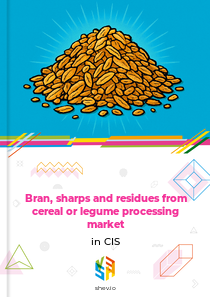






"CIS" region includes following countries:
 Azerbaijan
 Armenia
 Belarus
 Kazakhstan
 Kyrgyzstan
 Moldova
 Russia
 Tajikistan
 Uzbekistan
Earlier Report Observations
From 2018 to 2020, the market volume for bran and residues from cereal and legume processing in the CIS expanded from 6.4 million tons to 6.8 million tons. This growth was driven by the launch of new processing plant projects with investments of $150–200 million, which aimed to produce pelletized feed and export goods. The introduction of automated milling and air classification technologies improved the efficiency of converting grain waste into feed additives and raw materials. In 2019, rising interest in using bran for bioethanol production created an additional demand stream. The approval of a government program in 2020 to increase the use of secondary resources in industry, alongside the adoption of modern automated and extrusion technologies for feed processing, further stimulated production and supported market expansion.
After 2020, the domestic market volume contracted to 6.5 million tons in 2021 and 6.2 million tons in 2022, then stabilized at 6.1 million tons in 2023. This shift occurred despite ongoing advancements in sorting technologies and stricter environmental disposal requirements. The key factor was a rapid rise in exports, which grew by over 70% from 1.2 million tons in 2018 to 2.1 million tons in 2023. State policies that facilitated the export of grain by-products—including expanded lists of approved commodities and enhanced quality monitoring—redirected supply abroad. Concurrently, the active implementation of biotechnologies for biofuel production from grain waste, highlighted in 2022, fostered a new export-oriented segment, drawing volume away from the domestic market.
Table of content
- 1. Disclaimer
- 2. Terms of use of the report
- 3. Product codes in the statistical classifications used in the report
-
4. Key Market Indicators and Trends
-
4.1. Key Market Indicators
-
4.1.1. In kind
- 4.1.1.1. Production, 2018-2023
- 4.1.1.2. Imports, 2018-2024
- 4.1.1.3. Exports, 2018-2024
- 4.1.1.4. Market size, 2018-2023
-
4.1.1. In kind
- 4.2. Market Trends and Factors
-
4.1. Key Market Indicators
-
5. Production
-
5.1. Production in CIS
- 5.1.1. Annual dynamics of production in CIS in kind, 2018-2023, K t
-
5.2. Global production by Country, 2018-2023
- 5.2.1. Annual dynamics of production by macroregions in kind, 2018-2023, K t
- 5.2.2. Dynamics of production structure by macroregions in kind, 2018-2023
- 5.2.3. Annual dynamics of production by country in kind, 2018-2023, K t
- 5.2.4. Structure of production by countries in kind, 2018-2023
- 5.2.5. Dynamics of peoduction structure by countries in kind, 2018-2023
-
5.1. Production in CIS
-
6. Imports
-
6.1. Imports (Direct Data*)
- 6.1.1. Imports - Total information
-
6.1.2. Imports in kind, K t
- 6.1.2.1. Annual dynamics of product's imports to Azerbaijan in kind, 2018-2024, K t
- 6.1.2.2. Dynamics of product's imports in kind to Azerbaijan by countries, 2018-2024, K t
- 6.1.2.3. Structure of product's imports in kind by countries, 2018-2024
-
6.1.3. Imports in value, M $ US
- 6.1.3.1. Annual dynamics of product's imports to Azerbaijan in value, 2018-2024, M $ US
- 6.1.3.2. Dynamics of product's imports in value to Azerbaijan by countries, 2018-2024, M $ US
- 6.1.3.3. Structure of product's imports in value by countries, 2018-2024
-
6.1.4. Average price of product's imports, $ US/t
- 6.1.4.1. Annual dynamics of average price of product's imports to Azerbaijan, 2018-2024, $ US/t
- 6.1.4.2. Dynamics of average price of product's imports to Azerbaijan by countries, 2018-2024, $ US/t
-
6.2. Imports (Mirror Data)
- 6.2.1. Imports - Total information
-
6.2.2. Imports in kind, K t
- 6.2.2.1. Annual dynamics of product's imports to Azerbaijan in kind, 2018-2024, K t
- 6.2.2.2. Dynamics of product's imports in kind to Azerbaijan by countries, 2018-2024, K t
- 6.2.2.3. Structure of product's imports in kind by countries, 2018-2024
-
6.2.3. Imports in value, M $ US
- 6.2.3.1. Annual dynamics of product's imports to Azerbaijan in value, 2018-2024, M $ US
- 6.2.3.2. Dynamics of product's imports in value to Azerbaijan by countries, 2018-2024, M $ US
- 6.2.3.3. Structure of product's imports in value by countries, 2018-2024
-
6.2.4. Average price of product's imports, $ US/t
- 6.2.4.1. Annual dynamics of average price of product's imports to Azerbaijan, 2018-2024, $ US/t
- 6.2.4.2. Dynamics of average price of product's imports to Azerbaijan by countries, 2018-2024, $ US/t
-
6.1. Imports (Direct Data*)
-
7. Exports
-
7.1. Exports (Direct Data*)
- 7.1.1. Exports - Total information
-
7.1.2. Exports in kind, K t
- 7.1.2.1. Annual dynamics of product's exports from Azerbaijan in kind, 2018-2024, K t
- 7.1.2.2. Dynamics of product's exports in kind from Azerbaijan by countries, 2018-2024, K t
- 7.1.2.3. Structure of product's exports in kind by countries, 2018-2024
-
7.1.3. Exports in value, M $ US
- 7.1.3.1. Annual dynamics of product's exports from Azerbaijan in value, 2018-2024, M $ US
- 7.1.3.2. Dynamics of product's exports in value from Azerbaijan by countries, 2018-2024, M $ US
- 7.1.3.3. Structure of product's exports in value by countries, 2018-2024
-
7.1.4. Average price of product's exports, $ US/t
- 7.1.4.1. Annual dynamics of average price of product's exports from Azerbaijan, 2018-2024, $ US/t
- 7.1.4.2. Dynamics of average price of product's exports from Azerbaijan by countries, 2018-2024, $ US/t
-
7.2. Exports (Mirror Data)
- 7.2.1. Exports - Total information
-
7.2.2. Exports in kind, K t
- 7.2.2.1. Annual dynamics of product's exports from Azerbaijan in kind, 2018-2024, K t
- 7.2.2.2. Dynamics of product's exports in kind from Azerbaijan by countries, 2018-2024, K t
- 7.2.2.3. Structure of product's exports in kind by countries, 2018-2024
-
7.2.3. Exports in value, M $ US
- 7.2.3.1. Annual dynamics of product's exports from Azerbaijan in value, 2018-2024, M $ US
- 7.2.3.2. Dynamics of product's exports in value from Azerbaijan by countries, 2018-2024, M $ US
- 7.2.3.3. Structure of product's exports in value by countries, 2018-2024
-
7.2.4. Average price of product's exports, $ US/t
- 7.2.4.1. Annual dynamics of average price of product's exports from Azerbaijan, 2018-2024, $ US/t
- 7.2.4.2. Dynamics of average price of product's exports from Azerbaijan by countries, 2018-2024, $ US/t
-
7.1. Exports (Direct Data*)
-
8. Trade balance
-
8.1. Trade balance (Direct Data)
- 8.1.1. In kind, K t
- 8.1.2. In value, M $ US
-
8.2. Trade balance (Mirror Data)
- 8.2.1. In kind, K t
- 8.2.2. In value, M $ US
-
8.1. Trade balance (Direct Data)
-
9. Top buying and selling countries, 2018-2024
-
9.1. Direct Data
- 9.1.1. Import in Value by Countries-buyers
- 9.1.2. Export in Value by Countries-suppliers
-
9.2. Mirror Data
- 9.2.1. Import in Value by Countries-buyers
- 9.2.2. Export in Value by Countries-suppliers
-
9.1. Direct Data
Production bran, sharps and residues from cereal or legume processing in CIS
In kind, 2017-2020, K t
Top producers of bran, sharps and residues from cereal or legume processing, 2017-2020
World map of production of bran, sharps and residues from cereal or legume processing, 2017-2020
Production of bran, sharps, and residues from cereal or legume processing in the CIS has increased for the second consecutive year. In 2020, the region produced 7 994 K t, up 6.5% from 2019. Over the 2017-2020 period, production grew by 4.9%, with a compound annual growth rate of 1.6%. The lowest production level was recorded in 2018 at 7 468 K t, which also saw the largest decline of 2.0%.
Annual dynamics of production in CIS in kind, 2017-2020, K t
| Parameter | 2018 | 2019 | 2020 | CAGR | |
|---|---|---|---|---|---|
| 1 | Change from last year | (2.0%) | 0.5% | 6.5% | 1.6% |
In value, 2017-2020, M $ US
The value of bran, sharps, and residues from cereal or legume processing production in the CIS has risen for the third consecutive year. In 2020, output was valued at 1 262 M $ US, reflecting a gradual increase of 9.2% compared to 2019. From 2017 to 2020, production value grew by 27.9%, with a compound annual growth rate of 8.5%.
Annual dynamics of production in CIS in value, 2017-2020, M $ US
| Parameter | 2018 | 2019 | 2020 | CAGR | |
|---|---|---|---|---|---|
| 1 | Change from last year | 8.7% | 7.7% | 9.2% | 8.5% |
Exports bran, sharps and residues from cereal or legume processing from CIS
Exports in kind, K t
In 2020, exports of bran, sharps, and residues from cereal or legume processing from the CIS amounted to 1 229 K t, showing a moderate uptick of 9.1% compared to 2019. Between 2017 and 2020, exports increased by 2.6%, equating to an annualized rate of 0.8%. The lowest export volume was recorded in 2019 at 1 126 K t, which also experienced the largest decline of 7.0%.
Annual dynamics of product's exports from CIS in kind, 2017-2020, K t
| Parameter | 2018 | 2019 | 2020 | CAGR | |
|---|---|---|---|---|---|
| 1 | Change from last year | 1.0% | (7.0%) | 9.1% | 0.8% |
From 2017 to 2020, the geographical pattern of exports in kind was characterized by a strong dominance of Turkey, which accounted for 70.7% of total flows, while other partners held relatively minor shares.
Structure of product's exports in kind by countries, 2017-2020
World map of product's exports from CIS in kind, 2017-2020
Exports in value, M $ US
In 2020, the CIS exported 194.0 M $ US worth of bran, sharps, and residues from cereal or legume processing, reflecting a substantial increase of 11.9% year-over-year. Between 2017 and 2020, exports grew by 25%, equating to an annualized rate of 7.7%. The largest decline occurred in 2019 at 0.3%, while the largest increase was recorded in 2018 at 12.1%.
Annual dynamics of product's exports from CIS in value, 2017-2020, M $ US
| Parameter | 2018 | 2019 | 2020 | CAGR | |
|---|---|---|---|---|---|
| 1 | Change from last year | 12.1% | (0.3%) | 11.9% | 7.7% |
From 2017 to 2020, Turkey accounted for 77.2% of total exports in value terms, with the remaining flows distributed among a broad group of smaller countries.
Structure of product's exports in value by countries, 2017-2020
World map of product's exports from CIS in value, 2017-2020
Imports bran, sharps and residues from cereal or legume processing to CIS
Imports in kind, K t
Imports of foreign bran, sharps, and residues from cereal or legume processing into the CIS declined for the second consecutive year. In 2020, imports reached 62 K t, marking a fall of 30.2% year-over-year. Between 2017 and 2020, imports decreased by 21.1%, equating to an annualized rate of 7.6%. The highest import volume was recorded in 2018 at 127 K t, which also saw the largest increase of 61.8%.
Annual dynamics of product's imports to CIS in kind, 2017-2020, K t
| Parameter | 2018 | 2019 | 2020 | CAGR | |
|---|---|---|---|---|---|
| 1 | Change from last year | 61.8% | (30.1%) | (30.2%) | (7.6%) |
Over the 2017-2020 period, Ukraine remained the key source for imports in kind, accounting for 9.5% of total flows.
Structure of product's imports in kind by countries, 2017-2020
World map of product's imports to CIS in kind, 2017-2020
Imports in value, M $ US
Deliveries of bran, sharps, and residues from cereal or legume processing into the CIS declined for the second consecutive year. In 2020, imports stood at 10.9 M $ US, showing an abrupt decrease of 36.0% versus the previous year. Over the 2017-2020 period, imports decreased by 37.9%, with a compound annual growth rate of 14.7%. The highest import value was recorded in 2018 at 22.8 M $ US, which also experienced the largest increase of 29.9%.
Annual dynamics of product's imports to CIS in value, 2017-2020, M $ US
| Parameter | 2018 | 2019 | 2020 | CAGR | |
|---|---|---|---|---|---|
| 1 | Change from last year | 29.9% | (25.4%) | (36.0%) | (14.7%) |
From 2017 to 2020, Ukraine (10.6% of imports in value terms), Poland (2.1%), and Finland (1.8%) were the principal destinations for imports in value terms, jointly accounting for 14.5% of total flows.
Structure of product's imports in value by countries, 2017-2020
World map of product's imports to CIS in value, 2017-2020
Related Reports




Why Choose Us?
Only Verified Data
No Hidden Costs or Separate Fees
Smarter Subscription Pricing
Contact Our Team
Submit your inquiry using the form below — our team will get back to you within 24 hours.