






"Latin America and the Caribbean" region includes following countries:
 Argentina
 Bolivia
 Brazil
 Chile
Chile Colombia
 Ecuador
 Falkland Islands (Malvinas)
 French Guiana
 Guyana
 Paraguay
 Peru
Peru Suriname
 Uruguay
 Venezuela
 Belize
 Costa Rica
 El Salvador
 Guatemala
 Honduras
 Mexico
 Nicaragua
 Panama
 Antigua and Barbuda
 the Bahamas
 Barbados
 British Virgin Islands
 Cayman Islands
 Cuba
Cuba Dominica
 Dominican Republic
 Grenada
 Guadeloupe
 Haiti
Haiti Jamaica
 Martinique
 Montserrat
 Curacao
 Aruba
Aruba Saint Maarten (Dutch part)
 Bonaire
 Puerto Rico
 Saint Kitts and Nevis
 Anguilla
 Saint Lucia
 Saint-Martin (French Part)
 Saint Vincent and the Grenadines
 Trinidad and Tobago
 Turks and Caicos Islands
 United States Virgin Islands
Earlier Report Observations
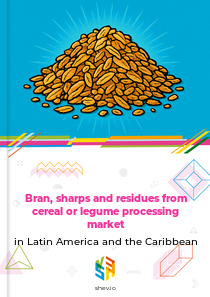
From 2018 to 2023, the market volume for bran, sharps and residues from cereal or legume processing in Latin America and the Caribbean showed notable fluctuations, peaking in 2021. The initial market size of 10.8 million tons in 2018 was supported by the region's high generation of organic waste, which spurred the search for sustainable alternatives and valorization opportunities. The COVID-19 pandemic in 2020 accelerated the modernization of traditional food markets and the adoption of circular economy principles to reduce food loss and waste, contributing to a market increase to 10.9 million tons. This upward trend continued into 2021, when the increased implementation of bioeconomy technologies for agricultural and organic waste, focused on creating economic value and enhancing food security, drove the market volume to a high of 11.8 million tons.
The market declined to 10.9 million tons in 2022, partly due to a rise in exports of secondary raw materials and solid waste, which generated nearly US$23 billion annually for the region. In 2023, the market stabilized at 10.9 million tons, underpinned by policies aimed at reducing food waste, where 25% of cereals and 55% of fruits and vegetables were being lost, motivating more efficient use of resources across the supply chain. Throughout the period, extended producer responsibility laws and single-use plastic bans in several countries reinforced waste management frameworks and circular economy practices, shaping the market's structure.
By 2024, trade flows for these residues were directed toward Chile, Colombia, and the United States, with the U.S. as a primary import source, reflecting the market's regional and global integration. Ongoing projects and international collaborations supported efficient e-waste management and circular economy promotion, while continued strengthening of producer responsibility regulations and plastic bans provided a regulatory backdrop for waste valorization in the region.
Table of content
- 1. Disclaimer
- 2. Terms of use of the report
- 3. Product codes in the statistical classifications used in the report
-
4. Key Market Indicators and Trends
-
4.1. Key Market Indicators
-
4.1.1. In kind
- 4.1.1.1. Production, 2018-2023
- 4.1.1.2. Imports, 2018-2024
- 4.1.1.3. Exports, 2018-2024
- 4.1.1.4. Market size, 2018-2023
-
4.1.1. In kind
- 4.2. Market Trends and Factors
-
4.1. Key Market Indicators
-
5. Production
-
5.1. Production in Latin America and the Caribbean
- 5.1.1. Annual dynamics of production in Latin America and the Caribbean in kind, 2018-2023, K t
-
5.2. Global production by Country, 2018-2023
- 5.2.1. Annual dynamics of production by macroregions in kind, 2018-2023, K t
- 5.2.2. Dynamics of production structure by macroregions in kind, 2018-2023
- 5.2.3. Annual dynamics of production by country in kind, 2018-2023, K t
- 5.2.4. Structure of production by countries in kind, 2018-2023
- 5.2.5. Dynamics of peoduction structure by countries in kind, 2018-2023
-
5.1. Production in Latin America and the Caribbean
-
6. Exports
-
6.1. Exports (Direct Data*)
- 6.1.1. Exports - Total information
-
6.1.2. Exports in kind, K t
- 6.1.2.1. Annual dynamics of product's exports from Argentina in kind, 2018-2024, K t
- 6.1.2.2. Dynamics of product's exports in kind from Argentina by countries, 2018-2024, K t
- 6.1.2.3. Structure of product's exports in kind by countries, 2018-2024
-
6.1.3. Exports in value, M $ US
- 6.1.3.1. Annual dynamics of product's exports from Argentina in value, 2018-2024, M $ US
- 6.1.3.2. Dynamics of product's exports in value from Argentina by countries, 2018-2024, M $ US
- 6.1.3.3. Structure of product's exports in value by countries, 2018-2024
-
6.1.4. Average price of product's exports, $ US/t
- 6.1.4.1. Annual dynamics of average price of product's exports from Argentina, 2018-2024, $ US/t
- 6.1.4.2. Dynamics of average price of product's exports from Argentina by countries, 2018-2024, $ US/t
-
6.2. Exports (Mirror Data)
- 6.2.1. Exports - Total information
-
6.2.2. Exports in kind, K t
- 6.2.2.1. Annual dynamics of product's exports from Argentina in kind, 2018-2024, K t
- 6.2.2.2. Dynamics of product's exports in kind from Argentina by countries, 2018-2024, K t
- 6.2.2.3. Structure of product's exports in kind by countries, 2018-2024
-
6.2.3. Exports in value, M $ US
- 6.2.3.1. Annual dynamics of product's exports from Argentina in value, 2018-2024, M $ US
- 6.2.3.2. Dynamics of product's exports in value from Argentina by countries, 2018-2024, M $ US
- 6.2.3.3. Structure of product's exports in value by countries, 2018-2024
-
6.2.4. Average price of product's exports, $ US/t
- 6.2.4.1. Annual dynamics of average price of product's exports from Argentina, 2018-2024, $ US/t
- 6.2.4.2. Dynamics of average price of product's exports from Argentina by countries, 2018-2024, $ US/t
-
6.1. Exports (Direct Data*)
-
7. Imports
-
7.1. Imports (Direct Data*)
- 7.1.1. Imports - Total information
-
7.1.2. Imports in kind, K t
- 7.1.2.1. Annual dynamics of product's imports to Argentina in kind, 2018-2024, K t
- 7.1.2.2. Dynamics of product's imports in kind to Argentina by countries, 2018-2024, K t
- 7.1.2.3. Structure of product's imports in kind by countries, 2018-2024
-
7.1.3. Imports in value, M $ US
- 7.1.3.1. Annual dynamics of product's imports to Argentina in value, 2018-2024, M $ US
- 7.1.3.2. Dynamics of product's imports in value to Argentina by countries, 2018-2024, M $ US
- 7.1.3.3. Structure of product's imports in value by countries, 2018-2024
-
7.1.4. Average price of product's imports, $ US/t
- 7.1.4.1. Annual dynamics of average price of product's imports to Argentina, 2018-2024, $ US/t
- 7.1.4.2. Dynamics of average price of product's imports to Argentina by countries, 2018-2024, $ US/t
-
7.2. Imports (Mirror Data)
- 7.2.1. Imports - Total information
-
7.2.2. Imports in kind, K t
- 7.2.2.1. Annual dynamics of product's imports to Argentina in kind, 2018-2024, K t
- 7.2.2.2. Dynamics of product's imports in kind to Argentina by countries, 2018-2024, K t
- 7.2.2.3. Structure of product's imports in kind by countries, 2018-2024
-
7.2.3. Imports in value, M $ US
- 7.2.3.1. Annual dynamics of product's imports to Argentina in value, 2018-2024, M $ US
- 7.2.3.2. Dynamics of product's imports in value to Argentina by countries, 2018-2024, M $ US
- 7.2.3.3. Structure of product's imports in value by countries, 2018-2024
-
7.2.4. Average price of product's imports, $ US/t
- 7.2.4.1. Annual dynamics of average price of product's imports to Argentina, 2018-2024, $ US/t
- 7.2.4.2. Dynamics of average price of product's imports to Argentina by countries, 2018-2024, $ US/t
-
7.1. Imports (Direct Data*)
-
8. Trade balance
-
8.1. Trade balance (Direct Data)
- 8.1.1. In kind, K t
- 8.1.2. In value, M $ US
-
8.2. Trade balance (Mirror Data)
- 8.2.1. In kind, K t
- 8.2.2. In value, M $ US
-
8.1. Trade balance (Direct Data)
-
9. Top buying and selling countries, 2018-2024
-
9.1. Direct Data
- 9.1.1. Import in Value by Countries-buyers
- 9.1.2. Export in Value by Countries-suppliers
-
9.2. Mirror Data
- 9.2.1. Import in Value by Countries-buyers
- 9.2.2. Export in Value by Countries-suppliers
-
9.1. Direct Data
Production bran, sharps and residues from cereal or legume processing in Latin America and the Caribbean
In kind, 2017-2020, K t
Top producers of bran, sharps and residues from cereal or legume processing, 2017-2020
World map of production of bran, sharps and residues from cereal or legume processing, 2017-2020
Latin America and the Caribbean have seen their production of bran, sharps, and residues from cereal or legume processing grow for the third year in a row. In 2020, the region produced 12 572 K t, which represents a slight increase of 0.7% compared to 2019. Looking at the period from 2017 to 2020, production rose by 6.2%, translating to an average annual growth rate of 2.0%.
Annual dynamics of production in Latin America and the Caribbean in kind, 2017-2020, K t
| Parameter | 2018 | 2019 | 2020 | CAGR | |
|---|---|---|---|---|---|
| 1 | Change from last year | 3.6% | 1.8% | 0.7% | 2.0% |
Exports bran, sharps and residues from cereal or legume processing from Latin America and the Caribbean
Exports in kind, K t
In 2020, Latin America and the Caribbean exported 2 048 K t of bran, sharps, and residues from cereal or legume processing, marking a significant drop of 18.6% from 2019. Over the 2017-2020 period, exports decreased by 9.1%, with an annualized decline of 3.1%. The lowest export volume was recorded in 2018 at 1 927 K t, while the peak occurred in 2019 with 2 516 K t. The most notable increase was in 2019, when exports surged by 30.6%.
Annual dynamics of product's exports from Latin America and the Caribbean in kind, 2017-2020, K t
| Parameter | 2018 | 2019 | 2020 | CAGR | |
|---|---|---|---|---|---|
| 1 | Change from last year | (14.5%) | 30.6% | (18.6%) | (3.1%) |
From 2017 to 2020, exports of bran, sharps, and residues from cereal or legume processing from Latin America and the Caribbean were distributed across numerous markets. The United Kingdom, Ireland, and the Netherlands were the top destinations, accounting for 17.5%, 14.8%, and 11.9% of exports in kind, respectively. Together, these three countries made up 44.2% of the total export flows.
Structure of product's exports in kind by countries, 2017-2020
World map of product's exports from Latin America and the Caribbean in kind, 2017-2020
Exports in value, M $ US
Cross-border shipments of bran, sharps, and residues from cereal or legume processing from Latin America and the Caribbean declined for the second consecutive year. In 2020, export value stood at 306.1 M $ US, down 6.1% from the previous year. However, over the 2017-2020 period, exports in value terms increased by 6.9%, averaging an annual growth rate of 2.2%. The highest value was recorded in 2018 at 332.6 M $ US, which also saw the largest increase of 16.1%.
Annual dynamics of product's exports from Latin America and the Caribbean in value, 2017-2020, M $ US
| Parameter | 2018 | 2019 | 2020 | CAGR | |
|---|---|---|---|---|---|
| 1 | Change from last year | 16.1% | (2.0%) | (6.1%) | 2.2% |
During 2017-2020, exports in value terms of bran, sharps, and residues from cereal or legume processing from Latin America and the Caribbean were relatively evenly spread across markets. The United Kingdom, Ireland, and the Netherlands led the way, contributing 17.6%, 14.9%, and 11.8% of export value, respectively. Combined, these three countries accounted for 44.4% of total export flows.
Structure of product's exports in value by countries, 2017-2020
World map of product's exports from Latin America and the Caribbean in value, 2017-2020
Imports bran, sharps and residues from cereal or legume processing to Latin America and the Caribbean
Imports in kind, K t
Imports of bran, sharps, and residues from cereal or legume processing into Latin America and the Caribbean fell for the second year in a row. In 2020, imports reached 387 K t, showing only a minor change from 2019. The highest import volume was in 2018 at 420 K t. The largest decrease occurred in 2019 with a 7.7% drop, while the biggest increase was in 2018, rising by 8.2%.
Annual dynamics of product's imports to Latin America and the Caribbean in kind, 2017-2020, K t
| Parameter | 2018 | 2019 | 2020 | CAGR | |
|---|---|---|---|---|---|
| 1 | Change from last year | 8.2% | (7.7%) | (0.1%) | (0.1%) |
Between 2017 and 2020, the United States and Nigeria were the primary sources for imports in kind of bran, sharps, and residues from cereal or legume processing into Latin America and the Caribbean, together making up 17.8% of total import flows.
Structure of product's imports in kind by countries, 2017-2020
World map of product's imports to Latin America and the Caribbean in kind, 2017-2020
Imports in value, M $ US
In 2020, Latin America and the Caribbean imported 94.6 M $ US worth of bran, sharps, and residues from cereal or legume processing, reflecting a modest year-over-year increase of 1.6%. Over the 2017-2020 period, imports grew by 2.6%, with a compound annual growth rate of 0.9%. The peak import value was in 2018 at 110.0 M $ US, which also experienced the largest increase of 19.3%. The most significant decline was in 2019, with a drop of 15.4%.
Annual dynamics of product's imports to Latin America and the Caribbean in value, 2017-2020, M $ US
| Parameter | 2018 | 2019 | 2020 | CAGR | |
|---|---|---|---|---|---|
| 1 | Change from last year | 19.3% | (15.4%) | 1.6% | 0.9% |
From 2017 to 2020, the United States and Nigeria consistently dominated imports in value terms of bran, sharps, and residues from cereal or legume processing into Latin America and the Caribbean, accounting for 28.2% of total import flows.
Structure of product's imports in value by countries, 2017-2020
World map of product's imports to Latin America and the Caribbean in value, 2017-2020
Related Reports




Why Choose Us?
Only Verified Data
No Hidden Costs or Separate Fees
Smarter Subscription Pricing
Contact Our Team
Submit your inquiry using the form below — our team will get back to you within 24 hours.