Vietnam's Wood Exports Grow in H1 2026, but $19 Billion Target Under Pressure
Vietnam's wood and wood-product exports rose 4.4% to $8.54 billion in the first half of 2026, according to the Ministry of Agriculture and Environment. Rising logistics costs, heavy reliance on the United States and tightening sustainability rules threaten the sector's $19 billion annual goal.
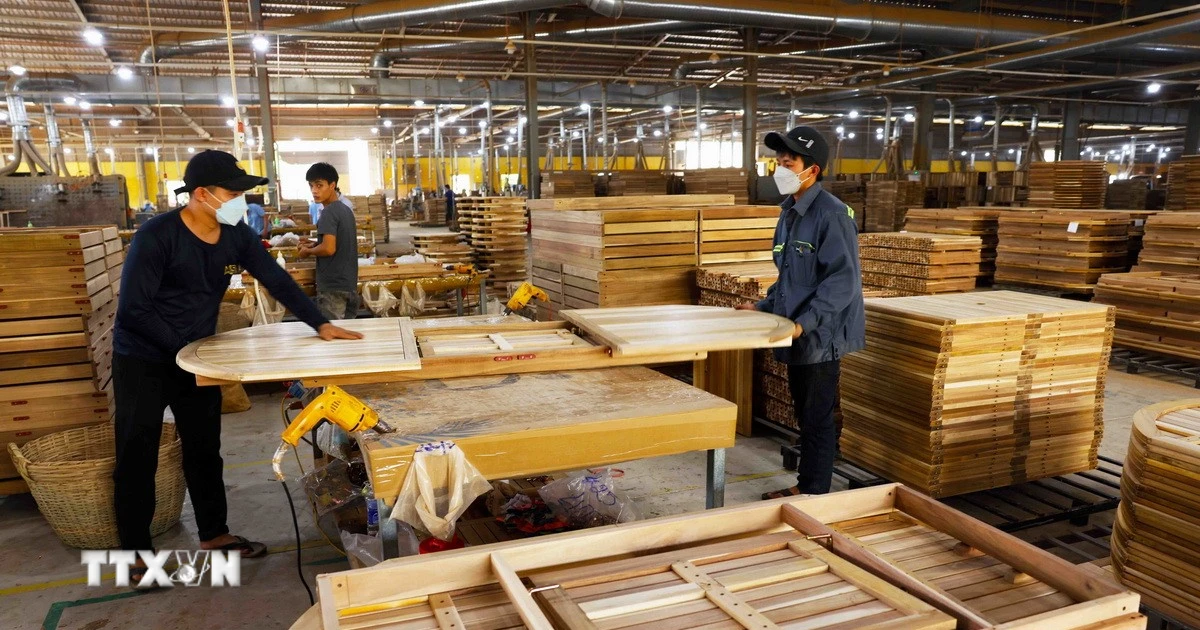
Vietnam's exports of wood and wood products continued to grow in the first half of 2026, but rising logistics costs, geopolitical conflict and stricter import-market standards are testing the sector's ability to reach its $19 billion annual export target, according to reporting by vietnamplus.vn and dttc.sggp.org.vn.
Export values and key markets
The Ministry of Agriculture and Environment estimated June 2026 wood and wood-product exports at $1.53 billion, lifting first-half turnover to $8.54 billion, up 4.4% from the same period in 2025. The result came as conflict in the Middle East pushed up transport and logistics costs, weighing on exporters' operations.
The United States remained the largest market, taking nearly 50% of Vietnam's total wood and wood-product export value, followed by China at 15% and Japan at 12.9%. Market trends diverged sharply. In the first five months of the year, exports to the United States fell 8%, while shipments to China rose 49% and Japan gained 5.1%. The Netherlands was the fastest-growing destination, while South Korea posted the steepest decline among Vietnam's 15 largest export markets.
Concentration risk and diversification
Vietnam ranks among the world's five largest wood-furniture exporters, with products present in nearly 170 countries and territories. Yet its share is only about 7% of global wood-furniture import demand, a market worth roughly $230 billion a year, indicating substantial room to grow.
The sector's biggest bottleneck is dependence on the United States, where about half of export turnover is concentrated. That exposure leaves companies vulnerable to shifts in trade policy, tariffs and trade-defense measures. As a result, diversification toward the European Union, Japan, China, India and the Middle East has become an urgent priority. Businesses report that many orders have been signed through the end of the second quarter and in some cases into the third, a positive signal as global consumer demand gradually recovers.
Sustainability standards tighten
According to Nguyen Van Dien, Deputy Director of the Department of Forestry and Forest Protection, the main challenge is no longer orders but meeting increasingly strict requirements on legal timber origin, anti-deforestation, traceability and lower carbon emissions. He said Vietnam had built its international position by developing legal raw-material sources and expanding sustainably certified forest area, but that this was only an initial foundation.
Progress on transparent supply chains remains limited. The production forest plantation code system has been piloted on about 25,500 hectares across five northern provinces, against nearly 4.9 million hectares of planted forest nationwide. Sustainably certified forest area stands at about 868,000 hectares, still short of the volumes needed for export. Nguyen Van Dien said priorities include expanding certified area, digitalizing traceability and preparing for new rules such as the European Union Deforestation Regulation (EUDR), the US Lacey Act and carbon-emission standards.
- June 2026 exports: $1.53 billion; H1 2026: $8.54 billion (+4.4%)
- US share nearly 50%, China 15%, Japan 12.9%
- Certified forest: about 868,000 hectares of nearly 4.9 million planted
Policy support
Phung Quoc Man, Chairman of the Handicraft and Wood Industry Association of Ho Chi Minh City (HAWA), said the ASEAN wood industry can only develop sustainably if countries cooperate on transparent, responsible supply chains. To support firms, the Ministry of Agriculture and Environment is working with the Ministry of Finance to resolve value-added tax refund issues for preliminarily processed wood products under Decree 181/2025/ND-CP, and finalizing EUDR implementation guidance. The ministry will also roll out a national production forest plantation code plan for 2026-2030, expanding the pilot to 15-20 key provinces integrated into the national forest database.