India and Mozambique sign three-year statement of interest on new oilseed supply corridor
The Solvent Extractors' Association of India has signed a three-year statement of interest with the government of Nampula province in northern Mozambique to explore a new supply corridor for oilseeds and edible oils. Groundnut, soybean and sesame are the crops in focus. The document sets no volumes or prices and is aimed at widening the list of origins serving India's crushing and refining industry.
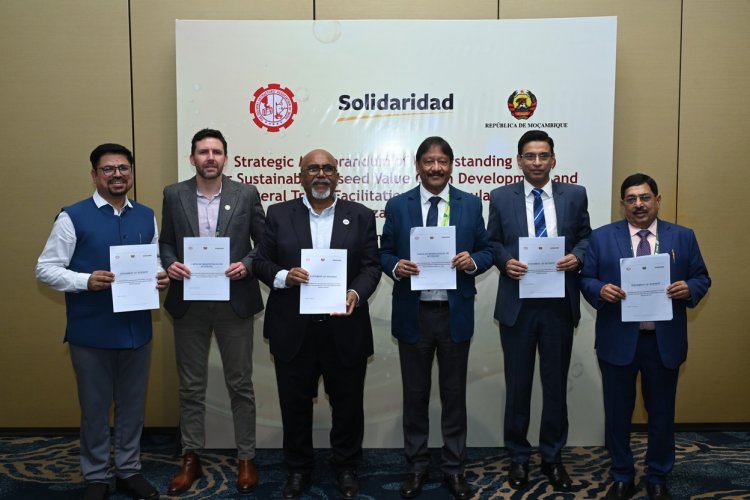
The Solvent Extractors' Association of India (SEA), the industry body representing the country's edible oil processors, has signed a three-year statement of interest with the provincial government of Nampula in northern Mozambique. The two sides will examine the creation of a new corridor for the supply of oilseeds and vegetable oils to India, ruralvoice.in reported.
Groundnut, soybean and sesame are the crops at the centre of the talks. India's stated purpose is diversification — adding Mozambique to the list of origins that supply its crushing plants and refineries rather than replacing any existing supplier.
What the statement of interest covers
The document is a framework for cooperation over a defined period rather than a commercial contract. It fixes neither volumes nor prices, and it does not oblige Indian processors to buy. What it does is give both sides three years to establish whether a working trade route can be built, and on what terms. The crops named in the statement are:
- Groundnut
- Soybean
- Sesame
All three are traded internationally out of East Africa, and all three are processed in India — groundnut and sesame largely for crushing and direct food use, soybean for meal and oil. That overlap is what makes the Nampula proposition more than a diplomatic gesture: the province's crop mix matches what Indian plants are configured to handle.
Nampula's role in the trade
Nampula lies on Mozambique's northern coast, on the Indian Ocean shipping lanes that connect East Africa to India's west coast ports. Freight distance is short by the standards of India's oilseed and oil trade, which draws heavily on Southeast Asia, South America and the Black Sea region. Geography, however, is only one part of the equation. Moving agricultural commodities out of northern Mozambique at commercial scale requires aggregation from smallholder production, storage, quality grading and port handling capacity.
That is the work the three-year window is meant to cover. Indian buyers will want consistent quality and predictable loading schedules before committing to regular purchases; Nampula's producers will want assured offtake before expanding plantings. Neither side can deliver that from a statement of interest alone.
Why India is widening its origin list
India imports a large share of the vegetable oil it consumes, and its import basket is concentrated in a small number of origins and products — palm oil from Southeast Asia, soybean and sunflower oil from South America and the Black Sea. Concentration of that kind transmits any disruption at origin, whether policy-driven or weather-driven, straight into Indian refinery margins and retail prices.
Sourcing oilseeds rather than finished oil also matters to Indian crushers, who have long argued that importing seed keeps domestic crushing capacity employed while importing refined oil does not. Groundnut and sesame carry an additional domestic dimension: both are grown in India, and any sustained new import flow would feed into price formation for local growers as well as into processor economics.
For now the arrangement is exploratory. The measurable tests will be the first commercial cargoes moving from Nampula to Indian ports, and whether Indian processors or trading houses put capital into aggregation, storage or crushing capacity in the province.