Coffee prices slide as Vietnam’s cassava export volumes fall
International coffee futures fell sharply, while Vietnamese domestic prices declined by 800 dong per kilogram. Vietnam’s cassava export volume dropped 15.3% in the first seven months of 2026, but higher average prices kept revenue almost unchanged.
Coffee futures fall across major exchanges
Coffee prices declined across the London and New York exchanges on August 28, with New York arabica contracts recording the steeper losses. Dân trí reported that all London robusta maturities covered in the latest session closed lower, while Vietnamese domestic coffee prices fell by an average of 800 dong per kilogram.
September 2026 London robusta settled at $3,518 per tonne, down $70 per tonne, or 1.95%. The November 2026 contract lost $59 to $3,555 per tonne, while January 2027 declined by $57 to $3,541 per tonne. March and May 2027 contracts fell by $52 and $49 per tonne to $3,522 and $3,508 per tonne, respectively.
In New York, September 2026 arabica dropped 15.70 cents per pound to 341.90 cents per pound, a decline equivalent to about $346.5 per tonne. The resulting price was equivalent to approximately $7,538 per tonne. December 2026 fell 12.50 cents to 309.65 cents per pound, while March 2027 lost 9.80 cents to 298.30 cents. May and July 2027 contracts declined by 8.75 and 8.20 cents per pound, respectively.
Brazilian arabica contracts were mixed. September 2026 fell 2.05 cents to 401.95 cents per pound, equivalent to about $8,862 per tonne, while December 2026 gained 3 cents to 381 cents per pound, or about $8,399 per tonne.
Vietnamese cash prices move below 97,000 dong
Vietnam’s domestic coffee price averaged 96,300 dong per kilogram on August 27 after the 800-dong decline. Prices stood at 96,200 dong per kilogram in both Đắk Lắk and Gia Lai, 95,700 dong in Lâm Đồng and 96,500 dong in the former Đắk Nông province.
The broad decline in futures and local quotations gives processors and exporters lower reference prices, although the source did not identify a specific trigger for the session’s move. The heavier fall in arabica compared with robusta also widened the contrast between the two main coffee markets.
Higher cassava prices cushion lower shipments
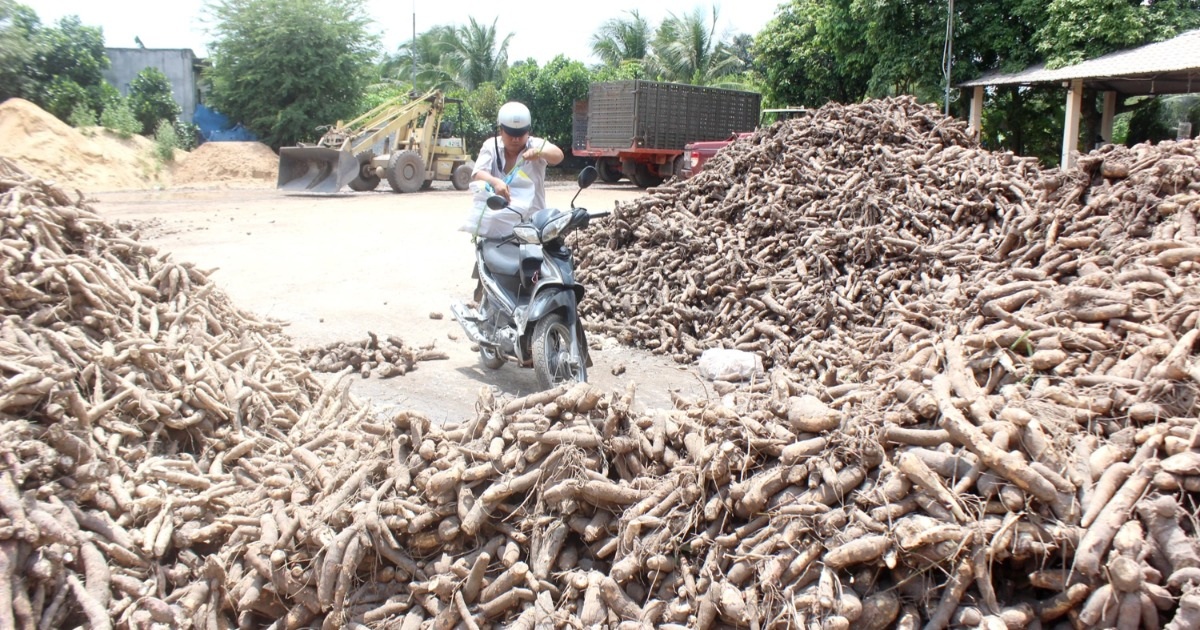
Vietnam exported 1.104 million tonnes of cassava and cassava products worth $756.2 million in the first seven months of 2026, according to Vietnam Customs data cited by Dân trí. Volume fell 15.3% from the same period of 2025, but value declined only 0.1%. China accounted for 93.2% of total volume, while the average export price rose 17.6% to $299 per tonne.
July shipments exceeded 130,900 tonnes and generated $57.4 million. Compared with June, volume fell 28.8% and value declined 29%. Against July 2025, the decreases were 41.5% and 18%, respectively.
Imported cassava-starch stocks at major Chinese ports including Qingdao, Shanghai and Ningbo were estimated at 120,000-125,000 tonnes. Border-delivered starch prices at Lạng Sơn and Móng Cái held at CNY3,950-4,050 per tonne in the first half of August, while imported cassava chips traded at $285-295 per tonne.
Regional supply remains constrained. Thailand’s 2026/2027 cassava crop was forecast at 18.757 million tonnes against domestic demand of about 37-45 million tonnes a year. Mosaic disease, irregular weather and abandoned acreage have forced many processors to close, while starch plants were operating at only 20-30% of capacity. Vietnamese export starch was offered at $610-630 per tonne FOB Ho Chi Minh City, below Thailand’s record $705 per tonne FOB Bangkok. Vietnam also increased seven-month shipment volumes to South Korea and Malaysia by 176.3% and 47%, respectively.