






"Western Africa" region includes following countries:
 Cabo Verde
 Benin
Benin Gambia
 Ghana
Ghana Guinea
 Côte d'Ivoire
 Liberia
 Mali
Mali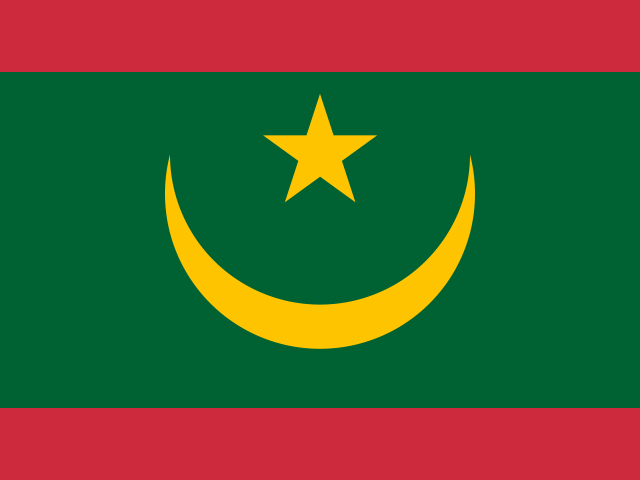 Mauritania
 Niger
Niger Nigeria
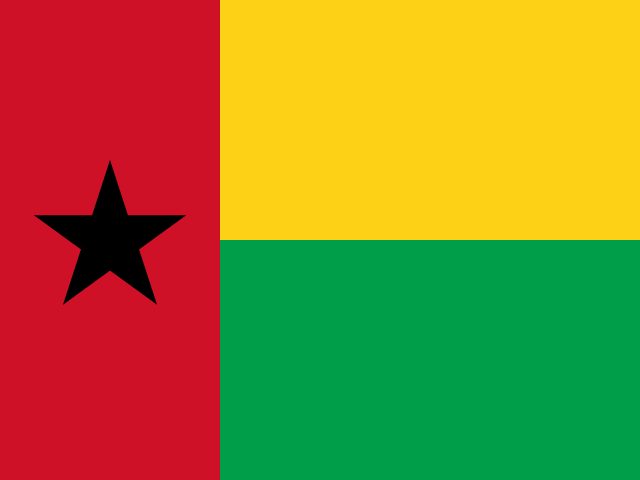 Guinea-Bissau
 Saint Helena, Ascension and Tristan da Cunha
 Senegal
 Sierra Leone
 Togo
Togo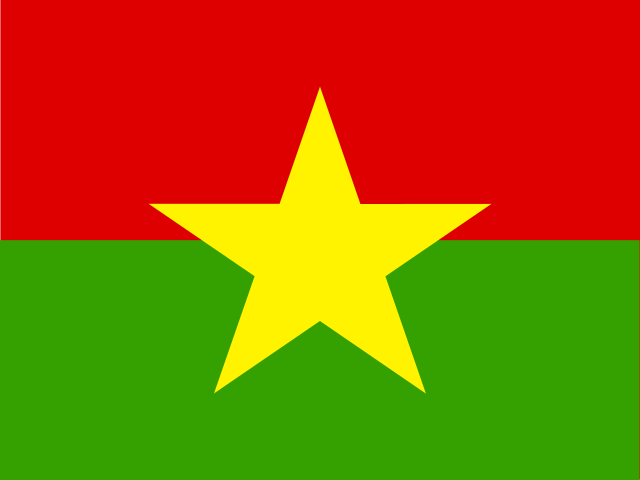 Burkina Faso
Earlier Report Observations
The yams market volume in Western Africa increased from 74 810 thousand tonnes in 2018 to 85 446 thousand tonnes in 2023, despite a minor contraction in 2019. A key infrastructural development was the commissioning of a large cold storage facility in Côte d'Ivoire in 2019, which enhanced the cold chain for preserving and distributing fresh yams, laying groundwork for improved market access in subsequent years.
Market growth accelerated notably from 2020 onward. In 2023, food crop production in Côte d'Ivoire, including yams, rose by 10%, reaching annual harvests around 8 million tonnes. This surge was supported by government agricultural policies and coincided with ongoing expansions in cold storage logistics across the region.
West Africa remains the global center for yam production, with Nigeria consistently accounting for about 71% of the region's output. This concentrated production base provides inherent stability to the overall market supply.
Table of content
- 1. Disclaimer
- 2. Terms of use of the report
- 3. Product codes in the statistical classifications used in the report
-
4. Key Market Indicators and Trends
-
4.1. Key Market Indicators
-
4.1.1. In kind
- 4.1.1.1. Production, 2018-2023
- 4.1.1.2. Imports, 2018-2024
- 4.1.1.3. Exports, 2018-2024
- 4.1.1.4. Market size, 2018-2023
-
4.1.1. In kind
- 4.2. Market Trends and Factors
-
4.1. Key Market Indicators
-
5. Production
-
5.1. Production in Western Africa
- 5.1.1. Annual dynamics of production in Western Africa in kind, 2018-2023, K t
-
5.2. Global production by Country, 2018-2023
- 5.2.1. Annual dynamics of production by macroregions in kind, 2018-2023, K t
- 5.2.2. Dynamics of production structure by macroregions in kind, 2018-2023
- 5.2.3. Annual dynamics of production by country in kind, 2018-2023, K t
- 5.2.4. Structure of production by countries in kind, 2018-2023
- 5.2.5. Dynamics of peoduction structure by countries in kind, 2018-2023
-
5.1. Production in Western Africa
-
6. Imports
-
6.1. Imports (Direct Data*)
- 6.1.1. Imports - Total information
-
6.1.2. Imports in kind, t
- 6.1.2.1. Annual dynamics of product's imports to Cabo Verde in kind, 2018-2024, t
- 6.1.2.2. Dynamics of product's imports in kind to Cabo Verde by countries, 2018-2024, t
- 6.1.2.3. Structure of product's imports in kind by countries, 2018-2024
-
6.1.3. Imports in value, K $ US
- 6.1.3.1. Annual dynamics of product's imports to Cabo Verde in value, 2018-2024, K $ US
- 6.1.3.2. Dynamics of product's imports in value to Cabo Verde by countries, 2018-2024, K $ US
- 6.1.3.3. Structure of product's imports in value by countries, 2018-2024
-
6.1.4. Average price of product's imports, $ US/t
- 6.1.4.1. Annual dynamics of average price of product's imports to Cabo Verde, 2018-2024, $ US/t
- 6.1.4.2. Dynamics of average price of product's imports to Cabo Verde by countries, 2018-2024, $ US/t
-
6.2. Imports (Mirror Data)
- 6.2.1. Imports - Total information
-
6.2.2. Imports in kind, t
- 6.2.2.1. Annual dynamics of product's imports to Cabo Verde in kind, 2018-2024, t
- 6.2.2.2. Dynamics of product's imports in kind to Cabo Verde by countries, 2018-2024, t
- 6.2.2.3. Structure of product's imports in kind by countries, 2018-2024
-
6.2.3. Imports in value, K $ US
- 6.2.3.1. Annual dynamics of product's imports to Cabo Verde in value, 2018-2024, K $ US
- 6.2.3.2. Dynamics of product's imports in value to Cabo Verde by countries, 2018-2024, K $ US
- 6.2.3.3. Structure of product's imports in value by countries, 2018-2024
-
6.2.4. Average price of product's imports, $ US/t
- 6.2.4.1. Annual dynamics of average price of product's imports to Cabo Verde, 2018-2024, $ US/t
- 6.2.4.2. Dynamics of average price of product's imports to Cabo Verde by countries, 2018-2024, $ US/t
-
6.1. Imports (Direct Data*)
-
7. Exports
-
7.1. Exports (Direct Data*)
- 7.1.1. Exports - Total information
-
7.1.2. Exports in kind, t
- 7.1.2.1. Annual dynamics of product's exports from Cabo Verde in kind, 2018-2024, t
- 7.1.2.2. Dynamics of product's exports in kind from Cabo Verde by countries, 2018-2024, t
- 7.1.2.3. Structure of product's exports in kind by countries, 2018-2024
-
7.1.3. Exports in value, K $ US
- 7.1.3.1. Annual dynamics of product's exports from Cabo Verde in value, 2018-2024, K $ US
- 7.1.3.2. Dynamics of product's exports in value from Cabo Verde by countries, 2018-2024, K $ US
- 7.1.3.3. Structure of product's exports in value by countries, 2018-2024
-
7.1.4. Average price of product's exports, $ US/t
- 7.1.4.1. Annual dynamics of average price of product's exports from Cabo Verde, 2018-2024, $ US/t
- 7.1.4.2. Dynamics of average price of product's exports from Cabo Verde by countries, 2018-2024, $ US/t
-
7.2. Exports (Mirror Data)
- 7.2.1. Exports - Total information
-
7.2.2. Exports in kind, t
- 7.2.2.1. Annual dynamics of product's exports from Cabo Verde in kind, 2018-2024, t
- 7.2.2.2. Dynamics of product's exports in kind from Cabo Verde by countries, 2018-2024, t
- 7.2.2.3. Structure of product's exports in kind by countries, 2018-2024
-
7.2.3. Exports in value, K $ US
- 7.2.3.1. Annual dynamics of product's exports from Cabo Verde in value, 2018-2024, K $ US
- 7.2.3.2. Dynamics of product's exports in value from Cabo Verde by countries, 2018-2024, K $ US
- 7.2.3.3. Structure of product's exports in value by countries, 2018-2024
-
7.2.4. Average price of product's exports, $ US/t
- 7.2.4.1. Annual dynamics of average price of product's exports from Cabo Verde, 2018-2024, $ US/t
- 7.2.4.2. Dynamics of average price of product's exports from Cabo Verde by countries, 2018-2024, $ US/t
-
7.1. Exports (Direct Data*)
-
8. Trade balance
-
8.1. Trade balance (Direct Data)
- 8.1.1. In kind, t
- 8.1.2. In value, K $ US
-
8.2. Trade balance (Mirror Data)
- 8.2.1. In kind, t
- 8.2.2. In value, K $ US
-
8.1. Trade balance (Direct Data)
-
9. Top buying and selling countries, 2018-2024
-
9.1. Direct Data
- 9.1.1. Import in Value by Countries-buyers
- 9.1.2. Export in Value by Countries-suppliers
-
9.2. Mirror Data
- 9.2.1. Import in Value by Countries-buyers
- 9.2.2. Export in Value by Countries-suppliers
-
9.1. Direct Data
Production yams in Western Africa
In kind, 2017-2020, K t
Top producers of yams, 2017-2020
World map of production of yams, 2017-2020
In Western Africa, yam production reached 77 603 thousand tonnes in 2020, marking a 5.2% increase compared to the previous year. From 2017 to 2020, production grew by 12.6%, which translates to an average annual growth rate of 4.0%. The most significant production decline occurred in 2019, at 1.4%, while the largest increase was recorded in 2018, with an 8.6% rise.
Annual dynamics of production in Western Africa in kind, 2017-2020, K t
| Parameter | 2018 | 2019 | 2020 | CAGR | |
|---|---|---|---|---|---|
| 1 | Change from last year | 8.6% | (1.4%) | 5.2% | 4.0% |
Exports yams from Western Africa
Exports in kind, t
Yam exports from Western Africa have increased for the third year in a row. In 2020, exports totaled 39 566 tonnes, showing a substantial year-over-year increase of 42.4%. Over the period from 2017 to 2020, exports surged by 145.6%, with a compound annual growth rate (CAGR) of 34.9%.
Annual dynamics of product's exports from Western Africa in kind, 2017-2020, t
| Parameter | 2018 | 2019 | 2020 | CAGR | |
|---|---|---|---|---|---|
| 1 | Change from last year | 2.9% | 67.5% | 42.4% | 34.9% |
Between 2017 and 2020, the export market for yams in kind was quite diverse. The United Kingdom accounted for 20.2% of exports, the United States for 18.4%, and South Africa for 3.1%. Together, these three countries represented just 41.7% of total export flows, while the remaining 58.3% was distributed among numerous other countries.
Structure of product's exports in kind by countries, 2017-2020
World map of product's exports from Western Africa in kind, 2017-2020
Exports in value, K $ US
Foreign yam supplies from Western Africa have risen for the third consecutive year. In 2020, Western Africa exported yams worth 39 945 thousand US dollars, representing a dramatic increase of 196.3% compared to the previous year. From 2017 to 2020, export value grew by 386.4%, with a compound annual growth rate (CAGR) of 69.4%.
Annual dynamics of product's exports from Western Africa in value, 2017-2020, K $ US
| Parameter | 2018 | 2019 | 2020 | CAGR | |
|---|---|---|---|---|---|
| 1 | Change from last year | 16.0% | 41.5% | 196.3% | 69.4% |
From 2017 to 2020, the United States, the United Kingdom, and Canada consistently served as the primary destinations for yam exports in value terms. The United States accounted for 37.1% of export value, the United Kingdom for 33.3%, and Canada for 5.9%. Collectively, these three countries made up 76.4% of total export flows.
Structure of product's exports in value by countries, 2017-2020
World map of product's exports from Western Africa in value, 2017-2020
Imports yams to Western Africa
Imports in kind, t
The import market for yams in kind showed an unstable trend during this period. The lowest import volume was recorded in 2017, while the highest occurred in 2018, with a peak-to-trough ratio of 536 times. In 2020, Western Africa imported 922 tonnes of yams, which was a 66.2% increase from the previous year. The maximum import volume was 1 221 tonnes in 2018. The largest decline in imports happened in 2019, at 54.6%, while the largest increase was in 2018, with a staggering rise of 53 498.3%.
Annual dynamics of product's imports to Western Africa in kind, 2017-2020, t
| Parameter | 2018 | 2019 | 2020 | CAGR | |
|---|---|---|---|---|---|
| 1 | Change from last year | 53 498.3% | (54.6%) | 66.2% | 639.6% |
Structure of product's imports in kind by countries, 2017-2020
World map of product's imports to Western Africa in kind, 2017-2020
Imports in value, K $ US
Import data reveals irregular changes, indicating a volatile market environment. The lowest import value was recorded in 2019, while the highest was in 2018, reflecting a 2.8-fold gap between these years. In 2020, yam imports into Western Africa amounted to 1 079 thousand US dollars, showing a sharp year-over-year increase of 79.0%. The minimum import value was 603 thousand US dollars in 2019, and the maximum was 1 676 thousand US dollars in 2018. The largest decline in import value occurred in 2019, at 64.0%.
Annual dynamics of product's imports to Western Africa in value, 2017-2020, K $ US
| Parameter | 2018 | 2019 | 2020 | CAGR | |
|---|---|---|---|---|---|
| 1 | Change from last year | 34.9% | (64.0%) | 79.0% | (4.6%) |
From 2017 to 2020, Portugal remained the key partner for yam imports in value terms to Western Africa, accounting for 0.9% of total import flows.
Structure of product's imports in value by countries, 2017-2020
World map of product's imports to Western Africa in value, 2017-2020
Related Reports

2026-03-27
2026-03-27
Yams market in Central America
2026-03-27
2026-03-27

Tomato market in Western Africa
2026-03-27


Garlic market in Western Africa
2026-03-27

Sweet potatoe market in Western Africa
2026-03-27
Why Choose Us?
Only Verified Data
No Hidden Costs or Separate Fees
Smarter Subscription Pricing
Contact Our Team
Submit your inquiry using the form below — our team will get back to you within 24 hours.