






"Western Africa" region includes following countries:
 Cabo Verde
 Benin
Benin Gambia
 Ghana
Ghana Guinea
 Côte d'Ivoire
 Liberia
 Mali
Mali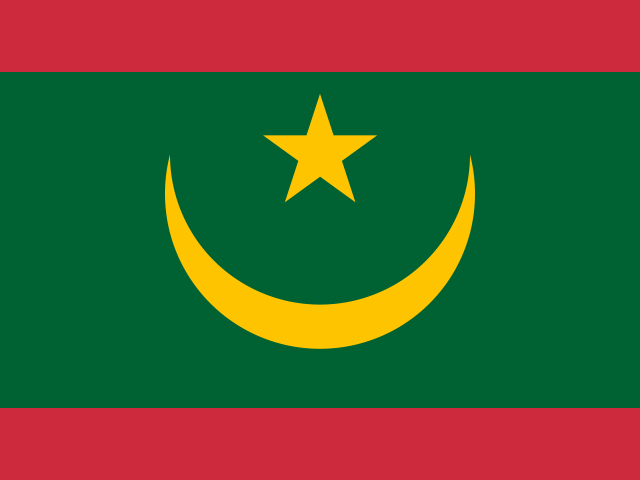 Mauritania
 Niger
Niger Nigeria
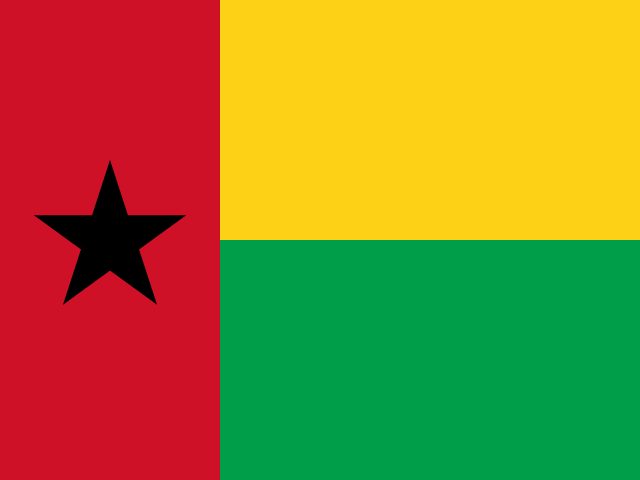 Guinea-Bissau
 Saint Helena, Ascension and Tristan da Cunha
 Senegal
 Sierra Leone
 Togo
Togo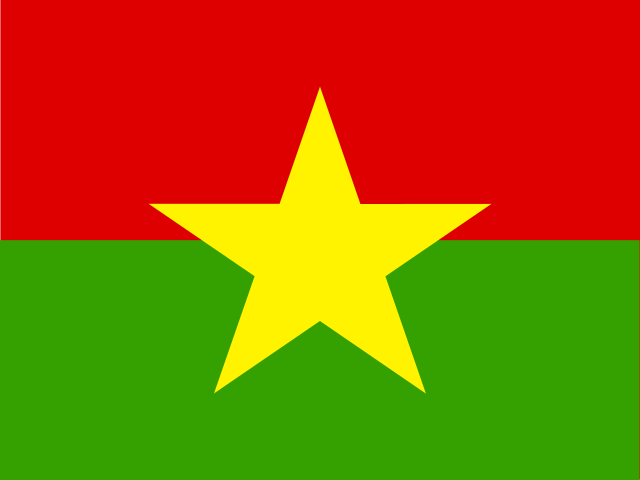 Burkina Faso
Earlier Report Observations
The garlic market in Western Africa started at 66.6 thousand tonnes in 2018, with steady demand and price competition from Chinese and Spanish imports influencing the market. The COVID-19 pandemic in 2020 doubled demand in some segments, contributing to a surge in market volume to 87.6 thousand tonnes despite concurrent supply chain disruptions.
Market growth continued, reaching 93.9 thousand tonnes in 2021 and peaking at 103.8 thousand tonnes in 2022, supported by rising global popularity of garlic due to fusion cuisine trends and perceived health benefits. However, the market volume declined to 96.4 thousand tonnes in 2023.
Table of content
- 1. Disclaimer
- 2. Terms of use of the report
- 3. Product codes in the statistical classifications used in the report
-
4. Key Market Indicators and Trends
-
4.1. Key Market Indicators
-
4.1.1. In kind
- 4.1.1.1. Production, 2018-2023
- 4.1.1.2. Imports, 2018-2024
- 4.1.1.3. Exports, 2018-2024
- 4.1.1.4. Market size, 2018-2023
-
4.1.1. In kind
- 4.2. Market Trends and Factors
-
4.1. Key Market Indicators
-
5. Production
-
5.1. Production in Western Africa
- 5.1.1. Annual dynamics of production in Western Africa in kind, 2018-2023, t
-
5.2. Global production by Country, 2018-2023
- 5.2.1. Annual dynamics of production by macroregions in kind, 2018-2023, t
- 5.2.2. Dynamics of production structure by macroregions in kind, 2018-2023
- 5.2.3. Annual dynamics of production by country in kind, 2018-2023, t
- 5.2.4. Structure of production by countries in kind, 2018-2023
- 5.2.5. Dynamics of peoduction structure by countries in kind, 2018-2023
-
5.1. Production in Western Africa
-
6. Imports
-
6.1. Imports (Direct Data*)
- 6.1.1. Imports - Total information
-
6.1.2. Imports in kind, t
- 6.1.2.1. Annual dynamics of product's imports to Cabo Verde in kind, 2018-2024, t
- 6.1.2.2. Dynamics of product's imports in kind to Cabo Verde by countries, 2018-2024, t
- 6.1.2.3. Structure of product's imports in kind by countries, 2018-2024
-
6.1.3. Imports in value, K $ US
- 6.1.3.1. Annual dynamics of product's imports to Cabo Verde in value, 2018-2024, K $ US
- 6.1.3.2. Dynamics of product's imports in value to Cabo Verde by countries, 2018-2024, K $ US
- 6.1.3.3. Structure of product's imports in value by countries, 2018-2024
-
6.1.4. Average price of product's imports, $ US/kg
- 6.1.4.1. Annual dynamics of average price of product's imports to Cabo Verde, 2018-2024, $ US/kg
- 6.1.4.2. Dynamics of average price of product's imports to Cabo Verde by countries, 2018-2024, $ US/kg
-
6.2. Imports (Mirror Data)
- 6.2.1. Imports - Total information
-
6.2.2. Imports in kind, t
- 6.2.2.1. Annual dynamics of product's imports to Cabo Verde in kind, 2018-2024, t
- 6.2.2.2. Dynamics of product's imports in kind to Cabo Verde by countries, 2018-2024, t
- 6.2.2.3. Structure of product's imports in kind by countries, 2018-2024
-
6.2.3. Imports in value, K $ US
- 6.2.3.1. Annual dynamics of product's imports to Cabo Verde in value, 2018-2024, K $ US
- 6.2.3.2. Dynamics of product's imports in value to Cabo Verde by countries, 2018-2024, K $ US
- 6.2.3.3. Structure of product's imports in value by countries, 2018-2024
-
6.2.4. Average price of product's imports, $ US/kg
- 6.2.4.1. Annual dynamics of average price of product's imports to Cabo Verde, 2018-2024, $ US/kg
- 6.2.4.2. Dynamics of average price of product's imports to Cabo Verde by countries, 2018-2024, $ US/kg
-
6.1. Imports (Direct Data*)
-
7. Exports
-
7.1. Exports (Direct Data*)
- 7.1.1. Exports - Total information
-
7.1.2. Exports in kind, t
- 7.1.2.1. Annual dynamics of product's exports from Cabo Verde in kind, 2018-2024, t
- 7.1.2.2. Dynamics of product's exports in kind from Cabo Verde by countries, 2018-2024, t
- 7.1.2.3. Structure of product's exports in kind by countries, 2018-2024
-
7.1.3. Exports in value, K $ US
- 7.1.3.1. Annual dynamics of product's exports from Cabo Verde in value, 2018-2024, K $ US
- 7.1.3.2. Dynamics of product's exports in value from Cabo Verde by countries, 2018-2024, K $ US
- 7.1.3.3. Structure of product's exports in value by countries, 2018-2024
-
7.1.4. Average price of product's exports, $ US/kg
- 7.1.4.1. Annual dynamics of average price of product's exports from Cabo Verde, 2018-2024, $ US/kg
- 7.1.4.2. Dynamics of average price of product's exports from Cabo Verde by countries, 2018-2024, $ US/kg
-
7.2. Exports (Mirror Data)
- 7.2.1. Exports - Total information
-
7.2.2. Exports in kind, t
- 7.2.2.1. Annual dynamics of product's exports from Cabo Verde in kind, 2018-2024, t
- 7.2.2.2. Dynamics of product's exports in kind from Cabo Verde by countries, 2018-2024, t
- 7.2.2.3. Structure of product's exports in kind by countries, 2018-2024
-
7.2.3. Exports in value, K $ US
- 7.2.3.1. Annual dynamics of product's exports from Cabo Verde in value, 2018-2024, K $ US
- 7.2.3.2. Dynamics of product's exports in value from Cabo Verde by countries, 2018-2024, K $ US
- 7.2.3.3. Structure of product's exports in value by countries, 2018-2024
-
7.2.4. Average price of product's exports, $ US/kg
- 7.2.4.1. Annual dynamics of average price of product's exports from Cabo Verde, 2018-2024, $ US/kg
- 7.2.4.2. Dynamics of average price of product's exports from Cabo Verde by countries, 2018-2024, $ US/kg
-
7.1. Exports (Direct Data*)
-
8. Trade balance
-
8.1. Trade balance (Direct Data)
- 8.1.1. In kind, t
- 8.1.2. In value, K $ US
-
8.2. Trade balance (Mirror Data)
- 8.2.1. In kind, t
- 8.2.2. In value, K $ US
-
8.1. Trade balance (Direct Data)
-
9. Top buying and selling countries, 2018-2024
-
9.1. Direct Data
- 9.1.1. Import in Value by Countries-buyers
- 9.1.2. Export in Value by Countries-suppliers
-
9.2. Mirror Data
- 9.2.1. Import in Value by Countries-buyers
- 9.2.2. Export in Value by Countries-suppliers
-
9.1. Direct Data
Production garlic in Western Africa
In kind, 2017-2020, t
Top producers of garlic, 2017-2020
World map of production of garlic, 2017-2020
Garlic production in Western Africa has grown for the third year in a row. In 2020, the region produced 29 422 tonnes of garlic, marking a significant increase of 19.5% compared to 2019. Looking at the period from 2017 to 2020, production rose by 48.2%, which translates to an average annual growth rate of 14.0%.
Annual dynamics of production in Western Africa in kind, 2017-2020, t
| Parameter | 2018 | 2019 | 2020 | CAGR | |
|---|---|---|---|---|---|
| 1 | Change from last year | 9.5% | 13.3% | 19.5% | 14.0% |
Exports garlic from Western Africa
Exports in kind, t
The garlic market exhibited volatility during the observed period. Export levels varied significantly, with a fivefold difference between the peak in 2017 and the low point in 2019. In 2020, Western Africa exported 51 tonnes of garlic, representing a substantial year-over-year surge of 238.4%. The lowest export volume was recorded in 2019 at 15 tonnes, which also saw the largest decline of 65.9%.
Annual dynamics of product's exports from Western Africa in kind, 2017-2020, t
| Parameter | 2018 | 2019 | 2020 | CAGR | |
|---|---|---|---|---|---|
| 1 | Change from last year | (41.4%) | (65.9%) | 238.4% | (12.2%) |
From 2017 to 2020, Algeria consistently remained the primary buyer of garlic from Western Africa, accounting for 0.9% of total exports in volume terms.
Structure of product's exports in kind by countries, 2017-2020
World map of product's exports from Western Africa in kind, 2017-2020
Exports in value, K $ US
After two consecutive years of growth, garlic exports from Western Africa experienced a decline. In 2020, the region exported garlic worth 203 thousand US dollars, reflecting a decrease of 23.9% compared to the previous year. Over the 2017-2020 period, exports overall increased by 20.6%, with a compound annual growth rate of 6.4%. The highest export value was recorded in 2019 at 267 thousand US dollars, which also saw the largest increase of 42.0%.
Annual dynamics of product's exports from Western Africa in value, 2017-2020, K $ US
| Parameter | 2018 | 2019 | 2020 | CAGR | |
|---|---|---|---|---|---|
| 1 | Change from last year | 11.6% | 42.0% | (23.9%) | 6.4% |
Throughout 2017 to 2020, Algeria continued to be the main buyer of garlic from Western Africa in value terms, holding a 0.5% share of total exports.
Structure of product's exports in value by countries, 2017-2020
World map of product's exports from Western Africa in value, 2017-2020
Imports garlic to Western Africa
Imports in kind, t
Following a two-year decline, garlic imports into Western Africa rebounded. In 2020, imports reached 58 256 tonnes, showing a rise of 43.4% compared to 2019. Between 2017 and 2020, imports grew by 17.8%, equivalent to an annualized rate of 5.6%. The lowest import volume was in 2019 at 40 618 tonnes, which also recorded the largest decline of 9.5%.
Annual dynamics of product's imports to Western Africa in kind, 2017-2020, t
| Parameter | 2018 | 2019 | 2020 | CAGR | |
|---|---|---|---|---|---|
| 1 | Change from last year | (9.3%) | (9.5%) | 43.4% | 5.6% |
From 2017 to 2020, China was the central partner for garlic imports into Western Africa in volume terms, representing 73.5% of total flows, while other markets played a less significant role.
Structure of product's imports in kind by countries, 2017-2020
World map of product's imports to Western Africa in kind, 2017-2020
Imports in value, K $ US
In 2020, foreign garlic supplies to Western Africa amounted to 33 959 thousand US dollars, indicating a dramatic increase of 62.9% from the previous year. Over the 2017-2020 period, imports rose by 50.8%, corresponding to an annualized growth rate of 14.7%. The lowest import value was in 2019 at 20 852 thousand US dollars, which also saw the largest decline of 10.7%.
Annual dynamics of product's imports to Western Africa in value, 2017-2020, K $ US
| Parameter | 2018 | 2019 | 2020 | CAGR | |
|---|---|---|---|---|---|
| 1 | Change from last year | 3.7% | (10.7%) | 62.9% | 14.7% |
During 2017-2020, China maintained its dominance as the key partner for garlic imports into Western Africa in value terms, with an 81.8% share of total flows, while other markets formed a long tail.
Structure of product's imports in value by countries, 2017-2020
World map of product's imports to Western Africa in value, 2017-2020
Related Reports

2026-03-27
Garlic market in North Macedonia
2026-03-27
2026-03-27
2026-03-27




Cassava market in Western Africa
2026-03-27
Why Choose Us?
Only Verified Data
No Hidden Costs or Separate Fees
Smarter Subscription Pricing
Contact Our Team
Submit your inquiry using the form below — our team will get back to you within 24 hours.