






"ECOWAS" region includes following countries:
 Benin
Benin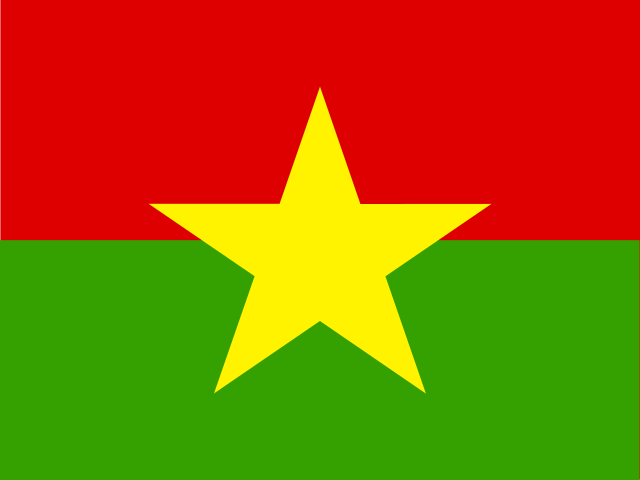 Burkina Faso
 Gambia
 Ghana
Ghana Guinea
 Guinea-Bissau
 Côte d'Ivoire
 Cabo Verde
 Liberia
 Mali
Mali Niger
Niger Nigeria
 Senegal
 Sierra Leone
 Togo
TogoEarlier Report Observations
The market volume for watermelons and melons in ECOWAS expanded from 1 759 thousand tonnes in 2018 to 2 608 thousand tonnes in 2020. This growth coincided with rising global demand, particularly in Europe where watermelon purchases increased, and with production challenges in key supplying regions such as difficult weather conditions affecting European watermelon output and reduced planting areas for melons and watermelons in Spain.
After peaking in 2020, the market volume contracted to 2 393 thousand tonnes in 2021 and stabilized around 2 360–2 390 thousand tonnes through 2022–2023. This period saw the introduction of aphid-resistant varieties in Morocco altering competitive dynamics, while drought and production restrictions in Morocco during 2023 led to local shortages and higher prices, influencing broader market conditions.
Table of content
- 1. Disclaimer
- 2. Terms of use of the report
- 3. Product codes in the statistical classifications used in the report
-
4. Key Market Indicators and Trends
-
4.1. Key Market Indicators
-
4.1.1. In kind
- 4.1.1.1. Production, 2018-2023
- 4.1.1.2. Imports, 2018-2024
- 4.1.1.3. Exports, 2018-2024
- 4.1.1.4. Market size, 2018-2023
-
4.1.1. In kind
- 4.2. Market Trends and Factors
-
4.1. Key Market Indicators
-
5. Production
-
5.1. Production in ECOWAS
- 5.1.1. Annual dynamics of production in ECOWAS in kind, 2018-2023, K t
-
5.2. Global production by Country, 2018-2023
- 5.2.1. Annual dynamics of production by macroregions in kind, 2018-2023, K t
- 5.2.2. Dynamics of production structure by macroregions in kind, 2018-2023
- 5.2.3. Annual dynamics of production by country in kind, 2018-2023, K t
- 5.2.4. Structure of production by countries in kind, 2018-2023
- 5.2.5. Dynamics of peoduction structure by countries in kind, 2018-2023
-
5.1. Production in ECOWAS
-
6. Imports
-
6.1. Imports (Direct Data*)
- 6.1.1. Imports - Total information
-
6.1.2. Imports in kind, t
- 6.1.2.1. Annual dynamics of product's imports to Benin in kind, 2018-2024, t
- 6.1.2.2. Dynamics of product's imports in kind to Benin by countries, 2018-2024, t
- 6.1.2.3. Structure of product's imports in kind by countries, 2018-2024
-
6.1.3. Imports in value, K $ US
- 6.1.3.1. Annual dynamics of product's imports to Benin in value, 2018-2024, K $ US
- 6.1.3.2. Dynamics of product's imports in value to Benin by countries, 2018-2024, K $ US
- 6.1.3.3. Structure of product's imports in value by countries, 2018-2024
-
6.1.4. Average price of product's imports, $ US/t
- 6.1.4.1. Annual dynamics of average price of product's imports to Benin, 2018-2024, $ US/t
- 6.1.4.2. Dynamics of average price of product's imports to Benin by countries, 2018-2024, $ US/t
-
6.2. Imports (Mirror Data)
- 6.2.1. Imports - Total information
-
6.2.2. Imports in kind, t
- 6.2.2.1. Annual dynamics of product's imports to Benin in kind, 2018-2024, t
- 6.2.2.2. Dynamics of product's imports in kind to Benin by countries, 2018-2024, t
- 6.2.2.3. Structure of product's imports in kind by countries, 2018-2024
-
6.2.3. Imports in value, K $ US
- 6.2.3.1. Annual dynamics of product's imports to Benin in value, 2018-2024, K $ US
- 6.2.3.2. Dynamics of product's imports in value to Benin by countries, 2018-2024, K $ US
- 6.2.3.3. Structure of product's imports in value by countries, 2018-2024
-
6.2.4. Average price of product's imports, $ US/t
- 6.2.4.1. Annual dynamics of average price of product's imports to Benin, 2018-2024, $ US/t
- 6.2.4.2. Dynamics of average price of product's imports to Benin by countries, 2018-2024, $ US/t
-
6.1. Imports (Direct Data*)
-
7. Exports
-
7.1. Exports (Direct Data*)
- 7.1.1. Exports - Total information
-
7.1.2. Exports in kind, t
- 7.1.2.1. Annual dynamics of product's exports from Benin in kind, 2018-2024, t
- 7.1.2.2. Dynamics of product's exports in kind from Benin by countries, 2018-2024, t
- 7.1.2.3. Structure of product's exports in kind by countries, 2018-2024
-
7.1.3. Exports in value, K $ US
- 7.1.3.1. Annual dynamics of product's exports from Benin in value, 2018-2024, K $ US
- 7.1.3.2. Dynamics of product's exports in value from Benin by countries, 2018-2024, K $ US
- 7.1.3.3. Structure of product's exports in value by countries, 2018-2024
-
7.1.4. Average price of product's exports, $ US/t
- 7.1.4.1. Annual dynamics of average price of product's exports from Benin, 2018-2024, $ US/t
- 7.1.4.2. Dynamics of average price of product's exports from Benin by countries, 2018-2024, $ US/t
-
7.2. Exports (Mirror Data)
- 7.2.1. Exports - Total information
-
7.2.2. Exports in kind, t
- 7.2.2.1. Annual dynamics of product's exports from Benin in kind, 2018-2024, t
- 7.2.2.2. Dynamics of product's exports in kind from Benin by countries, 2018-2024, t
- 7.2.2.3. Structure of product's exports in kind by countries, 2018-2024
-
7.2.3. Exports in value, K $ US
- 7.2.3.1. Annual dynamics of product's exports from Benin in value, 2018-2024, K $ US
- 7.2.3.2. Dynamics of product's exports in value from Benin by countries, 2018-2024, K $ US
- 7.2.3.3. Structure of product's exports in value by countries, 2018-2024
-
7.2.4. Average price of product's exports, $ US/t
- 7.2.4.1. Annual dynamics of average price of product's exports from Benin, 2018-2024, $ US/t
- 7.2.4.2. Dynamics of average price of product's exports from Benin by countries, 2018-2024, $ US/t
-
7.1. Exports (Direct Data*)
-
8. Trade balance
-
8.1. Trade balance (Direct Data)
- 8.1.1. In kind, t
- 8.1.2. In value, K $ US
-
8.2. Trade balance (Mirror Data)
- 8.2.1. In kind, t
- 8.2.2. In value, K $ US
-
8.1. Trade balance (Direct Data)
-
9. Top buying and selling countries, 2018-2024
-
9.1. Direct Data
- 9.1.1. Import in Value by Countries-buyers
- 9.1.2. Export in Value by Countries-suppliers
-
9.2. Mirror Data
- 9.2.1. Import in Value by Countries-buyers
- 9.2.2. Export in Value by Countries-suppliers
-
9.1. Direct Data
Production watermelons and melons in ECOWAS
In kind, 2017-2020, K t
Top producers of watermelons and melons, 2017-2020
World map of production of watermelons and melons, 2017-2020
ECOWAS has seen its production of watermelons and melons rise for the third year in a row. In 2020, the region produced 2 637 thousand tonnes of these fruits, marking a significant 31.5% increase compared to 2019. Looking at the period from 2017 to 2020, production surged by 223.4%, which translates to an average annual growth rate of 47.9%.
Annual dynamics of production in ECOWAS in kind, 2017-2020, K t
| Parameter | 2018 | 2019 | 2020 | CAGR | |
|---|---|---|---|---|---|
| 1 | Change from last year | 118.3% | 12.6% | 31.5% | 47.9% |
In value, 2017-2020, M $ US
ECOWAS has experienced a third consecutive year of growth in the value of its watermelon and melon production. In 2020, the output was valued at 1 773 million US dollars, representing a 36.6% increase from the previous year. Over the 2017-2020 period, the value of production rose by 238.8%, with a compound annual growth rate of 50.2%.
Annual dynamics of production in ECOWAS in value, 2017-2020, M $ US
| Parameter | 2018 | 2019 | 2020 | CAGR | |
|---|---|---|---|---|---|
| 1 | Change from last year | 147.3% | 0.3% | 36.6% | 50.2% |
Exports watermelons and melons from ECOWAS
Exports in kind, t
In 2020, the volume of watermelons and melons exported from ECOWAS totaled 29 640 tonnes, showing a notable 13.6% decrease from 2019. Between 2017 and 2020, exports overall increased by 7.4%, averaging an annual growth rate of 2.4%. The lowest export volume was recorded in 2018 at 22 477 tonnes, while the peak occurred in 2019 with 34 291 tonnes. The sharpest decline of 18.5% happened in 2018, whereas the largest increase of 52.6% was observed in 2019.
Annual dynamics of product's exports from ECOWAS in kind, 2017-2020, t
| Parameter | 2018 | 2019 | 2020 | CAGR | |
|---|---|---|---|---|---|
| 1 | Change from last year | (18.5%) | 52.6% | (13.6%) | 2.4% |
From 2017 to 2020, Spain was the leading buyer of watermelons and melons from ECOWAS, accounting for 76.3% of total exports by volume. The remaining share was distributed among other countries.
Structure of product's exports in kind by countries, 2017-2020
World map of product's exports from ECOWAS in kind, 2017-2020
Exports in value, K $ US
In 2020, the value of watermelon and melon exports from ECOWAS reached 19 930 thousand US dollars, down by 10.2% compared to the previous year. Over the 2017-2020 period, export value increased by 12.5%, with an average annual growth rate of 4.0%. The lowest value was recorded in 2018 at 16 339 thousand US dollars, while the highest was in 2019 at 22 198 thousand US dollars. The most significant increase of 35.9% occurred in 2019.
Annual dynamics of product's exports from ECOWAS in value, 2017-2020, K $ US
| Parameter | 2018 | 2019 | 2020 | CAGR | |
|---|---|---|---|---|---|
| 1 | Change from last year | (7.7%) | 35.9% | (10.2%) | 4.0% |
Between 2017 and 2020, Spain and France were the primary destinations for ECOWAS's watermelon and melon exports in value terms, together accounting for 85.7% of total flows. The remaining share was divided among other markets.
Structure of product's exports in value by countries, 2017-2020
World map of product's exports from ECOWAS in value, 2017-2020
Imports watermelons and melons to ECOWAS
Imports in kind, t
In 2020, ECOWAS imported 1 398 tonnes of watermelons and melons, a 6.9% decrease from 2019. Over the 2017-2020 period, imports fell by 46.8%, with an average annual decline of 19.0%. The largest drop of 43.4% was recorded in 2018, while the biggest increase of 0.9% occurred in 2019.
Annual dynamics of product's imports to ECOWAS in kind, 2017-2020, t
| Parameter | 2018 | 2019 | 2020 | CAGR | |
|---|---|---|---|---|---|
| 1 | Change from last year | (43.4%) | 0.9% | (6.9%) | (19.0%) |
From 2017 to 2020, imports of watermelons and melons into ECOWAS were spread across various markets. Morocco accounted for 16.3% of imports by volume, Portugal for 14.6%, and Spain for 9.1%, with these three countries together making up 40.0% of total flows.
Structure of product's imports in kind by countries, 2017-2020
World map of product's imports to ECOWAS in kind, 2017-2020
Imports in value, K $ US
After two years of growth, ECOWAS's imports of watermelons and melons declined in 2020. The region imported 1 072 thousand US dollars worth of these fruits, indicating a sharp 33.4% decrease compared to the previous year. Between 2017 and 2020, imports decreased by 21.3%, averaging an annual decline of 7.7%. The highest import value was recorded in 2019 at 1 609 thousand US dollars, while the largest increase of 13.4% occurred in 2018.
Annual dynamics of product's imports to ECOWAS in value, 2017-2020, K $ US
| Parameter | 2018 | 2019 | 2020 | CAGR | |
|---|---|---|---|---|---|
| 1 | Change from last year | 13.4% | 4.2% | (33.4%) | (7.7%) |
During the 2017-2020 period, three key markets—Portugal, Spain, and Morocco—collectively absorbed 74.7% of the total value of watermelon and melon imports into ECOWAS.
Structure of product's imports in value by countries, 2017-2020
World map of product's imports to ECOWAS in value, 2017-2020
Related Reports

Watermelons and melons market in Japan
2026-03-28
Watermelons and melons market in Americas
2026-03-28
Watermelons and melons market in Tanzania
2026-03-28
Watermelons and melons market in Paraguay
2026-03-28

2026-03-28

Lemons and limes market in ECOWAS
2026-03-28


2026-03-28
Why Choose Us?
Only Verified Data
No Hidden Costs or Separate Fees
Smarter Subscription Pricing
Contact Our Team
Submit your inquiry using the form below — our team will get back to you within 24 hours.