






"Middle Africa" region includes following countries:
 Angola
 Cameroon
 Central African Republic
 Chad
Chad Congo
Congo Democratic Republic of the Congo
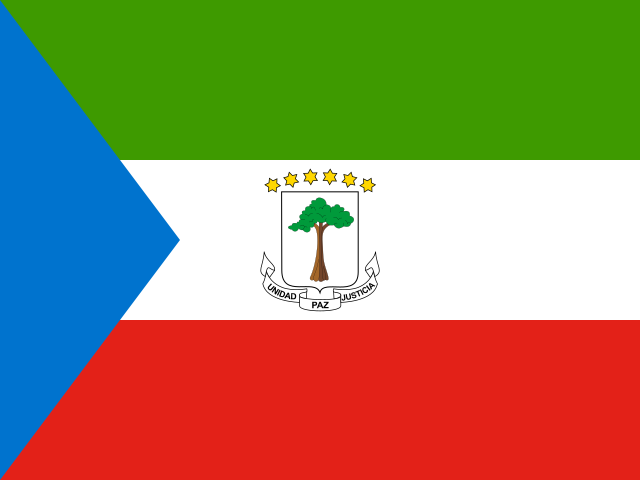 Equatorial Guinea
 Gabon
Gabon Sao Tome and Principe
Earlier Report Observations
Tomato production in Middle Africa showed resilience in the late 2010s, with output hovering around 1.7-1.75 million tons annually. Government backing for the sector, which supports approximately 600,000 jobs, provided a foundation for stable cultivation. However, persistent challenges such as rainy season logistics and poor road conditions periodically constrained supply chains and raised costs. The COVID-19 pandemic in 2020 led to border closures, disrupting traditional trade flows and affecting prices, but state-led recovery plans and the distribution of agricultural inputs helped maintain production levels.
The market entered a phase of incremental growth from 2021, bolstered by the development of tomato processing infrastructure. A fresh tomato processing plant project in Maroua aimed to enhance local value addition and reduce post-harvest losses. This was followed in 2022 by the launch of Delifood Agroindustrie Sarl's industrial project for tomato production, processing, and marketing, with an initial capacity of 5,400 tons, creating new demand for fresh tomatoes. Concurrently, the Ministry of Agriculture issued improved cultivation guidelines and lists of authorized fertilizers, strengthening technical support for growers.
Production accelerated markedly in 2023, reaching 2,069 thousand tons, an increase of over 11% from the previous year. This surge continued the upward trajectory established in the preceding years, reflecting the cumulative impact of earlier investments and capacity expansions.
Table of content
- 1. Disclaimer
- 2. Terms of use of the report
- 3. Product codes in the statistical classifications used in the report
-
4. Key Market Indicators and Trends
-
4.1. Key Market Indicators
-
4.1.1. In kind
- 4.1.1.1. Production, 2018-2023
- 4.1.1.2. Imports, 2018-2024
- 4.1.1.3. Exports, 2018-2024
- 4.1.1.4. Market size, 2018-2023
-
4.1.1. In kind
- 4.2. Market Trends and Factors
-
4.1. Key Market Indicators
-
5. Production
-
5.1. Production in Middle Africa
- 5.1.1. Annual dynamics of production in Middle Africa in kind, 2018-2023, K t
-
5.2. Global production by Country, 2018-2023
- 5.2.1. Annual dynamics of production by macroregions in kind, 2018-2023, K t
- 5.2.2. Dynamics of production structure by macroregions in kind, 2018-2023
- 5.2.3. Annual dynamics of production by country in kind, 2018-2023, K t
- 5.2.4. Structure of production by countries in kind, 2018-2023
- 5.2.5. Dynamics of peoduction structure by countries in kind, 2018-2023
-
5.1. Production in Middle Africa
-
6. Imports
-
6.1. Imports (Direct Data*)
- 6.1.1. Imports - Total information
-
6.1.2. Imports in kind, t
- 6.1.2.1. Annual dynamics of product's imports to Angola in kind, 2018-2024, t
- 6.1.2.2. Dynamics of product's imports in kind to Angola by countries, 2018-2024, t
- 6.1.2.3. Structure of product's imports in kind by countries, 2018-2024
-
6.1.3. Imports in value, K $ US
- 6.1.3.1. Annual dynamics of product's imports to Angola in value, 2018-2024, K $ US
- 6.1.3.2. Dynamics of product's imports in value to Angola by countries, 2018-2024, K $ US
- 6.1.3.3. Structure of product's imports in value by countries, 2018-2024
-
6.1.4. Average price of product's imports, $ US/t
- 6.1.4.1. Annual dynamics of average price of product's imports to Angola, 2018-2024, $ US/t
- 6.1.4.2. Dynamics of average price of product's imports to Angola by countries, 2018-2024, $ US/t
-
6.2. Imports (Mirror Data)
- 6.2.1. Imports - Total information
-
6.2.2. Imports in kind, t
- 6.2.2.1. Annual dynamics of product's imports to Angola in kind, 2018-2024, t
- 6.2.2.2. Dynamics of product's imports in kind to Angola by countries, 2018-2024, t
- 6.2.2.3. Structure of product's imports in kind by countries, 2018-2024
-
6.2.3. Imports in value, K $ US
- 6.2.3.1. Annual dynamics of product's imports to Angola in value, 2018-2024, K $ US
- 6.2.3.2. Dynamics of product's imports in value to Angola by countries, 2018-2024, K $ US
- 6.2.3.3. Structure of product's imports in value by countries, 2018-2024
-
6.2.4. Average price of product's imports, $ US/t
- 6.2.4.1. Annual dynamics of average price of product's imports to Angola, 2018-2024, $ US/t
- 6.2.4.2. Dynamics of average price of product's imports to Angola by countries, 2018-2024, $ US/t
-
6.1. Imports (Direct Data*)
-
7. Exports
-
7.1. Exports (Direct Data*)
- 7.1.1. Exports - Total information
-
7.1.2. Exports in kind, t
- 7.1.2.1. Annual dynamics of product's exports from Angola in kind, 2018-2024, t
- 7.1.2.2. Dynamics of product's exports in kind from Angola by countries, 2018-2024, t
- 7.1.2.3. Structure of product's exports in kind by countries, 2018-2024
-
7.1.3. Exports in value, K $ US
- 7.1.3.1. Annual dynamics of product's exports from Angola in value, 2018-2024, K $ US
- 7.1.3.2. Dynamics of product's exports in value from Angola by countries, 2018-2024, K $ US
- 7.1.3.3. Structure of product's exports in value by countries, 2018-2024
-
7.1.4. Average price of product's exports, $ US/t
- 7.1.4.1. Annual dynamics of average price of product's exports from Angola, 2018-2024, $ US/t
- 7.1.4.2. Dynamics of average price of product's exports from Angola by countries, 2018-2024, $ US/t
-
7.2. Exports (Mirror Data)
- 7.2.1. Exports - Total information
-
7.2.2. Exports in kind, t
- 7.2.2.1. Annual dynamics of product's exports from Angola in kind, 2018-2024, t
- 7.2.2.2. Dynamics of product's exports in kind from Angola by countries, 2018-2024, t
- 7.2.2.3. Structure of product's exports in kind by countries, 2018-2024
-
7.2.3. Exports in value, K $ US
- 7.2.3.1. Annual dynamics of product's exports from Angola in value, 2018-2024, K $ US
- 7.2.3.2. Dynamics of product's exports in value from Angola by countries, 2018-2024, K $ US
- 7.2.3.3. Structure of product's exports in value by countries, 2018-2024
-
7.2.4. Average price of product's exports, $ US/t
- 7.2.4.1. Annual dynamics of average price of product's exports from Angola, 2018-2024, $ US/t
- 7.2.4.2. Dynamics of average price of product's exports from Angola by countries, 2018-2024, $ US/t
-
7.1. Exports (Direct Data*)
-
8. Trade balance
-
8.1. Trade balance (Direct Data)
- 8.1.1. In kind, t
- 8.1.2. In value, K $ US
-
8.2. Trade balance (Mirror Data)
- 8.2.1. In kind, t
- 8.2.2. In value, K $ US
-
8.1. Trade balance (Direct Data)
-
9. Top buying and selling countries, 2018-2024
-
9.1. Direct Data
- 9.1.1. Import in Value by Countries-buyers
- 9.1.2. Export in Value by Countries-suppliers
-
9.2. Mirror Data
- 9.2.1. Import in Value by Countries-buyers
- 9.2.2. Export in Value by Countries-suppliers
-
9.1. Direct Data
Production tomato in Middle Africa
In kind, 2017-2020, K t
Top producers of tomato, 2017-2020
World map of production of tomato, 2017-2020
In 2020, Middle Africa produced 1,749 thousand tons of tomatoes, representing a 1.9% increase from the previous year. Over the period from 2017 to 2020, production grew by 4%, which translates to an average annual growth rate of 1.3%. The highest production level was recorded in 2018 at 1,754 thousand tons. The largest year-on-year decline occurred in 2019, with a drop of 2.1%, while the most significant increase was seen in 2018, with growth of 4.3%.
Annual dynamics of production in Middle Africa in kind, 2017-2020, K t
| Parameter | 2018 | 2019 | 2020 | CAGR | |
|---|---|---|---|---|---|
| 1 | Change from last year | 4.3% | (2.1%) | 1.9% | 1.3% |
Exports tomato from Middle Africa
Exports in kind, t
The market exhibited considerable volatility during these years. Export volumes reached their peak in 2017 and fell to their lowest point in 2019, with the peak volume being 17 times higher than the trough. In 2020, tomato exports from Middle Africa amounted to 303.6 tons, marking a dramatic increase of 665.3% compared to 2019. The minimum export volume was recorded in 2019 at 39.7 tons. The largest year-on-year decline occurred in 2018, with a decrease of 87.5%.
Annual dynamics of product's exports from Middle Africa in kind, 2017-2020, t
| Parameter | 2018 | 2019 | 2020 | CAGR | |
|---|---|---|---|---|---|
| 1 | Change from last year | (87.5%) | (51.6%) | 665.3% | (22.7%) |
From 2017 to 2020, Nigeria and Namibia consistently held the leading positions in the export structure by volume, together accounting for 27.7% of total export flows.
Structure of product's exports in kind by countries, 2017-2020
World map of product's exports from Middle Africa in kind, 2017-2020
Exports in value, K $ US
The market showed significant volatility during this period. The highest export value was recorded in 2017, while the lowest was in 2019, with a nine-fold difference between these years. In 2020, tomato shipments from Middle Africa to international markets were valued at 378.6 thousand US dollars, representing a dramatic gain of 494.1% compared to the previous year. The minimum export value was recorded in 2019 at 63.7 thousand US dollars. The largest year-on-year decline occurred in 2019, with a decrease of 72.5%.
Annual dynamics of product's exports from Middle Africa in value, 2017-2020, K $ US
| Parameter | 2018 | 2019 | 2020 | CAGR | |
|---|---|---|---|---|---|
| 1 | Change from last year | (59.4%) | (72.5%) | 494.1% | (12.8%) |
Between 2017 and 2020, Nigeria, Namibia, and Portugal were the primary buyers of tomatoes from Middle Africa in value terms. Nigeria accounted for 60.7% of exports, Namibia for 2.4%, and Portugal for 0.6%, with these three countries jointly representing 63.8% of total export value.
Structure of product's exports in value by countries, 2017-2020
World map of product's exports from Middle Africa in value, 2017-2020
Imports tomato to Middle Africa
Imports in kind, t
Tomato imports into Middle Africa declined for the third consecutive year. In 2020, imports reached 54.8 tons, down by 53.3% compared to the previous year. Over the period from 2017 to 2020, imports decreased by 85.4%, equating to an average annual decline of 47.4%.
Annual dynamics of product's imports to Middle Africa in kind, 2017-2020, t
| Parameter | 2018 | 2019 | 2020 | CAGR | |
|---|---|---|---|---|---|
| 1 | Change from last year | (67.6%) | (3.8%) | (53.3%) | (47.4%) |
From 2017 to 2020, South Africa, Portugal, and France were the principal sources of tomato imports by volume into Middle Africa. South Africa accounted for 50.0% of imports, Portugal for 13.1%, and France for 10.8%, with these three countries jointly representing 73.9% of total import flows.
Structure of product's imports in kind by countries, 2017-2020
World map of product's imports to Middle Africa in kind, 2017-2020
Imports in value, K $ US
Middle Africa's tomato import value declined for the third year in a row. In 2020, imports stood at 175.6 thousand US dollars, reflecting a steep reduction of 57.7% over the past year. Over the period from 2017 to 2020, imports decreased by 74.3%, with a compound annual growth rate (CAGR) of -36.5%.
Annual dynamics of product's imports to Middle Africa in value, 2017-2020, K $ US
| Parameter | 2018 | 2019 | 2020 | CAGR | |
|---|---|---|---|---|---|
| 1 | Change from last year | (24.4%) | (19.7%) | (57.7%) | (36.5%) |
Between 2017 and 2020, South Africa, Portugal, and France continued to be the main suppliers of tomatoes to Middle Africa in value terms. South Africa accounted for 39.0% of imports, Portugal for 23.4%, and France for 19.0%, with these three countries jointly forming 81.4% of total import value.
Structure of product's imports in value by countries, 2017-2020
World map of product's imports to Middle Africa in value, 2017-2020
Related Reports

2026-03-27
2026-03-27
2026-03-27
2026-03-27

Garlic market in Middle Africa
2026-03-27

Sweet potatoe market in Middle Africa
2026-03-27


Cabbages market in Middle Africa
2026-03-30
Why Choose Us?
Only Verified Data
No Hidden Costs or Separate Fees
Smarter Subscription Pricing
Contact Our Team
Submit your inquiry using the form below — our team will get back to you within 24 hours.