






"Sub-Saharan Africa" region includes following countries:
 Cabo Verde
 Benin
Benin Gambia
 Ghana
Ghana Guinea
 Côte d'Ivoire
 Liberia
 Mali
Mali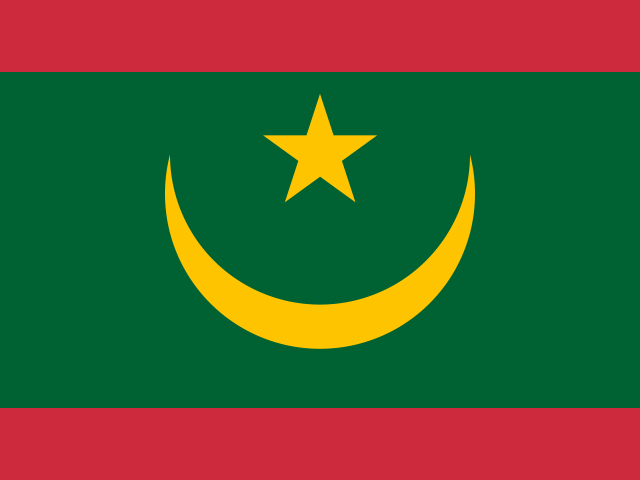 Mauritania
 Niger
Niger Nigeria
 Guinea-Bissau
 Saint Helena, Ascension and Tristan da Cunha
 Senegal
 Sierra Leone
 Togo
Togo Burkina Faso
 British Indian Ocean Territory
 Burundi
 Comoros
 Mayotte
 Ethiopia
 Eritrea
 French Southern Territories
 Djibouti
 Kenya
Kenya Madagascar
 Malawi
 Mauritius
 Mozambique
 Reunion
 Rwanda
 Seychelles
 Somalia
 Zimbabwe
 South Sudan
 Uganda
 Tanzania
 Zambia
 Angola
 Cameroon
 Central African Republic
 Chad
Chad Congo
Congo Democratic Republic of the Congo
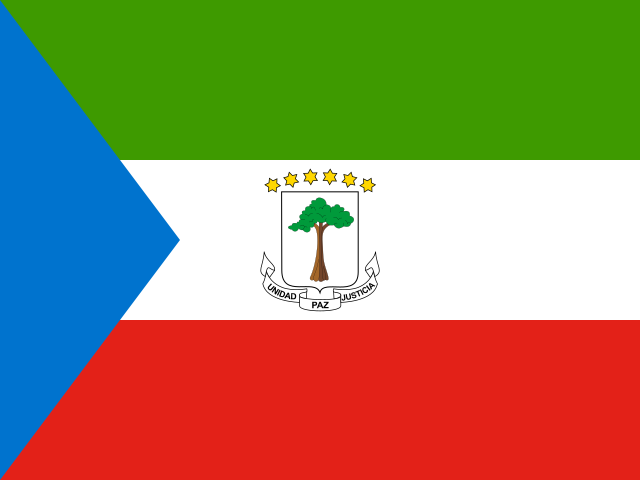 Equatorial Guinea
 Gabon
Gabon Sao Tome and Principe
 Botswana
 Lesotho
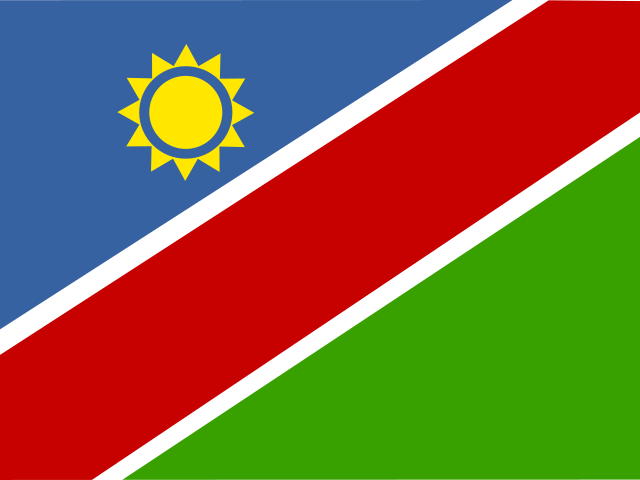 Namibia
 South Africa
 Eswatini
Earlier Report Observations
The sunflower seeds market in Sub-Saharan Africa saw its volume fluctuate between 2.3 and 2.6 million tonnes from 2018 to 2023. After a minor contraction in 2019, consumption rebounded strongly in 2020, surpassing pre-pandemic levels. Growth continued through 2022, reaching a peak of 2.6 million tonnes, before stabilizing at a similar high level in 2023.
In value terms, the market experienced more pronounced swings, with the total value falling from 5.8 billion US dollars in 2018 to 4.4 billion by 2020. A partial recovery followed in 2021 and 2022, but a significant drop to 4.0 billion dollars occurred in 2023, reflecting changing global commodity prices and supply chain conditions that affected local market valuations.
Recent market developments in the region are being shaped by a rapid rise in demand within emerging African economies, supported by increasing consumer health consciousness and snack consumption. The adoption of hybrid seed varieties and the expansion of modern retail channels, including e-commerce platforms, are improving agricultural productivity and product accessibility.
Table of content
- 1. Disclaimer
- 2. Terms of use of the report
- 3. Product codes in the statistical classifications used in the report
-
4. Key Market Indicators and Trends
-
4.1. Key Market Indicators
-
4.1.1. In kind
- 4.1.1.1. Production, 2018-2023
- 4.1.1.2. Imports, 2018-2024
- 4.1.1.3. Exports, 2018-2024
- 4.1.1.4. Market size, 2018-2023
-
4.1.2. In value
- 4.1.2.1. Production, 2018-2023
- 4.1.2.2. Imports, 2018-2024
- 4.1.2.3. Exports, 2018-2024
- 4.1.2.4. Market size, 2018-2023
-
4.1.1. In kind
- 4.2. Market Trends and Factors
-
4.1. Key Market Indicators
-
5. Production
-
5.1. Production in Sub-Saharan Africa
- 5.1.1. Annual dynamics of production in Sub-Saharan Africa in kind, 2018-2023, K t
-
5.2. Global production by Country, 2018-2023
- 5.2.1. Annual dynamics of production by macroregions in kind, 2018-2023, K t
- 5.2.2. Dynamics of production structure by macroregions in kind, 2018-2023
- 5.2.3. Annual dynamics of production by country in kind, 2018-2023, K t
- 5.2.4. Structure of production by countries in kind, 2018-2023
- 5.2.5. Dynamics of peoduction structure by countries in kind, 2018-2023
-
5.1. Production in Sub-Saharan Africa
-
6. Exports
-
6.1. Exports (Direct Data*)
- 6.1.1. Exports - Total information
-
6.1.2. Exports in kind, t
- 6.1.2.1. Annual dynamics of product's exports from Cabo Verde in kind, 2018-2024, t
- 6.1.2.2. Dynamics of product's exports in kind from Cabo Verde by countries, 2018-2024, t
- 6.1.2.3. Structure of product's exports in kind by countries, 2018-2024
-
6.1.3. Exports in value, K $ US
- 6.1.3.1. Annual dynamics of product's exports from Cabo Verde in value, 2018-2024, K $ US
- 6.1.3.2. Dynamics of product's exports in value from Cabo Verde by countries, 2018-2024, K $ US
- 6.1.3.3. Structure of product's exports in value by countries, 2018-2024
-
6.1.4. Average price of product's exports, $ US/t
- 6.1.4.1. Annual dynamics of average price of product's exports from Cabo Verde, 2018-2024, $ US/t
- 6.1.4.2. Dynamics of average price of product's exports from Cabo Verde by countries, 2018-2024, $ US/t
-
6.2. Exports (Mirror Data)
- 6.2.1. Exports - Total information
-
6.2.2. Exports in kind, t
- 6.2.2.1. Annual dynamics of product's exports from Cabo Verde in kind, 2018-2024, t
- 6.2.2.2. Dynamics of product's exports in kind from Cabo Verde by countries, 2018-2024, t
- 6.2.2.3. Structure of product's exports in kind by countries, 2018-2024
-
6.2.3. Exports in value, K $ US
- 6.2.3.1. Annual dynamics of product's exports from Cabo Verde in value, 2018-2024, K $ US
- 6.2.3.2. Dynamics of product's exports in value from Cabo Verde by countries, 2018-2024, K $ US
- 6.2.3.3. Structure of product's exports in value by countries, 2018-2024
-
6.2.4. Average price of product's exports, $ US/t
- 6.2.4.1. Annual dynamics of average price of product's exports from Cabo Verde, 2018-2024, $ US/t
- 6.2.4.2. Dynamics of average price of product's exports from Cabo Verde by countries, 2018-2024, $ US/t
-
6.1. Exports (Direct Data*)
-
7. Imports
-
7.1. Imports (Direct Data*)
- 7.1.1. Imports - Total information
-
7.1.2. Imports in kind, t
- 7.1.2.1. Annual dynamics of product's imports to Cabo Verde in kind, 2018-2024, t
- 7.1.2.2. Dynamics of product's imports in kind to Cabo Verde by countries, 2018-2024, t
- 7.1.2.3. Structure of product's imports in kind by countries, 2018-2024
-
7.1.3. Imports in value, K $ US
- 7.1.3.1. Annual dynamics of product's imports to Cabo Verde in value, 2018-2024, K $ US
- 7.1.3.2. Dynamics of product's imports in value to Cabo Verde by countries, 2018-2024, K $ US
- 7.1.3.3. Structure of product's imports in value by countries, 2018-2024
-
7.1.4. Average price of product's imports, $ US/t
- 7.1.4.1. Annual dynamics of average price of product's imports to Cabo Verde, 2018-2024, $ US/t
- 7.1.4.2. Dynamics of average price of product's imports to Cabo Verde by countries, 2018-2024, $ US/t
-
7.2. Imports (Mirror Data)
- 7.2.1. Imports - Total information
-
7.2.2. Imports in kind, t
- 7.2.2.1. Annual dynamics of product's imports to Cabo Verde in kind, 2018-2024, t
- 7.2.2.2. Dynamics of product's imports in kind to Cabo Verde by countries, 2018-2024, t
- 7.2.2.3. Structure of product's imports in kind by countries, 2018-2024
-
7.2.3. Imports in value, K $ US
- 7.2.3.1. Annual dynamics of product's imports to Cabo Verde in value, 2018-2024, K $ US
- 7.2.3.2. Dynamics of product's imports in value to Cabo Verde by countries, 2018-2024, K $ US
- 7.2.3.3. Structure of product's imports in value by countries, 2018-2024
-
7.2.4. Average price of product's imports, $ US/t
- 7.2.4.1. Annual dynamics of average price of product's imports to Cabo Verde, 2018-2024, $ US/t
- 7.2.4.2. Dynamics of average price of product's imports to Cabo Verde by countries, 2018-2024, $ US/t
-
7.1. Imports (Direct Data*)
-
8. Trade balance
-
8.1. Trade balance (Direct Data)
- 8.1.1. In kind, t
- 8.1.2. In value, K $ US
-
8.2. Trade balance (Mirror Data)
- 8.2.1. In kind, t
- 8.2.2. In value, K $ US
-
8.1. Trade balance (Direct Data)
-
9. Top buying and selling countries, 2018-2024
-
9.1. Direct Data
- 9.1.1. Import in Value by Countries-buyers
- 9.1.2. Export in Value by Countries-suppliers
-
9.2. Mirror Data
- 9.2.1. Import in Value by Countries-buyers
- 9.2.2. Export in Value by Countries-suppliers
-
9.1. Direct Data
Production sunflower seeds in Sub-Saharan Africa
In kind, 2017-2020, K t
Top producers of sunflower seeds, 2017-2020
World map of production of sunflower seeds, 2017-2020
In Sub-Saharan Africa, sunflower seed production reached 2 430 K t in 2020, marking a gradual increase of 7.7% compared to the previous year. Looking at the period from 2017 to 2020, production grew by 7%, which translates to an annualized growth rate of 2.3%. The lowest production level was recorded in 2019 at 2 257 K t, with the largest decline occurring that same year at 2.0%.
Annual dynamics of production in Sub-Saharan Africa in kind, 2017-2020, K t
| Parameter | 2018 | 2019 | 2020 | CAGR | |
|---|---|---|---|---|---|
| 1 | Change from last year | 1.4% | (2.0%) | 7.7% | 2.3% |
In value, 2017-2020, M $ US
Sunflower seed production in Sub-Saharan Africa declined for the third consecutive year in 2020, with output valued at 4 415 M $ US, representing a 13.0% decrease from the previous year. Over the period from 2017 to 2020, production fell by 27.6%, equating to an annualized decline of 10.2%.
Annual dynamics of production in Sub-Saharan Africa in value, 2017-2020, M $ US
| Parameter | 2018 | 2019 | 2020 | CAGR | |
|---|---|---|---|---|---|
| 1 | Change from last year | (5.8%) | (11.7%) | (13.0%) | (10.2%) |
Exports sunflower seeds from Sub-Saharan Africa
Exports in kind, t
Market performance showed noticeable fluctuations during this period. Exports reached their lowest point in 2019 at 1 115 t, then peaked in 2020 at 2 570 t, creating a 2.3-fold gap between these years. The 2020 export volume represented an abrupt increase of 130.6% compared to the previous year. The largest decline occurred in 2019 at 49.4%.
Annual dynamics of product's exports from Sub-Saharan Africa in kind, 2017-2020, t
| Parameter | 2018 | 2019 | 2020 | CAGR | |
|---|---|---|---|---|---|
| 1 | Change from last year | 13.0% | (49.4%) | 130.6% | 9.6% |
Between 2017 and 2020, sunflower seed exports from Sub-Saharan Africa were distributed across numerous partner countries. Sudan accounted for 1.8% of exports in kind, Brazil for 1.4%, and India for 0.9%, with these three countries together representing just 4.0% of total export flows.
Structure of product's exports in kind by countries, 2017-2020
World map of product's exports from Sub-Saharan Africa in kind, 2017-2020
Exports in value, K $ US
The market exhibited an unstable trend throughout this timeframe. Exports reached their lowest point in 2019 at 2 507 K $ US, then peaked in 2018 at 5 504 K $ US, showing a 2.2-fold difference between these years. In 2020, sunflower seed exports from Sub-Saharan Africa registered 4 670 K $ US, representing an 86.3% increase compared to the previous year. The largest decline occurred in 2019 at 54.4%.
Annual dynamics of product's exports from Sub-Saharan Africa in value, 2017-2020, K $ US
| Parameter | 2018 | 2019 | 2020 | CAGR | |
|---|---|---|---|---|---|
| 1 | Change from last year | 5.0% | (54.4%) | 86.3% | (3.8%) |
From 2017 to 2020, sunflower seed exports from Sub-Saharan Africa in value terms were spread across many countries. Sudan accounted for 18.2% of exports in value terms, Pakistan for 5.9%, and the Netherlands for 3.5%, with these three countries together representing only 27.7% of total export flows.
Structure of product's exports in value by countries, 2017-2020
World map of product's exports from Sub-Saharan Africa in value, 2017-2020
Imports sunflower seeds to Sub-Saharan Africa
Imports in kind, t
The market exhibited an unstable trend throughout this timeframe. Imports reached their lowest point in 2019 at 3 567 t, then peaked in 2017, creating a 9.8-fold gap between these years. In 2020, sunflower seed imports to Sub-Saharan Africa totaled 3 575 t, remaining almost flat compared to 2019. The largest decline occurred in 2018 at 79.5%.
Annual dynamics of product's imports to Sub-Saharan Africa in kind, 2017-2020, t
| Parameter | 2018 | 2019 | 2020 | CAGR | |
|---|---|---|---|---|---|
| 1 | Change from last year | (79.5%) | (50.1%) | 0.2% | (53.2%) |
Between 2017 and 2020, Romania accounted for 48.2% of sunflower seed imports in kind to Sub-Saharan Africa, France for 5.6%, and Bulgaria for 2.4%. These three countries formed the main cluster of markets for imports in kind, with a combined share of 56.1% of total import flows.
Structure of product's imports in kind by countries, 2017-2020
World map of product's imports to Sub-Saharan Africa in kind, 2017-2020
Imports in value, K $ US
Market performance showed noticeable fluctuations during this period. Imports reached their lowest point in 2019 at 5 173 K $ US, then peaked in 2018 at 23 305 K $ US, creating a 4.5-fold gap between these years. In 2020, sunflower seed imports to Sub-Saharan Africa totaled 5 608 K $ US, corresponding to a moderate year-over-year gain of 8.4%. The largest decline occurred in 2019 at 77.8%, while the largest increase was recorded in 2018 at 27.4%.
Annual dynamics of product's imports to Sub-Saharan Africa in value, 2017-2020, K $ US
| Parameter | 2018 | 2019 | 2020 | CAGR | |
|---|---|---|---|---|---|
| 1 | Change from last year | 27.4% | (77.8%) | 8.4% | (32.6%) |
Between 2017 and 2020, Chile accounted for 35.4% of sunflower seed imports to Sub-Saharan Africa in value terms, Romania for 25.5%, and Argentina for 4.0%. These three countries headed the ranking of suppliers, with their combined share reaching 64.8% of total imports in value terms.
Structure of product's imports in value by countries, 2017-2020
World map of product's imports to Sub-Saharan Africa in value, 2017-2020
Related Reports

Sunflower seeds market in Thailand
2026-03-28
Sunflower seeds market in Germany
2026-03-28
Sunflower seeds market in Argentina
2026-03-28


Safflower seeds market in Sub-Saharan Africa
2026-03-28

Rapeseed market in Sub-Saharan Africa
2026-03-28

Soybeans market in Sub-Saharan Africa
2026-03-28
In-depth market research on this product
Global Sunflower Seeds Market 2021–2031: Size, Share, Trends and Forecast
Global market report: size, trends and forecast to 2031 · 184 pages
Why Choose Us?
Only Verified Data
No Hidden Costs or Separate Fees
Smarter Subscription Pricing
Contact Our Team
Submit your inquiry using the form below — our team will get back to you within 24 hours.