






"ASEAN" region includes following countries:
 Brunei Darussalam
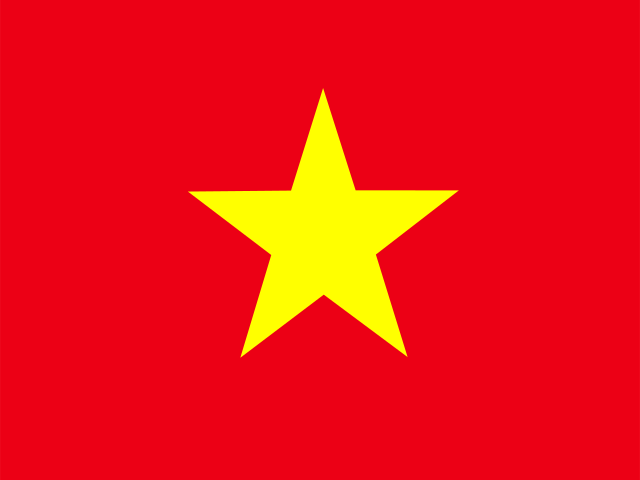 Vietnam
 Indonesia
 Cambodia
 Laos
Laos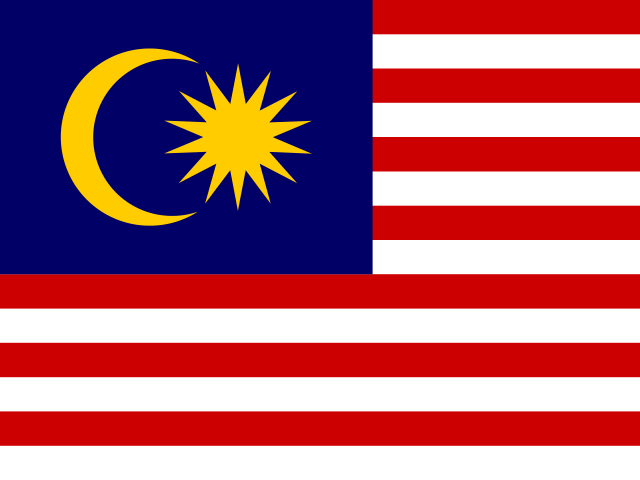 Malaysia
 Myanmar
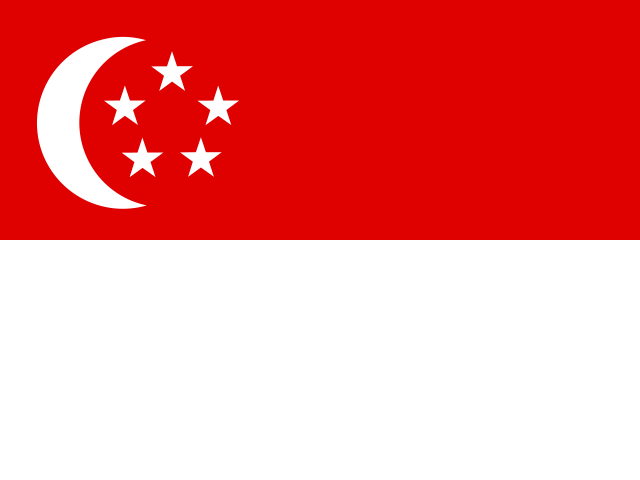 Singapore
 Thailand
 the Philippines
Earlier Report Observations
The market volume for sunflower seeds in ASEAN declined from 320 thousand tonnes in 2018 to 269 thousand tonnes in 2021. This downward trend reversed in 2022, with the market expanding to 298 thousand tonnes. The recovery was primarily driven by global supply chain disruptions following the Ukraine-Russia war, which increased demand for sunflower seeds in the region. In response, governments like Indonesia encouraged local growers to boost cultivation to reduce import reliance, supporting domestic production and imports.
Market volume eased to 285 thousand tonnes in 2023 as imports fell, while production remained stable. During this period, strategic industry developments aimed at enhancing future supply emerged, such as Corteva Agriscience's partnership with Evogene to develop innovative sunflower traits for improved resilience. Concurrently, rising global health consciousness and the expansion of plant-based, ready-to-eat snacks containing sunflower seeds continued to influence consumer preferences and import trends in ASEAN, with imports projected to reach 57 thousand tonnes in 2024.
Table of content
- 1. Disclaimer
- 2. Terms of use of the report
- 3. Product codes in the statistical classifications used in the report
-
4. Key Market Indicators and Trends
-
4.1. Key Market Indicators
-
4.1.1. In kind
- 4.1.1.1. Production, 2018-2023
- 4.1.1.2. Imports, 2018-2024
- 4.1.1.3. Exports, 2018-2024
- 4.1.1.4. Market size, 2018-2023
-
4.1.1. In kind
- 4.2. Market Trends and Factors
-
4.1. Key Market Indicators
-
5. Production
-
5.1. Production in ASEAN
- 5.1.1. Annual dynamics of production in ASEAN in kind, 2018-2023, K t
-
5.2. Global production by Country, 2018-2023
- 5.2.1. Annual dynamics of production by macroregions in kind, 2018-2023, K t
- 5.2.2. Dynamics of production structure by macroregions in kind, 2018-2023
- 5.2.3. Annual dynamics of production by country in kind, 2018-2023, K t
- 5.2.4. Structure of production by countries in kind, 2018-2023
- 5.2.5. Dynamics of peoduction structure by countries in kind, 2018-2023
-
5.1. Production in ASEAN
-
6. Imports
-
6.1. Imports (Direct Data*)
- 6.1.1. Imports - Total information
-
6.1.2. Imports in kind, t
- 6.1.2.1. Annual dynamics of product's imports to Brunei Darussalam in kind, 2018-2024, t
- 6.1.2.2. Dynamics of product's imports in kind to Brunei Darussalam by countries, 2018-2024, t
- 6.1.2.3. Structure of product's imports in kind by countries, 2018-2024
-
6.1.3. Imports in value, K $ US
- 6.1.3.1. Annual dynamics of product's imports to Brunei Darussalam in value, 2018-2024, K $ US
- 6.1.3.2. Dynamics of product's imports in value to Brunei Darussalam by countries, 2018-2024, K $ US
- 6.1.3.3. Structure of product's imports in value by countries, 2018-2024
-
6.1.4. Average price of product's imports, $ US/t
- 6.1.4.1. Annual dynamics of average price of product's imports to Brunei Darussalam, 2018-2024, $ US/t
- 6.1.4.2. Dynamics of average price of product's imports to Brunei Darussalam by countries, 2018-2024, $ US/t
-
6.2. Imports (Mirror Data)
- 6.2.1. Imports - Total information
-
6.2.2. Imports in kind, t
- 6.2.2.1. Annual dynamics of product's imports to Brunei Darussalam in kind, 2018-2024, t
- 6.2.2.2. Dynamics of product's imports in kind to Brunei Darussalam by countries, 2018-2024, t
- 6.2.2.3. Structure of product's imports in kind by countries, 2018-2024
-
6.2.3. Imports in value, K $ US
- 6.2.3.1. Annual dynamics of product's imports to Brunei Darussalam in value, 2018-2024, K $ US
- 6.2.3.2. Dynamics of product's imports in value to Brunei Darussalam by countries, 2018-2024, K $ US
- 6.2.3.3. Structure of product's imports in value by countries, 2018-2024
-
6.2.4. Average price of product's imports, $ US/t
- 6.2.4.1. Annual dynamics of average price of product's imports to Brunei Darussalam, 2018-2024, $ US/t
- 6.2.4.2. Dynamics of average price of product's imports to Brunei Darussalam by countries, 2018-2024, $ US/t
-
6.1. Imports (Direct Data*)
-
7. Exports
-
7.1. Exports (Direct Data*)
- 7.1.1. Exports - Total information
-
7.1.2. Exports in kind, t
- 7.1.2.1. Annual dynamics of product's exports from Brunei Darussalam in kind, 2018-2024, t
- 7.1.2.2. Dynamics of product's exports in kind from Brunei Darussalam by countries, 2018-2024, t
- 7.1.2.3. Structure of product's exports in kind by countries, 2018-2024
-
7.1.3. Exports in value, K $ US
- 7.1.3.1. Annual dynamics of product's exports from Brunei Darussalam in value, 2018-2024, K $ US
- 7.1.3.2. Dynamics of product's exports in value from Brunei Darussalam by countries, 2018-2024, K $ US
- 7.1.3.3. Structure of product's exports in value by countries, 2018-2024
-
7.1.4. Average price of product's exports, $ US/t
- 7.1.4.1. Annual dynamics of average price of product's exports from Brunei Darussalam, 2018-2024, $ US/t
- 7.1.4.2. Dynamics of average price of product's exports from Brunei Darussalam by countries, 2018-2024, $ US/t
-
7.2. Exports (Mirror Data)
- 7.2.1. Exports - Total information
-
7.2.2. Exports in kind, t
- 7.2.2.1. Annual dynamics of product's exports from Brunei Darussalam in kind, 2018-2024, t
- 7.2.2.2. Dynamics of product's exports in kind from Brunei Darussalam by countries, 2018-2024, t
- 7.2.2.3. Structure of product's exports in kind by countries, 2018-2024
-
7.2.3. Exports in value, K $ US
- 7.2.3.1. Annual dynamics of product's exports from Brunei Darussalam in value, 2018-2024, K $ US
- 7.2.3.2. Dynamics of product's exports in value from Brunei Darussalam by countries, 2018-2024, K $ US
- 7.2.3.3. Structure of product's exports in value by countries, 2018-2024
-
7.2.4. Average price of product's exports, $ US/t
- 7.2.4.1. Annual dynamics of average price of product's exports from Brunei Darussalam, 2018-2024, $ US/t
- 7.2.4.2. Dynamics of average price of product's exports from Brunei Darussalam by countries, 2018-2024, $ US/t
-
7.1. Exports (Direct Data*)
-
8. Trade balance
-
8.1. Trade balance (Direct Data)
- 8.1.1. In kind, t
- 8.1.2. In value, K $ US
-
8.2. Trade balance (Mirror Data)
- 8.2.1. In kind, t
- 8.2.2. In value, K $ US
-
8.1. Trade balance (Direct Data)
-
9. Top buying and selling countries, 2018-2024
-
9.1. Direct Data
- 9.1.1. Import in Value by Countries-buyers
- 9.1.2. Export in Value by Countries-suppliers
-
9.2. Mirror Data
- 9.2.1. Import in Value by Countries-buyers
- 9.2.2. Export in Value by Countries-suppliers
-
9.1. Direct Data
Production sunflower seeds in ASEAN
In kind, 2017-2020, K t
Top producers of sunflower seeds, 2017-2020
World map of production of sunflower seeds, 2017-2020
ASEAN's sunflower seed production has declined for the third consecutive year. In 2020, the region produced 235.4 thousand tons of sunflower seeds, representing a 6.3% decrease compared to the previous year. Between 2017 and 2020, production fell by 14%, which translates to an average annual decline of 4.9%.
Annual dynamics of production in ASEAN in kind, 2017-2020, K t
| Parameter | 2018 | 2019 | 2020 | CAGR | |
|---|---|---|---|---|---|
| 1 | Change from last year | (5.2%) | (3.1%) | (6.3%) | (4.9%) |
Exports sunflower seeds from ASEAN
Exports in kind, t
The market experienced significant fluctuations during this period. Exports reached their lowest point in 2017 and peaked in 2019, with a 13.1-fold difference between these years. In 2020, ASEAN exported 1 148 tons of sunflower seeds, marking a dramatic 87.2% decline from 2019. The highest export volume was recorded in 2019 at 8 960 tons, while the largest year-over-year increase occurred in 2018 at 733.4%.
Annual dynamics of product's exports from ASEAN in kind, 2017-2020, t
| Parameter | 2018 | 2019 | 2020 | CAGR | |
|---|---|---|---|---|---|
| 1 | Change from last year | 733.4% | 57.1% | (87.2%) | 18.8% |
From 2017 to 2020, India, the United Kingdom, and Belgium were the top contributors to ASEAN's sunflower seed exports by volume. India accounted for 51.6% of exports, followed by the United Kingdom at 10.5% and Belgium at 9.3%. Together, these three countries represented 71.4% of total export flows.
Structure of product's exports in kind by countries, 2017-2020
World map of product's exports from ASEAN in kind, 2017-2020
Exports in value, K $ US
The market showed an unstable trend throughout the timeframe. The lowest export value was recorded in 2017, while the highest was in 2019, with a 4.9-fold difference between these years. In 2020, ASEAN's cross-border shipments of sunflower seeds amounted to 2 065 thousand US dollars, reflecting a 65.4% decrease compared to the previous year. The peak value was 5 967 thousand US dollars in 2019, and the largest year-over-year increase occurred in 2018 at 241.4%.
Annual dynamics of product's exports from ASEAN in value, 2017-2020, K $ US
| Parameter | 2018 | 2019 | 2020 | CAGR | |
|---|---|---|---|---|---|
| 1 | Change from last year | 241.4% | 43.0% | (65.4%) | 19.1% |
Between 2017 and 2020, India, the United Kingdom, and Belgium remained the primary destinations for ASEAN's sunflower seed exports by value. India accounted for 50.2% of export value, the United Kingdom for 8.2%, and Belgium for 7.3%. Collectively, these three countries represented 65.6% of total export value during this period.
Structure of product's exports in value by countries, 2017-2020
World map of product's exports from ASEAN in value, 2017-2020
Imports sunflower seeds to ASEAN
Imports in kind, t
Market behavior was characterized by volatility during these years. Imports hit their lowest point in 2017 and peaked in 2018, with a 2.3-fold gap between these years. In 2020, ASEAN's sunflower seed imports totaled 47 808 tons, showing a substantial 19.7% increase compared to the previous year. The maximum volume was recorded in 2018 at 66 831 tons. The largest year-over-year decline occurred in 2019 at 40.2%, while the largest increase was in 2018 at 128.5%.
Annual dynamics of product's imports to ASEAN in kind, 2017-2020, t
| Parameter | 2018 | 2019 | 2020 | CAGR | |
|---|---|---|---|---|---|
| 1 | Change from last year | 128.5% | (40.2%) | 19.7% | 17.8% |
From 2017 to 2020, China dominated ASEAN's sunflower seed imports by volume, accounting for 72.4% of total flows. Other markets had comparatively modest shares during this period.
Structure of product's imports in kind by countries, 2017-2020
World map of product's imports to ASEAN in kind, 2017-2020
Imports in value, K $ US
ASEAN's sunflower seed imports have increased for the third consecutive year. In 2020, imports totaled 55 536 thousand US dollars, reflecting a strong 20.9% advance relative to the prior year. Over the period from 2017 to 2020, imports grew by 83.9%, with a compound annual growth rate of 22.5%.
Annual dynamics of product's imports to ASEAN in value, 2017-2020, K $ US
| Parameter | 2018 | 2019 | 2020 | CAGR | |
|---|---|---|---|---|---|
| 1 | Change from last year | 46.3% | 4.0% | 20.9% | 22.5% |
Between 2017 and 2020, China accounted for 86.9% of the total value of sunflower seed imports to ASEAN. The remaining flows were distributed among multiple smaller partners.
Structure of product's imports in value by countries, 2017-2020
World map of product's imports to ASEAN in value, 2017-2020
Related Reports

Sunflower seeds market in Eastern Africa
2026-03-28
Sunflower seeds market in Bulgaria
2026-03-28
Sunflower seeds market in Azerbaijan
2026-03-28
Sunflower seeds market in China
2026-03-28

2026-03-28

Palm nuts and kernels market in ASEAN
2026-03-28

2026-03-28

2026-03-28
In-depth market research on this product
Global Sunflower Seeds Market 2021–2031: Size, Share, Trends and Forecast
Global market report: size, trends and forecast to 2031 · 184 pages
Why Choose Us?
Only Verified Data
No Hidden Costs or Separate Fees
Smarter Subscription Pricing
Contact Our Team
Submit your inquiry using the form below — our team will get back to you within 24 hours.