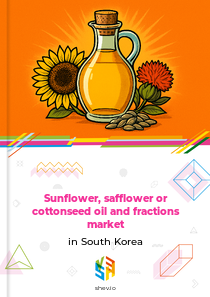







Earlier Report Observations
From 2018 to 2021, the market volume for sunflower, safflower, or cottonseed oil in South Korea increased from 56 917 t to 69 304 t. This growth was primarily driven by rising imports, which expanded from 29 291 t to 43 655 t over the same period. The expansion was supported by growing consumer interest in healthy and functional foods, alongside research into the functional benefits of these vegetable oils, which boosted demand.
After peaking in 2021, the market stabilized at 68 338 t in 2022 before contracting sharply to 49 438 t in 2023. The decline was triggered by regulatory tightening: enhanced food labeling and advertising rules in 2022 temporarily constrained imports, while the introduction of new safety regulations for imported foods and general products in 2023 led to a significant drop in import volumes from 42 400 t to 26 714 t.
Table of content
- 1. Disclaimer
- 2. Terms of use of the report
- 3. Product codes in the statistical classifications used in the report
-
4. Key Market Indicators and Trends
-
4.1. Key Market Indicators
-
4.1.1. In kind
- 4.1.1.1. Production, 2018-2023
- 4.1.1.2. Imports, 2018-2024
- 4.1.1.3. Exports, 2018-2024
- 4.1.1.4. Market size, 2018-2023
-
4.1.1. In kind
- 4.2. Market Trends and Factors
-
4.1. Key Market Indicators
-
5. Production
-
5.1. Production in South Korea
- 5.1.1. Annual dynamics of production in South Korea in kind, 2018-2023, t
- 5.1.2. Annual dynamics of production in South Korea in value, 2018-2023, $ US
-
5.2. Global production by Country, 2018-2023
- 5.2.1. Annual dynamics of production by macroregions in kind, 2018-2023, t
- 5.2.2. Dynamics of production structure by macroregions in kind, 2018-2023
- 5.2.3. Annual dynamics of production by country in kind, 2018-2023, t
- 5.2.4. Structure of production by countries in kind, 2018-2023
- 5.2.5. Dynamics of peoduction structure by countries in kind, 2018-2023
-
5.1. Production in South Korea
-
6. Imports
-
6.1. Imports (Direct Data)
- 6.1.1. Imports - Total information
-
6.1.2. Imports in kind, t
- 6.1.2.1. Annual dynamics of product's imports to South Korea in kind, 2018-2024, t
- 6.1.2.2. Dynamics of product's imports in kind to South Korea by countries, 2018-2024, t
- 6.1.2.3. Structure of product's imports in kind by countries, 2018-2024
-
6.1.3. Imports in value, M $ US
- 6.1.3.1. Annual dynamics of product's imports to South Korea in value, 2018-2024, M $ US
- 6.1.3.2. Dynamics of product's imports in value to South Korea by countries, 2018-2024, M $ US
- 6.1.3.3. Structure of product's imports in value by countries, 2018-2024
-
6.1.4. Average price of product's imports, $ US/t
- 6.1.4.1. Annual dynamics of average price of product's imports to South Korea, 2018-2024, $ US/t
- 6.1.4.2. Dynamics of average price of product's imports to South Korea by countries, 2018-2024, $ US/t
-
6.2. Imports (Mirror Data)
- 6.2.1. Imports - Total information
-
6.2.2. Imports in kind, t
- 6.2.2.1. Annual dynamics of product's imports to South Korea in kind, 2018-2024, t
- 6.2.2.2. Dynamics of product's imports in kind to South Korea by countries, 2018-2024, t
- 6.2.2.3. Structure of product's imports in kind by countries, 2018-2024
-
6.2.3. Imports in value, M $ US
- 6.2.3.1. Annual dynamics of product's imports to South Korea in value, 2018-2024, M $ US
- 6.2.3.2. Dynamics of product's imports in value to South Korea by countries, 2018-2024, M $ US
- 6.2.3.3. Structure of product's imports in value by countries, 2018-2024
-
6.2.4. Average price of product's imports, $ US/t
- 6.2.4.1. Annual dynamics of average price of product's imports to South Korea, 2018-2024, $ US/t
- 6.2.4.2. Dynamics of average price of product's imports to South Korea by countries, 2018-2024, $ US/t
-
6.1. Imports (Direct Data)
-
7. Exports
-
7.1. Exports (Direct Data)
- 7.1.1. Exports - Total information
-
7.1.2. Exports in kind, t
- 7.1.2.1. Annual dynamics of product's exports from South Korea in kind, 2018-2024, t
- 7.1.2.2. Dynamics of product's exports in kind from South Korea by countries, 2018-2024, t
- 7.1.2.3. Structure of product's exports in kind by countries, 2018-2024
-
7.1.3. Exports in value, M $ US
- 7.1.3.1. Annual dynamics of product's exports from South Korea in value, 2018-2024, M $ US
- 7.1.3.2. Dynamics of product's exports in value from South Korea by countries, 2018-2024, M $ US
- 7.1.3.3. Structure of product's exports in value by countries, 2018-2024
-
7.1.4. Average price of product's exports, $ US/t
- 7.1.4.1. Annual dynamics of average price of product's exports from South Korea, 2018-2024, $ US/t
- 7.1.4.2. Dynamics of average price of product's exports from South Korea by countries, 2018-2024, $ US/t
-
7.2. Exports (Mirror Data)
- 7.2.1. Exports - Total information
-
7.2.2. Exports in kind, t
- 7.2.2.1. Annual dynamics of product's exports from South Korea in kind, 2018-2024, t
- 7.2.2.2. Dynamics of product's exports in kind from South Korea by countries, 2018-2024, t
- 7.2.2.3. Structure of product's exports in kind by countries, 2018-2024
-
7.2.3. Exports in value, M $ US
- 7.2.3.1. Annual dynamics of product's exports from South Korea in value, 2018-2024, M $ US
- 7.2.3.2. Dynamics of product's exports in value from South Korea by countries, 2018-2024, M $ US
- 7.2.3.3. Structure of product's exports in value by countries, 2018-2024
-
7.2.4. Average price of product's exports, $ US/t
- 7.2.4.1. Annual dynamics of average price of product's exports from South Korea, 2018-2024, $ US/t
- 7.2.4.2. Dynamics of average price of product's exports from South Korea by countries, 2018-2024, $ US/t
-
7.1. Exports (Direct Data)
-
8. Trade balance
-
8.1. Trade balance (Direct Data)
- 8.1.1. In kind, t
- 8.1.2. In value, M $ US
-
8.2. Trade balance (Mirror Data)
- 8.2.1. In kind, t
- 8.2.2. In value, M $ US
-
8.1. Trade balance (Direct Data)
-
9. Top buying and selling countries, 2018-2024
-
9.1. Direct Data
- 9.1.1. Import in Value by Countries-buyers
- 9.1.2. Export in Value by Countries-suppliers
-
9.2. Mirror Data
- 9.2.1. Import in Value by Countries-buyers
- 9.2.2. Export in Value by Countries-suppliers
-
9.1. Direct Data
Production sunflower, safflower or cottonseed oil and fractions in South Korea
In kind, 2017-2020, t
Top producers of sunflower, safflower or cottonseed oil and fractions, 2017-2020
World map of production of sunflower, safflower or cottonseed oil and fractions, 2017-2020
After two years of decline, South Korea's production of sunflower, safflower, or cottonseed oil and fractions has rebounded. In 2020, the country produced 27 200 tonnes, marking a 3.8% increase from the previous year. Looking at the period from 2017 to 2020, overall production decreased by 2.2%, which translates to an average annual decline of 0.7%. The lowest production level was recorded in 2019 at 26 200 tonnes, with that year also seeing the largest drop of 5.4%.
Annual dynamics of production in South Korea in kind, 2017-2020, t
| Parameter | 2018 | 2019 | 2020 | CAGR | |
|---|---|---|---|---|---|
| 1 | Change from last year | (0.4%) | (5.4%) | 3.8% | (0.7%) |
Exports sunflower, safflower or cottonseed oil and fractions from South Korea
Exports in kind, t
The data shows irregular changes, pointing to a volatile market environment. From 2017 to 2019, exports varied significantly, with a peak-to-trough amplitude of 12.9 times. In 2020, South Korea exported 36 tonnes of sunflower, safflower, or cottonseed oil and fractions, representing a substantial increase of 141.2% compared to 2019. The lowest export volume was recorded in 2019 at 15 tonnes, which also saw the largest decline of 76.3%.
Annual dynamics of product's exports from South Korea in kind, 2017-2020, t
| Parameter | 2018 | 2019 | 2020 | CAGR | |
|---|---|---|---|---|---|
| 1 | Change from last year | (67.3%) | (76.3%) | 141.2% | (42.9%) |
Between 2017 and 2020, Spain, China, and Hong Kong remained the top buyers of sunflower, safflower, or cottonseed oil and fractions from South Korea. Spain accounted for 43.4% of exports in kind, China for 24.3%, and Hong Kong for 18.8%. Together, these three markets made up 86.5% of total exports in kind.
Structure of product's exports in kind by countries, 2017-2020
World map of product's exports from South Korea in kind, 2017-2020
Exports in value, K $ US
Market performance showed noticeable fluctuations during this period. From the high in 2017 to the low in 2019, export volumes varied by a factor of six. In 2020, South Korea's exports of sunflower, safflower, or cottonseed oil and fractions totaled 146 thousand US dollars, reflecting a sharp uptick of 176.2% compared to the previous year. The minimum value was recorded in 2019 at 53 thousand US dollars, while the largest decline occurred in 2018 with a drop of 63.0%.
Annual dynamics of product's exports from South Korea in value, 2017-2020, K $ US
| Parameter | 2018 | 2019 | 2020 | CAGR | |
|---|---|---|---|---|---|
| 1 | Change from last year | (63.0%) | (54.9%) | 176.2% | (22.8%) |
From 2017 to 2020, China, Hong Kong, and Spain emerged as the main markets for South Korea's exports in value terms. China led with 33.2% of exports in value, followed by Hong Kong at 21.4%, and Spain at 20.9%. Collectively, these three countries represented 75.5% of total export flows.
Structure of product's exports in value by countries, 2017-2020
World map of product's exports from South Korea in value, 2017-2020
Imports sunflower, safflower or cottonseed oil and fractions to South Korea
Imports in kind, t
South Korea's imports of sunflower, safflower, or cottonseed oil and fractions have increased for the third consecutive year. In 2020, the country imported 37 615 tonnes, showing a modest year-on-year advance of 6.0%. Over the period from 2017 to 2020, imports grew by 44.9%, which corresponds to an average annual rate of 13.2%.
Annual dynamics of product's imports to South Korea in kind, 2017-2020, t
| Parameter | 2018 | 2019 | 2020 | CAGR | |
|---|---|---|---|---|---|
| 1 | Change from last year | 12.8% | 21.2% | 6.0% | 13.2% |
In the years 2017 to 2020, Spain, Ukraine, and Argentina were the primary sources for South Korea's imports of sunflower, safflower, or cottonseed oil and fractions in kind. Spain contributed 37.4% of imports, Ukraine 33.3%, and Argentina 6.4%. Together, these three countries accounted for 77.2% of total import flows.
Structure of product's imports in kind by countries, 2017-2020
World map of product's imports to South Korea in kind, 2017-2020
Imports in value, K $ US
South Korea's imports of sunflower, safflower, or cottonseed oil and fractions in value terms have risen for the third year in a row. In 2020, imports amounted to 47 172 thousand US dollars, indicating a moderate increase of 9.3% compared to the previous year. From 2017 to 2020, import values grew by 52%, equating to an annualized rate of 15.0%.
Annual dynamics of product's imports to South Korea in value, 2017-2020, K $ US
| Parameter | 2018 | 2019 | 2020 | CAGR | |
|---|---|---|---|---|---|
| 1 | Change from last year | 15.8% | 20.1% | 9.3% | 15.0% |
Between 2017 and 2020, Spain, Ukraine, and Turkey were the largest suppliers of sunflower, safflower, or cottonseed oil and fractions to South Korea in value terms. Spain held a 36.1% share, Ukraine 27.6%, and Turkey 7.2%. Combined, these three countries made up 70.9% of total imports in value.
Structure of product's imports in value by countries, 2017-2020
World map of product's imports to South Korea in value, 2017-2020
Related Reports




In-depth market research on this product
Global Sunflower Seeds Market 2021–2031: Size, Share, Trends and Forecast
Global market report: size, trends and forecast to 2031 · 184 pages
Global Cottonseed Oil Market 2021–2031: Size, Share, Trends and Forecast
Global market report: size, trends and forecast to 2031 · 186 pages
Why Choose Us?
Only Verified Data
No Hidden Costs or Separate Fees
Smarter Subscription Pricing
Contact Our Team
Submit your inquiry using the form below — our team will get back to you within 24 hours.