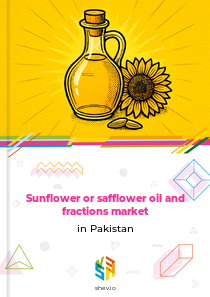







Earlier Report Observations
The market volume for sunflower or safflower oil in Pakistan fluctuated between 2018 and 2023. It started at 56 576 t in 2018, dipped to 52 279 t in 2019, then recovered to 56 606 t in 2020. A sharp contraction followed in 2021, with the market falling to 38 737 t. This was followed by two years of strong growth, reaching 51 617 t in 2022 and 68 353 t in 2023.
The rapid expansion in 2022 and 2023 was influenced by global supply chain disruptions, particularly the competition between major sunflower oil suppliers Russia and Ukraine, which affected prices and availability. Concurrently, consumer preferences in Pakistan shifted towards sunflower oil as prices for alternative oils like Indonesian palm oil rose and their availability decreased, supporting higher demand.
In 2024, a notable policy change occurred with the government ceasing the wheat minimum support price, an action designed to encourage farmers to cultivate alternative oilseeds such as sunflower seed. This shift in agricultural policy marks a significant development for the domestic oilseed sector.
Table of content
- 1. Disclaimer
- 2. Terms of use of the report
- 3. Product codes in the statistical classifications used in the report
-
4. Key Market Indicators and Trends
-
4.1. Key Market Indicators
-
4.1.1. In kind
- 4.1.1.1. Production, 2018-2023
- 4.1.1.2. Imports, 2018-2024
- 4.1.1.3. Exports, 2018-2024
- 4.1.1.4. Market size, 2018-2023
-
4.1.1. In kind
- 4.2. Market Trends and Factors
-
4.1. Key Market Indicators
-
5. Production
-
5.1. Production in Pakistan
- 5.1.1. Annual dynamics of production in Pakistan in kind, 2018-2023, t
- 5.1.2. Annual dynamics of production in Pakistan in value, 2018-2023, $ US
-
5.2. Global production by Country, 2018-2023
- 5.2.1. Annual dynamics of production by macroregions in kind, 2018-2023, t
- 5.2.2. Dynamics of production structure by macroregions in kind, 2018-2023
- 5.2.3. Annual dynamics of production by country in kind, 2018-2023, t
- 5.2.4. Structure of production by countries in kind, 2018-2023
- 5.2.5. Dynamics of peoduction structure by countries in kind, 2018-2023
-
5.1. Production in Pakistan
-
6. Imports
-
6.1. Imports (Direct Data)
- 6.1.1. Imports - Total information
-
6.1.2. Imports in kind, t
- 6.1.2.1. Annual dynamics of product's imports to Pakistan in kind, 2018-2024, t
- 6.1.2.2. Dynamics of product's imports in kind to Pakistan by countries, 2018-2024, t
- 6.1.2.3. Structure of product's imports in kind by countries, 2018-2024
-
6.1.3. Imports in value, K $ US
- 6.1.3.1. Annual dynamics of product's imports to Pakistan in value, 2018-2024, K $ US
- 6.1.3.2. Dynamics of product's imports in value to Pakistan by countries, 2018-2024, K $ US
- 6.1.3.3. Structure of product's imports in value by countries, 2018-2024
-
6.1.4. Average price of product's imports, $ US/t
- 6.1.4.1. Annual dynamics of average price of product's imports to Pakistan, 2018-2024, $ US/t
- 6.1.4.2. Dynamics of average price of product's imports to Pakistan by countries, 2018-2024, $ US/t
-
6.2. Imports (Mirror Data)
- 6.2.1. Imports - Total information
-
6.2.2. Imports in kind, t
- 6.2.2.1. Annual dynamics of product's imports to Pakistan in kind, 2018-2024, t
- 6.2.2.2. Dynamics of product's imports in kind to Pakistan by countries, 2018-2024, t
- 6.2.2.3. Structure of product's imports in kind by countries, 2018-2024
-
6.2.3. Imports in value, K $ US
- 6.2.3.1. Annual dynamics of product's imports to Pakistan in value, 2018-2024, K $ US
- 6.2.3.2. Dynamics of product's imports in value to Pakistan by countries, 2018-2024, K $ US
- 6.2.3.3. Structure of product's imports in value by countries, 2018-2024
-
6.2.4. Average price of product's imports, $ US/t
- 6.2.4.1. Annual dynamics of average price of product's imports to Pakistan, 2018-2024, $ US/t
- 6.2.4.2. Dynamics of average price of product's imports to Pakistan by countries, 2018-2024, $ US/t
-
6.1. Imports (Direct Data)
-
7. Exports
-
7.1. Exports (Direct Data)
- 7.1.1. Exports - Total information
-
7.1.2. Exports in kind, t
- 7.1.2.1. Annual dynamics of product's exports from Pakistan in kind, 2018-2024, t
- 7.1.2.2. Dynamics of product's exports in kind from Pakistan by countries, 2018-2024, t
- 7.1.2.3. Structure of product's exports in kind by countries, 2018-2024
-
7.1.3. Exports in value, K $ US
- 7.1.3.1. Annual dynamics of product's exports from Pakistan in value, 2018-2024, K $ US
- 7.1.3.2. Dynamics of product's exports in value from Pakistan by countries, 2018-2024, K $ US
- 7.1.3.3. Structure of product's exports in value by countries, 2018-2024
-
7.1.4. Average price of product's exports, $ US/t
- 7.1.4.1. Annual dynamics of average price of product's exports from Pakistan, 2018-2024, $ US/t
- 7.1.4.2. Dynamics of average price of product's exports from Pakistan by countries, 2018-2024, $ US/t
-
7.2. Exports (Mirror Data)
- 7.2.1. Exports - Total information
-
7.2.2. Exports in kind, t
- 7.2.2.1. Annual dynamics of product's exports from Pakistan in kind, 2018-2024, t
- 7.2.2.2. Dynamics of product's exports in kind from Pakistan by countries, 2018-2024, t
- 7.2.2.3. Structure of product's exports in kind by countries, 2018-2024
-
7.2.3. Exports in value, K $ US
- 7.2.3.1. Annual dynamics of product's exports from Pakistan in value, 2018-2024, K $ US
- 7.2.3.2. Dynamics of product's exports in value from Pakistan by countries, 2018-2024, K $ US
- 7.2.3.3. Structure of product's exports in value by countries, 2018-2024
-
7.2.4. Average price of product's exports, $ US/t
- 7.2.4.1. Annual dynamics of average price of product's exports from Pakistan, 2018-2024, $ US/t
- 7.2.4.2. Dynamics of average price of product's exports from Pakistan by countries, 2018-2024, $ US/t
-
7.1. Exports (Direct Data)
-
8. Trade balance
-
8.1. Trade balance (Direct Data)
- 8.1.1. In kind, t
- 8.1.2. In value, K $ US
-
8.2. Trade balance (Mirror Data)
- 8.2.1. In kind, t
- 8.2.2. In value, K $ US
-
8.1. Trade balance (Direct Data)
-
9. Top buying and selling countries, 2018-2024
-
9.1. Direct Data
- 9.1.1. Import in Value by Countries-buyers
- 9.1.2. Export in Value by Countries-suppliers
-
9.2. Mirror Data
- 9.2.1. Import in Value by Countries-buyers
- 9.2.2. Export in Value by Countries-suppliers
-
9.1. Direct Data
Production sunflower or safflower oil and fractions in Pakistan
In kind, 2017-2020, t
From 2017 to 2020, Pakistan ranked 27th globally in terms of sunflower or safflower oil and fractions production volume.
Top producers of sunflower or safflower oil and fractions, 2017-2020
World map of production of sunflower or safflower oil and fractions, 2017-2020
After a two-year decline, sunflower or safflower oil and fractions production in Pakistan increased in 2020. That year, Pakistan produced 56 200 tonnes, marking a gradual 8.1% rise compared to 2019. Over the 2017-2020 period, overall production decreased by 6.6%, with a compound annual growth rate of 2.3%. The lowest production level was recorded in 2019 at 52 000 tonnes, while the largest decline occurred in 2018 with an 8.0% drop.
Annual dynamics of production in Pakistan in kind, 2017-2020, t
| Parameter | 2018 | 2019 | 2020 | CAGR | |
|---|---|---|---|---|---|
| 1 | Change from last year | (8.0%) | (6.1%) | 8.1% | (2.3%) |
Exports sunflower or safflower oil and fractions from Pakistan
Exports in kind, t
The market showed significant volatility during these years. Export volumes reached their lowest point in 2017 and peaked in 2018, representing a 275-fold difference. In 2020, Pakistan's cross-border shipments of sunflower or safflower oil and fractions totaled 1 tonne, reflecting a sharp increase of 27 373.7% compared to the previous year.
Annual dynamics of product's exports from Pakistan in kind, 2017-2020, t
| Parameter | 2018 | 2019 | 2020 | CAGR | |
|---|---|---|---|---|---|
| 1 | Change from last year | 27 373.7% | n/a | n/a | 165.6% |
Between 2017 and 2020, Iraq dominated Pakistan's exports of sunflower or safflower oil and fractions in kind, accounting for 93.3% of total flows.
Structure of product's exports in kind by countries, 2017-2020
World map of product's exports from Pakistan in kind, 2017-2020
Exports in value, K $ US
The market exhibited an unstable trend throughout this period. Export values bottomed in 2017 and peaked in 2018, with a 69-fold difference. In 2020, Pakistan exported 1.7 thousand US dollars worth of sunflower or safflower oil and fractions, representing an increase of 6 778.7% over the previous year.
Annual dynamics of product's exports from Pakistan in value, 2017-2020, K $ US
| Parameter | 2018 | 2019 | 2020 | CAGR | |
|---|---|---|---|---|---|
| 1 | Change from last year | 6 778.7% | n/a | n/a | 82.6% |
From 2017 to 2020, Iraq was the dominant market for Pakistan's exports of sunflower or safflower oil and fractions in value terms, accounting for 90.7% of total exports.
Structure of product's exports in value by countries, 2017-2020
World map of product's exports from Pakistan in value, 2017-2020
Imports sunflower or safflower oil and fractions to Pakistan
Imports in kind, t
Market performance showed noticeable fluctuations during this period. Import volumes reached their lowest point in 2019 and peaked in 2018, with a 4.3-fold gap. In 2020, Pakistan's cross-border shipments of sunflower or safflower oil and fractions amounted to 407 tonnes, marking a 46.2% year-on-year advance. The minimum value was recorded in 2019 at 279 tonnes, while the maximum was in 2018 at 1 192 tonnes. The largest decline occurred in 2019 with a 76.6% drop, and the largest increase was in 2018 with a 284.5% rise.
Annual dynamics of product's imports to Pakistan in kind, 2017-2020, t
| Parameter | 2018 | 2019 | 2020 | CAGR | |
|---|---|---|---|---|---|
| 1 | Change from last year | 284.5% | (76.6%) | 46.2% | 9.5% |
From 2017 to 2020, the United Arab Emirates (69.9% of imports in kind), Turkey (7.8%), and Saudi Arabia (6.1%) led the structure of Pakistan's imports in kind, together representing 83.9% of total flows.
Structure of product's imports in kind by countries, 2017-2020
World map of product's imports to Pakistan in kind, 2017-2020
Imports in value, K $ US
After a two-year decrease, sunflower or safflower oil and fractions imports to Pakistan increased in 2020. That year, imports totaled 635.9 thousand US dollars, corresponding to a 43.9% gain compared to the previous year. Between 2017 and 2020, overall imports decreased by 7.8%, equating to a 2.7% annualized rate. The minimum value was recorded in 2019 at 441.9 thousand US dollars, while the largest decline occurred in 2018 with a 30.3% drop.
Annual dynamics of product's imports to Pakistan in value, 2017-2020, K $ US
| Parameter | 2018 | 2019 | 2020 | CAGR | |
|---|---|---|---|---|---|
| 1 | Change from last year | (30.3%) | (8.1%) | 43.9% | (2.7%) |
From 2017 to 2020, the United Arab Emirates (50.3% of imports in value terms), Saudi Arabia (13.3%), and Turkey (8.5%) consistently remained the main destinations for Pakistan's imports in value terms, together accounting for 72.1% of total flows.
Structure of product's imports in value by countries, 2017-2020
World map of product's imports to Pakistan in value, 2017-2020
Related Reports


Non-vegetable waxes market in Pakistan
2026-03-28
Coconut oil and fractions market in Pakistan
2026-03-28
In-depth market research on this product
Global Sunflower Seeds Market 2021–2031: Size, Share, Trends and Forecast
Global market report: size, trends and forecast to 2031 · 184 pages
Why Choose Us?
Only Verified Data
No Hidden Costs or Separate Fees
Smarter Subscription Pricing
Contact Our Team
Submit your inquiry using the form below — our team will get back to you within 24 hours.