






"Central Asia" region includes following countries:
 Kazakhstan
 Kyrgyzstan
 Tajikistan
 Turkmenistan
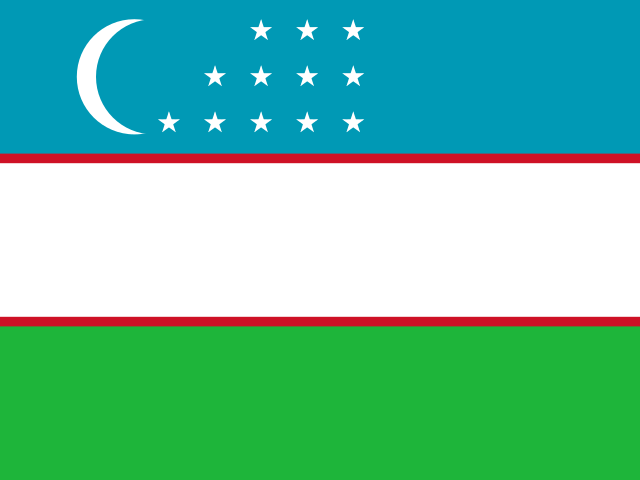 Uzbekistan
Earlier Report Observations
The Central Asian market for sunflower and safflower oil expanded significantly between 2018 and 2019, with volume rising from 623 thousand tonnes to 805 thousand tonnes. This growth was primarily driven by increased production and export volumes from Russia, a key supplier to the region, where a saturated domestic market directed surplus oil abroad.
Market volume stabilized in 2020 despite global supply chain disruptions caused by the COVID-19 pandemic. A sharp contraction followed in 2021, as export duties and restrictions on sunflower oil and seeds enacted by Russia and neighboring countries reduced the availability of imports, pulling the regional market size down to 716 thousand tonnes.
The market rebounded from 2022 onwards. Sanctions and trade restrictions prompted a shift towards import substitution and localization of production within Central Asia, leading to a surge in domestic output from 404 thousand tonnes in 2021 to 642 thousand tonnes in 2022. Concurrently, the launch of new large-scale processing facilities in Russia and continued high export volumes supported supply. By 2023, the market had recovered to 797 thousand tonnes, aided by these structural changes and the ongoing integration of regional labeling and certification requirements within the Customs Union framework.
Table of content
- 1. Disclaimer
- 2. Terms of use of the report
- 3. Product codes in the statistical classifications used in the report
-
4. Key Market Indicators and Trends
-
4.1. Key Market Indicators
-
4.1.1. In kind
- 4.1.1.1. Production, 2018-2023
- 4.1.1.2. Imports, 2018-2024
- 4.1.1.3. Exports, 2018-2024
- 4.1.1.4. Market size, 2018-2023
-
4.1.1. In kind
- 4.2. Market Trends and Factors
-
4.1. Key Market Indicators
-
5. Production
-
5.1. Production in Central Asia
- 5.1.1. Annual dynamics of production in Central Asia in kind, 2018-2023, K t
-
5.2. Global production by Country, 2018-2023
- 5.2.1. Annual dynamics of production by macroregions in kind, 2018-2023, K t
- 5.2.2. Dynamics of production structure by macroregions in kind, 2018-2023
- 5.2.3. Annual dynamics of production by country in kind, 2018-2023, K t
- 5.2.4. Structure of production by countries in kind, 2018-2023
- 5.2.5. Dynamics of peoduction structure by countries in kind, 2018-2023
-
5.1. Production in Central Asia
-
6. Imports
-
6.1. Imports (Direct Data*)
- 6.1.1. Imports - Total information
-
6.1.2. Imports in kind, K t
- 6.1.2.1. Annual dynamics of product's imports to Kazakhstan in kind, 2018-2024, K t
- 6.1.2.2. Dynamics of product's imports in kind to Kazakhstan by countries, 2018-2024, K t
- 6.1.2.3. Structure of product's imports in kind by countries, 2018-2024
-
6.1.3. Imports in value, M $ US
- 6.1.3.1. Annual dynamics of product's imports to Kazakhstan in value, 2018-2024, M $ US
- 6.1.3.2. Dynamics of product's imports in value to Kazakhstan by countries, 2018-2024, M $ US
- 6.1.3.3. Structure of product's imports in value by countries, 2018-2024
-
6.1.4. Average price of product's imports, $ US/t
- 6.1.4.1. Annual dynamics of average price of product's imports to Kazakhstan, 2018-2024, $ US/t
- 6.1.4.2. Dynamics of average price of product's imports to Kazakhstan by countries, 2018-2024, $ US/t
-
6.2. Imports (Mirror Data)
- 6.2.1. Imports - Total information
-
6.2.2. Imports in kind, K t
- 6.2.2.1. Annual dynamics of product's imports to Kazakhstan in kind, 2018-2024, K t
- 6.2.2.2. Dynamics of product's imports in kind to Kazakhstan by countries, 2018-2024, K t
- 6.2.2.3. Structure of product's imports in kind by countries, 2018-2024
-
6.2.3. Imports in value, M $ US
- 6.2.3.1. Annual dynamics of product's imports to Kazakhstan in value, 2018-2024, M $ US
- 6.2.3.2. Dynamics of product's imports in value to Kazakhstan by countries, 2018-2024, M $ US
- 6.2.3.3. Structure of product's imports in value by countries, 2018-2024
-
6.2.4. Average price of product's imports, $ US/t
- 6.2.4.1. Annual dynamics of average price of product's imports to Kazakhstan, 2018-2024, $ US/t
- 6.2.4.2. Dynamics of average price of product's imports to Kazakhstan by countries, 2018-2024, $ US/t
-
6.1. Imports (Direct Data*)
-
7. Exports
-
7.1. Exports (Direct Data*)
- 7.1.1. Exports - Total information
-
7.1.2. Exports in kind, K t
- 7.1.2.1. Annual dynamics of product's exports from Kazakhstan in kind, 2018-2024, K t
- 7.1.2.2. Dynamics of product's exports in kind from Kazakhstan by countries, 2018-2024, K t
- 7.1.2.3. Structure of product's exports in kind by countries, 2018-2024
-
7.1.3. Exports in value, M $ US
- 7.1.3.1. Annual dynamics of product's exports from Kazakhstan in value, 2018-2024, M $ US
- 7.1.3.2. Dynamics of product's exports in value from Kazakhstan by countries, 2018-2024, M $ US
- 7.1.3.3. Structure of product's exports in value by countries, 2018-2024
-
7.1.4. Average price of product's exports, $ US/t
- 7.1.4.1. Annual dynamics of average price of product's exports from Kazakhstan, 2018-2024, $ US/t
- 7.1.4.2. Dynamics of average price of product's exports from Kazakhstan by countries, 2018-2024, $ US/t
-
7.2. Exports (Mirror Data)
- 7.2.1. Exports - Total information
-
7.2.2. Exports in kind, K t
- 7.2.2.1. Annual dynamics of product's exports from Kazakhstan in kind, 2018-2024, K t
- 7.2.2.2. Dynamics of product's exports in kind from Kazakhstan by countries, 2018-2024, K t
- 7.2.2.3. Structure of product's exports in kind by countries, 2018-2024
-
7.2.3. Exports in value, M $ US
- 7.2.3.1. Annual dynamics of product's exports from Kazakhstan in value, 2018-2024, M $ US
- 7.2.3.2. Dynamics of product's exports in value from Kazakhstan by countries, 2018-2024, M $ US
- 7.2.3.3. Structure of product's exports in value by countries, 2018-2024
-
7.2.4. Average price of product's exports, $ US/t
- 7.2.4.1. Annual dynamics of average price of product's exports from Kazakhstan, 2018-2024, $ US/t
- 7.2.4.2. Dynamics of average price of product's exports from Kazakhstan by countries, 2018-2024, $ US/t
-
7.1. Exports (Direct Data*)
-
8. Trade balance
-
8.1. Trade balance (Direct Data)
- 8.1.1. In kind, K t
- 8.1.2. In value, M $ US
-
8.2. Trade balance (Mirror Data)
- 8.2.1. In kind, K t
- 8.2.2. In value, M $ US
-
8.1. Trade balance (Direct Data)
-
9. Top buying and selling countries, 2018-2024
-
9.1. Direct Data
- 9.1.1. Import in Value by Countries-buyers
- 9.1.2. Export in Value by Countries-suppliers
-
9.2. Mirror Data
- 9.2.1. Import in Value by Countries-buyers
- 9.2.2. Export in Value by Countries-suppliers
-
9.1. Direct Data
Production sunflower or safflower oil and fractions in Central Asia
In kind, 2017-2020, K t
Top producers of sunflower or safflower oil and fractions, 2017-2020
World map of production of sunflower or safflower oil and fractions, 2017-2020
After two years of growth, sunflower or safflower oil and fractions production in Central Asia declined. In 2020, production reached 415.0 K t, marking a 2.0% decrease from the previous year. Looking at the period from 2017 to 2020, production rose by 37.7%, which translates to an average annual growth rate of 11.3%. The peak was recorded in 2019 at 423.5 K t, with the largest annual increase of 27.5% also occurring that year.
Annual dynamics of production in Central Asia in kind, 2017-2020, K t
| Parameter | 2018 | 2019 | 2020 | CAGR | |
|---|---|---|---|---|---|
| 1 | Change from last year | 10.2% | 27.5% | (2.0%) | 11.3% |
Exports sunflower or safflower oil and fractions from Central Asia
Exports in kind, K t
Central Asia's exports of sunflower or safflower oil and fractions grew for the second year in a row. In 2020, exports totaled 58.3 K t, representing a 24.8% increase over the previous year. From 2017 to 2020, exports expanded by 43.3%, averaging an annual growth rate of 12.7%. The lowest point was in 2018 at 30.4 K t, which saw the largest decline of 25.3%. In contrast, 2019 experienced the biggest surge with a 53.7% increase.
Annual dynamics of product's exports from Central Asia in kind, 2017-2020, K t
| Parameter | 2018 | 2019 | 2020 | CAGR | |
|---|---|---|---|---|---|
| 1 | Change from last year | (25.3%) | 53.7% | 24.8% | 12.7% |
From 2017 to 2020, China, Afghanistan, and Russia were the core markets for Central Asia's exports in kind. China accounted for 41.3% of exports, Afghanistan for 7.4%, and Russia for 0.8%. Together, these three countries represented 49.5% of total export flows.
Structure of product's exports in kind by countries, 2017-2020
World map of product's exports from Central Asia in kind, 2017-2020
Exports in value, M $ US
Central Asia's exports of sunflower or safflower oil and fractions in value terms increased for the third consecutive year. In 2020, exports amounted to 100.9 M $ US, showing a 48.3% gain compared to 2019. Over the period from 2017 to 2020, exports grew by 145.3%, with an average annual rate of 34.9%.
Annual dynamics of product's exports from Central Asia in value, 2017-2020, M $ US
| Parameter | 2018 | 2019 | 2020 | CAGR | |
|---|---|---|---|---|---|
| 1 | Change from last year | 29.5% | 27.7% | 48.3% | 34.9% |
During 2017–2020, China, Afghanistan, and Russia consistently served as the main destinations for Central Asia's exports in value terms. China held a 42.0% share, Afghanistan 8.5%, and Russia 0.8%. Combined, these markets accounted for 51.3% of total export flows.
Structure of product's exports in value by countries, 2017-2020
World map of product's exports from Central Asia in value, 2017-2020
Imports sunflower or safflower oil and fractions to Central Asia
Imports in kind, K t
Central Asia's imports of sunflower or safflower oil and fractions in kind rose for the third year in a row. In 2020, import volume reached 434.3 K t, reflecting a 1.3% increase from the previous year. Between 2017 and 2020, imports grew by 43.5%, with a compound annual growth rate of 12.8%.
Annual dynamics of product's imports to Central Asia in kind, 2017-2020, K t
| Parameter | 2018 | 2019 | 2020 | CAGR | |
|---|---|---|---|---|---|
| 1 | Change from last year | 6.1% | 33.5% | 1.3% | 12.8% |
From 2017 to 2020, Russia was the key partner for Central Asia's imports of sunflower or safflower oil and fractions in kind, dominating with an 88.2% share of total flows.
Structure of product's imports in kind by countries, 2017-2020
World map of product's imports to Central Asia in kind, 2017-2020
Imports in value, M $ US
Central Asia's imports of sunflower or safflower oil and fractions in value terms increased for the third consecutive year. In 2020, imports totaled 392.7 M $ US, indicating a strong 13.2% rise compared to 2019. Over the period from 2017 to 2020, imports expanded by 54.1%, averaging an annual growth rate of 15.5%.
Annual dynamics of product's imports to Central Asia in value, 2017-2020, M $ US
| Parameter | 2018 | 2019 | 2020 | CAGR | |
|---|---|---|---|---|---|
| 1 | Change from last year | 8.6% | 25.4% | 13.2% | 15.5% |
In 2017–2020, Russia stood out as the primary supplier of sunflower or safflower oil and fractions to Central Asia in value terms, accounting for 89.1% of total imports.
Structure of product's imports in value by countries, 2017-2020
World map of product's imports to Central Asia in value, 2017-2020
Related Reports



Lard and poultry fats market in Central Asia
2026-03-28


In-depth market research on this product
Global Sunflower Seeds Market 2021–2031: Size, Share, Trends and Forecast
Global market report: size, trends and forecast to 2031 · 184 pages
Why Choose Us?
Only Verified Data
No Hidden Costs or Separate Fees
Smarter Subscription Pricing
Contact Our Team
Submit your inquiry using the form below — our team will get back to you within 24 hours.