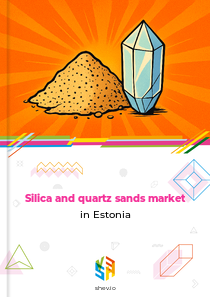







Earlier Report Observations
Between 2018 and 2024, the Estonian market for natural silica and quartz sands experienced significant volatility in volume. Starting at 41 645 t in 2018, market size grew strongly to reach a peak of 56 004 t in 2021, an increase of 34% over three years. This upward trajectory was interrupted only by a moderate contraction in 2020, which was swiftly reversed the following year.
Following the 2021 peak, the market entered a phase of consistent decline, falling to 51 035 t in 2022 and further to 41 213 t in 2024—a total reduction of 26% from the high. Domestic production mirrored this pattern, also peaking in 2021 at 47 200 t before dropping to 33 281 t in 2024. Import volumes, which had surged to 9 407 t in 2019, remained a highly variable component, contributing to the overall market fluctuations.
In value terms, the market followed a similar path, rising from 1.6 million USD in 2018 to a high of 2.2 million USD in 2021, then declining to 1.7 million USD by 2024. The parallel movements in both volume and value indicate that price changes were not the primary driver of the market's overall trend during this period.
Table of content
- 1. Disclaimer
- 2. Terms of use of the report
- 3. Product codes in the statistical classifications used in the report
-
4. Key Market Indicators and Trends
-
4.1. Key Market Indicators
-
4.1.1. In kind
- 4.1.1.1. Production, 2018-2024
- 4.1.1.2. Imports, 2018-2025
- 4.1.1.3. Exports, 2018-2025
- 4.1.1.4. Market size, 2018-2024
-
4.1.2. In value
- 4.1.2.1. Production, 2018-2024
- 4.1.2.2. Imports, 2018-2025
- 4.1.2.3. Exports, 2018-2025
- 4.1.2.4. Market size, 2018-2024
-
4.1.1. In kind
- 4.2. Market Trends and Factors
-
4.1. Key Market Indicators
-
5. Production
-
5.1. Production in Estonia
- 5.1.1. In kind, 2018-2024, t
- 5.1.2. In value, 2018-2024, K $ US
-
5.2. Production in the EU, 2018-2024
- 5.2.1. In kind, 2018-2024, t
- 5.2.2. In value, 2018-2024, K $ US
-
5.1. Production in Estonia
-
6. Exports
-
6.1. Exports (Direct Data)
- 6.1.1. Exports - Total information
-
6.1.2. Exports in kind, t
- 6.1.2.1. Annual dynamics of product's exports from Estonia in kind, 2018-2025, t
- 6.1.2.2. Dynamics of product's exports in kind from Estonia by countries, 2018-2025, t
- 6.1.2.3. Structure of product's exports in kind by countries, 2018-2025
-
6.1.3. Exports in value, K $ US
- 6.1.3.1. Annual dynamics of product's exports from Estonia in value, 2018-2025, K $ US
- 6.1.3.2. Dynamics of product's exports in value from Estonia by countries, 2018-2025, K $ US
- 6.1.3.3. Structure of product's exports in value by countries, 2018-2025
-
6.1.4. Average price of product's exports, $ US/t
- 6.1.4.1. Annual dynamics of average price of product's exports from Estonia, 2018-2025, $ US/t
- 6.1.4.2. Dynamics of average price of product's exports from Estonia by countries, 2018-2025, $ US/t
-
6.2. Exports (Mirror Data)
- 6.2.1. Exports - Total information
-
6.2.2. Exports in kind, t
- 6.2.2.1. Annual dynamics of product's exports from Estonia in kind, 2018-2025, t
- 6.2.2.2. Dynamics of product's exports in kind from Estonia by countries, 2018-2025, t
- 6.2.2.3. Structure of product's exports in kind by countries, 2018-2025
-
6.2.3. Exports in value, K $ US
- 6.2.3.1. Annual dynamics of product's exports from Estonia in value, 2018-2025, K $ US
- 6.2.3.2. Dynamics of product's exports in value from Estonia by countries, 2018-2025, K $ US
- 6.2.3.3. Structure of product's exports in value by countries, 2018-2025
-
6.2.4. Average price of product's exports, $ US/t
- 6.2.4.1. Annual dynamics of average price of product's exports from Estonia, 2018-2025, $ US/t
- 6.2.4.2. Dynamics of average price of product's exports from Estonia by countries, 2018-2025, $ US/t
-
6.1. Exports (Direct Data)
-
7. Imports
-
7.1. Imports (Direct Data)
- 7.1.1. Imports - Total information
-
7.1.2. Imports in kind, t
- 7.1.2.1. Annual dynamics of product's imports to Estonia in kind, 2018-2025, t
- 7.1.2.2. Dynamics of product's imports in kind to Estonia by countries, 2018-2025, t
- 7.1.2.3. Structure of product's imports in kind by countries, 2018-2025
-
7.1.3. Imports in value, K $ US
- 7.1.3.1. Annual dynamics of product's imports to Estonia in value, 2018-2025, K $ US
- 7.1.3.2. Dynamics of product's imports in value to Estonia by countries, 2018-2025, K $ US
- 7.1.3.3. Structure of product's imports in value by countries, 2018-2025
-
7.1.4. Average price of product's imports, $ US/t
- 7.1.4.1. Annual dynamics of average price of product's imports to Estonia, 2018-2025, $ US/t
- 7.1.4.2. Dynamics of average price of product's imports to Estonia by countries, 2018-2025, $ US/t
-
7.2. Imports (Mirror Data)
- 7.2.1. Imports - Total information
-
7.2.2. Imports in kind, t
- 7.2.2.1. Annual dynamics of product's imports to Estonia in kind, 2018-2025, t
- 7.2.2.2. Dynamics of product's imports in kind to Estonia by countries, 2018-2025, t
- 7.2.2.3. Structure of product's imports in kind by countries, 2018-2025
-
7.2.3. Imports in value, K $ US
- 7.2.3.1. Annual dynamics of product's imports to Estonia in value, 2018-2025, K $ US
- 7.2.3.2. Dynamics of product's imports in value to Estonia by countries, 2018-2025, K $ US
- 7.2.3.3. Structure of product's imports in value by countries, 2018-2025
-
7.2.4. Average price of product's imports, $ US/t
- 7.2.4.1. Annual dynamics of average price of product's imports to Estonia, 2018-2025, $ US/t
- 7.2.4.2. Dynamics of average price of product's imports to Estonia by countries, 2018-2025, $ US/t
-
7.1. Imports (Direct Data)
-
8. Trade balance
-
8.1. Trade balance (Direct Data)
- 8.1.1. In kind, t
- 8.1.2. In value, K $ US
-
8.2. Trade balance (Mirror Data)
- 8.2.1. In kind, t
- 8.2.2. In value, K $ US
-
8.1. Trade balance (Direct Data)
-
9. Top buying and selling countries, 2018-2025
-
9.1. Direct Data
- 9.1.1. Import in Value by Countries-buyers
- 9.1.2. Export in Value by Countries-suppliers
-
9.2. Mirror Data
- 9.2.1. Import in Value by Countries-buyers
- 9.2.2. Export in Value by Countries-suppliers
-
9.1. Direct Data
Production silica and quartz sands in Estonia
In value, 2018-2021, K $ US
In 2021, Estonia's production of silica and quartz sands reached a value of 1 807 thousand US dollars, marking a significant increase of 27.7% compared to the previous year. Looking at the period from 2018 to 2021, production grew by 19.5%, which translates to an average annual growth rate of 6.1%. The lowest value was recorded in 2020 at 1 415 thousand US dollars, and that year also saw the largest decline of 7.8%.
Annual dynamics of production in Estonia in value, 2018-2021, K $ US
| Parameter | 2019 | 2020 | 2021 | CAGR | |
|---|---|---|---|---|---|
| 1 | Change from last year | 1.5% | (7.8%) | 27.7% | 6.1% |
In kind, 2018-2021, t
In 2021, Estonia produced 47 200 tonnes of silica and quartz sands, representing a 21.0% increase from the year before. Over the 2018-2021 period, production rose by 15.1%, with a compound annual growth rate of 4.8%. The minimum output was in 2020 at 39 000 tonnes, and the largest decline of 7.1% also occurred that year.
Annual dynamics of production in Estonia in kind, 2018-2021, t
| Parameter | 2019 | 2020 | 2021 | CAGR | |
|---|---|---|---|---|---|
| 1 | Change from last year | 2.4% | (7.1%) | 21.0% | 4.8% |
Exports silica and quartz sands from Estonia
Exports in kind, t
Silica and quartz sands exports from Estonia have declined for the third year in a row. In 2021, exports amounted to just 13 tonnes, a sharp drop of 86.5% from 2020. From 2018 to 2021, exports plummeted by 99.2%, with an average annual decline of 80.0%.
Annual dynamics of product's exports from Estonia in kind, 2018-2021, t
| Parameter | 2019 | 2020 | 2021 | CAGR | |
|---|---|---|---|---|---|
| 1 | Change from last year | (94.0%) | (2.1%) | (86.5%) | (80.0%) |
Between 2018 and 2021, Latvia was the primary buyer of silica and quartz sands from Estonia, accounting for 76.4% of total exports in volume. The remaining share was distributed among a diverse group of other countries.
Structure of product's exports in kind by countries, 2018-2021
World map of product's exports from Estonia in kind, 2018-2021
Exports in value, K $ US
The data shows irregular fluctuations, pointing to a volatile market environment. From 2018 to 2021, the peak-to-trough amplitude was 70 times. In 2021, Estonia exported silica and quartz sands worth 4.7 thousand US dollars, a decrease of 52.3% year-over-year. The largest decline occurred in 2019 at 97.4%, while the largest increase was in 2020 at 15.4%.
Annual dynamics of product's exports from Estonia in value, 2018-2021, K $ US
| Parameter | 2019 | 2020 | 2021 | CAGR | |
|---|---|---|---|---|---|
| 1 | Change from last year | (97.4%) | 15.4% | (52.3%) | (75.7%) |
Throughout 2018-2021, Latvia and Kazakhstan were the main buyers of silica and quartz sands from Estonia in value terms, together making up 82.0% of total exports. Other countries accounted for the rest.
Structure of product's exports in value by countries, 2018-2021
World map of product's exports from Estonia in value, 2018-2021
Imports silica and quartz sands to Estonia
Imports in kind, t
The data indicates irregular changes, reflecting a volatile market. Imports peaked in 2019 and hit their lowest point in 2018, with a 4.1-fold difference between these years. In 2021, Estonia's imports of silica and quartz sands stood at 8 817 tonnes, a substantial increase of 40.9% from the previous year. The maximum volume was recorded in 2019 at 9 407 tonnes. The largest decline of 33.5% was in 2020, while the largest increase of 314.9% occurred in 2019.
Annual dynamics of product's imports to Estonia in kind, 2018-2021, t
| Parameter | 2019 | 2020 | 2021 | CAGR | |
|---|---|---|---|---|---|
| 1 | Change from last year | 314.9% | (33.5%) | 40.9% | 57.3% |
From 2018 to 2021, the main sources for Estonia's imports of silica and quartz sands in volume were Europe, not elsewhere specified (48.9% of imports), Latvia (24.8%), and Finland (16.2%). Together, these markets accounted for 90.0% of total import flows.
Structure of product's imports in kind by countries, 2018-2021
World map of product's imports to Estonia in kind, 2018-2021
Imports in value, K $ US
In 2021, Estonia's imports of silica and quartz sands were valued at 435.8 thousand US dollars, up 27.7% from the previous year. Over the 2018-2021 period, imports increased by 16.6%, with a compound annual growth rate of 5.2%. The minimum value was in 2020 at 341.2 thousand US dollars, while the maximum was in 2019 at 482.2 thousand US dollars. The largest decline of 29.2% was recorded in 2020, and the largest increase of 29.0% was in 2019.
Annual dynamics of product's imports to Estonia in value, 2018-2021, K $ US
| Parameter | 2019 | 2020 | 2021 | CAGR | |
|---|---|---|---|---|---|
| 1 | Change from last year | 29.0% | (29.2%) | 27.7% | 5.2% |
Between 2018 and 2021, Belgium (31.9% of imports in value), Europe, not elsewhere specified (17.3%), and Finland (13.9%) were the leading sources in Estonia's import structure for silica and quartz sands. Combined, they represented 63.2% of total import flows.
Structure of product's imports in value by countries, 2018-2021
World map of product's imports to Estonia in value, 2018-2021
Related Reports

Silica and quartz sands market in Romania
2026-03-29
Silica and quartz sands market in Finland
2026-03-29
Silica and quartz sands market in Lithuania
2026-03-29
Silica and quartz sands market in Greece
2026-03-29
Portland cement market in Estonia
2026-03-29
Stone granules and powder market in Estonia
2026-03-29


Natural sands market in Estonia
2026-03-29
Why Choose Us?
Only Verified Data
No Hidden Costs or Separate Fees
Smarter Subscription Pricing
Contact Our Team
Submit your inquiry using the form below — our team will get back to you within 24 hours.