






"Sub-Saharan Africa" region includes following countries:
 Cabo Verde
 Benin
Benin Gambia
 Ghana
Ghana Guinea
 Côte d'Ivoire
 Liberia
 Mali
Mali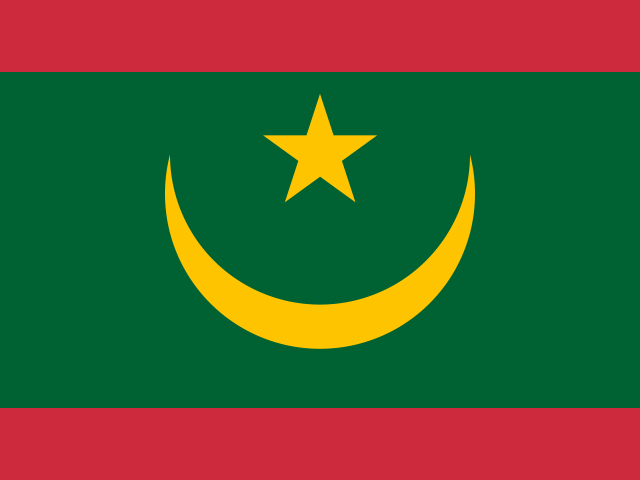 Mauritania
 Niger
Niger Nigeria
 Guinea-Bissau
 Saint Helena, Ascension and Tristan da Cunha
 Senegal
 Sierra Leone
 Togo
Togo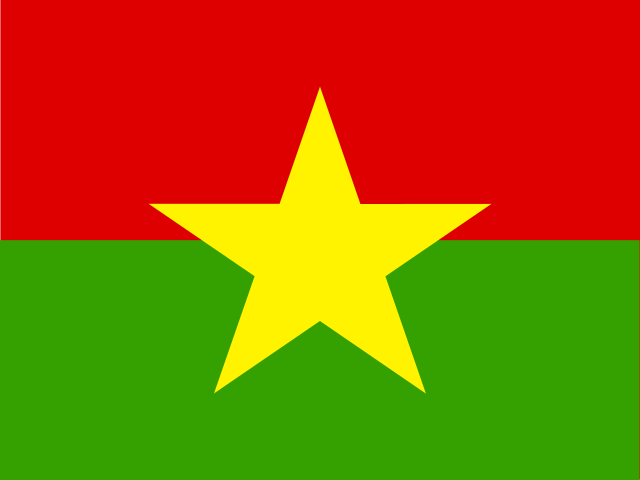 Burkina Faso
 British Indian Ocean Territory
 Burundi
 Comoros
 Mayotte
 Ethiopia
 Eritrea
 French Southern Territories
 Djibouti
 Kenya
Kenya Madagascar
 Malawi
 Mauritius
 Mozambique
 Reunion
 Rwanda
 Seychelles
 Somalia
 Zimbabwe
 South Sudan
 Uganda
 Tanzania
 Zambia
 Angola
 Cameroon
 Central African Republic
 Chad
Chad Congo
Congo Democratic Republic of the Congo
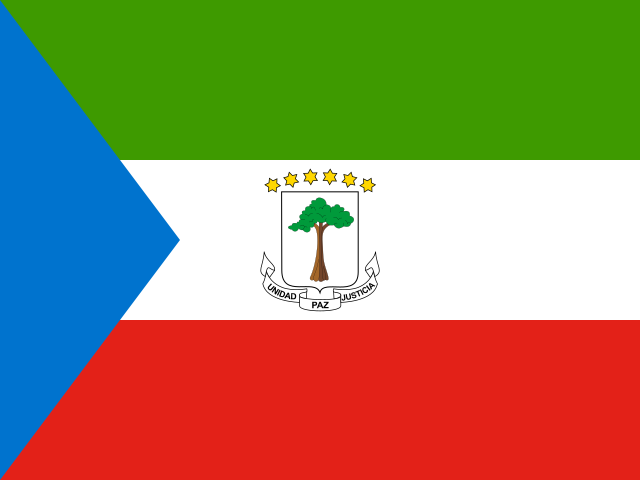 Equatorial Guinea
 Gabon
Gabon Sao Tome and Principe
 Botswana
 Lesotho
 Namibia
 South Africa
 Eswatini
Earlier Report Observations
The market volume for sheep and goat meat in Sub-Saharan Africa grew from 4.1 million tons in 2018 to 4.6 million tons in 2020. This expansion was supported by the significant growth of commercial livestock farming, particularly in Kenya, where production surged by 58% in 2020 driven by rising domestic and export demand.
Following a period of stabilization in 2021, the market volume increased to 4.7 million tons in 2022. This growth was reinforced by stronger demand for fresh processed meat, including goat and sheep meat, across the Middle East and African regions.
Market volume reached 4.9 million tons in 2023, supported by a 7.3% increase in Kenyan production, which was boosted by imports of feeder cattle from Namibia and Botswana. The expansion of cold storage networks in South Africa improved the distribution of fresh and frozen meat. Export growth continued, facilitated by global demand for halal meat and enhancements in cold-chain logistics, although consumer preference in rural areas remained oriented toward freshly slaughtered meat.
Table of content
- 1. Disclaimer
- 2. Terms of use of the report
- 3. Product codes in the statistical classifications used in the report
-
4. Key Market Indicators and Trends
-
4.1. Key Market Indicators
-
4.1.1. In kind
- 4.1.1.1. Production, 2018-2023
- 4.1.1.2. Imports, 2018-2024
- 4.1.1.3. Exports, 2018-2024
- 4.1.1.4. Market size, 2018-2023
-
4.1.2. In value
- 4.1.2.1. Production, 2018-2023
- 4.1.2.2. Imports, 2018-2024
- 4.1.2.3. Exports, 2018-2024
- 4.1.2.4. Market size, 2018-2023
-
4.1.1. In kind
- 4.2. Market Trends and Factors
-
4.1. Key Market Indicators
-
5. Production
-
5.1. Production in Sub-Saharan Africa
- 5.1.1. Annual dynamics of production in Sub-Saharan Africa in kind, 2018-2023, K t
-
5.2. Global production by Country, 2018-2023
- 5.2.1. Annual dynamics of production by macroregions in kind, 2018-2023, K t
- 5.2.2. Dynamics of production structure by macroregions in kind, 2018-2023
- 5.2.3. Annual dynamics of production by country in kind, 2018-2023, K t
- 5.2.4. Structure of production by countries in kind, 2018-2023
- 5.2.5. Dynamics of peoduction structure by countries in kind, 2018-2023
-
5.1. Production in Sub-Saharan Africa
-
6. Imports
-
6.1. Imports (Direct Data*)
- 6.1.1. Imports - Total information
-
6.1.2. Imports in kind, t
- 6.1.2.1. Annual dynamics of product's imports to Cabo Verde in kind, 2018-2024, t
- 6.1.2.2. Dynamics of product's imports in kind to Cabo Verde by countries, 2018-2024, t
- 6.1.2.3. Structure of product's imports in kind by countries, 2018-2024
-
6.1.3. Imports in value, M $ US
- 6.1.3.1. Annual dynamics of product's imports to Cabo Verde in value, 2018-2024, M $ US
- 6.1.3.2. Dynamics of product's imports in value to Cabo Verde by countries, 2018-2024, M $ US
- 6.1.3.3. Structure of product's imports in value by countries, 2018-2024
-
6.1.4. Average price of product's imports, $ US/t
- 6.1.4.1. Annual dynamics of average price of product's imports to Cabo Verde, 2018-2024, $ US/t
- 6.1.4.2. Dynamics of average price of product's imports to Cabo Verde by countries, 2018-2024, $ US/t
-
6.2. Imports (Mirror Data)
- 6.2.1. Imports - Total information
-
6.2.2. Imports in kind, t
- 6.2.2.1. Annual dynamics of product's imports to Cabo Verde in kind, 2018-2024, t
- 6.2.2.2. Dynamics of product's imports in kind to Cabo Verde by countries, 2018-2024, t
- 6.2.2.3. Structure of product's imports in kind by countries, 2018-2024
-
6.2.3. Imports in value, M $ US
- 6.2.3.1. Annual dynamics of product's imports to Cabo Verde in value, 2018-2024, M $ US
- 6.2.3.2. Dynamics of product's imports in value to Cabo Verde by countries, 2018-2024, M $ US
- 6.2.3.3. Structure of product's imports in value by countries, 2018-2024
-
6.2.4. Average price of product's imports, $ US/t
- 6.2.4.1. Annual dynamics of average price of product's imports to Cabo Verde, 2018-2024, $ US/t
- 6.2.4.2. Dynamics of average price of product's imports to Cabo Verde by countries, 2018-2024, $ US/t
-
6.1. Imports (Direct Data*)
-
7. Exports
-
7.1. Exports (Direct Data*)
- 7.1.1. Exports - Total information
-
7.1.2. Exports in kind, t
- 7.1.2.1. Annual dynamics of product's exports from Cabo Verde in kind, 2018-2024, t
- 7.1.2.2. Dynamics of product's exports in kind from Cabo Verde by countries, 2018-2024, t
- 7.1.2.3. Structure of product's exports in kind by countries, 2018-2024
-
7.1.3. Exports in value, M $ US
- 7.1.3.1. Annual dynamics of product's exports from Cabo Verde in value, 2018-2024, M $ US
- 7.1.3.2. Dynamics of product's exports in value from Cabo Verde by countries, 2018-2024, M $ US
- 7.1.3.3. Structure of product's exports in value by countries, 2018-2024
-
7.1.4. Average price of product's exports, $ US/t
- 7.1.4.1. Annual dynamics of average price of product's exports from Cabo Verde, 2018-2024, $ US/t
- 7.1.4.2. Dynamics of average price of product's exports from Cabo Verde by countries, 2018-2024, $ US/t
-
7.2. Exports (Mirror Data)
- 7.2.1. Exports - Total information
-
7.2.2. Exports in kind, t
- 7.2.2.1. Annual dynamics of product's exports from Cabo Verde in kind, 2018-2024, t
- 7.2.2.2. Dynamics of product's exports in kind from Cabo Verde by countries, 2018-2024, t
- 7.2.2.3. Structure of product's exports in kind by countries, 2018-2024
-
7.2.3. Exports in value, M $ US
- 7.2.3.1. Annual dynamics of product's exports from Cabo Verde in value, 2018-2024, M $ US
- 7.2.3.2. Dynamics of product's exports in value from Cabo Verde by countries, 2018-2024, M $ US
- 7.2.3.3. Structure of product's exports in value by countries, 2018-2024
-
7.2.4. Average price of product's exports, $ US/t
- 7.2.4.1. Annual dynamics of average price of product's exports from Cabo Verde, 2018-2024, $ US/t
- 7.2.4.2. Dynamics of average price of product's exports from Cabo Verde by countries, 2018-2024, $ US/t
-
7.1. Exports (Direct Data*)
-
8. Trade balance
-
8.1. Trade balance (Direct Data)
- 8.1.1. In kind, t
- 8.1.2. In value, M $ US
-
8.2. Trade balance (Mirror Data)
- 8.2.1. In kind, t
- 8.2.2. In value, M $ US
-
8.1. Trade balance (Direct Data)
-
9. Top buying and selling countries, 2018-2024
-
9.1. Direct Data
- 9.1.1. Import in Value by Countries-buyers
- 9.1.2. Export in Value by Countries-suppliers
-
9.2. Mirror Data
- 9.2.1. Import in Value by Countries-buyers
- 9.2.2. Export in Value by Countries-suppliers
-
9.1. Direct Data
Production sheep and goat meat in Sub-Saharan Africa
In kind, 2017-2020, K t
Top producers of sheep and goat meat, 2017-2020
World map of production of sheep and goat meat, 2017-2020
Sub-Saharan Africa's sheep and goat meat production has grown for the third year in a row. In 2020, the region produced 4 590 thousand tonnes, marking a 3.3% increase from 2019. Looking at the period from 2017 to 2020, production rose by 17%, which translates to an average annual growth rate of 5.4%.
Annual dynamics of production in Sub-Saharan Africa in kind, 2017-2020, K t
| Parameter | 2018 | 2019 | 2020 | CAGR | |
|---|---|---|---|---|---|
| 1 | Change from last year | 5.2% | 7.6% | 3.3% | 5.4% |
In value, 2017-2020, M $ US
After two years of growth, Sub-Saharan Africa's sheep and goat meat production saw a decline in value. In 2020, the output was valued at 23 588 million US dollars, down 2.3% year-on-year. Between 2017 and 2020, production value increased by 5.3%, equivalent to an annualized rate of 1.7%. The peak value was recorded in 2019 at 24 154 million US dollars, with the largest increase that year at 6.5%.
Annual dynamics of production in Sub-Saharan Africa in value, 2017-2020, M $ US
| Parameter | 2018 | 2019 | 2020 | CAGR | |
|---|---|---|---|---|---|
| 1 | Change from last year | 1.3% | 6.5% | (2.3%) | 1.7% |
Exports sheep and goat meat from Sub-Saharan Africa
Exports in kind, t
In 2020, Sub-Saharan Africa exported 25 648 tonnes of sheep and goat meat, a slight increase of 0.6% compared to 2019. The lowest export volume was in 2019 at 25 483 tonnes, while the highest was in 2018 at 26 312 tonnes. The most significant decline occurred in 2019 with a 3.2% drop, and the largest increase was in 2018 with a 2.2% rise.
Annual dynamics of product's exports from Sub-Saharan Africa in kind, 2017-2020, t
| Parameter | 2018 | 2019 | 2020 | CAGR | |
|---|---|---|---|---|---|
| 1 | Change from last year | 2.2% | (3.2%) | 0.6% | (0.1%) |
From 2017 to 2020, the United Arab Emirates, Saudi Arabia, and Oman were the main destinations for Sub-Saharan Africa's sheep and goat meat exports in volume terms. Together, they accounted for 79.7% of total exports, with the UAE at 51.9%, Saudi Arabia at 23.3%, and Oman at 4.5%.
Structure of product's exports in kind by countries, 2017-2020
World map of product's exports from Sub-Saharan Africa in kind, 2017-2020
Exports in value, M $ US
Sheep and goat meat exports from Sub-Saharan Africa in value terms have declined for the third consecutive year. In 2020, exports totaled 131.8 million US dollars, a moderate decrease of 4.9% from 2019. Over the 2017-2020 period, exports fell by 10.3%, with an average annual decline of 3.6%.
Annual dynamics of product's exports from Sub-Saharan Africa in value, 2017-2020, M $ US
| Parameter | 2018 | 2019 | 2020 | CAGR | |
|---|---|---|---|---|---|
| 1 | Change from last year | (1.6%) | (4.1%) | (4.9%) | (3.6%) |
During 2017-2020, the United Arab Emirates, Saudi Arabia, and Oman dominated Sub-Saharan Africa's sheep and goat meat exports in value, collectively representing 84.0% of total export flows.
Structure of product's exports in value by countries, 2017-2020
World map of product's exports from Sub-Saharan Africa in value, 2017-2020
Imports sheep and goat meat to Sub-Saharan Africa
Imports in kind, t
Sheep and goat meat imports into Sub-Saharan Africa have decreased for the third year in a row. In 2020, imports amounted to 9 771 tonnes, a significant drop of 21.3% from the previous year. From 2017 to 2020, imports fell by 45.4%, with an average annual decline of 18.2%.
Annual dynamics of product's imports to Sub-Saharan Africa in kind, 2017-2020, t
| Parameter | 2018 | 2019 | 2020 | CAGR | |
|---|---|---|---|---|---|
| 1 | Change from last year | (8.9%) | (23.8%) | (21.3%) | (18.2%) |
Between 2017 and 2020, Australia, New Zealand, and Spain were the primary sources for Sub-Saharan Africa's sheep and goat meat imports in volume. Together, they made up 56.4% of total imports, with Australia contributing 39.9%, New Zealand 11.0%, and Spain 5.6%.
Structure of product's imports in kind by countries, 2017-2020
World map of product's imports to Sub-Saharan Africa in kind, 2017-2020
Imports in value, M $ US
Sheep and goat meat imports into Sub-Saharan Africa in value terms have declined for the second consecutive year. In 2020, imports were approximately 44.6 million US dollars, a substantial decrease of 17.3% from the year before. Over the 2017-2020 period, imports dropped by 35.5%, with an average annual decline of 13.6%. The highest value was recorded in 2018 at 69.8 million US dollars, with the largest decline in 2019 at 22.8% and the largest increase in 2018 at 1.1%.
Annual dynamics of product's imports to Sub-Saharan Africa in value, 2017-2020, M $ US
| Parameter | 2018 | 2019 | 2020 | CAGR | |
|---|---|---|---|---|---|
| 1 | Change from last year | 1.1% | (22.8%) | (17.3%) | (13.6%) |
From 2017 to 2020, Australia, New Zealand, and Spain were the key sources for Sub-Saharan Africa's sheep and goat meat imports in value, accounting for 68.5% of total imports. Australia led with 51.1%, followed by New Zealand at 11.2%, and Spain at 6.2%.
Structure of product's imports in value by countries, 2017-2020
World map of product's imports to Sub-Saharan Africa in value, 2017-2020
Related Reports

Sheep and goat meat market in Iran
2026-03-27
Sheep and goat meat market in Barbados
2026-03-27
Sheep and goat meat market in Congo
2026-03-27




Why Choose Us?
Only Verified Data
No Hidden Costs or Separate Fees
Smarter Subscription Pricing
Contact Our Team
Submit your inquiry using the form below — our team will get back to you within 24 hours.