






"Sub-Saharan Africa" region includes following countries:
 Cabo Verde
 Benin
Benin Gambia
 Ghana
Ghana Guinea
 Côte d'Ivoire
 Liberia
 Mali
Mali Mauritania
 Niger
Niger Nigeria
 Guinea-Bissau
 Saint Helena, Ascension and Tristan da Cunha
 Senegal
 Sierra Leone
 Togo
Togo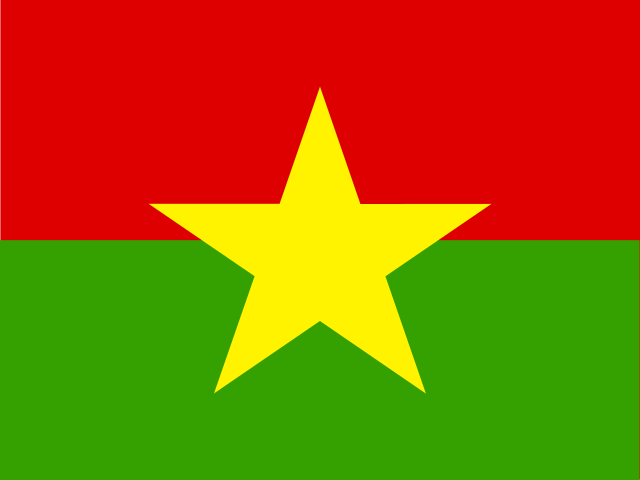 Burkina Faso
 British Indian Ocean Territory
 Burundi
 Comoros
 Mayotte
 Ethiopia
 Eritrea
 French Southern Territories
 Djibouti
 Kenya
Kenya Madagascar
 Malawi
 Mauritius
 Mozambique
 Reunion
 Rwanda
 Seychelles
 Somalia
 Zimbabwe
 South Sudan
 Uganda
 Tanzania
 Zambia
 Angola
 Cameroon
 Central African Republic
 Chad
Chad Congo
Congo Democratic Republic of the Congo
 Equatorial Guinea
 Gabon
Gabon Sao Tome and Principe
 Botswana
 Lesotho
 Namibia
 South Africa
 Eswatini
Earlier Report Observations
Sesame seed production in Ghana increased from 3 026 thousand tons in 2018 to 3 323 thousand tons in 2019. This growth was supported by the launch of the Ghana Commodity Exchange (GCX) for sesame trading, which improved market infrastructure, and by capacity-building partnerships that trained farmers in the Northern regions on good agricultural practices and provided certified seeds.
Production fell sharply to 2 443 thousand tons in 2020, reducing domestic market volume to 1 633 thousand tons. That same year, sesame farming was introduced in the Sissala enclave, where farmers began shifting from maize to sesame due to lower production costs, though this expansion did not prevent the overall decline. The market gradually stabilized, with production recovering to 2 689 thousand tons by 2023, supported by ongoing promotion of sesame as a climate-resilient crop and persistent calls for tax relief and mechanization to enhance value addition.
Throughout the period, sesame maintained its appeal due to high global demand and suitability for marginal soils in Northern Ghana. By 2024, the focus included using seasonal weather forecasts for planting decisions and improving seed sector policies to support farmers.
Table of content
- 1. Disclaimer
- 2. Terms of use of the report
- 3. Product codes in the statistical classifications used in the report
-
4. Key Market Indicators and Trends
-
4.1. Key Market Indicators
-
4.1.1. In kind
- 4.1.1.1. Production, 2018-2023
- 4.1.1.2. Imports, 2018-2024
- 4.1.1.3. Exports, 2018-2024
- 4.1.1.4. Market size, 2018-2023
-
4.1.1. In kind
- 4.2. Market Trends and Factors
-
4.1. Key Market Indicators
-
5. Production
-
5.1. Production in Sub-Saharan Africa
- 5.1.1. Annual dynamics of production in Sub-Saharan Africa in kind, 2018-2023, K t
-
5.2. Global production by Country, 2018-2023
- 5.2.1. Annual dynamics of production by macroregions in kind, 2018-2023, K t
- 5.2.2. Dynamics of production structure by macroregions in kind, 2018-2023
- 5.2.3. Annual dynamics of production by country in kind, 2018-2023, K t
- 5.2.4. Structure of production by countries in kind, 2018-2023
- 5.2.5. Dynamics of peoduction structure by countries in kind, 2018-2023
-
5.1. Production in Sub-Saharan Africa
-
6. Imports
-
6.1. Imports (Direct Data*)
- 6.1.1. Imports - Total information
-
6.1.2. Imports in kind, K t
- 6.1.2.1. Annual dynamics of product's imports to Cabo Verde in kind, 2018-2024, K t
- 6.1.2.2. Dynamics of product's imports in kind to Cabo Verde by countries, 2018-2024, K t
- 6.1.2.3. Structure of product's imports in kind by countries, 2018-2024
-
6.1.3. Imports in value, M $ US
- 6.1.3.1. Annual dynamics of product's imports to Cabo Verde in value, 2018-2024, M $ US
- 6.1.3.2. Dynamics of product's imports in value to Cabo Verde by countries, 2018-2024, M $ US
- 6.1.3.3. Structure of product's imports in value by countries, 2018-2024
-
6.1.4. Average price of product's imports, $ US/t
- 6.1.4.1. Annual dynamics of average price of product's imports to Cabo Verde, 2018-2024, $ US/t
- 6.1.4.2. Dynamics of average price of product's imports to Cabo Verde by countries, 2018-2024, $ US/t
-
6.2. Imports (Mirror Data)
- 6.2.1. Imports - Total information
-
6.2.2. Imports in kind, K t
- 6.2.2.1. Annual dynamics of product's imports to Cabo Verde in kind, 2018-2024, K t
- 6.2.2.2. Dynamics of product's imports in kind to Cabo Verde by countries, 2018-2024, K t
- 6.2.2.3. Structure of product's imports in kind by countries, 2018-2024
-
6.2.3. Imports in value, M $ US
- 6.2.3.1. Annual dynamics of product's imports to Cabo Verde in value, 2018-2024, M $ US
- 6.2.3.2. Dynamics of product's imports in value to Cabo Verde by countries, 2018-2024, M $ US
- 6.2.3.3. Structure of product's imports in value by countries, 2018-2024
-
6.2.4. Average price of product's imports, $ US/t
- 6.2.4.1. Annual dynamics of average price of product's imports to Cabo Verde, 2018-2024, $ US/t
- 6.2.4.2. Dynamics of average price of product's imports to Cabo Verde by countries, 2018-2024, $ US/t
-
6.1. Imports (Direct Data*)
-
7. Exports
-
7.1. Exports (Direct Data*)
- 7.1.1. Exports - Total information
-
7.1.2. Exports in kind, K t
- 7.1.2.1. Annual dynamics of product's exports from Cabo Verde in kind, 2018-2024, K t
- 7.1.2.2. Dynamics of product's exports in kind from Cabo Verde by countries, 2018-2024, K t
- 7.1.2.3. Structure of product's exports in kind by countries, 2018-2024
-
7.1.3. Exports in value, M $ US
- 7.1.3.1. Annual dynamics of product's exports from Cabo Verde in value, 2018-2024, M $ US
- 7.1.3.2. Dynamics of product's exports in value from Cabo Verde by countries, 2018-2024, M $ US
- 7.1.3.3. Structure of product's exports in value by countries, 2018-2024
-
7.1.4. Average price of product's exports, $ US/t
- 7.1.4.1. Annual dynamics of average price of product's exports from Cabo Verde, 2018-2024, $ US/t
- 7.1.4.2. Dynamics of average price of product's exports from Cabo Verde by countries, 2018-2024, $ US/t
-
7.2. Exports (Mirror Data)
- 7.2.1. Exports - Total information
-
7.2.2. Exports in kind, K t
- 7.2.2.1. Annual dynamics of product's exports from Cabo Verde in kind, 2018-2024, K t
- 7.2.2.2. Dynamics of product's exports in kind from Cabo Verde by countries, 2018-2024, K t
- 7.2.2.3. Structure of product's exports in kind by countries, 2018-2024
-
7.2.3. Exports in value, M $ US
- 7.2.3.1. Annual dynamics of product's exports from Cabo Verde in value, 2018-2024, M $ US
- 7.2.3.2. Dynamics of product's exports in value from Cabo Verde by countries, 2018-2024, M $ US
- 7.2.3.3. Structure of product's exports in value by countries, 2018-2024
-
7.2.4. Average price of product's exports, $ US/t
- 7.2.4.1. Annual dynamics of average price of product's exports from Cabo Verde, 2018-2024, $ US/t
- 7.2.4.2. Dynamics of average price of product's exports from Cabo Verde by countries, 2018-2024, $ US/t
-
7.1. Exports (Direct Data*)
-
8. Trade balance
-
8.1. Trade balance (Direct Data)
- 8.1.1. In kind, K t
- 8.1.2. In value, M $ US
-
8.2. Trade balance (Mirror Data)
- 8.2.1. In kind, K t
- 8.2.2. In value, M $ US
-
8.1. Trade balance (Direct Data)
-
9. Top buying and selling countries, 2018-2024
-
9.1. Direct Data
- 9.1.1. Import in Value by Countries-buyers
- 9.1.2. Export in Value by Countries-suppliers
-
9.2. Mirror Data
- 9.2.1. Import in Value by Countries-buyers
- 9.2.2. Export in Value by Countries-suppliers
-
9.1. Direct Data
Production sesame seeds in Sub-Saharan Africa
In kind, 2017-2020, K t
Top producers of sesame seeds, 2017-2020
World map of production of sesame seeds, 2017-2020
Sub-Saharan Africa's sesame seed production volume declined after two years of improvement. In 2019, production reached its peak at 3,323 thousand tons, marking the largest annual increase of 9.8%. However, in 2020, production fell sharply to 2,443 thousand tons, representing a dramatic 26.5% decrease compared to the previous year. Over the period from 2017 to 2020, overall production decreased by 18.4%, with a compound annual growth rate of -6.6%.
Annual dynamics of production in Sub-Saharan Africa in kind, 2017-2020, K t
| Parameter | 2018 | 2019 | 2020 | CAGR | |
|---|---|---|---|---|---|
| 1 | Change from last year | 1.0% | 9.8% | (26.5%) | (6.6%) |
In value, 2017-2020, M $ US
Sub-Saharan Africa's sesame seed production value declined for the second consecutive year. In 2018, production value peaked at 4,003 million US dollars, showing the largest annual increase of 14.8%. The following year, in 2019, it experienced the largest decline of 18.4%. By 2020, production value dropped to 3,023 million US dollars, a decrease of 7.5% from the previous year. From 2017 to 2020, overall production value fell by 13.3%, equating to an annualized decline rate of 4.6%.
Annual dynamics of production in Sub-Saharan Africa in value, 2017-2020, M $ US
| Parameter | 2018 | 2019 | 2020 | CAGR | |
|---|---|---|---|---|---|
| 1 | Change from last year | 14.8% | (18.4%) | (7.5%) | (4.6%) |
Exports sesame seeds from Sub-Saharan Africa
Exports in kind, K t
The data reveals irregular changes, indicating a volatile market environment for sesame seed exports from Sub-Saharan Africa. In 2018, exports hit their lowest point at 584 thousand tons. The following year, in 2019, they surged to a peak of 1,003 thousand tons, marking the largest annual increase of 71.8% and showing a 1.7-fold difference from the 2018 low. In 2020, exports decreased to 819 thousand tons, representing an 18.3% reduction compared to 2019.
Annual dynamics of product's exports from Sub-Saharan Africa in kind, 2017-2020, K t
| Parameter | 2018 | 2019 | 2020 | CAGR | |
|---|---|---|---|---|---|
| 1 | Change from last year | (8.3%) | 71.8% | (18.3%) | 8.8% |
From 2017 to 2020, the leading destinations for sesame seed exports from Sub-Saharan Africa in volume terms were China, Japan, and Israel. China accounted for 32.3% of exports, Japan for 19.3%, and Israel for 7.1%. Together, these three countries represented 58.7% of total export flows.
Structure of product's exports in kind by countries, 2017-2020
World map of product's exports from Sub-Saharan Africa in kind, 2017-2020
Exports in value, M $ US
Sesame seed exports from Sub-Saharan Africa increased for the third consecutive year in value terms. In 2020, exports totaled 1,014 million US dollars, showing a slight rise of 2.8% compared to the previous year. Over the period from 2017 to 2020, export value grew by 36.8%, with a compound annual growth rate of 11.0%.
Annual dynamics of product's exports from Sub-Saharan Africa in value, 2017-2020, M $ US
| Parameter | 2018 | 2019 | 2020 | CAGR | |
|---|---|---|---|---|---|
| 1 | Change from last year | 4.2% | 27.7% | 2.8% | 11.0% |
From 2017 to 2020, China, Japan, and Israel remained the main destinations for sesame seed exports from Sub-Saharan Africa in value terms. China accounted for 33.5% of export value, Japan for 12.6%, and Israel for 9.2%. Collectively, these three countries represented 55.4% of total export value.
Structure of product's exports in value by countries, 2017-2020
World map of product's exports from Sub-Saharan Africa in value, 2017-2020
Imports sesame seeds to Sub-Saharan Africa
Imports in kind, K t
The market exhibited an unstable trend throughout the timeframe for sesame seed imports into Sub-Saharan Africa. In 2019, imports dropped to their minimum of 5 thousand tons, marking the largest annual decline of 33.8%. The following year, in 2020, imports surged to a peak of 9 thousand tons, showing a steep gain of 99.4% compared to 2019 and a 2-fold shift from the previous year's low.
Annual dynamics of product's imports to Sub-Saharan Africa in kind, 2017-2020, K t
| Parameter | 2018 | 2019 | 2020 | CAGR | |
|---|---|---|---|---|---|
| 1 | Change from last year | (10.5%) | (33.8%) | 99.4% | 5.7% |
Over the period from 2017 to 2020, India and Mexico made the largest contribution to sesame seed imports into Sub-Saharan Africa in volume terms, together representing 5.9% of total import flows.
Structure of product's imports in kind by countries, 2017-2020
World map of product's imports to Sub-Saharan Africa in kind, 2017-2020
Imports in value, M $ US
After a two-year decline, sesame seed imports into Sub-Saharan Africa increased in value terms. In 2019, imports hit their lowest point at 10 million US dollars, with the largest annual decline of 19.8%. In 2020, imports rose to 17 million US dollars, up by 69.7% compared to the previous year. From 2017 to 2020, overall import value increased by 31.7%, equating to an annualized growth rate of 9.6%.
Annual dynamics of product's imports to Sub-Saharan Africa in value, 2017-2020, M $ US
| Parameter | 2018 | 2019 | 2020 | CAGR | |
|---|---|---|---|---|---|
| 1 | Change from last year | (3.3%) | (19.8%) | 69.7% | 9.6% |
The structure of sesame seed imports into Sub-Saharan Africa in value terms from 2017 to 2020 can be described as diversified. India accounted for 16.0% of import value, Mexico for 2.4%, and the United States for 0.9%. Together, these three countries represented just 19.3% of total import flows, with no single country holding a clearly dominant position.
Structure of product's imports in value by countries, 2017-2020
World map of product's imports to Sub-Saharan Africa in value, 2017-2020
Related Reports

Sesame seeds market in Eastern Africa
2026-03-28
Sesame seeds market in Central America
2026-03-28
Sesame seeds market in Cambodia
2026-03-28
2026-03-28

Melon seeds market in Sub-Saharan Africa
2026-03-28



Safflower seeds market in Sub-Saharan Africa
2026-03-28
In-depth market research on this product
Global Sesame Seeds Market 2021–2031: Size, Share, Trends and Forecast
Global market report: size, trends and forecast to 2031 · 215 pages
Why Choose Us?
Only Verified Data
No Hidden Costs or Separate Fees
Smarter Subscription Pricing
Contact Our Team
Submit your inquiry using the form below — our team will get back to you within 24 hours.