






"SADC" region includes following countries:
 Angola
 Botswana
 Comoros
 Democratic Republic of the Congo
 Eswatini
 Lesotho
 Madagascar
 Malawi
 Mauritius
 Mozambique
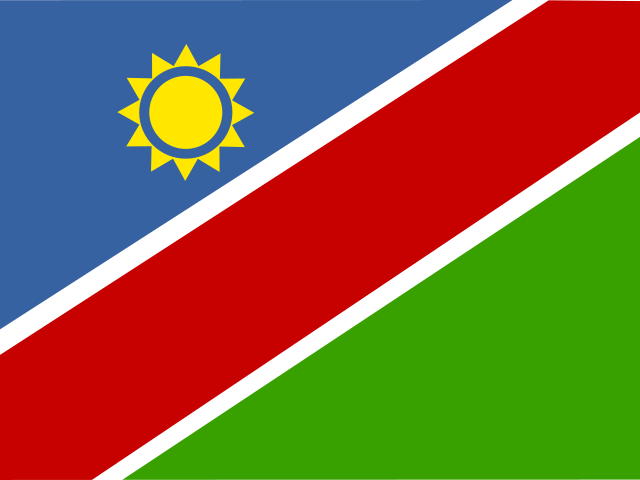 Namibia
 Seychelles
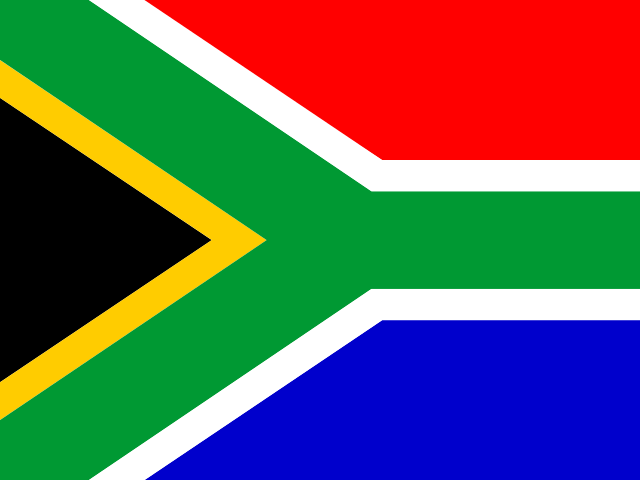 South Africa
 Tanzania
 Zambia
 Zimbabwe
Earlier Report Observations
Primary sugar crops production in the SADC region reached 55 220 thousand tonnes in 2019, its highest point in the period, before beginning a multi-year decline. This downturn was accelerated in 2020 by the COVID-19 pandemic, which disrupted global demand and altered consumer purchasing behavior for sugary foods. A concurrent, long-term shift in consumer preferences towards healthier diets also reduced domestic sugar consumption in key markets like South Africa, placing sustained pressure on the industry.
The sector faced persistent structural challenges including high input costs, recurring droughts, and infrastructure limitations, which particularly constrained small-scale growers. In strategic response, the South African sugar industry published its Sugarcane Value Chain Master Plan to 2030, aiming to improve profitability through crop and value chain diversification. A rebound in global sugar prices during 2022 provided some market support, leading to a modest production recovery to 52 155 thousand tonnes, though this was tempered by sharply rising costs for fuel and fertilizers. Production in 2023 settled at 51 318 thousand tonnes as the market adjusted to these volatile cost and price dynamics.
Table of content
- 1. Disclaimer
- 2. Terms of use of the report
- 3. Product codes in the statistical classifications used in the report
-
4. Key Market Indicators and Trends
-
4.1. Key Market Indicators
-
4.1.1. In kind
- 4.1.1.1. Production, 2018-2023
- 4.1.1.2. Imports, 2018-2024
- 4.1.1.3. Exports, 2018-2024
- 4.1.1.4. Market size, 2018-2023
-
4.1.1. In kind
- 4.2. Market Trends and Factors
-
4.1. Key Market Indicators
-
5. Production
-
5.1. Production in SADC
- 5.1.1. Annual dynamics of production in SADC in kind, 2018-2023, K t
-
5.2. Global production by Country, 2018-2023
- 5.2.1. Annual dynamics of production by macroregions in kind, 2018-2023, K t
- 5.2.2. Dynamics of production structure by macroregions in kind, 2018-2023
- 5.2.3. Annual dynamics of production by country in kind, 2018-2023, K t
- 5.2.4. Structure of production by countries in kind, 2018-2023
- 5.2.5. Dynamics of peoduction structure by countries in kind, 2018-2023
-
5.1. Production in SADC
-
6. Exports
-
6.1. Exports (Direct Data*)
- 6.1.1. Exports - Total information
-
6.1.2. Exports in kind, t
- 6.1.2.1. Annual dynamics of product's exports from Angola in kind, 2018-2024, t
- 6.1.2.2. Dynamics of product's exports in kind from Angola by countries, 2018-2024, t
- 6.1.2.3. Structure of product's exports in kind by countries, 2018-2024
-
6.1.3. Exports in value, K $ US
- 6.1.3.1. Annual dynamics of product's exports from Angola in value, 2018-2024, K $ US
- 6.1.3.2. Dynamics of product's exports in value from Angola by countries, 2018-2024, K $ US
- 6.1.3.3. Structure of product's exports in value by countries, 2018-2024
-
6.1.4. Average price of product's exports, $ US/kg
- 6.1.4.1. Annual dynamics of average price of product's exports from Angola, 2018-2024, $ US/kg
- 6.1.4.2. Dynamics of average price of product's exports from Angola by countries, 2018-2024, $ US/kg
-
6.2. Exports (Mirror Data)
- 6.2.1. Exports - Total information
-
6.2.2. Exports in kind, t
- 6.2.2.1. Annual dynamics of product's exports from Angola in kind, 2018-2024, t
- 6.2.2.2. Dynamics of product's exports in kind from Angola by countries, 2018-2024, t
- 6.2.2.3. Structure of product's exports in kind by countries, 2018-2024
-
6.2.3. Exports in value, K $ US
- 6.2.3.1. Annual dynamics of product's exports from Angola in value, 2018-2024, K $ US
- 6.2.3.2. Dynamics of product's exports in value from Angola by countries, 2018-2024, K $ US
- 6.2.3.3. Structure of product's exports in value by countries, 2018-2024
-
6.2.4. Average price of product's exports, $ US/kg
- 6.2.4.1. Annual dynamics of average price of product's exports from Angola, 2018-2024, $ US/kg
- 6.2.4.2. Dynamics of average price of product's exports from Angola by countries, 2018-2024, $ US/kg
-
6.1. Exports (Direct Data*)
-
7. Imports
-
7.1. Imports (Direct Data*)
- 7.1.1. Imports - Total information
-
7.1.2. Imports in kind, t
- 7.1.2.1. Annual dynamics of product's imports to Angola in kind, 2018-2024, t
- 7.1.2.2. Dynamics of product's imports in kind to Angola by countries, 2018-2024, t
- 7.1.2.3. Structure of product's imports in kind by countries, 2018-2024
-
7.1.3. Imports in value, K $ US
- 7.1.3.1. Annual dynamics of product's imports to Angola in value, 2018-2024, K $ US
- 7.1.3.2. Dynamics of product's imports in value to Angola by countries, 2018-2024, K $ US
- 7.1.3.3. Structure of product's imports in value by countries, 2018-2024
-
7.1.4. Average price of product's imports, $ US/kg
- 7.1.4.1. Annual dynamics of average price of product's imports to Angola, 2018-2024, $ US/kg
- 7.1.4.2. Dynamics of average price of product's imports to Angola by countries, 2018-2024, $ US/kg
-
7.2. Imports (Mirror Data)
- 7.2.1. Imports - Total information
-
7.2.2. Imports in kind, t
- 7.2.2.1. Annual dynamics of product's imports to Angola in kind, 2018-2024, t
- 7.2.2.2. Dynamics of product's imports in kind to Angola by countries, 2018-2024, t
- 7.2.2.3. Structure of product's imports in kind by countries, 2018-2024
-
7.2.3. Imports in value, K $ US
- 7.2.3.1. Annual dynamics of product's imports to Angola in value, 2018-2024, K $ US
- 7.2.3.2. Dynamics of product's imports in value to Angola by countries, 2018-2024, K $ US
- 7.2.3.3. Structure of product's imports in value by countries, 2018-2024
-
7.2.4. Average price of product's imports, $ US/kg
- 7.2.4.1. Annual dynamics of average price of product's imports to Angola, 2018-2024, $ US/kg
- 7.2.4.2. Dynamics of average price of product's imports to Angola by countries, 2018-2024, $ US/kg
-
7.1. Imports (Direct Data*)
-
8. Trade balance
-
8.1. Trade balance (Direct Data)
- 8.1.1. In kind, t
- 8.1.2. In value, K $ US
-
8.2. Trade balance (Mirror Data)
- 8.2.1. In kind, t
- 8.2.2. In value, K $ US
-
8.1. Trade balance (Direct Data)
-
9. Top buying and selling countries, 2018-2024
-
9.1. Direct Data
- 9.1.1. Import in Value by Countries-buyers
- 9.1.2. Export in Value by Countries-suppliers
-
9.2. Mirror Data
- 9.2.1. Import in Value by Countries-buyers
- 9.2.2. Export in Value by Countries-suppliers
-
9.1. Direct Data
Production primary sugar crops in SADC
In kind, 2017-2020, K t
Top producers of primary sugar crops, 2017-2020
World map of production of primary sugar crops, 2017-2020
Primary sugar crops production in SADC experienced a decline after two consecutive years of growth. In 2019, production reached its peak at 55 220 K t, but then fell by 4.7% to 52 651 K t in 2020. Over the 2017-2020 period, overall production grew by 3%, representing a compound annual growth rate of 1.0%. The most significant year-on-year increase occurred in 2018, when production rose by 4.4%.
Annual dynamics of production in SADC in kind, 2017-2020, K t
| Parameter | 2018 | 2019 | 2020 | CAGR | |
|---|---|---|---|---|---|
| 1 | Change from last year | 4.4% | 3.5% | (4.7%) | 1.0% |
Exports primary sugar crops from SADC
Exports in kind, t
The export market for primary sugar crops from SADC demonstrated considerable volatility during the observed period. In 2017, exports hit their lowest point, while 2019 saw the peak at 127.1 t, representing a staggering 5 410-fold difference between these two years. In 2020, export volumes declined to 87.6 t, marking a 31.1% decrease compared to the previous year. The most dramatic increase occurred in 2018, with exports surging by 72 972.2%.
Annual dynamics of product's exports from SADC in kind, 2017-2020, t
| Parameter | 2018 | 2019 | 2020 | CAGR | |
|---|---|---|---|---|---|
| 1 | Change from last year | 72 972.2% | 640.3% | (31.1%) | 1 450.7% |
From 2017 to 2020, Malta consistently served as the primary export partner for SADC's primary sugar crops in kind, accounting for 3.2% of total export flows.
Structure of product's exports in kind by countries, 2017-2020
World map of product's exports from SADC in kind, 2017-2020
Exports in value, K $ US
The export market in value terms exhibited notable volatility throughout the period. In 2018, export values reached their minimum at 16.4 K $ US, while 2019 saw the maximum at 115.6 K $ US, representing a 7-fold difference. In 2020, export values totaled 111.8 K $ US, showing a moderate year-over-year decline of 3.3%. The most significant decrease occurred in 2018, falling by 27.8%, while the largest increase was recorded in 2019, surging by 604.9%.
Annual dynamics of product's exports from SADC in value, 2017-2020, K $ US
| Parameter | 2018 | 2019 | 2020 | CAGR | |
|---|---|---|---|---|---|
| 1 | Change from last year | (27.8%) | 604.9% | (3.3%) | 70.1% |
During the 2017-2020 period, Pakistan, Côte d'Ivoire, and the Netherlands emerged as the main markets for SADC's primary sugar crops exports in value terms. Pakistan accounted for 14.4% of export value, Côte d'Ivoire for 4.7%, and the Netherlands for 1.4%. Together, these three markets represented 20.5% of total export flows.
Structure of product's exports in value by countries, 2017-2020
World map of product's exports from SADC in value, 2017-2020
Imports primary sugar crops to SADC
Imports in kind, t
Import volumes in kind showed significant volatility during these years. In 2017, imports reached their minimum, while 2018 saw the maximum at 289.3 t, representing a 117-fold difference. In 2020, import volumes declined to 49.9 t, marking a 35.7% decrease compared to 2019. The most dramatic increase occurred in 2018, with imports surging by 11 632.7%, while the largest decline was recorded in 2019, falling by 73.2%.
Annual dynamics of product's imports to SADC in kind, 2017-2020, t
| Parameter | 2018 | 2019 | 2020 | CAGR | |
|---|---|---|---|---|---|
| 1 | Change from last year | 11 632.7% | (73.2%) | (35.7%) | 172.6% |
From 2017 to 2020, the United Arab Emirates, Belgium, and Portugal formed the key group of import partners for SADC's primary sugar crops in kind. The United Arab Emirates accounted for 3.4% of import volumes, Belgium for 2.9%, and Portugal for 1.6%. Together, these three partners represented 8.0% of total import flows.
Structure of product's imports in kind by countries, 2017-2020
World map of product's imports to SADC in kind, 2017-2020
Imports in value, K $ US
The import market in value terms displayed considerable volatility over the observed period. In 2020, import values reached their minimum at 30.2 K $ US, while 2018 saw the maximum at 136.0 K $ US, representing a 4.5-fold difference. In 2020, import values showed a dramatic year-over-year decline of 54.2% compared to 2019. The most significant increase occurred in 2018, with import values surging by 197.4%.
Annual dynamics of product's imports to SADC in value, 2017-2020, K $ US
| Parameter | 2018 | 2019 | 2020 | CAGR | |
|---|---|---|---|---|---|
| 1 | Change from last year | 197.4% | (51.5%) | (54.2%) | (12.9%) |
Throughout the 2017-2020 period, the geographical structure of imports in value terms was highly diversified. Belgium accounted for 7.9% of import value, the United Arab Emirates for 1.6%, and France for 1.0%. Together, these three countries represented only 10.6% of total import flows, with the remaining 89.4% distributed among numerous smaller partner countries.
Structure of product's imports in value by countries, 2017-2020
World map of product's imports to SADC in value, 2017-2020
Related Reports

Primary sugar crops market in MERCOSUR
2026-03-30
Primary sugar crops market in Myanmar
2026-03-30
Primary sugar crops market in Niger
2026-03-30
Primary sugar crops market in Nigeria
2026-03-30
Sunflower seeds market in SADC
2026-03-28

2026-03-28
Why Choose Us?
Only Verified Data
No Hidden Costs or Separate Fees
Smarter Subscription Pricing
Contact Our Team
Submit your inquiry using the form below — our team will get back to you within 24 hours.