






"Sub-Saharan Africa" region includes following countries:
 Cabo Verde
 Benin
Benin Gambia
 Ghana
Ghana Guinea
 Côte d'Ivoire
 Liberia
 Mali
Mali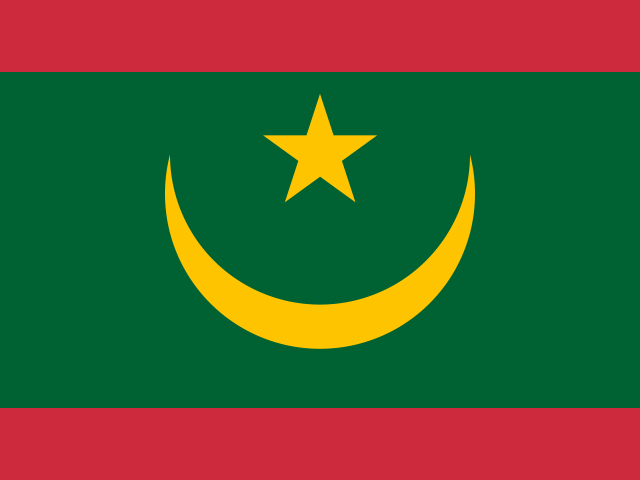 Mauritania
 Niger
Niger Nigeria
 Guinea-Bissau
 Saint Helena, Ascension and Tristan da Cunha
 Senegal
 Sierra Leone
 Togo
Togo Burkina Faso
 British Indian Ocean Territory
 Burundi
 Comoros
 Mayotte
 Ethiopia
 Eritrea
 French Southern Territories
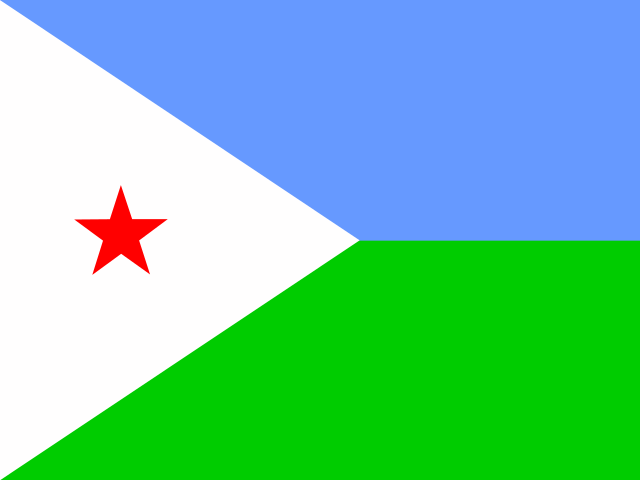 Djibouti
 Kenya
Kenya Madagascar
 Malawi
 Mauritius
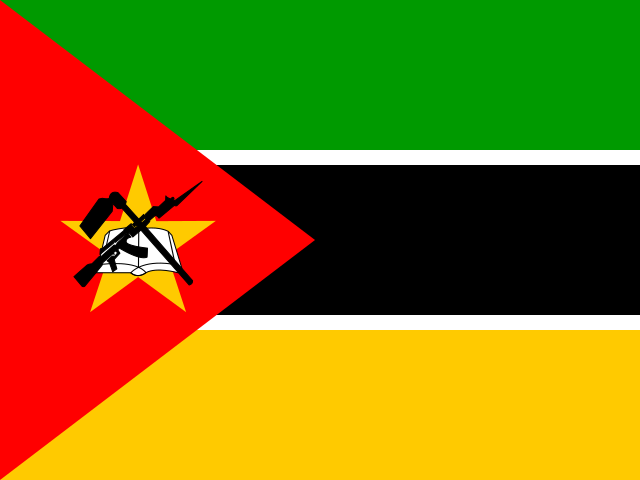 Mozambique
 Reunion
 Rwanda
 Seychelles
 Somalia
 Zimbabwe
 South Sudan
 Uganda
 Tanzania
 Zambia
 Angola
 Cameroon
 Central African Republic
 Chad
Chad Congo
Congo Democratic Republic of the Congo
 Equatorial Guinea
 Gabon
Gabon Sao Tome and Principe
 Botswana
 Lesotho
 Namibia
 South Africa
 Eswatini
Earlier Report Observations
The market for prepared or preserved poultry meat in Sub-Saharan Africa began the period with substantial import-driven growth. In 2018, Angola's rise as a major importer of US poultry contributed to regional imports of 18 561 t. The following year, rising urban population growth increased demand, pushing imports to 32 657 t and lifting the total market volume to 38 830 t, while protective tariff measures in countries like South Africa aimed to shield local producers.
A sharp contraction in imports during 2020 reduced the market volume to 19 533 t. By 2021, intensifying international meat trade, fueled by strong population growth and regional demand, helped imports recover, supporting a market volume of 20 965 t. Regional trade policies, such as those within the Economic and Monetary Community of Central Africa, continued to influence tariff structures and market access.
Local production surged in 2022 to 9 079 t, boosted by strategic acquisitions in the animal feed sector, like Olam Agri in Senegal, and local facility development by international companies such as Nutreco, which expanded production capacity and drove the market volume to 24 965 t. However, in 2023, production fell to 6 629 t and the market shrank to 19 218 t, amid growing urban consumption of ready-to-eat products and ongoing volatility in grain prices affecting feed costs.
Table of content
- 1. Disclaimer
- 2. Terms of use of the report
- 3. Product codes in the statistical classifications used in the report
-
4. Key Market Indicators and Trends
-
4.1. Key Market Indicators
-
4.1.1. In kind
- 4.1.1.1. Production, 2018-2023
- 4.1.1.2. Imports, 2018-2024
- 4.1.1.3. Exports, 2018-2024
- 4.1.1.4. Market size, 2018-2023
-
4.1.1. In kind
- 4.2. Market Trends and Factors
-
4.1. Key Market Indicators
-
5. Production
-
5.1. Production in Sub-Saharan Africa
- 5.1.1. Annual dynamics of production in Sub-Saharan Africa in kind, 2018-2023, t
-
5.2. Global production by Country, 2018-2023
- 5.2.1. Annual dynamics of production by macroregions in kind, 2018-2023, t
- 5.2.2. Dynamics of production structure by macroregions in kind, 2018-2023
- 5.2.3. Annual dynamics of production by country in kind, 2018-2023, t
- 5.2.4. Structure of production by countries in kind, 2018-2023
- 5.2.5. Dynamics of peoduction structure by countries in kind, 2018-2023
-
5.1. Production in Sub-Saharan Africa
-
6. Imports
-
6.1. Imports (Direct Data*)
- 6.1.1. Imports - Total information
-
6.1.2. Imports in kind, t
- 6.1.2.1. Annual dynamics of product's imports to Cabo Verde in kind, 2018-2024, t
- 6.1.2.2. Dynamics of product's imports in kind to Cabo Verde by countries, 2018-2024, t
- 6.1.2.3. Structure of product's imports in kind by countries, 2018-2024
-
6.1.3. Imports in value, K $ US
- 6.1.3.1. Annual dynamics of product's imports to Cabo Verde in value, 2018-2024, K $ US
- 6.1.3.2. Dynamics of product's imports in value to Cabo Verde by countries, 2018-2024, K $ US
- 6.1.3.3. Structure of product's imports in value by countries, 2018-2024
-
6.1.4. Average price of product's imports, $ US/t
- 6.1.4.1. Annual dynamics of average price of product's imports to Cabo Verde, 2018-2024, $ US/t
- 6.1.4.2. Dynamics of average price of product's imports to Cabo Verde by countries, 2018-2024, $ US/t
-
6.2. Imports (Mirror Data)
- 6.2.1. Imports - Total information
-
6.2.2. Imports in kind, t
- 6.2.2.1. Annual dynamics of product's imports to Cabo Verde in kind, 2018-2024, t
- 6.2.2.2. Dynamics of product's imports in kind to Cabo Verde by countries, 2018-2024, t
- 6.2.2.3. Structure of product's imports in kind by countries, 2018-2024
-
6.2.3. Imports in value, K $ US
- 6.2.3.1. Annual dynamics of product's imports to Cabo Verde in value, 2018-2024, K $ US
- 6.2.3.2. Dynamics of product's imports in value to Cabo Verde by countries, 2018-2024, K $ US
- 6.2.3.3. Structure of product's imports in value by countries, 2018-2024
-
6.2.4. Average price of product's imports, $ US/t
- 6.2.4.1. Annual dynamics of average price of product's imports to Cabo Verde, 2018-2024, $ US/t
- 6.2.4.2. Dynamics of average price of product's imports to Cabo Verde by countries, 2018-2024, $ US/t
-
6.1. Imports (Direct Data*)
-
7. Exports
-
7.1. Exports (Direct Data*)
- 7.1.1. Exports - Total information
-
7.1.2. Exports in kind, t
- 7.1.2.1. Annual dynamics of product's exports from Cabo Verde in kind, 2018-2024, t
- 7.1.2.2. Dynamics of product's exports in kind from Cabo Verde by countries, 2018-2024, t
- 7.1.2.3. Structure of product's exports in kind by countries, 2018-2024
-
7.1.3. Exports in value, K $ US
- 7.1.3.1. Annual dynamics of product's exports from Cabo Verde in value, 2018-2024, K $ US
- 7.1.3.2. Dynamics of product's exports in value from Cabo Verde by countries, 2018-2024, K $ US
- 7.1.3.3. Structure of product's exports in value by countries, 2018-2024
-
7.1.4. Average price of product's exports, $ US/t
- 7.1.4.1. Annual dynamics of average price of product's exports from Cabo Verde, 2018-2024, $ US/t
- 7.1.4.2. Dynamics of average price of product's exports from Cabo Verde by countries, 2018-2024, $ US/t
-
7.2. Exports (Mirror Data)
- 7.2.1. Exports - Total information
-
7.2.2. Exports in kind, t
- 7.2.2.1. Annual dynamics of product's exports from Cabo Verde in kind, 2018-2024, t
- 7.2.2.2. Dynamics of product's exports in kind from Cabo Verde by countries, 2018-2024, t
- 7.2.2.3. Structure of product's exports in kind by countries, 2018-2024
-
7.2.3. Exports in value, K $ US
- 7.2.3.1. Annual dynamics of product's exports from Cabo Verde in value, 2018-2024, K $ US
- 7.2.3.2. Dynamics of product's exports in value from Cabo Verde by countries, 2018-2024, K $ US
- 7.2.3.3. Structure of product's exports in value by countries, 2018-2024
-
7.2.4. Average price of product's exports, $ US/t
- 7.2.4.1. Annual dynamics of average price of product's exports from Cabo Verde, 2018-2024, $ US/t
- 7.2.4.2. Dynamics of average price of product's exports from Cabo Verde by countries, 2018-2024, $ US/t
-
7.1. Exports (Direct Data*)
-
8. Trade balance
-
8.1. Trade balance (Direct Data)
- 8.1.1. In kind, t
- 8.1.2. In value, K $ US
-
8.2. Trade balance (Mirror Data)
- 8.2.1. In kind, t
- 8.2.2. In value, K $ US
-
8.1. Trade balance (Direct Data)
-
9. Top buying and selling countries, 2018-2024
-
9.1. Direct Data
- 9.1.1. Import in Value by Countries-buyers
- 9.1.2. Export in Value by Countries-suppliers
-
9.2. Mirror Data
- 9.2.1. Import in Value by Countries-buyers
- 9.2.2. Export in Value by Countries-suppliers
-
9.1. Direct Data
Production prepared or preserved poultry meat or offal in Sub-Saharan Africa
In kind, 2017-2020, t
Top producers of prepared or preserved poultry meat or offal, 2017-2020
World map of production of prepared or preserved poultry meat or offal, 2017-2020
Following two consecutive years of decline, Sub-Saharan Africa's production of prepared or preserved poultry meat or offal rebounded in 2020. Output reached 7 170 tonnes, marking a 7.3% increase compared to the previous year. The lowest production level was recorded in 2019 at 6 681 tonnes, while the most significant annual decline occurred in 2018 at 3.0%.
Annual dynamics of production in Sub-Saharan Africa in kind, 2017-2020, t
| Parameter | 2018 | 2019 | 2020 | CAGR | |
|---|---|---|---|---|---|
| 1 | Change from last year | (3.0%) | (3.0%) | 7.3% | 0.3% |
Exports prepared or preserved poultry meat or offal from Sub-Saharan Africa
Exports in kind, t
Export volumes experienced notable fluctuations throughout the period. The lowest point was recorded in 2019 at 507 tonnes, while shipments peaked in 2020 at 1 575 tonnes, representing a substantial 210.4% year-over-year increase. This created a 3.1-fold difference between the two years. The most significant decline occurred in 2019, when exports fell by 48.3%.
Annual dynamics of product's exports from Sub-Saharan Africa in kind, 2017-2020, t
| Parameter | 2018 | 2019 | 2020 | CAGR | |
|---|---|---|---|---|---|
| 1 | Change from last year | (28.0%) | (48.3%) | 210.4% | 4.9% |
Between 2017 and 2020, Sub-Saharan Africa's prepared or preserved poultry meat or offal exports showed relatively low concentration. The United Arab Emirates accounted for 11.4% of export volumes, Special Categories represented 3.9%, and Qatar contributed 1.8%. Together, these three destinations captured just 17.1% of total export flows.
Structure of product's exports in kind by countries, 2017-2020
World map of product's exports from Sub-Saharan Africa in kind, 2017-2020
Exports in value, K $ US
Export values followed a different pattern than volumes. The minimum value was recorded in 2018 at 6 036 thousand US dollars, while the maximum occurred in 2019 at 8 823 thousand US dollars. In 2020, exports declined to 6 118 thousand US dollars, representing a 30.7% decrease from the previous year. Over the entire 2017-2020 period, export values fell by 12.1%, equivalent to a 4.2% compound annual decline. The most significant increase occurred in 2019 at 46.2%.
Annual dynamics of product's exports from Sub-Saharan Africa in value, 2017-2020, K $ US
| Parameter | 2018 | 2019 | 2020 | CAGR | |
|---|---|---|---|---|---|
| 1 | Change from last year | (13.3%) | 46.2% | (30.7%) | (4.2%) |
During the 2017-2020 period, the United Arab Emirates accounted for 11.7% of export value, Special Categories represented 5.7%, and Bunkers contributed 2.0%. While these were important buyers, their combined share reached only 19.5% of total export value, with the remaining 80.5% distributed among numerous other trading partners.
Structure of product's exports in value by countries, 2017-2020
World map of product's exports from Sub-Saharan Africa in value, 2017-2020
Imports prepared or preserved poultry meat or offal to Sub-Saharan Africa
Imports in kind, t
Import volumes demonstrated considerable volatility during the observed period. The lowest level was recorded in 2017, while imports peaked in 2019 at 32 657 tonnes. In 2020, imports declined sharply to 13 937 tonnes, representing a 57.3% decrease from the previous year. This created a 2.5-fold difference between the highest and lowest years. The most significant increase occurred in 2019 at 75.9%.
Annual dynamics of product's imports to Sub-Saharan Africa in kind, 2017-2020, t
| Parameter | 2018 | 2019 | 2020 | CAGR | |
|---|---|---|---|---|---|
| 1 | Change from last year | 43.9% | 75.9% | (57.3%) | 2.6% |
Between 2017 and 2020, Brazil dominated Sub-Saharan Africa's prepared or preserved poultry meat or offal imports, accounting for 47.0% of import volumes. France contributed 8.1%, while the Netherlands supplied 6.8%. Together, these three countries comprised 61.8% of total import volumes.
Structure of product's imports in kind by countries, 2017-2020
World map of product's imports to Sub-Saharan Africa in kind, 2017-2020
Imports in value, K $ US
After two years of growth, import values declined in 2020. The maximum value was recorded in 2019 at 43 630 thousand US dollars, while 2020 imports fell to 33 397 thousand US dollars, representing a 23.5% decrease from the previous year. Over the entire 2017-2020 period, import values increased by 8.3%, equivalent to a 2.7% compound annual growth rate. The most significant increase occurred in 2019 at 38.7%.
Annual dynamics of product's imports to Sub-Saharan Africa in value, 2017-2020, K $ US
| Parameter | 2018 | 2019 | 2020 | CAGR | |
|---|---|---|---|---|---|
| 1 | Change from last year | 2.0% | 38.7% | (23.5%) | 2.7% |
The geographical structure of import values was highly diversified between 2017 and 2020. Brazil accounted for 22.1% of import value, France represented 12.1%, and the Netherlands contributed 10.1%. Together, these three countries comprised just 44.3% of total import value, with the remaining 55.7% distributed among numerous smaller trading partners.
Structure of product's imports in value by countries, 2017-2020
World map of product's imports to Sub-Saharan Africa in value, 2017-2020
Related Reports





Why Choose Us?
Only Verified Data
No Hidden Costs or Separate Fees
Smarter Subscription Pricing
Contact Our Team
Submit your inquiry using the form below — our team will get back to you within 24 hours.