






"Western Asia" region includes following countries:
 Azerbaijan
 Armenia
 Bahrain
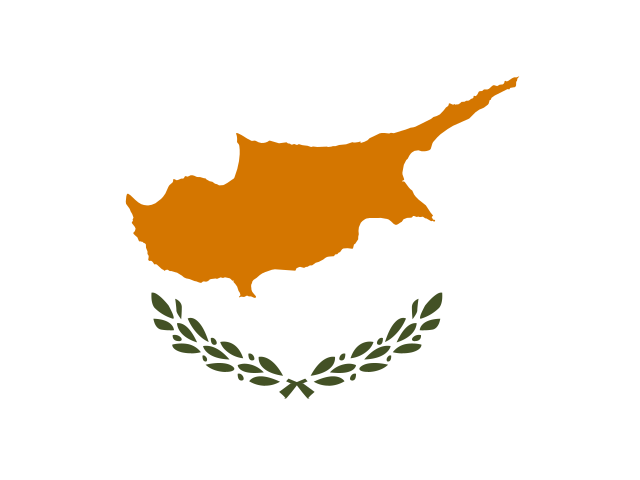 Cyprus
 Georgia
 Palestine
 Iraq
Iraq Israel
 Jordan
 Kuwait
 Lebanon
 Oman
Oman Qatar
Qatar Saudi Arabia
 Syria
Syria Turkey
 the United Arab Emirates
 Yemen
YemenEarlier Report Observations
The market for prepared or preserved beef and offal in Western Asia experienced fluctuations between 2018 and 2020. After an initial volume of 20 584 t in 2018, the market shrank to 18 304 t the following year before recovering to 21 184 t in 2020.
A period of sustained growth followed, with the market expanding to 24 798 t in 2021 and further to 27 822 t in 2022. The rise in 2021 was supported by a sharp contraction in regional exports, which fell by over 50%, altering trade flows within Asia. However, the market volume declined significantly to 19 745 t in 2023.
Trade data for 2024 indicates a recovery, with imports reaching 17 676 t and exports 12 618 t. Demand from key Western Asian importers, including the United Arab Emirates and Iraq, was fueled by consumer shifts toward convenient prepared meat products.
Table of content
- 1. Disclaimer
- 2. Terms of use of the report
- 3. Product codes in the statistical classifications used in the report
-
4. Key Market Indicators and Trends
-
4.1. Key Market Indicators
-
4.1.1. In kind
- 4.1.1.1. Production, 2018-2023
- 4.1.1.2. Imports, 2018-2024
- 4.1.1.3. Exports, 2018-2024
- 4.1.1.4. Market size, 2018-2023
-
4.1.1. In kind
- 4.2. Market Trends and Factors
-
4.1. Key Market Indicators
-
5. Production
-
5.1. Production in Western Asia
- 5.1.1. Annual dynamics of production in Western Asia in kind, 2018-2023, t
-
5.2. Global production by Country, 2018-2023
- 5.2.1. Annual dynamics of production by macroregions in kind, 2018-2023, t
- 5.2.2. Dynamics of production structure by macroregions in kind, 2018-2023
- 5.2.3. Annual dynamics of production by country in kind, 2018-2023, t
- 5.2.4. Structure of production by countries in kind, 2018-2023
- 5.2.5. Dynamics of peoduction structure by countries in kind, 2018-2023
-
5.1. Production in Western Asia
-
6. Imports
-
6.1. Imports (Direct Data*)
- 6.1.1. Imports - Total information
-
6.1.2. Imports in kind, t
- 6.1.2.1. Annual dynamics of product's imports to Azerbaijan in kind, 2018-2024, t
- 6.1.2.2. Dynamics of product's imports in kind to Azerbaijan by countries, 2018-2024, t
- 6.1.2.3. Structure of product's imports in kind by countries, 2018-2024
-
6.1.3. Imports in value, M $ US
- 6.1.3.1. Annual dynamics of product's imports to Azerbaijan in value, 2018-2024, M $ US
- 6.1.3.2. Dynamics of product's imports in value to Azerbaijan by countries, 2018-2024, M $ US
- 6.1.3.3. Structure of product's imports in value by countries, 2018-2024
-
6.1.4. Average price of product's imports, $ US/t
- 6.1.4.1. Annual dynamics of average price of product's imports to Azerbaijan, 2018-2024, $ US/t
- 6.1.4.2. Dynamics of average price of product's imports to Azerbaijan by countries, 2018-2024, $ US/t
-
6.2. Imports (Mirror Data)
- 6.2.1. Imports - Total information
-
6.2.2. Imports in kind, t
- 6.2.2.1. Annual dynamics of product's imports to Azerbaijan in kind, 2018-2024, t
- 6.2.2.2. Dynamics of product's imports in kind to Azerbaijan by countries, 2018-2024, t
- 6.2.2.3. Structure of product's imports in kind by countries, 2018-2024
-
6.2.3. Imports in value, M $ US
- 6.2.3.1. Annual dynamics of product's imports to Azerbaijan in value, 2018-2024, M $ US
- 6.2.3.2. Dynamics of product's imports in value to Azerbaijan by countries, 2018-2024, M $ US
- 6.2.3.3. Structure of product's imports in value by countries, 2018-2024
-
6.2.4. Average price of product's imports, $ US/t
- 6.2.4.1. Annual dynamics of average price of product's imports to Azerbaijan, 2018-2024, $ US/t
- 6.2.4.2. Dynamics of average price of product's imports to Azerbaijan by countries, 2018-2024, $ US/t
-
6.1. Imports (Direct Data*)
-
7. Exports
-
7.1. Exports (Direct Data*)
- 7.1.1. Exports - Total information
-
7.1.2. Exports in kind, t
- 7.1.2.1. Annual dynamics of product's exports from Azerbaijan in kind, 2018-2024, t
- 7.1.2.2. Dynamics of product's exports in kind from Azerbaijan by countries, 2018-2024, t
- 7.1.2.3. Structure of product's exports in kind by countries, 2018-2024
-
7.1.3. Exports in value, M $ US
- 7.1.3.1. Annual dynamics of product's exports from Azerbaijan in value, 2018-2024, M $ US
- 7.1.3.2. Dynamics of product's exports in value from Azerbaijan by countries, 2018-2024, M $ US
- 7.1.3.3. Structure of product's exports in value by countries, 2018-2024
-
7.1.4. Average price of product's exports, $ US/t
- 7.1.4.1. Annual dynamics of average price of product's exports from Azerbaijan, 2018-2024, $ US/t
- 7.1.4.2. Dynamics of average price of product's exports from Azerbaijan by countries, 2018-2024, $ US/t
-
7.2. Exports (Mirror Data)
- 7.2.1. Exports - Total information
-
7.2.2. Exports in kind, t
- 7.2.2.1. Annual dynamics of product's exports from Azerbaijan in kind, 2018-2024, t
- 7.2.2.2. Dynamics of product's exports in kind from Azerbaijan by countries, 2018-2024, t
- 7.2.2.3. Structure of product's exports in kind by countries, 2018-2024
-
7.2.3. Exports in value, M $ US
- 7.2.3.1. Annual dynamics of product's exports from Azerbaijan in value, 2018-2024, M $ US
- 7.2.3.2. Dynamics of product's exports in value from Azerbaijan by countries, 2018-2024, M $ US
- 7.2.3.3. Structure of product's exports in value by countries, 2018-2024
-
7.2.4. Average price of product's exports, $ US/t
- 7.2.4.1. Annual dynamics of average price of product's exports from Azerbaijan, 2018-2024, $ US/t
- 7.2.4.2. Dynamics of average price of product's exports from Azerbaijan by countries, 2018-2024, $ US/t
-
7.1. Exports (Direct Data*)
-
8. Trade balance
-
8.1. Trade balance (Direct Data)
- 8.1.1. In kind, t
- 8.1.2. In value, M $ US
-
8.2. Trade balance (Mirror Data)
- 8.2.1. In kind, t
- 8.2.2. In value, M $ US
-
8.1. Trade balance (Direct Data)
-
9. Top buying and selling countries, 2018-2024
-
9.1. Direct Data
- 9.1.1. Import in Value by Countries-buyers
- 9.1.2. Export in Value by Countries-suppliers
-
9.2. Mirror Data
- 9.2.1. Import in Value by Countries-buyers
- 9.2.2. Export in Value by Countries-suppliers
-
9.1. Direct Data
Production prepared or preserved beef and offal in Western Asia
In kind, 2017-2020, t
Top producers of prepared or preserved beef and offal, 2017-2020
World map of production of prepared or preserved beef and offal, 2017-2020
Production of prepared or preserved beef and offal in Western Asia has grown for the third year in a row. In 2020, the region produced 16 994 tonnes, marking a significant 26.5% increase compared to the previous year. Over the period from 2017 to 2020, production rose by 71.9%, with an average annual growth rate of 19.8%.
Annual dynamics of production in Western Asia in kind, 2017-2020, t
| Parameter | 2018 | 2019 | 2020 | CAGR | |
|---|---|---|---|---|---|
| 1 | Change from last year | 18.5% | 14.7% | 26.5% | 19.8% |
Exports prepared or preserved beef and offal from Western Asia
Exports in kind, t
Export volumes showed considerable volatility during this period. The lowest point was in 2018, with 7 938 tonnes exported, while the peak occurred in 2020 at 16 387 tonnes, representing a 2.1-fold difference. In 2020, exports increased by 16.6% year-on-year. The largest decline was recorded in 2018 at 47.2%, followed by the biggest increase in 2019 of 77.0%.
Annual dynamics of product's exports from Western Asia in kind, 2017-2020, t
| Parameter | 2018 | 2019 | 2020 | CAGR | |
|---|---|---|---|---|---|
| 1 | Change from last year | (47.2%) | 77.0% | 16.6% | 2.9% |
From 2017 to 2020, the main buyers of prepared or preserved beef and offal from Western Asia were Hong Kong, accounting for 3.7% of exports in volume, Vietnam at 3.0%, and Thailand with 1.2%. Together, these three markets represented 7.8% of total export volumes.
Structure of product's exports in kind by countries, 2017-2020
World map of product's exports from Western Asia in kind, 2017-2020
Exports in value, M $ US
Export values for prepared or preserved beef and offal from Western Asia have risen for the second consecutive year. In 2020, exports reached 97.3 million US dollars, showing a substantial 20.8% increase compared to the previous year. Over the 2017-2020 period, export values grew by 41.3%, with an average annual growth rate of 12.2%. The lowest value was recorded in 2018 at 66.4 million US dollars, which saw a decline of 3.6%. The largest increase occurred in 2019, with a 21.5% rise.
Annual dynamics of product's exports from Western Asia in value, 2017-2020, M $ US
| Parameter | 2018 | 2019 | 2020 | CAGR | |
|---|---|---|---|---|---|
| 1 | Change from last year | (3.6%) | 21.5% | 20.8% | 12.2% |
Between 2017 and 2020, the primary destinations for prepared or preserved beef and offal exports from Western Asia in value terms were Hong Kong, representing 3.0% of export value, Vietnam at 2.7%, and Thailand with 0.8%. Collectively, these three markets accounted for 6.5% of total export value.
Structure of product's exports in value by countries, 2017-2020
World map of product's exports from Western Asia in value, 2017-2020
Imports prepared or preserved beef and offal to Western Asia
Imports in kind, t
Import volumes of prepared or preserved beef and offal into Western Asia have increased for the second year in a row. In 2020, the region imported 20 577 tonnes, reflecting a moderate 8.7% gain compared to 2019. However, over the 2017-2020 period, imports decreased by 6.7%, equivalent to an average annual decline of 2.3%. The lowest volume was recorded in 2018 at 16 806 tonnes, which saw a significant drop of 23.8%. The largest increase occurred in 2019, with a 12.6% rise.
Annual dynamics of product's imports to Western Asia in kind, 2017-2020, t
| Parameter | 2018 | 2019 | 2020 | CAGR | |
|---|---|---|---|---|---|
| 1 | Change from last year | (23.8%) | 12.6% | 8.7% | (2.3%) |
From 2017 to 2020, imports of prepared or preserved beef and offal into Western Asia came from a diverse range of suppliers. The top sources were Brazil, accounting for 15.1% of import volume, Russia at 8.3%, and South Africa with 5.6%. Together, these three countries represented 29.1% of total import volume, while numerous smaller markets made up the remaining 70.9%.
Structure of product's imports in kind by countries, 2017-2020
World map of product's imports to Western Asia in kind, 2017-2020
Imports in value, M $ US
Import values for prepared or preserved beef and offal into Western Asia have declined for the third consecutive year. In 2020, imports totaled 89.9 million US dollars, showing a slight contraction of 1.0% compared to the previous year. Over the 2017-2020 period, import values decreased by 14.6%, with an average annual decline of 5.1%.
Annual dynamics of product's imports to Western Asia in value, 2017-2020, M $ US
| Parameter | 2018 | 2019 | 2020 | CAGR | |
|---|---|---|---|---|---|
| 1 | Change from last year | (12.2%) | (1.7%) | (1.0%) | (5.1%) |
During 2017-2020, import values of prepared or preserved beef and offal into Western Asia were relatively evenly distributed among suppliers. The leading sources were Brazil, accounting for 13.2% of import value, the United States at 5.5%, and South Africa also at 5.5%. Together, these three countries represented 24.2% of total import value.
Structure of product's imports in value by countries, 2017-2020
World map of product's imports to Western Asia in value, 2017-2020
Related Reports





Cocoa butter market in Western Asia
2026-03-29
Why Choose Us?
Only Verified Data
No Hidden Costs or Separate Fees
Smarter Subscription Pricing
Contact Our Team
Submit your inquiry using the form below — our team will get back to you within 24 hours.