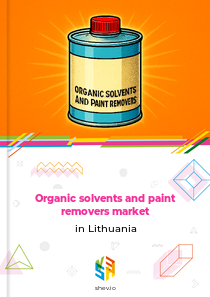







Earlier Report Observations
The market for organic solvents and paint removers in Lithuania saw sustained growth from USD 3.2 million in 2018 to USD 8.5 million in 2023. This expansion was primarily driven by the implementation of strict VOC emission limits in 2018, which forced industry to reduce volatile organic compound content in solvents and stimulated demand for low-VOC and eco-friendly alternatives. Increasing consumer and industrial focus on safety, health, and environmental compliance further supported the shift towards higher-value products.
In 2024, the market volume contracted to USD 7.5 million. That year, international regulatory developments, including a proposed U.S. EPA restriction on N-methylpyrrolidone (NMP) in paint removers, highlighted evolving compliance requirements. Simultaneously, underlying demand for water-based and bio-based solvents continued, reflecting the ongoing trend towards greener solutions in response to VOC regulations.
Table of content
- 1. Disclaimer
- 2. Terms of use of the report
- 3. Product codes in the statistical classifications used in the report
-
4. Key Market Indicators and Trends
-
4.1. Key Market Indicators
-
4.1.1. In value
- 4.1.1.1. Production, 2018-2024
- 4.1.1.2. Imports, 2018-2025
- 4.1.1.3. Exports, 2018-2025
- 4.1.1.4. Market size, 2018-2024
-
4.1.1. In value
- 4.2. Market Trends and Factors
-
4.1. Key Market Indicators
-
5. Production
-
5.1. Production in Lithuania
- 5.1.1. In kind, 2018-2024, t
- 5.1.2. In value, 2018-2024, K $ US
-
5.2. Production in the EU, 2018-2024
- 5.2.1. In kind, 2018-2024, t
- 5.2.2. In value, 2018-2024, K $ US
-
5.1. Production in Lithuania
-
6. Exports
-
6.1. Exports (Direct Data)
- 6.1.1. Exports - Total information
-
6.1.2. Exports in kind, t
- 6.1.2.1. Annual dynamics of product's exports from Lithuania in kind, 2018-2025, t
- 6.1.2.2. Dynamics of product's exports in kind from Lithuania by countries, 2018-2025, t
- 6.1.2.3. Structure of product's exports in kind by countries, 2018-2025
-
6.1.3. Exports in value, K $ US
- 6.1.3.1. Annual dynamics of product's exports from Lithuania in value, 2018-2025, K $ US
- 6.1.3.2. Dynamics of product's exports in value from Lithuania by countries, 2018-2025, K $ US
- 6.1.3.3. Structure of product's exports in value by countries, 2018-2025
-
6.1.4. Average price of product's exports, $ US/t
- 6.1.4.1. Annual dynamics of average price of product's exports from Lithuania, 2018-2025, $ US/t
- 6.1.4.2. Dynamics of average price of product's exports from Lithuania by countries, 2018-2025, $ US/t
-
6.2. Exports (Mirror Data)
- 6.2.1. Exports - Total information
-
6.2.2. Exports in kind, t
- 6.2.2.1. Annual dynamics of product's exports from Lithuania in kind, 2018-2025, t
- 6.2.2.2. Dynamics of product's exports in kind from Lithuania by countries, 2018-2025, t
- 6.2.2.3. Structure of product's exports in kind by countries, 2018-2025
-
6.2.3. Exports in value, K $ US
- 6.2.3.1. Annual dynamics of product's exports from Lithuania in value, 2018-2025, K $ US
- 6.2.3.2. Dynamics of product's exports in value from Lithuania by countries, 2018-2025, K $ US
- 6.2.3.3. Structure of product's exports in value by countries, 2018-2025
-
6.2.4. Average price of product's exports, $ US/t
- 6.2.4.1. Annual dynamics of average price of product's exports from Lithuania, 2018-2025, $ US/t
- 6.2.4.2. Dynamics of average price of product's exports from Lithuania by countries, 2018-2025, $ US/t
-
6.1. Exports (Direct Data)
-
7. Imports
-
7.1. Imports (Direct Data)
- 7.1.1. Imports - Total information
-
7.1.2. Imports in kind, t
- 7.1.2.1. Annual dynamics of product's imports to Lithuania in kind, 2018-2025, t
- 7.1.2.2. Dynamics of product's imports in kind to Lithuania by countries, 2018-2025, t
- 7.1.2.3. Structure of product's imports in kind by countries, 2018-2025
-
7.1.3. Imports in value, K $ US
- 7.1.3.1. Annual dynamics of product's imports to Lithuania in value, 2018-2025, K $ US
- 7.1.3.2. Dynamics of product's imports in value to Lithuania by countries, 2018-2025, K $ US
- 7.1.3.3. Structure of product's imports in value by countries, 2018-2025
-
7.1.4. Average price of product's imports, $ US/t
- 7.1.4.1. Annual dynamics of average price of product's imports to Lithuania, 2018-2025, $ US/t
- 7.1.4.2. Dynamics of average price of product's imports to Lithuania by countries, 2018-2025, $ US/t
-
7.2. Imports (Mirror Data)
- 7.2.1. Imports - Total information
-
7.2.2. Imports in kind, t
- 7.2.2.1. Annual dynamics of product's imports to Lithuania in kind, 2018-2025, t
- 7.2.2.2. Dynamics of product's imports in kind to Lithuania by countries, 2018-2025, t
- 7.2.2.3. Structure of product's imports in kind by countries, 2018-2025
-
7.2.3. Imports in value, K $ US
- 7.2.3.1. Annual dynamics of product's imports to Lithuania in value, 2018-2025, K $ US
- 7.2.3.2. Dynamics of product's imports in value to Lithuania by countries, 2018-2025, K $ US
- 7.2.3.3. Structure of product's imports in value by countries, 2018-2025
-
7.2.4. Average price of product's imports, $ US/t
- 7.2.4.1. Annual dynamics of average price of product's imports to Lithuania, 2018-2025, $ US/t
- 7.2.4.2. Dynamics of average price of product's imports to Lithuania by countries, 2018-2025, $ US/t
-
7.1. Imports (Direct Data)
-
8. Trade balance
-
8.1. Trade balance (Direct Data)
- 8.1.1. In kind, t
- 8.1.2. In value, K $ US
-
8.2. Trade balance (Mirror Data)
- 8.2.1. In kind, t
- 8.2.2. In value, K $ US
-
8.1. Trade balance (Direct Data)
-
9. Top buying and selling countries, 2018-2025
-
9.1. Direct Data
- 9.1.1. Import in Value by Countries-buyers
- 9.1.2. Export in Value by Countries-suppliers
-
9.2. Mirror Data
- 9.2.1. Import in Value by Countries-buyers
- 9.2.2. Export in Value by Countries-suppliers
-
9.1. Direct Data
Production organic solvents and paint removers in Lithuania
In value, 2018-2021, K $ US
Lithuania's production of organic solvents and paint removers has grown for the third year in a row. In 2021, output reached 1 858 thousand US dollars, marking a significant increase of 11.4% compared to 2020. From 2018 to 2021, production rose by 72.2%, which translates to an average annual growth rate of 19.9%.
Annual dynamics of production in Lithuania in value, 2018-2021, K $ US
| Parameter | 2019 | 2020 | 2021 | CAGR | |
|---|---|---|---|---|---|
| 1 | Change from last year | 10.2% | 40.3% | 11.4% | 19.9% |
In kind, 2018-2021, t
Lithuania's production volume of organic solvents and paint removers has increased for the third consecutive year. In 2021, the country produced 3 876 tonnes, up 18.7% from the previous year. Over the 2018-2021 period, production grew by 78.2%, with a compound annual growth rate of 21.2%.
Annual dynamics of production in Lithuania in kind, 2018-2021, t
| Parameter | 2019 | 2020 | 2021 | CAGR | |
|---|---|---|---|---|---|
| 1 | Change from last year | 8.8% | 38.0% | 18.7% | 21.2% |
Exports organic solvents and paint removers from Lithuania
Exports in kind, t
In 2021, Lithuania exported 3 012 tonnes of organic solvents and paint removers, a 35.2% increase compared to 2020. From 2018 to 2021, exports rose by 20.2%, averaging 6.3% per year. The lowest volume was recorded in 2020 at 2 227 tonnes, which represented a decline of 25.6%.
Annual dynamics of product's exports from Lithuania in kind, 2018-2021, t
| Parameter | 2019 | 2020 | 2021 | CAGR | |
|---|---|---|---|---|---|
| 1 | Change from last year | 19.4% | (25.6%) | 35.2% | 6.3% |
Between 2018 and 2021, Russia, Ukraine, and Latvia were the main destinations for Lithuania's exports in volume terms. Russia accounted for 23.6% of exports, Ukraine for 18.4%, and Latvia for 12.0%. Together, these three countries made up 54.1% of total export flows.
Structure of product's exports in kind by countries, 2018-2021
World map of product's exports from Lithuania in kind, 2018-2021
Exports in value, K $ US
In 2021, Lithuania's exports of organic solvents and paint removers amounted to 5 997 thousand US dollars, a 9.4% increase year-over-year. From 2018 to 2021, exports grew by 13.8%, with an average annual rate of 4.4%. The largest decline occurred in 2020 at 8.5%, while the highest increase was in 2019 at 13.7%.
Annual dynamics of product's exports from Lithuania in value, 2018-2021, K $ US
| Parameter | 2019 | 2020 | 2021 | CAGR | |
|---|---|---|---|---|---|
| 1 | Change from last year | 13.7% | (8.5%) | 9.4% | 4.4% |
From 2018 to 2021, Russia, Belarus, and Latvia consistently led Lithuania's export structure in value terms. Russia held 31.0% of exports, Belarus 11.5%, and Latvia 10.9%. Combined, these three countries accounted for 53.5% of total export flows.
Structure of product's exports in value by countries, 2018-2021
World map of product's exports from Lithuania in value, 2018-2021
Imports organic solvents and paint removers to Lithuania
Imports in kind, t
After two years of growth, Lithuania's imports of organic solvents and paint removers declined. In 2021, imports totaled 3 552 tonnes, down 14.6% from the previous year. Over the 2018-2021 period, imports increased by 17.7%, with a compound annual growth rate of 5.6%. The peak volume was in 2020 at 4 159 tonnes, following a significant rise of 27.7% in 2019.
Annual dynamics of product's imports to Lithuania in kind, 2018-2021, t
| Parameter | 2019 | 2020 | 2021 | CAGR | |
|---|---|---|---|---|---|
| 1 | Change from last year | 27.7% | 7.9% | (14.6%) | 5.6% |
Between 2018 and 2021, Lithuania's imports in volume terms were distributed across multiple countries. Poland accounted for 20.4% of imports, Latvia for 18.8%, and Italy for 10.7%. Together, these three partners represented 49.9% of total import flows, with no single country dominating the market.
Structure of product's imports in kind by countries, 2018-2021
World map of product's imports to Lithuania in kind, 2018-2021
Imports in value, K $ US
Lithuania's imports of organic solvents and paint removers have increased for the third consecutive year. In 2021, imports reached 9 616 thousand US dollars, up 9.0% from the previous year. From 2018 to 2021, imports grew by 29.5%, averaging 9.0% per year.
Annual dynamics of product's imports to Lithuania in value, 2018-2021, K $ US
| Parameter | 2019 | 2020 | 2021 | CAGR | |
|---|---|---|---|---|---|
| 1 | Change from last year | 16.6% | 1.9% | 9.0% | 9.0% |
From 2018 to 2021, Lithuania's imports in value terms were widely spread among partner countries. Poland accounted for 16.2% of imports, Germany for 14.8%, and Latvia for 13.5%. Together, these three countries made up 44.5% of total import flows.
Structure of product's imports in value by countries, 2018-2021
World map of product's imports to Lithuania in value, 2018-2021
Related Reports

2026-03-29


Fungicides market in Lithuania
2026-03-29
Why Choose Us?
Only Verified Data
No Hidden Costs or Separate Fees
Smarter Subscription Pricing
Contact Our Team
Submit your inquiry using the form below — our team will get back to you within 24 hours.