






"Middle Africa" region includes following countries:
 Angola
 Cameroon
 Central African Republic
 Chad
Chad Congo
Congo Democratic Republic of the Congo
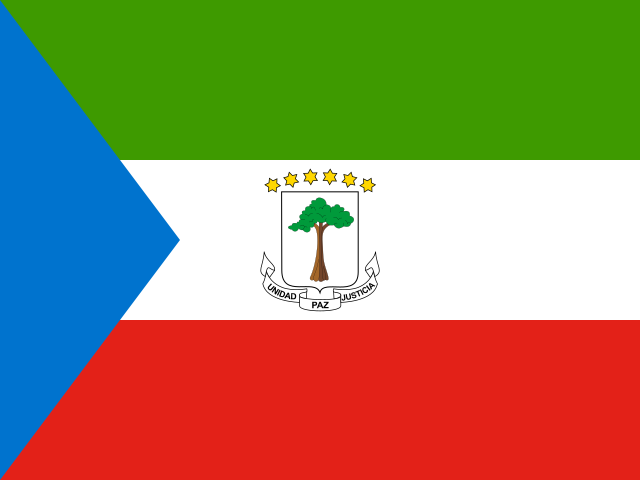 Equatorial Guinea
 Gabon
Gabon Sao Tome and Principe
Earlier Report Observations
From 2018 to 2021, the orange market in Middle Africa experienced a decline in volume from 221.5 thousand tons to 214.4 thousand tons. The drop was most pronounced in 2019 when imports fell sharply from 18.8 thousand tons to 6.8 thousand tons, while domestic production remained steady around 200 thousand tons. Imports gradually recovered in 2020 and 2021, supporting a rebound in market size.
During the 2022-2023 period, the market stabilized at approximately 214-215 thousand tons. Global factors influenced this trend: unfavorable weather events, including hurricanes in Florida and drought in Mexico, reduced orange production in key supplying regions. New EU restrictions on citrus imports from South Africa also affected international trade flows. These supply-side constraints, alongside sustained demand for orange products, contributed to stable market volumes in Middle Africa despite reported increases in production and logistics costs across the sector.
In 2024, orange imports into Middle Africa decreased to 6.5 thousand tons, with exports remaining minimal at 0.1 thousand tons. Industry reports for the year cited persistent inflation in raw material and logistics costs, as well as ongoing global production challenges from extreme weather and citrus diseases.
Table of content
- 1. Disclaimer
- 2. Terms of use of the report
- 3. Product codes in the statistical classifications used in the report
-
4. Key Market Indicators and Trends
-
4.1. Key Market Indicators
-
4.1.1. In kind
- 4.1.1.1. Production, 2018-2023
- 4.1.1.2. Imports, 2018-2024
- 4.1.1.3. Exports, 2018-2024
- 4.1.1.4. Market size, 2018-2023
-
4.1.1. In kind
- 4.2. Market Trends and Factors
-
4.1. Key Market Indicators
-
5. Production
-
5.1. Production in Middle Africa
- 5.1.1. Annual dynamics of production in Middle Africa in kind, 2018-2023, K t
-
5.2. Global production by Country, 2018-2023
- 5.2.1. Annual dynamics of production by macroregions in kind, 2018-2023, K t
- 5.2.2. Dynamics of production structure by macroregions in kind, 2018-2023
- 5.2.3. Annual dynamics of production by country in kind, 2018-2023, K t
- 5.2.4. Structure of production by countries in kind, 2018-2023
- 5.2.5. Dynamics of peoduction structure by countries in kind, 2018-2023
-
5.1. Production in Middle Africa
-
6. Imports
-
6.1. Imports (Direct Data*)
- 6.1.1. Imports - Total information
-
6.1.2. Imports in kind, t
- 6.1.2.1. Annual dynamics of product's imports to Angola in kind, 2018-2024, t
- 6.1.2.2. Dynamics of product's imports in kind to Angola by countries, 2018-2024, t
- 6.1.2.3. Structure of product's imports in kind by countries, 2018-2024
-
6.1.3. Imports in value, K $ US
- 6.1.3.1. Annual dynamics of product's imports to Angola in value, 2018-2024, K $ US
- 6.1.3.2. Dynamics of product's imports in value to Angola by countries, 2018-2024, K $ US
- 6.1.3.3. Structure of product's imports in value by countries, 2018-2024
-
6.1.4. Average price of product's imports, $ US/kg
- 6.1.4.1. Annual dynamics of average price of product's imports to Angola, 2018-2024, $ US/kg
- 6.1.4.2. Dynamics of average price of product's imports to Angola by countries, 2018-2024, $ US/kg
-
6.2. Imports (Mirror Data)
- 6.2.1. Imports - Total information
-
6.2.2. Imports in kind, t
- 6.2.2.1. Annual dynamics of product's imports to Angola in kind, 2018-2024, t
- 6.2.2.2. Dynamics of product's imports in kind to Angola by countries, 2018-2024, t
- 6.2.2.3. Structure of product's imports in kind by countries, 2018-2024
-
6.2.3. Imports in value, K $ US
- 6.2.3.1. Annual dynamics of product's imports to Angola in value, 2018-2024, K $ US
- 6.2.3.2. Dynamics of product's imports in value to Angola by countries, 2018-2024, K $ US
- 6.2.3.3. Structure of product's imports in value by countries, 2018-2024
-
6.2.4. Average price of product's imports, $ US/kg
- 6.2.4.1. Annual dynamics of average price of product's imports to Angola, 2018-2024, $ US/kg
- 6.2.4.2. Dynamics of average price of product's imports to Angola by countries, 2018-2024, $ US/kg
-
6.1. Imports (Direct Data*)
-
7. Exports
-
7.1. Exports (Direct Data*)
- 7.1.1. Exports - Total information
-
7.1.2. Exports in kind, t
- 7.1.2.1. Annual dynamics of product's exports from Angola in kind, 2018-2024, t
- 7.1.2.2. Dynamics of product's exports in kind from Angola by countries, 2018-2024, t
- 7.1.2.3. Structure of product's exports in kind by countries, 2018-2024
-
7.1.3. Exports in value, K $ US
- 7.1.3.1. Annual dynamics of product's exports from Angola in value, 2018-2024, K $ US
- 7.1.3.2. Dynamics of product's exports in value from Angola by countries, 2018-2024, K $ US
- 7.1.3.3. Structure of product's exports in value by countries, 2018-2024
-
7.1.4. Average price of product's exports, $ US/kg
- 7.1.4.1. Annual dynamics of average price of product's exports from Angola, 2018-2024, $ US/kg
- 7.1.4.2. Dynamics of average price of product's exports from Angola by countries, 2018-2024, $ US/kg
-
7.2. Exports (Mirror Data)
- 7.2.1. Exports - Total information
-
7.2.2. Exports in kind, t
- 7.2.2.1. Annual dynamics of product's exports from Angola in kind, 2018-2024, t
- 7.2.2.2. Dynamics of product's exports in kind from Angola by countries, 2018-2024, t
- 7.2.2.3. Structure of product's exports in kind by countries, 2018-2024
-
7.2.3. Exports in value, K $ US
- 7.2.3.1. Annual dynamics of product's exports from Angola in value, 2018-2024, K $ US
- 7.2.3.2. Dynamics of product's exports in value from Angola by countries, 2018-2024, K $ US
- 7.2.3.3. Structure of product's exports in value by countries, 2018-2024
-
7.2.4. Average price of product's exports, $ US/kg
- 7.2.4.1. Annual dynamics of average price of product's exports from Angola, 2018-2024, $ US/kg
- 7.2.4.2. Dynamics of average price of product's exports from Angola by countries, 2018-2024, $ US/kg
-
7.1. Exports (Direct Data*)
-
8. Trade balance
-
8.1. Trade balance (Direct Data)
- 8.1.1. In kind, t
- 8.1.2. In value, K $ US
-
8.2. Trade balance (Mirror Data)
- 8.2.1. In kind, t
- 8.2.2. In value, K $ US
-
8.1. Trade balance (Direct Data)
-
9. Top buying and selling countries, 2018-2024
-
9.1. Direct Data
- 9.1.1. Import in Value by Countries-buyers
- 9.1.2. Export in Value by Countries-suppliers
-
9.2. Mirror Data
- 9.2.1. Import in Value by Countries-buyers
- 9.2.2. Export in Value by Countries-suppliers
-
9.1. Direct Data
Production oranges in Middle Africa
In kind, 2017-2020, K t
Top producers of oranges, 2017-2020
World map of production of oranges, 2017-2020
Middle Africa's orange production volume has declined for the third consecutive year. In 2020, the region produced 200.1 K t of oranges, which remained broadly stable compared to 2019. Over the period from 2017 to 2020, production decreased by 2.2%, with a compound annual growth rate of 0.7%.
Annual dynamics of production in Middle Africa in kind, 2017-2020, K t
| Parameter | 2018 | 2019 | 2020 | CAGR | |
|---|---|---|---|---|---|
| 1 | Change from last year | (0.9%) | (0.9%) | (0.3%) | (0.7%) |
Exports oranges from Middle Africa
Exports in kind, t
Orange shipments from Middle Africa to abroad have increased for the third consecutive year. In 2020, the region exported 31 t of oranges, marking a sharp gain of 94.7% year-over-year. From 2017 to 2020, exports surged by 1 063.4%, with a compound annual growth rate of 126.6%.
Annual dynamics of product's exports from Middle Africa in kind, 2017-2020, t
| Parameter | 2018 | 2019 | 2020 | CAGR | |
|---|---|---|---|---|---|
| 1 | Change from last year | 150.2% | 138.9% | 94.7% | 126.6% |
From 2017 to 2020, Spain, Burundi, and Namibia were the main destinations for oranges from Middle Africa, accounting for 10.1% of total exports in kind. Specifically, Spain represented 6.4%, Burundi 1.9%, and Namibia 1.8% of exports in kind during this period.
Structure of product's exports in kind by countries, 2017-2020
World map of product's exports from Middle Africa in kind, 2017-2020
Exports in value, K $ US
Foreign orange supplies from Middle Africa have increased for the third consecutive year. In 2020, exports amounted to 35 K $ US, showing an increase of 85.7% compared to the previous year. Over the period from 2017 to 2020, exports grew by 246.7%, with a compound annual growth rate of 51.4%.
Annual dynamics of product's exports from Middle Africa in value, 2017-2020, K $ US
| Parameter | 2018 | 2019 | 2020 | CAGR | |
|---|---|---|---|---|---|
| 1 | Change from last year | 22.7% | 52.1% | 85.7% | 51.4% |
From 2017 to 2020, Spain, Namibia, and the Bahamas were among the largest buyers of oranges from Middle Africa in value terms. Spain accounted for 33.1% of exports, Namibia for 6.7%, and the Bahamas for 5.0%. Together, they represented just 44.8% of total exports in value terms, indicating a broadly diversified partner base.
Structure of product's exports in value by countries, 2017-2020
World map of product's exports from Middle Africa in value, 2017-2020
Imports oranges to Middle Africa
Imports in kind, t
After a two-year decline, orange import volumes into Middle Africa increased. In 2020, imports totalled 9 655 t, up by 41.8% from a year earlier. The minimum value was recorded in 2019 at 6 808 t, which saw the largest decline of 63.9%. Over the period from 2017 to 2020, imports decreased by 59.6%, with a compound annual growth rate of 26.1%.
Annual dynamics of product's imports to Middle Africa in kind, 2017-2020, t
| Parameter | 2018 | 2019 | 2020 | CAGR | |
|---|---|---|---|---|---|
| 1 | Change from last year | (21.2%) | (63.9%) | 41.8% | (26.1%) |
Throughout 2017 to 2020, Nigeria, South Africa, and Egypt formed the core group of markets for imports in kind. Nigeria accounted for 49.3% of imports, South Africa for 24.9%, and Egypt for 13.3%, together representing 87.5% of total flows.
Structure of product's imports in kind by countries, 2017-2020
World map of product's imports to Middle Africa in kind, 2017-2020
Imports in value, K $ US
Orange shipments to Middle Africa from abroad have declined for the third consecutive year. In 2020, the region imported 4 084 K $ US of oranges, corresponding to a significant decline of 20.3% year-over-year. From 2017 to 2020, imports decreased by 50.1%, with a compound annual growth rate of 20.7%.
Annual dynamics of product's imports to Middle Africa in value, 2017-2020, K $ US
| Parameter | 2018 | 2019 | 2020 | CAGR | |
|---|---|---|---|---|---|
| 1 | Change from last year | (21.2%) | (20.5%) | (20.3%) | (20.7%) |
Over 2017 to 2020, South Africa, Egypt, and Portugal remained the leading destinations in the country structure of imports in value terms. South Africa accounted for 44.4% of imports, Egypt for 15.2%, and Portugal for 10.1%, with a combined share of 69.7% of total flows.
Structure of product's imports in value by countries, 2017-2020
World map of product's imports to Middle Africa in value, 2017-2020
Related Reports

Oranges market in Dominican Republic
2026-03-28
2026-03-28
2026-03-28
2026-03-28

2026-03-28


Treenuts market in Middle Africa
2026-03-30

Cashew nuts market in Middle Africa
2026-03-28
Why Choose Us?
Only Verified Data
No Hidden Costs or Separate Fees
Smarter Subscription Pricing
Contact Our Team
Submit your inquiry using the form below — our team will get back to you within 24 hours.