






"SADC" region includes following countries:
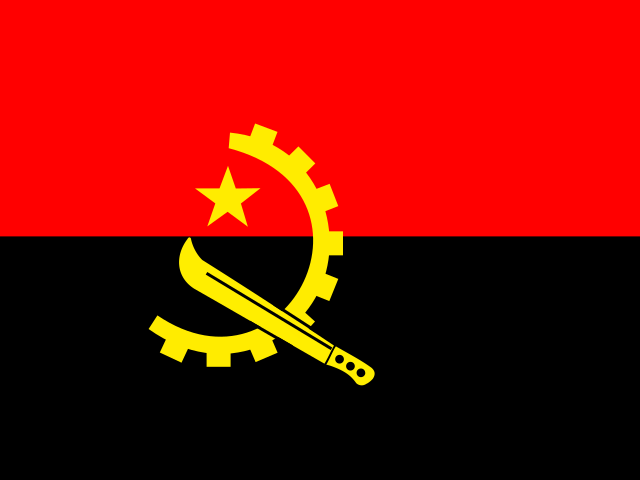 Angola
 Botswana
 Comoros
 Democratic Republic of the Congo
 Eswatini
 Lesotho
 Madagascar
 Malawi
 Mauritius
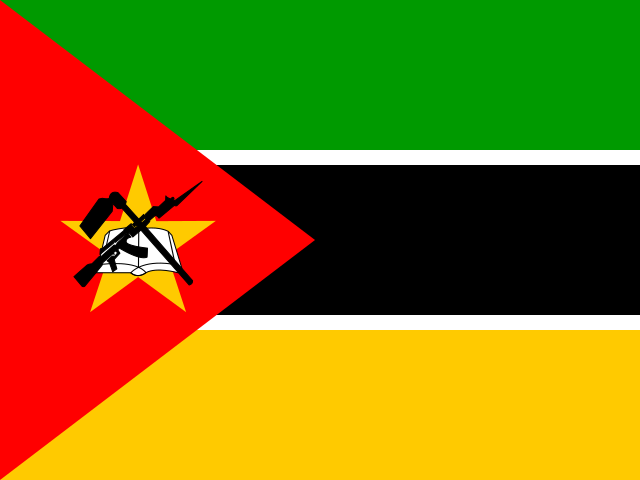 Mozambique
 Namibia
 Seychelles
 South Africa
 Tanzania
 Zambia
 Zimbabwe
Earlier Report Observations
The market for fresh onions and shallots in South Africa saw its volume grow from 2.3 million tonnes in 2018 to 2.9 million tonnes in 2022, before contracting to 2.5 million tonnes in 2023. This variability was largely driven by climatic factors, including droughts and intense rains, which directly impacted onion yields and supply availability. At the same time, evolving consumer preferences towards healthier and more convenient options, such as sweet onions and shallots, provided underlying support for demand.
In 2018, very low shallot prices—falling below production costs—squeezed profitability, potentially affecting grower investment decisions. Adverse weather conditions in 2021 contributed to a slight dip in market volume. The subsequent rebound in 2022 was supported by increased domestic production, particularly from key growing regions like the Western Cape, Limpopo, and Mpumalanga.
Rising input costs for electricity and water added upward pressure on consumer prices throughout the period. Additionally, the South African Competition Commission initiated investigations and proposed regulatory changes to improve competition and transparency in the fresh produce market, addressing high concentration and oligopolistic practices that could influence long-term market structure.
Table of content
- 1. Disclaimer
- 2. Terms of use of the report
- 3. Product codes in the statistical classifications used in the report
-
4. Key Market Indicators and Trends
-
4.1. Key Market Indicators
-
4.1.1. In kind
- 4.1.1.1. Production, 2018-2023
- 4.1.1.2. Imports, 2018-2024
- 4.1.1.3. Exports, 2018-2024
- 4.1.1.4. Market size, 2018-2023
-
4.1.1. In kind
- 4.2. Market Trends and Factors
-
4.1. Key Market Indicators
-
5. Production
-
5.1. Production in SADC
- 5.1.1. Annual dynamics of production in SADC in kind, 2018-2023, K t
-
5.2. Global production by Country, 2018-2023
- 5.2.1. Annual dynamics of production by macroregions in kind, 2018-2023, K t
- 5.2.2. Dynamics of production structure by macroregions in kind, 2018-2023
- 5.2.3. Annual dynamics of production by country in kind, 2018-2023, K t
- 5.2.4. Structure of production by countries in kind, 2018-2023
- 5.2.5. Dynamics of peoduction structure by countries in kind, 2018-2023
-
5.1. Production in SADC
-
6. Imports
-
6.1. Imports (Direct Data*)
- 6.1.1. Imports - Total information
-
6.1.2. Imports in kind, K t
- 6.1.2.1. Annual dynamics of product's imports to Angola in kind, 2018-2024, K t
- 6.1.2.2. Dynamics of product's imports in kind to Angola by countries, 2018-2024, K t
- 6.1.2.3. Structure of product's imports in kind by countries, 2018-2024
-
6.1.3. Imports in value, K $ US
- 6.1.3.1. Annual dynamics of product's imports to Angola in value, 2018-2024, K $ US
- 6.1.3.2. Dynamics of product's imports in value to Angola by countries, 2018-2024, K $ US
- 6.1.3.3. Structure of product's imports in value by countries, 2018-2024
-
6.1.4. Average price of product's imports, $ US/t
- 6.1.4.1. Annual dynamics of average price of product's imports to Angola, 2018-2024, $ US/t
- 6.1.4.2. Dynamics of average price of product's imports to Angola by countries, 2018-2024, $ US/t
-
6.2. Imports (Mirror Data)
- 6.2.1. Imports - Total information
-
6.2.2. Imports in kind, K t
- 6.2.2.1. Annual dynamics of product's imports to Angola in kind, 2018-2024, K t
- 6.2.2.2. Dynamics of product's imports in kind to Angola by countries, 2018-2024, K t
- 6.2.2.3. Structure of product's imports in kind by countries, 2018-2024
-
6.2.3. Imports in value, K $ US
- 6.2.3.1. Annual dynamics of product's imports to Angola in value, 2018-2024, K $ US
- 6.2.3.2. Dynamics of product's imports in value to Angola by countries, 2018-2024, K $ US
- 6.2.3.3. Structure of product's imports in value by countries, 2018-2024
-
6.2.4. Average price of product's imports, $ US/t
- 6.2.4.1. Annual dynamics of average price of product's imports to Angola, 2018-2024, $ US/t
- 6.2.4.2. Dynamics of average price of product's imports to Angola by countries, 2018-2024, $ US/t
-
6.1. Imports (Direct Data*)
-
7. Exports
-
7.1. Exports (Direct Data*)
- 7.1.1. Exports - Total information
-
7.1.2. Exports in kind, K t
- 7.1.2.1. Annual dynamics of product's exports from Angola in kind, 2018-2024, K t
- 7.1.2.2. Dynamics of product's exports in kind from Angola by countries, 2018-2024, K t
- 7.1.2.3. Structure of product's exports in kind by countries, 2018-2024
-
7.1.3. Exports in value, K $ US
- 7.1.3.1. Annual dynamics of product's exports from Angola in value, 2018-2024, K $ US
- 7.1.3.2. Dynamics of product's exports in value from Angola by countries, 2018-2024, K $ US
- 7.1.3.3. Structure of product's exports in value by countries, 2018-2024
-
7.1.4. Average price of product's exports, $ US/t
- 7.1.4.1. Annual dynamics of average price of product's exports from Angola, 2018-2024, $ US/t
- 7.1.4.2. Dynamics of average price of product's exports from Angola by countries, 2018-2024, $ US/t
-
7.2. Exports (Mirror Data)
- 7.2.1. Exports - Total information
-
7.2.2. Exports in kind, K t
- 7.2.2.1. Annual dynamics of product's exports from Angola in kind, 2018-2024, K t
- 7.2.2.2. Dynamics of product's exports in kind from Angola by countries, 2018-2024, K t
- 7.2.2.3. Structure of product's exports in kind by countries, 2018-2024
-
7.2.3. Exports in value, K $ US
- 7.2.3.1. Annual dynamics of product's exports from Angola in value, 2018-2024, K $ US
- 7.2.3.2. Dynamics of product's exports in value from Angola by countries, 2018-2024, K $ US
- 7.2.3.3. Structure of product's exports in value by countries, 2018-2024
-
7.2.4. Average price of product's exports, $ US/t
- 7.2.4.1. Annual dynamics of average price of product's exports from Angola, 2018-2024, $ US/t
- 7.2.4.2. Dynamics of average price of product's exports from Angola by countries, 2018-2024, $ US/t
-
7.1. Exports (Direct Data*)
-
8. Trade balance
-
8.1. Trade balance (Direct Data)
- 8.1.1. In kind, K t
- 8.1.2. In value, K $ US
-
8.2. Trade balance (Mirror Data)
- 8.2.1. In kind, K t
- 8.2.2. In value, K $ US
-
8.1. Trade balance (Direct Data)
-
9. Top buying and selling countries, 2018-2024
-
9.1. Direct Data
- 9.1.1. Import in Value by Countries-buyers
- 9.1.2. Export in Value by Countries-suppliers
-
9.2. Mirror Data
- 9.2.1. Import in Value by Countries-buyers
- 9.2.2. Export in Value by Countries-suppliers
-
9.1. Direct Data
Production onions and shallots in SADC
In kind, 2017-2020, K t
Top producers of onions and shallots, 2017-2020
World map of production of onions and shallots, 2017-2020
SADC's production of onions and shallots has grown for the third year in a row. In 2020, the region produced 2 406 thousand tonnes, marking a 3.5% increase from the previous year. Looking at the period from 2017 to 2020, production rose by 14.1%, which translates to an average annual growth rate of 4.5%.
Annual dynamics of production in SADC in kind, 2017-2020, K t
| Parameter | 2018 | 2019 | 2020 | CAGR | |
|---|---|---|---|---|---|
| 1 | Change from last year | 2.7% | 7.3% | 3.5% | 4.5% |
Exports onions and shallots from SADC
Exports in kind, K t
The export market for onions and shallots from SADC showed significant volatility during these years. Exports hit their lowest point in 2018 at 17.0 thousand tonnes, then surged to their peak in 2017, with a 4.9-fold difference between these two years. In 2020, exports reached 28.1 thousand tonnes, representing a notable 11.1% increase compared to 2019. The largest decline occurred in 2018, with a drop of 79.5%, while the biggest increase was recorded in 2019 at 48.6%.
Annual dynamics of product's exports from SADC in kind, 2017-2020, K t
| Parameter | 2018 | 2019 | 2020 | CAGR | |
|---|---|---|---|---|---|
| 1 | Change from last year | (79.5%) | 48.6% | 11.1% | (30.3%) |
From 2017 to 2020, the export structure for onions and shallots in kind was quite diversified. Uganda accounted for 6.7% of exports, Kenya for 1.2%, and Congo for 1.0%, with these three countries together making up just 8.9% of total flows. No single country held a clearly dominant position in the market.
Structure of product's exports in kind by countries, 2017-2020
World map of product's exports from SADC in kind, 2017-2020
Exports in value, K $ US
After two years of growth, the value of onions and shallots exported from SADC declined. In 2020, exports stood at 32 285 thousand US dollars, reflecting a 13.0% drop from the previous year. The highest value was recorded in 2019 at 37 110 thousand US dollars, while the largest increase occurred in 2018 with a rise of 14.6%.
Annual dynamics of product's exports from SADC in value, 2017-2020, K $ US
| Parameter | 2018 | 2019 | 2020 | CAGR | |
|---|---|---|---|---|---|
| 1 | Change from last year | 14.6% | 1.1% | (13.0%) | 0.3% |
Between 2017 and 2020, the top buyers of onions and shallots from SADC in value terms were Uganda with 3.0% of exports, the United Kingdom with 1.1%, and Congo with 1.1%. Together, these three countries accounted for 5.2% of total export value, but none held a dominant position, as the market was characterized by a wide range of smaller partners.
Structure of product's exports in value by countries, 2017-2020
World map of product's exports from SADC in value, 2017-2020
Imports onions and shallots to SADC
Imports in kind, K t
In 2020, SADC imported 120.6 thousand tonnes of onions and shallots, indicating a substantial year-on-year gain of 63.1%. Over the period from 2017 to 2020, imports increased by 19.7%, with a compound annual growth rate of 6.2%. The minimum value was recorded in 2019 at 74.0 thousand tonnes, while the maximum was in 2018 at 152.4 thousand tonnes. The largest decline occurred in 2019 with a drop of 51.5%.
Annual dynamics of product's imports to SADC in kind, 2017-2020, K t
| Parameter | 2018 | 2019 | 2020 | CAGR | |
|---|---|---|---|---|---|
| 1 | Change from last year | 51.2% | (51.5%) | 63.1% | 6.2% |
During 2017–2020, onions and shallots were imported into SADC from many different markets. Even the largest suppliers—the Netherlands, India, and Belgium—together represented only 37.7% of total imports in kind, highlighting the diversity of sources.
Structure of product's imports in kind by countries, 2017-2020
World map of product's imports to SADC in kind, 2017-2020
Imports in value, K $ US
In 2020, cross-border shipments of onions and shallots to SADC totaled 44 340 thousand US dollars, showing a small rise of 1.1% compared to the previous year. Over the period from 2017 to 2020, imports decreased by 3.3%, with a compound annual growth rate of -1.1%. The minimum value was recorded in 2019 at 43 857 thousand US dollars, while the maximum was in 2018 at 54 582 thousand US dollars. The largest decline occurred in 2019 with a drop of 19.7%, and the largest increase was in 2018 with a rise of 19.0%.
Annual dynamics of product's imports to SADC in value, 2017-2020, K $ US
| Parameter | 2018 | 2019 | 2020 | CAGR | |
|---|---|---|---|---|---|
| 1 | Change from last year | 19.0% | (19.7%) | 1.1% | (1.1%) |
Throughout 2017–2020, the Netherlands led imports in value terms with 15.9%, followed by India with 10.9%, and Egypt with 1.8%. These three countries jointly accounted for 28.6% of total import flows, playing key roles in supplying onions and shallots to SADC.
Structure of product's imports in value by countries, 2017-2020
World map of product's imports to SADC in value, 2017-2020
Related Reports

Onions and shallots market in Ethiopia
2026-03-27
Onions and shallots market in Sri Lanka
2026-03-27
Onions and shallots market in Indonesia
2026-03-27

Frozen sweetcorn market in SADC
2026-03-27

2026-03-27

Capsicum and pimenta fruits market in SADC
2026-03-27

Frozen potatoes market in SADC
2026-03-27
Why Choose Us?
Only Verified Data
No Hidden Costs or Separate Fees
Smarter Subscription Pricing
Contact Our Team
Submit your inquiry using the form below — our team will get back to you within 24 hours.