






"SADC" region includes following countries:
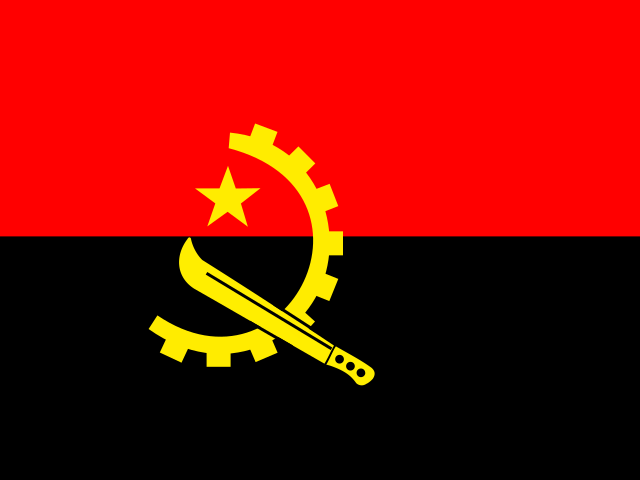 Angola
 Botswana
 Comoros
 Democratic Republic of the Congo
 Eswatini
 Lesotho
 Madagascar
 Malawi
 Mauritius
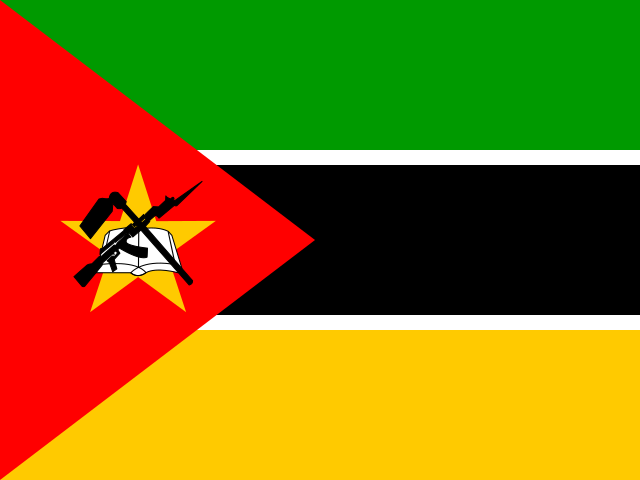 Mozambique
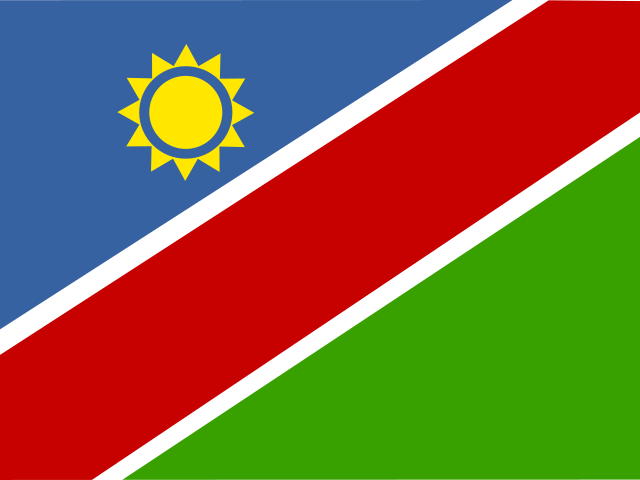 Namibia
 Seychelles
 South Africa
 Tanzania
 Zambia
 Zimbabwe
Earlier Report Observations
From 2018 to 2020, the yams market in SADC expanded from 148.6 thousand tonnes to 157.0 thousand tonnes. This growth was influenced by shifting consumer habits in South Africa, where frequent power outages (load shedding) increased demand for convenient frozen foods, including yams. The entry of new start-up manufacturers, facilitated by lower online platform costs, added fresh competition to the sector. The COVID-19 pandemic in 2020 introduced price volatility, but persistent electricity challenges continued to underpin demand for frozen products, supporting market resilience.
The upward trajectory continued through 2023, with market volume reaching 169.2 thousand tonnes. Government investments in refurbishing national fresh produce markets improved access for small-scale farmers and enhanced distribution efficiency. Established urban distribution networks and commodity-specific factors like harvest timing helped buffer supply shocks, contributing to the market's steady expansion during this period.
Table of content
- 1. Disclaimer
- 2. Terms of use of the report
- 3. Product codes in the statistical classifications used in the report
-
4. Key Market Indicators and Trends
-
4.1. Key Market Indicators
-
4.1.1. In kind
- 4.1.1.1. Production, 2018-2023
- 4.1.1.2. Imports, 2018-2024
- 4.1.1.3. Exports, 2018-2024
- 4.1.1.4. Market size, 2018-2023
-
4.1.1. In kind
- 4.2. Market Trends and Factors
-
4.1. Key Market Indicators
-
5. Production
-
5.1. Production in SADC
- 5.1.1. Annual dynamics of production in SADC in kind, 2018-2023, K t
-
5.2. Global production by Country, 2018-2023
- 5.2.1. Annual dynamics of production by macroregions in kind, 2018-2023, K t
- 5.2.2. Dynamics of production structure by macroregions in kind, 2018-2023
- 5.2.3. Annual dynamics of production by country in kind, 2018-2023, K t
- 5.2.4. Structure of production by countries in kind, 2018-2023
- 5.2.5. Dynamics of peoduction structure by countries in kind, 2018-2023
-
5.1. Production in SADC
-
6. Imports
-
6.1. Imports (Direct Data*)
- 6.1.1. Imports - Total information
-
6.1.2. Imports in kind, t
- 6.1.2.1. Annual dynamics of product's imports to Angola in kind, 2018-2024, t
- 6.1.2.2. Dynamics of product's imports in kind to Angola by countries, 2018-2024, t
- 6.1.2.3. Structure of product's imports in kind by countries, 2018-2024
-
6.1.3. Imports in value, K $ US
- 6.1.3.1. Annual dynamics of product's imports to Angola in value, 2018-2024, K $ US
- 6.1.3.2. Dynamics of product's imports in value to Angola by countries, 2018-2024, K $ US
- 6.1.3.3. Structure of product's imports in value by countries, 2018-2024
-
6.1.4. Average price of product's imports, $ US/kg
- 6.1.4.1. Annual dynamics of average price of product's imports to Angola, 2018-2024, $ US/kg
- 6.1.4.2. Dynamics of average price of product's imports to Angola by countries, 2018-2024, $ US/kg
-
6.2. Imports (Mirror Data)
- 6.2.1. Imports - Total information
-
6.2.2. Imports in kind, t
- 6.2.2.1. Annual dynamics of product's imports to Angola in kind, 2018-2024, t
- 6.2.2.2. Dynamics of product's imports in kind to Angola by countries, 2018-2024, t
- 6.2.2.3. Structure of product's imports in kind by countries, 2018-2024
-
6.2.3. Imports in value, K $ US
- 6.2.3.1. Annual dynamics of product's imports to Angola in value, 2018-2024, K $ US
- 6.2.3.2. Dynamics of product's imports in value to Angola by countries, 2018-2024, K $ US
- 6.2.3.3. Structure of product's imports in value by countries, 2018-2024
-
6.2.4. Average price of product's imports, $ US/kg
- 6.2.4.1. Annual dynamics of average price of product's imports to Angola, 2018-2024, $ US/kg
- 6.2.4.2. Dynamics of average price of product's imports to Angola by countries, 2018-2024, $ US/kg
-
6.1. Imports (Direct Data*)
-
7. Exports
-
7.1. Exports (Direct Data*)
- 7.1.1. Exports - Total information
-
7.1.2. Exports in kind, t
- 7.1.2.1. Annual dynamics of product's exports from Angola in kind, 2018-2024, t
- 7.1.2.2. Dynamics of product's exports in kind from Angola by countries, 2018-2024, t
- 7.1.2.3. Structure of product's exports in kind by countries, 2018-2024
-
7.1.3. Exports in value, K $ US
- 7.1.3.1. Annual dynamics of product's exports from Angola in value, 2018-2024, K $ US
- 7.1.3.2. Dynamics of product's exports in value from Angola by countries, 2018-2024, K $ US
- 7.1.3.3. Structure of product's exports in value by countries, 2018-2024
-
7.1.4. Average price of product's exports, $ US/kg
- 7.1.4.1. Annual dynamics of average price of product's exports from Angola, 2018-2024, $ US/kg
- 7.1.4.2. Dynamics of average price of product's exports from Angola by countries, 2018-2024, $ US/kg
-
7.2. Exports (Mirror Data)
- 7.2.1. Exports - Total information
-
7.2.2. Exports in kind, t
- 7.2.2.1. Annual dynamics of product's exports from Angola in kind, 2018-2024, t
- 7.2.2.2. Dynamics of product's exports in kind from Angola by countries, 2018-2024, t
- 7.2.2.3. Structure of product's exports in kind by countries, 2018-2024
-
7.2.3. Exports in value, K $ US
- 7.2.3.1. Annual dynamics of product's exports from Angola in value, 2018-2024, K $ US
- 7.2.3.2. Dynamics of product's exports in value from Angola by countries, 2018-2024, K $ US
- 7.2.3.3. Structure of product's exports in value by countries, 2018-2024
-
7.2.4. Average price of product's exports, $ US/kg
- 7.2.4.1. Annual dynamics of average price of product's exports from Angola, 2018-2024, $ US/kg
- 7.2.4.2. Dynamics of average price of product's exports from Angola by countries, 2018-2024, $ US/kg
-
7.1. Exports (Direct Data*)
-
8. Trade balance
-
8.1. Trade balance (Direct Data)
- 8.1.1. In kind, t
- 8.1.2. In value, K $ US
-
8.2. Trade balance (Mirror Data)
- 8.2.1. In kind, t
- 8.2.2. In value, K $ US
-
8.1. Trade balance (Direct Data)
-
9. Top buying and selling countries, 2018-2024
-
9.1. Direct Data
- 9.1.1. Import in Value by Countries-buyers
- 9.1.2. Export in Value by Countries-suppliers
-
9.2. Mirror Data
- 9.2.1. Import in Value by Countries-buyers
- 9.2.2. Export in Value by Countries-suppliers
-
9.1. Direct Data
Production yams in SADC
In kind, 2017-2020, K t
Top producers of yams, 2017-2020
World map of production of yams, 2017-2020
Yams production in SADC has increased for the third consecutive year. In 2020, 154.0 K t of yams were produced in the region, marking a modest 2.4% increase from the previous year. Over the period from 2017 to 2020, production grew by 6.9%, with a compound annual growth rate of 2.2%.
Annual dynamics of production in SADC in kind, 2017-2020, K t
| Parameter | 2018 | 2019 | 2020 | CAGR | |
|---|---|---|---|---|---|
| 1 | Change from last year | 1.9% | 2.4% | 2.4% | 2.2% |
Exports yams from SADC
Exports in kind, t
SADC's yams export volume has risen for the third year in a row. In 2020, the region exported 23 t of yams, representing a dramatic increase of 1 477.4% compared to 2019. Between 2017 and 2020, exports surged by 1.0125300810088E+19%, which translates to an annualized growth rate of 46 608 849.2%.
Annual dynamics of product's exports from SADC in kind, 2017-2020, t
| Parameter | 2018 | 2019 | 2020 | CAGR | |
|---|---|---|---|---|---|
| 1 | Change from last year | 620 088 290 817 989 760.0% | 3.5% | 1 477.4% | 46 608 849.2% |
From 2017 to 2020, Congo, the United Kingdom, and France emerged as the primary markets for SADC's yams exports in kind. Congo accounted for 20.9% of exports, the United Kingdom for 1.5%, and France for 0.6%. Together, these three countries represented 22.9% of total export flows.
Structure of product's exports in kind by countries, 2017-2020
World map of product's exports from SADC in kind, 2017-2020
Exports in value, K $ US
The data reveals irregular changes, indicating a volatile market environment. Exports bottomed in 2017 and peaked in 2020, with a 6.8-fold difference between these years. In 2020, SADC exported 9 K $ US of yams, reflecting a steep increase of 288.1% from the previous year. The largest decline was recorded in 2019 at 1.9%.
Annual dynamics of product's exports from SADC in value, 2017-2020, K $ US
| Parameter | 2018 | 2019 | 2020 | CAGR | |
|---|---|---|---|---|---|
| 1 | Change from last year | 78.1% | (1.9%) | 288.1% | 89.2% |
During 2017–2020, Congo, France, and the United Kingdom played notable but not dominant roles as buyers of yams from SADC in value terms. Congo's share was 9.3% of exports, France's was 7.3%, and the United Kingdom's was 3.3%. Their combined share reached only 19.9% of total exports in value.
Structure of product's exports in value by countries, 2017-2020
World map of product's exports from SADC in value, 2017-2020
Imports yams to SADC
Imports in kind, t
In 2020, foreign yams supplies to SADC registered 3 077 t, corresponding to a steep increase of 69.7% compared to the previous year. Over the period from 2017 to 2020, imports increased by 124.5%, with a compound annual growth rate of 30.9%. The largest decline was recorded in 2019 at 0.7%.
Annual dynamics of product's imports to SADC in kind, 2017-2020, t
| Parameter | 2018 | 2019 | 2020 | CAGR | |
|---|---|---|---|---|---|
| 1 | Change from last year | 33.3% | (0.7%) | 69.7% | 30.9% |
Throughout 2017–2020, Ghana was the key partner for SADC's yams imports in kind, accounting for 97.3% of total flows.
Structure of product's imports in kind by countries, 2017-2020
World map of product's imports to SADC in kind, 2017-2020
Imports in value, K $ US
The market showed signs of volatility over the observed period. The lowest imports were registered in 2017, with the highest in 2018, reflecting a 4.3-fold gap. In 2020, yams shipments to SADC from abroad reached 1 656 K $ US, showing a steep rise of 31.7% compared with 2019. The maximum value was recorded in 2018 at 2 257 K $ US. The largest decline occurred in 2019 at 44.3%, while the largest increase was in 2018 at 334.7%.
Annual dynamics of product's imports to SADC in value, 2017-2020, K $ US
| Parameter | 2018 | 2019 | 2020 | CAGR | |
|---|---|---|---|---|---|
| 1 | Change from last year | 334.7% | (44.3%) | 31.7% | 47.2% |
Throughout 2017–2020, the partner structure of imports in value terms was dominated by Ghana, which consistently accounted for 98.4% of total flows.
Structure of product's imports in value by countries, 2017-2020
World map of product's imports to SADC in value, 2017-2020
Related Reports

2026-03-27
2026-03-27
Yams market in Central America
2026-03-27
2026-03-27

Dried shelled cow peas market in SADC
2026-03-27

2026-03-28

2026-03-27

Lettuce and chicory market in SADC
2026-03-27
Why Choose Us?
Only Verified Data
No Hidden Costs or Separate Fees
Smarter Subscription Pricing
Contact Our Team
Submit your inquiry using the form below — our team will get back to you within 24 hours.