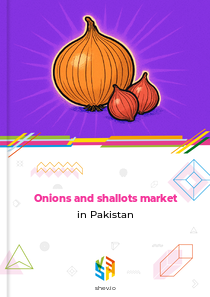







Earlier Report Observations
From 2018 to 2021, the market for onions and shallots in Pakistan remained stable, with volumes hovering between 1 980 and 2 000 thousand tons. Increased yields and expanded harvested area, which peaked in 2021, supported domestic production. However, a significant rise in exports, particularly in 2021, limited the growth of domestic availability, while fluctuations in onion import prices in 2018 and 2020 affected the cost of inbound shipments.
A sharp shift occurred in 2022 and 2023. The market volume jumped to 2 423 thousand tons in 2022, driven by a surge in imports to 493 thousand tons and a drop in exports. The following year, the market contracted to 2 034 thousand tons as production fell to 1 843 thousand tons and exports rebounded. A key driver was India's export ban on onions imposed in December 2023, which created an opportunity for Pakistan. Pakistani exporters responded aggressively, leading the government to set a minimum export price of $1,200 per ton and later impose a temporary export ban until April 2024 to curb domestic price inflation. This push opened new markets in the Middle East and Asia but also depleted local stocks and drove up consumer prices.
In 2024, after India lifted its export ban, domestic prices in Pakistan cooled. However, the market continued to face structural challenges, including limited storage capacity and shorter shelf life compared to Indian onions, which constrained export potential. Government initiatives to improve packaging and quality standards aimed to enhance competitiveness, while growth in the onion powder segment, fueled by the food processing industry, added a new dimension to the sector.
Table of content
- 1. Disclaimer
- 2. Terms of use of the report
- 3. Product codes in the statistical classifications used in the report
-
4. Key Market Indicators and Trends
-
4.1. Key Market Indicators
-
4.1.1. In kind
- 4.1.1.1. Production, 2018-2023
- 4.1.1.2. Imports, 2018-2024
- 4.1.1.3. Exports, 2018-2024
- 4.1.1.4. Market size, 2018-2023
-
4.1.1. In kind
- 4.2. Market Trends and Factors
-
4.1. Key Market Indicators
-
5. Production
-
5.1. Production in Pakistan
- 5.1.1. Annual dynamics of production in Pakistan in kind, 2018-2023, K t
- 5.1.2. Annual dynamics of production in Pakistan in value, 2018-2023, $ US
-
5.2. Global production by Country, 2018-2023
- 5.2.1. Annual dynamics of production by macroregions in kind, 2018-2023, K t
- 5.2.2. Dynamics of production structure by macroregions in kind, 2018-2023
- 5.2.3. Annual dynamics of production by country in kind, 2018-2023, K t
- 5.2.4. Structure of production by countries in kind, 2018-2023
- 5.2.5. Dynamics of peoduction structure by countries in kind, 2018-2023
-
5.1. Production in Pakistan
-
6. Exports
-
6.1. Exports (Direct Data)
- 6.1.1. Exports - Total information
-
6.1.2. Exports in kind, K t
- 6.1.2.1. Annual dynamics of product's exports from Pakistan in kind, 2018-2024, K t
- 6.1.2.2. Dynamics of product's exports in kind from Pakistan by countries, 2018-2024, K t
- 6.1.2.3. Structure of product's exports in kind by countries, 2018-2024
-
6.1.3. Exports in value, M $ US
- 6.1.3.1. Annual dynamics of product's exports from Pakistan in value, 2018-2024, M $ US
- 6.1.3.2. Dynamics of product's exports in value from Pakistan by countries, 2018-2024, M $ US
- 6.1.3.3. Structure of product's exports in value by countries, 2018-2024
-
6.1.4. Average price of product's exports, $ US/t
- 6.1.4.1. Annual dynamics of average price of product's exports from Pakistan, 2018-2024, $ US/t
- 6.1.4.2. Dynamics of average price of product's exports from Pakistan by countries, 2018-2024, $ US/t
-
6.2. Exports (Mirror Data)
- 6.2.1. Exports - Total information
-
6.2.2. Exports in kind, K t
- 6.2.2.1. Annual dynamics of product's exports from Pakistan in kind, 2018-2024, K t
- 6.2.2.2. Dynamics of product's exports in kind from Pakistan by countries, 2018-2024, K t
- 6.2.2.3. Structure of product's exports in kind by countries, 2018-2024
-
6.2.3. Exports in value, M $ US
- 6.2.3.1. Annual dynamics of product's exports from Pakistan in value, 2018-2024, M $ US
- 6.2.3.2. Dynamics of product's exports in value from Pakistan by countries, 2018-2024, M $ US
- 6.2.3.3. Structure of product's exports in value by countries, 2018-2024
-
6.2.4. Average price of product's exports, $ US/t
- 6.2.4.1. Annual dynamics of average price of product's exports from Pakistan, 2018-2024, $ US/t
- 6.2.4.2. Dynamics of average price of product's exports from Pakistan by countries, 2018-2024, $ US/t
-
6.1. Exports (Direct Data)
-
7. Imports
-
7.1. Imports (Direct Data)
- 7.1.1. Imports - Total information
-
7.1.2. Imports in kind, K t
- 7.1.2.1. Annual dynamics of product's imports to Pakistan in kind, 2018-2024, K t
- 7.1.2.2. Dynamics of product's imports in kind to Pakistan by countries, 2018-2024, K t
- 7.1.2.3. Structure of product's imports in kind by countries, 2018-2024
-
7.1.3. Imports in value, M $ US
- 7.1.3.1. Annual dynamics of product's imports to Pakistan in value, 2018-2024, M $ US
- 7.1.3.2. Dynamics of product's imports in value to Pakistan by countries, 2018-2024, M $ US
- 7.1.3.3. Structure of product's imports in value by countries, 2018-2024
-
7.1.4. Average price of product's imports, $ US/t
- 7.1.4.1. Annual dynamics of average price of product's imports to Pakistan, 2018-2024, $ US/t
- 7.1.4.2. Dynamics of average price of product's imports to Pakistan by countries, 2018-2024, $ US/t
-
7.2. Imports (Mirror Data)
- 7.2.1. Imports - Total information
-
7.2.2. Imports in kind, K t
- 7.2.2.1. Annual dynamics of product's imports to Pakistan in kind, 2018-2024, K t
- 7.2.2.2. Dynamics of product's imports in kind to Pakistan by countries, 2018-2024, K t
- 7.2.2.3. Structure of product's imports in kind by countries, 2018-2024
-
7.2.3. Imports in value, M $ US
- 7.2.3.1. Annual dynamics of product's imports to Pakistan in value, 2018-2024, M $ US
- 7.2.3.2. Dynamics of product's imports in value to Pakistan by countries, 2018-2024, M $ US
- 7.2.3.3. Structure of product's imports in value by countries, 2018-2024
-
7.2.4. Average price of product's imports, $ US/t
- 7.2.4.1. Annual dynamics of average price of product's imports to Pakistan, 2018-2024, $ US/t
- 7.2.4.2. Dynamics of average price of product's imports to Pakistan by countries, 2018-2024, $ US/t
-
7.1. Imports (Direct Data)
-
8. Trade balance
-
8.1. Trade balance (Direct Data)
- 8.1.1. In kind, K t
- 8.1.2. In value, M $ US
-
8.2. Trade balance (Mirror Data)
- 8.2.1. In kind, K t
- 8.2.2. In value, M $ US
-
8.1. Trade balance (Direct Data)
-
9. Top buying and selling countries, 2018-2024
-
9.1. Direct Data
- 9.1.1. Import in Value by Countries-buyers
- 9.1.2. Export in Value by Countries-suppliers
-
9.2. Mirror Data
- 9.2.1. Import in Value by Countries-buyers
- 9.2.2. Export in Value by Countries-suppliers
-
9.1. Direct Data
Production onions and shallots in Pakistan
In kind, 2017-2020, K t
On a global scale, Pakistan ranked as the 6th largest producer of onions and shallots between 2017 and 2020.
Top producers of onions and shallots, 2017-2020
World map of production of onions and shallots, 2017-2020
In 2020, Pakistan produced 2 122 thousand tonnes of onions and shallots, marking a 2.0% increase from the previous year. Over the 2017-2020 period, production grew by 15.8%, with a compound annual growth rate of 5.0%. The largest decline occurred in 2019 at 1.9%, while the most significant increase was recorded in 2018 at 15.6%.
Annual dynamics of production in Pakistan in kind, 2017-2020, K t
| Parameter | 2018 | 2019 | 2020 | CAGR | |
|---|---|---|---|---|---|
| 1 | Change from last year | 15.6% | (1.9%) | 2.0% | 5.0% |
Exports onions and shallots from Pakistan
Exports in kind, K t
The data shows irregular changes, reflecting a volatile market environment. Exports varied significantly, with a 5.1-fold difference between the low in 2017 and the high in 2020. In 2020, Pakistan's exports of onions and shallots reached 304.0 thousand tonnes, an 82.8% increase from the prior year. The largest decline was in 2019 at 21.1%, while the most substantial increase occurred in 2018 at 251.0%.
Annual dynamics of product's exports from Pakistan in kind, 2017-2020, K t
| Parameter | 2018 | 2019 | 2020 | CAGR | |
|---|---|---|---|---|---|
| 1 | Change from last year | 251.0% | (21.1%) | 82.8% | 71.7% |
From 2017 to 2020, Malaysia, the United Arab Emirates, and Sri Lanka were the key destinations for Pakistan's onion and shallot exports in volume terms. Malaysia accounted for 35.3% of exports, the United Arab Emirates for 17.7%, and Sri Lanka for 16.4%, together representing 69.4% of total export flows.
Structure of product's exports in kind by countries, 2017-2020
World map of product's exports from Pakistan in kind, 2017-2020
Exports in value, M $ US
Onions and shallots exports from Pakistan increased for the third consecutive year. In 2020, exports totaled 124.0 million US dollars, an 84.3% gain compared to 2019. Between 2017 and 2020, exports surged by 942.9%, equating to an annualized growth rate of 118.5%.
Annual dynamics of product's exports from Pakistan in value, 2017-2020, M $ US
| Parameter | 2018 | 2019 | 2020 | CAGR | |
|---|---|---|---|---|---|
| 1 | Change from last year | 308.8% | 38.4% | 84.3% | 118.5% |
Throughout 2017-2020, Malaysia, Sri Lanka, and the United Arab Emirates remained the largest markets for Pakistan's onion and shallot exports in value terms, collectively accounting for 69.8% of total export flows.
Structure of product's exports in value by countries, 2017-2020
World map of product's exports from Pakistan in value, 2017-2020
Imports onions and shallots to Pakistan
Imports in kind, K t
Market performance showed noticeable fluctuations during this period. Imports varied by a factor of 3, with the low in 2018 and the peak in 2020. In 2020, Pakistan's imports of onions and shallots amounted to 165.2 thousand tonnes, a 93.0% increase from the previous year. The minimum value was recorded in 2018 at 54.4 thousand tonnes, which also saw the largest decline of 28.2%.
Annual dynamics of product's imports to Pakistan in kind, 2017-2020, K t
| Parameter | 2018 | 2019 | 2020 | CAGR | |
|---|---|---|---|---|---|
| 1 | Change from last year | (28.2%) | 57.3% | 93.0% | 29.6% |
From 2017 to 2020, Pakistan's imports of onions and shallots in volume terms were highly concentrated on Afghanistan, which accounted for 97.1% of total import flows.
Structure of product's imports in kind by countries, 2017-2020
World map of product's imports to Pakistan in kind, 2017-2020
Imports in value, M $ US
The data reveals irregular changes, indicating a volatile market environment. Imports varied by 3.2 times, with the low in 2018 and the peak in 2020. In 2020, Pakistan's imported onions and shallots were valued at 28.9 million US dollars, an 84.8% gain compared to 2019. The minimum value was in 2018 at 9.1 million US dollars, which also experienced the largest decline of 32.6%.
Annual dynamics of product's imports to Pakistan in value, 2017-2020, M $ US
| Parameter | 2018 | 2019 | 2020 | CAGR | |
|---|---|---|---|---|---|
| 1 | Change from last year | (32.6%) | 72.6% | 84.8% | 29.0% |
Over the 2017-2020 period, Afghanistan was by far the main source for Pakistan's imports of onions and shallots in value terms, accounting for 96.9% of total import flows.
Structure of product's imports in value by countries, 2017-2020
World map of product's imports to Pakistan in value, 2017-2020
Related Reports

Onions and shallots market in Poland
2026-03-27
Onions and shallots market in Angola
2026-03-27
Onions and shallots market in South Africa
2026-03-27
Onions and shallots market in Slovakia
2026-03-27

2026-03-27
Alliaceous vegetables market in Pakistan
2026-03-27
Cauliflowers and broccoli market in Pakistan
2026-03-27
Why Choose Us?
Only Verified Data
No Hidden Costs or Separate Fees
Smarter Subscription Pricing
Contact Our Team
Submit your inquiry using the form below — our team will get back to you within 24 hours.