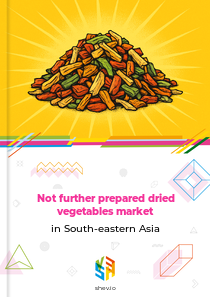







"South-eastern Asia" region includes following countries:
 Brunei Darussalam
 Myanmar
 Cambodia
 Indonesia
 Laos
Laos Malaysia
 the Philippines
 Timor-Leste
 Singapore
 Vietnam
 Thailand
Earlier Report Observations
Between 2018 and 2023, the market for not further prepared dried vegetables in South-eastern Asia saw its volume contract to 232.4 thousand tonnes in 2020, influenced by supply chain disruptions during the COVID-19 pandemic. However, a strong rebound followed, with the market reaching 275.5 thousand tonnes by 2023, driven by a lasting consumer pivot towards health-oriented and plant-based food products.
New entrants in the organic food segment intensified competition and broadened the variety of dried vegetable offerings from 2020 onward. This was coupled with rising demand for plant-based foods and clean-label products from 2021, which spurred manufacturers to innovate and supported consistent market growth through 2023.
Government measures to bolster local production, including the Singapore Food Agency's launch of land tenders for vegetable farming from 2022, provided structural support. These developments occurred alongside persistent consumer preference for organic, sustainable, and artisanal options, sustaining market expansion despite inflationary pressures and global supply uncertainties.
Table of content
- 1. Disclaimer
- 2. Terms of use of the report
- 3. Product codes in the statistical classifications used in the report
-
4. Key Market Indicators and Trends
-
4.1. Key Market Indicators
-
4.1.1. In kind
- 4.1.1.1. Production, 2018-2023
- 4.1.1.2. Imports, 2018-2024
- 4.1.1.3. Exports, 2018-2024
- 4.1.1.4. Market size, 2018-2023
-
4.1.1. In kind
- 4.2. Market Trends and Factors
-
4.1. Key Market Indicators
-
5. Production
-
5.1. Production in South-eastern Asia
- 5.1.1. Annual dynamics of production in South-eastern Asia in kind, 2018-2023, K t
-
5.2. Global production by Country, 2018-2023
- 5.2.1. Annual dynamics of production by macroregions in kind, 2018-2023, K t
- 5.2.2. Dynamics of production structure by macroregions in kind, 2018-2023
- 5.2.3. Annual dynamics of production by country in kind, 2018-2023, K t
- 5.2.4. Structure of production by countries in kind, 2018-2023
- 5.2.5. Dynamics of peoduction structure by countries in kind, 2018-2023
-
5.1. Production in South-eastern Asia
-
6. Imports
-
6.1. Imports (Direct Data*)
- 6.1.1. Imports - Total information
-
6.1.2. Imports in kind, K t
- 6.1.2.1. Annual dynamics of product's imports to Brunei Darussalam in kind, 2018-2024, K t
- 6.1.2.2. Dynamics of product's imports in kind to Brunei Darussalam by countries, 2018-2024, K t
- 6.1.2.3. Structure of product's imports in kind by countries, 2018-2024
-
6.1.3. Imports in value, M $ US
- 6.1.3.1. Annual dynamics of product's imports to Brunei Darussalam in value, 2018-2024, M $ US
- 6.1.3.2. Dynamics of product's imports in value to Brunei Darussalam by countries, 2018-2024, M $ US
- 6.1.3.3. Structure of product's imports in value by countries, 2018-2024
-
6.1.4. Average price of product's imports, $ US/kg
- 6.1.4.1. Annual dynamics of average price of product's imports to Brunei Darussalam, 2018-2024, $ US/kg
- 6.1.4.2. Dynamics of average price of product's imports to Brunei Darussalam by countries, 2018-2024, $ US/kg
-
6.2. Imports (Mirror Data)
- 6.2.1. Imports - Total information
-
6.2.2. Imports in kind, K t
- 6.2.2.1. Annual dynamics of product's imports to Brunei Darussalam in kind, 2018-2024, K t
- 6.2.2.2. Dynamics of product's imports in kind to Brunei Darussalam by countries, 2018-2024, K t
- 6.2.2.3. Structure of product's imports in kind by countries, 2018-2024
-
6.2.3. Imports in value, M $ US
- 6.2.3.1. Annual dynamics of product's imports to Brunei Darussalam in value, 2018-2024, M $ US
- 6.2.3.2. Dynamics of product's imports in value to Brunei Darussalam by countries, 2018-2024, M $ US
- 6.2.3.3. Structure of product's imports in value by countries, 2018-2024
-
6.2.4. Average price of product's imports, $ US/kg
- 6.2.4.1. Annual dynamics of average price of product's imports to Brunei Darussalam, 2018-2024, $ US/kg
- 6.2.4.2. Dynamics of average price of product's imports to Brunei Darussalam by countries, 2018-2024, $ US/kg
-
6.1. Imports (Direct Data*)
-
7. Exports
-
7.1. Exports (Direct Data*)
- 7.1.1. Exports - Total information
-
7.1.2. Exports in kind, K t
- 7.1.2.1. Annual dynamics of product's exports from Brunei Darussalam in kind, 2018-2024, K t
- 7.1.2.2. Dynamics of product's exports in kind from Brunei Darussalam by countries, 2018-2024, K t
- 7.1.2.3. Structure of product's exports in kind by countries, 2018-2024
-
7.1.3. Exports in value, M $ US
- 7.1.3.1. Annual dynamics of product's exports from Brunei Darussalam in value, 2018-2024, M $ US
- 7.1.3.2. Dynamics of product's exports in value from Brunei Darussalam by countries, 2018-2024, M $ US
- 7.1.3.3. Structure of product's exports in value by countries, 2018-2024
-
7.1.4. Average price of product's exports, $ US/kg
- 7.1.4.1. Annual dynamics of average price of product's exports from Brunei Darussalam, 2018-2024, $ US/kg
- 7.1.4.2. Dynamics of average price of product's exports from Brunei Darussalam by countries, 2018-2024, $ US/kg
-
7.2. Exports (Mirror Data)
- 7.2.1. Exports - Total information
-
7.2.2. Exports in kind, K t
- 7.2.2.1. Annual dynamics of product's exports from Brunei Darussalam in kind, 2018-2024, K t
- 7.2.2.2. Dynamics of product's exports in kind from Brunei Darussalam by countries, 2018-2024, K t
- 7.2.2.3. Structure of product's exports in kind by countries, 2018-2024
-
7.2.3. Exports in value, M $ US
- 7.2.3.1. Annual dynamics of product's exports from Brunei Darussalam in value, 2018-2024, M $ US
- 7.2.3.2. Dynamics of product's exports in value from Brunei Darussalam by countries, 2018-2024, M $ US
- 7.2.3.3. Structure of product's exports in value by countries, 2018-2024
-
7.2.4. Average price of product's exports, $ US/kg
- 7.2.4.1. Annual dynamics of average price of product's exports from Brunei Darussalam, 2018-2024, $ US/kg
- 7.2.4.2. Dynamics of average price of product's exports from Brunei Darussalam by countries, 2018-2024, $ US/kg
-
7.1. Exports (Direct Data*)
-
8. Trade balance
-
8.1. Trade balance (Direct Data)
- 8.1.1. In kind, K t
- 8.1.2. In value, M $ US
-
8.2. Trade balance (Mirror Data)
- 8.2.1. In kind, K t
- 8.2.2. In value, M $ US
-
8.1. Trade balance (Direct Data)
-
9. Top buying and selling countries, 2018-2024
-
9.1. Direct Data
- 9.1.1. Import in Value by Countries-buyers
- 9.1.2. Export in Value by Countries-suppliers
-
9.2. Mirror Data
- 9.2.1. Import in Value by Countries-buyers
- 9.2.2. Export in Value by Countries-suppliers
-
9.1. Direct Data
Production not further prepared dried vegetables in South-eastern Asia
In kind, 2017-2020, K t
Top producers of not further prepared dried vegetables, 2017-2020
World map of production of not further prepared dried vegetables, 2017-2020
In South-eastern Asia, the production of not further prepared dried vegetables has declined for the third year in a row. In 2020, the region produced 157.9 K t, which represents a 6.3% decrease compared to 2019. Looking at the period from 2017 to 2020, overall production fell by 20.9%, with an average annual decline of 7.5%.
Annual dynamics of production in South-eastern Asia in kind, 2017-2020, K t
| Parameter | 2018 | 2019 | 2020 | CAGR | |
|---|---|---|---|---|---|
| 1 | Change from last year | (2.0%) | (13.9%) | (6.3%) | (7.5%) |
Exports not further prepared dried vegetables from South-eastern Asia
Exports in kind, K t
Exports of not further prepared dried vegetables from South-eastern Asia have dropped for the second consecutive year. In 2020, exports stood at 12.5 K t, marking a significant 19.5% decrease from the previous year. Over the 2017-2020 period, exports plummeted by 61.5%, with an average annual decline of 27.2%. The peak was in 2018 at 41.1 K t, followed by the largest decline of 62.4% in 2019, while the largest increase of 27.2% occurred in 2018.
Annual dynamics of product's exports from South-eastern Asia in kind, 2017-2020, K t
| Parameter | 2018 | 2019 | 2020 | CAGR | |
|---|---|---|---|---|---|
| 1 | Change from last year | 27.2% | (62.4%) | (19.5%) | (27.2%) |
An analysis of export volumes from 2017 to 2020 reveals a wide distribution across various markets. China accounted for 3.8% of exports, Japan for 1.5%, and Asia, not elsewhere specified, for 1.2%. Together, these three markets made up only 6.4% of total flows, with the remaining 93.6% going to other partners.
Structure of product's exports in kind by countries, 2017-2020
World map of product's exports from South-eastern Asia in kind, 2017-2020
Exports in value, M $ US
The market exhibited volatility during the observed period. Exports reached their highest point in 2018 and fell to their lowest in 2020, with a 3.6-fold difference between these years. In 2020, South-eastern Asia's exports of not further prepared dried vegetables totaled 85.8 M $ US, reflecting a sharp 22.7% decrease from the previous year. The maximum value was recorded in 2018 at 307.3 M $ US, with the largest decline of 63.9% in 2019 and the largest increase of 77.7% in 2018.
Annual dynamics of product's exports from South-eastern Asia in value, 2017-2020, M $ US
| Parameter | 2018 | 2019 | 2020 | CAGR | |
|---|---|---|---|---|---|
| 1 | Change from last year | 77.7% | (63.9%) | (22.7%) | (20.8%) |
From 2017 to 2020, the value of not further prepared dried vegetables exports from South-eastern Asia was not highly concentrated. China held a 34.2% share, Japan 9.6%, and Asia, not elsewhere specified, 4.5%. Combined, these three markets accounted for 48.3% of total export value.
Structure of product's exports in value by countries, 2017-2020
World map of product's exports from South-eastern Asia in value, 2017-2020
Imports not further prepared dried vegetables to South-eastern Asia
Imports in kind, K t
Imports of not further prepared dried vegetables into South-eastern Asia have declined for the second year in a row. In 2020, the region imported 87.0 K t, down by 13.0% compared to 2019. Over the 2017-2020 period, imports increased by 4.1%, with an average annual growth rate of 1.3%. The peak was in 2018 at 103.5 K t, and the largest increase of 23.8% also occurred in 2018.
Annual dynamics of product's imports to South-eastern Asia in kind, 2017-2020, K t
| Parameter | 2018 | 2019 | 2020 | CAGR | |
|---|---|---|---|---|---|
| 1 | Change from last year | 23.8% | (3.4%) | (13.0%) | 1.3% |
Between 2017 and 2020, China was the dominant contributor to imports in kind, with a 67.4% share, followed by the United States at 8.8% and India at 5.7%. Together, these three countries accounted for 82.0% of total import volumes.
Structure of product's imports in kind by countries, 2017-2020
World map of product's imports to South-eastern Asia in kind, 2017-2020
Imports in value, M $ US
Market behavior was marked by volatility in these years. Imports peaked in 2018 and hit their lowest point in 2020, with a 1.9-fold difference between these years. In 2020, South-eastern Asia imported 341.4 M $ US of not further prepared dried vegetables, which is 35.5% lower than the previous year. The maximum value was recorded in 2018 at 661.3 M $ US, with the largest increase of 75.9% also in 2018.
Annual dynamics of product's imports to South-eastern Asia in value, 2017-2020, M $ US
| Parameter | 2018 | 2019 | 2020 | CAGR | |
|---|---|---|---|---|---|
| 1 | Change from last year | 75.9% | (20.0%) | (35.5%) | (3.2%) |
Throughout 2017-2020, China remained the nearly exclusive supplier of not further prepared dried vegetables to South-eastern Asia, accounting for 90.8% of total import value.
Structure of product's imports in value by countries, 2017-2020
World map of product's imports to South-eastern Asia in value, 2017-2020
Related Reports


Yams market in South-eastern Asia
2026-03-27


Taro market in South-eastern Asia
2026-03-27

Why Choose Us?
Only Verified Data
No Hidden Costs or Separate Fees
Smarter Subscription Pricing
Contact Our Team
Submit your inquiry using the form below — our team will get back to you within 24 hours.