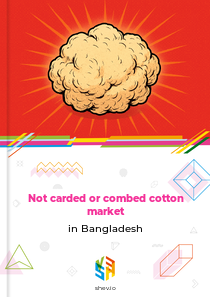







Earlier Report Observations
The market for not carded or combed cotton in Bangladesh showed considerable volatility between 2018 and 2023, starting at a high of 1.9 million tons in 2018 before falling and then recovering to 1.7 million tons in 2021. This peak was supported by a heavy reliance on imported raw materials, with India exporting $1.38 billion worth of cotton to Bangladesh that year, feeding the country's textile industry.
Market volume subsequently declined to 1.3 million tons by 2023. This period coincided with an expansion of domestic spinning mill capacity and cotton consumption potential within the textile sector. Concurrent shifts in sourcing, such as Bangladesh emerging as a major buyer of American cotton, and trade policy changes that affected competition—including deals favoring domestic spinners and restrictions on Indian yarn imports—influenced market dynamics.
In 2024, political unrest led to temporary factory shutdowns in the garments sector, while new environmental regulations prompted compliance measures from textile factories. The government and industry bodies jointly set farm gate prices for raw cotton, and trade policy shifts intensified competition for cotton imports, further shaping the operating environment.
Table of content
- 1. Disclaimer
- 2. Terms of use of the report
- 3. Product codes in the statistical classifications used in the report
-
4. Key Market Indicators and Trends
-
4.1. Key Market Indicators
-
4.1.1. In kind
- 4.1.1.1. Production, 2018-2023
- 4.1.1.2. Imports, 2018-2024
- 4.1.1.3. Exports, 2018-2024
- 4.1.1.4. Market size, 2018-2023
-
4.1.1. In kind
- 4.2. Market Trends and Factors
-
4.1. Key Market Indicators
-
5. Production
-
5.1. Production in Bangladesh
- 5.1.1. Annual dynamics of production in Bangladesh in kind, 2018-2023, K t
- 5.1.2. Annual dynamics of production in Bangladesh in value, 2018-2023, $ US
-
5.2. Global production by Country, 2018-2023
- 5.2.1. Annual dynamics of production by macroregions in kind, 2018-2023, K t
- 5.2.2. Dynamics of production structure by macroregions in kind, 2018-2023
- 5.2.3. Annual dynamics of production by country in kind, 2018-2023, K t
- 5.2.4. Structure of production by countries in kind, 2018-2023
- 5.2.5. Dynamics of peoduction structure by countries in kind, 2018-2023
-
5.1. Production in Bangladesh
-
6. Exports
-
6.1. Exports (Direct Data*)
- 6.1.1. Exports - Total information
-
6.1.2. Exports in kind, K t
- 6.1.2.1. Annual dynamics of product's exports from Bangladesh in kind, 2018-2024, K t
- 6.1.2.2. Dynamics of product's exports in kind from Bangladesh by countries, 2018-2024, K t
- 6.1.2.3. Structure of product's exports in kind by countries, 2018-2024
-
6.1.3. Exports in value, M $ US
- 6.1.3.1. Annual dynamics of product's exports from Bangladesh in value, 2018-2024, M $ US
- 6.1.3.2. Dynamics of product's exports in value from Bangladesh by countries, 2018-2024, M $ US
- 6.1.3.3. Structure of product's exports in value by countries, 2018-2024
-
6.1.4. Average price of product's exports, $ US/t
- 6.1.4.1. Annual dynamics of average price of product's exports from Bangladesh, 2018-2024, $ US/t
- 6.1.4.2. Dynamics of average price of product's exports from Bangladesh by countries, 2018-2024, $ US/t
-
6.2. Exports (Mirror Data)
- 6.2.1. Exports - Total information
-
6.2.2. Exports in kind, K t
- 6.2.2.1. Annual dynamics of product's exports from Bangladesh in kind, 2018-2024, K t
- 6.2.2.2. Dynamics of product's exports in kind from Bangladesh by countries, 2018-2024, K t
- 6.2.2.3. Structure of product's exports in kind by countries, 2018-2024
-
6.2.3. Exports in value, M $ US
- 6.2.3.1. Annual dynamics of product's exports from Bangladesh in value, 2018-2024, M $ US
- 6.2.3.2. Dynamics of product's exports in value from Bangladesh by countries, 2018-2024, M $ US
- 6.2.3.3. Structure of product's exports in value by countries, 2018-2024
-
6.2.4. Average price of product's exports, $ US/t
- 6.2.4.1. Annual dynamics of average price of product's exports from Bangladesh, 2018-2024, $ US/t
- 6.2.4.2. Dynamics of average price of product's exports from Bangladesh by countries, 2018-2024, $ US/t
-
6.1. Exports (Direct Data*)
-
7. Imports
-
7.1. Imports (Direct Data*)
- 7.1.1. Imports - Total information
-
7.1.2. Imports in kind, K t
- 7.1.2.1. Annual dynamics of product's imports to Bangladesh in kind, 2018-2024, K t
- 7.1.2.2. Dynamics of product's imports in kind to Bangladesh by countries, 2018-2024, K t
- 7.1.2.3. Structure of product's imports in kind by countries, 2018-2024
-
7.1.3. Imports in value, M $ US
- 7.1.3.1. Annual dynamics of product's imports to Bangladesh in value, 2018-2024, M $ US
- 7.1.3.2. Dynamics of product's imports in value to Bangladesh by countries, 2018-2024, M $ US
- 7.1.3.3. Structure of product's imports in value by countries, 2018-2024
-
7.1.4. Average price of product's imports, $ US/t
- 7.1.4.1. Annual dynamics of average price of product's imports to Bangladesh, 2018-2024, $ US/t
- 7.1.4.2. Dynamics of average price of product's imports to Bangladesh by countries, 2018-2024, $ US/t
-
7.2. Imports (Mirror Data)
- 7.2.1. Imports - Total information
-
7.2.2. Imports in kind, K t
- 7.2.2.1. Annual dynamics of product's imports to Bangladesh in kind, 2018-2024, K t
- 7.2.2.2. Dynamics of product's imports in kind to Bangladesh by countries, 2018-2024, K t
- 7.2.2.3. Structure of product's imports in kind by countries, 2018-2024
-
7.2.3. Imports in value, M $ US
- 7.2.3.1. Annual dynamics of product's imports to Bangladesh in value, 2018-2024, M $ US
- 7.2.3.2. Dynamics of product's imports in value to Bangladesh by countries, 2018-2024, M $ US
- 7.2.3.3. Structure of product's imports in value by countries, 2018-2024
-
7.2.4. Average price of product's imports, $ US/t
- 7.2.4.1. Annual dynamics of average price of product's imports to Bangladesh, 2018-2024, $ US/t
- 7.2.4.2. Dynamics of average price of product's imports to Bangladesh by countries, 2018-2024, $ US/t
-
7.1. Imports (Direct Data*)
-
8. Trade balance
-
8.1. Trade balance (Direct Data)
- 8.1.1. In kind, K t
- 8.1.2. In value, M $ US
-
8.2. Trade balance (Mirror Data)
- 8.2.1. In kind, K t
- 8.2.2. In value, M $ US
-
8.1. Trade balance (Direct Data)
-
9. Top buying and selling countries, 2018-2024
-
9.1. Direct Data
- 9.1.1. Import in Value by Countries-buyers
- 9.1.2. Export in Value by Countries-suppliers
-
9.2. Mirror Data
- 9.2.1. Import in Value by Countries-buyers
- 9.2.2. Export in Value by Countries-suppliers
-
9.1. Direct Data
Production not carded or combed cotton in Bangladesh
In kind, 2017-2020, K t
Top producers of not carded or combed cotton, 2017-2020
World map of production of not carded or combed cotton, 2017-2020
In 2019, Bangladesh produced 112.7 thousand tons of not carded or combed cotton, which was the lowest level during the 2017-2020 period. Production then increased by 3.8% to 117.0 thousand tons in 2020. Looking at the broader trend, output declined by 27.7% over these four years, with an average annual decrease of 10.3%. The peak was reached in 2018 at 177.8 thousand tons, marking a 9.8% increase from the previous year. However, the most significant drop occurred in 2019, when production fell by 36.6%.
Annual dynamics of production in Bangladesh in kind, 2017-2020, K t
| Parameter | 2018 | 2019 | 2020 | CAGR | |
|---|---|---|---|---|---|
| 1 | Change from last year | 9.8% | (36.6%) | 3.8% | (10.3%) |
Exports not carded or combed cotton from Bangladesh
Exports in kind, K t
In 2020, Bangladesh exported 3 thousand tons of not carded or combed cotton, representing a dramatic surge of 4,415.1% compared to 2019. Over the 2017-2020 period, exports grew by 12,776.3%, translating to an average annual growth rate of 405.0%.
Annual dynamics of product's exports from Bangladesh in kind, 2017-2020, K t
| Parameter | 2018 | 2019 | 2020 | CAGR | |
|---|---|---|---|---|---|
| 1 | Change from last year | n/a | n/a | 4 415.1% | 405.0% |
From 2017 to 2020, Tajikistan was the primary and nearly exclusive market for Bangladesh's exports of not carded or combed cotton in kind, accounting for 94.8% of the total volume.
Structure of product's exports in kind by countries, 2017-2020
World map of product's exports from Bangladesh in kind, 2017-2020
Exports in value, M $ US
In 2020, Bangladesh exported 4 million US dollars worth of not carded or combed cotton, showing a sharp year-over-year increase of 10,341.1%. Between 2017 and 2020, export value rose by 29,110.9%, with an average annual growth rate of 563.5%.
Annual dynamics of product's exports from Bangladesh in value, 2017-2020, M $ US
| Parameter | 2018 | 2019 | 2020 | CAGR | |
|---|---|---|---|---|---|
| 1 | Change from last year | n/a | n/a | 10 341.1% | 563.5% |
During the 2017-2020 period, Bangladesh's export value of not carded or combed cotton was heavily reliant on Tajikistan, which accounted for 94.7% of the total.
Structure of product's exports in value by countries, 2017-2020
World map of product's exports from Bangladesh in value, 2017-2020
Imports not carded or combed cotton to Bangladesh
Imports in kind, K t
In 2020, Bangladesh imported 1,325 thousand tons of not carded or combed cotton, a moderate increase of 9.1% from the previous year. Over the 2017-2020 span, imports decreased by 22.7%, with an average annual decline of 8.2%. The lowest import volume was recorded in 2019 at 1,214 thousand tons, while the peak occurred in 2018 at 1,751 thousand tons. The most substantial reduction took place in 2019, with a drop of 30.7%.
Annual dynamics of product's imports to Bangladesh in kind, 2017-2020, K t
| Parameter | 2018 | 2019 | 2020 | CAGR | |
|---|---|---|---|---|---|
| 1 | Change from last year | 2.2% | (30.7%) | 9.1% | (8.2%) |
Between 2017 and 2020, the partner structure for Bangladesh's imports of not carded or combed cotton in kind was fragmented. India accounted for 27.1% of imports, the United States for 13.8%, and Brazil for 9.1%, together making up 49.9% of total flows. No single country held a dominant share.
Structure of product's imports in kind by countries, 2017-2020
World map of product's imports to Bangladesh in kind, 2017-2020
Imports in value, M $ US
In 2020, Bangladesh's imports of not carded or combed cotton totaled 2,011 million US dollars, reflecting a slight decrease of 0.9% from 2019 and marking the second consecutive year of decline. Over the 2017-2020 period, import value fell by 40.1%, with an average annual reduction of 15.7%. The highest value was recorded in 2018 at 3,592 million US dollars, which represented a 6.9% increase from the previous year. The largest decline occurred in 2019, with a drop of 43.5%.
Annual dynamics of product's imports to Bangladesh in value, 2017-2020, M $ US
| Parameter | 2018 | 2019 | 2020 | CAGR | |
|---|---|---|---|---|---|
| 1 | Change from last year | 6.9% | (43.5%) | (0.9%) | (15.7%) |
From 2017 to 2020, the geographical structure of Bangladesh's imports of not carded or combed cotton in value terms was highly diversified. India contributed 26.6% of the import value, the United States 13.8%, and Brazil 8.2%, together accounting for 48.5% of total flows. The remaining 51.5% was distributed among numerous smaller partner countries.
Structure of product's imports in value by countries, 2017-2020
World map of product's imports to Bangladesh in value, 2017-2020
Related Reports
Not carded or combed cotton market in Uganda
2026-03-30
Not carded or combed cotton market in CIS
2026-03-30
Not carded or combed cotton market in ECOWAS
2026-03-30


Wood in the rough market in Bangladesh
2026-03-29

Beef, sheep or goat fat market in Bangladesh
2026-03-28
Why Choose Us?
Only Verified Data
No Hidden Costs or Separate Fees
Smarter Subscription Pricing
Contact Our Team
Submit your inquiry using the form below — our team will get back to you within 24 hours.