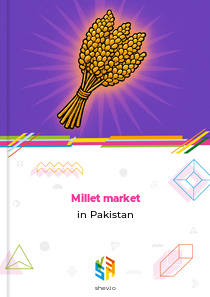







Earlier Report Observations
The millet market in Pakistan showed significant volatility from 2018 to 2023. After reaching a high of 385 thousand tons in 2019, the market volume fell sharply to 255 thousand tons in 2020.
A gradual recovery took place from 2021 onward, with the market expanding to 260 thousand tons in 2022 and then to 293 thousand tons in 2023. Domestic production followed a similar trajectory, indicating that internal supply was the primary driver of market fluctuations.
International trade played a minor role in overall market size. Imports, which had added 18 thousand tons in 2018, declined to less than 2 thousand tons in 2020 before modestly recovering. Exports also remained limited, with a notable increase to 12 thousand tons in 2020 that slightly amplified the market contraction that year.
Table of content
- 1. Disclaimer
- 2. Terms of use of the report
- 3. Product codes in the statistical classifications used in the report
-
4. Key Market Indicators and Trends
-
4.1. Key Market Indicators
-
4.1.1. In kind
- 4.1.1.1. Production, 2018-2023
- 4.1.1.2. Imports, 2018-2024
- 4.1.1.3. Exports, 2018-2024
- 4.1.1.4. Market size, 2018-2023
-
4.1.1. In kind
- 4.2. Market Trends and Factors
-
4.1. Key Market Indicators
-
5. Production
-
5.1. Production in Pakistan
- 5.1.1. Annual dynamics of production in Pakistan in kind, 2018-2023, K t
- 5.1.2. Annual dynamics of production in Pakistan in value, 2018-2023, $ US
-
5.2. Global production by Country, 2018-2023
- 5.2.1. Annual dynamics of production by macroregions in kind, 2018-2023, K t
- 5.2.2. Dynamics of production structure by macroregions in kind, 2018-2023
- 5.2.3. Annual dynamics of production by country in kind, 2018-2023, K t
- 5.2.4. Structure of production by countries in kind, 2018-2023
- 5.2.5. Dynamics of peoduction structure by countries in kind, 2018-2023
-
5.1. Production in Pakistan
-
6. Exports
-
6.1. Exports (Direct Data)
- 6.1.1. Exports - Total information
-
6.1.2. Exports in kind, t
- 6.1.2.1. Annual dynamics of product's exports from Pakistan in kind, 2018-2024, t
- 6.1.2.2. Dynamics of product's exports in kind from Pakistan by countries, 2018-2024, t
- 6.1.2.3. Structure of product's exports in kind by countries, 2018-2024
-
6.1.3. Exports in value, K $ US
- 6.1.3.1. Annual dynamics of product's exports from Pakistan in value, 2018-2024, K $ US
- 6.1.3.2. Dynamics of product's exports in value from Pakistan by countries, 2018-2024, K $ US
- 6.1.3.3. Structure of product's exports in value by countries, 2018-2024
-
6.1.4. Average price of product's exports, $ US/t
- 6.1.4.1. Annual dynamics of average price of product's exports from Pakistan, 2018-2024, $ US/t
- 6.1.4.2. Dynamics of average price of product's exports from Pakistan by countries, 2018-2024, $ US/t
-
6.2. Exports (Mirror Data)
- 6.2.1. Exports - Total information
-
6.2.2. Exports in kind, t
- 6.2.2.1. Annual dynamics of product's exports from Pakistan in kind, 2018-2024, t
- 6.2.2.2. Dynamics of product's exports in kind from Pakistan by countries, 2018-2024, t
- 6.2.2.3. Structure of product's exports in kind by countries, 2018-2024
-
6.2.3. Exports in value, K $ US
- 6.2.3.1. Annual dynamics of product's exports from Pakistan in value, 2018-2024, K $ US
- 6.2.3.2. Dynamics of product's exports in value from Pakistan by countries, 2018-2024, K $ US
- 6.2.3.3. Structure of product's exports in value by countries, 2018-2024
-
6.2.4. Average price of product's exports, $ US/t
- 6.2.4.1. Annual dynamics of average price of product's exports from Pakistan, 2018-2024, $ US/t
- 6.2.4.2. Dynamics of average price of product's exports from Pakistan by countries, 2018-2024, $ US/t
-
6.1. Exports (Direct Data)
-
7. Imports
-
7.1. Imports (Direct Data)
- 7.1.1. Imports - Total information
-
7.1.2. Imports in kind, t
- 7.1.2.1. Annual dynamics of product's imports to Pakistan in kind, 2018-2024, t
- 7.1.2.2. Dynamics of product's imports in kind to Pakistan by countries, 2018-2024, t
- 7.1.2.3. Structure of product's imports in kind by countries, 2018-2024
-
7.1.3. Imports in value, K $ US
- 7.1.3.1. Annual dynamics of product's imports to Pakistan in value, 2018-2024, K $ US
- 7.1.3.2. Dynamics of product's imports in value to Pakistan by countries, 2018-2024, K $ US
- 7.1.3.3. Structure of product's imports in value by countries, 2018-2024
-
7.1.4. Average price of product's imports, $ US/t
- 7.1.4.1. Annual dynamics of average price of product's imports to Pakistan, 2018-2024, $ US/t
- 7.1.4.2. Dynamics of average price of product's imports to Pakistan by countries, 2018-2024, $ US/t
-
7.2. Imports (Mirror Data)
- 7.2.1. Imports - Total information
-
7.2.2. Imports in kind, t
- 7.2.2.1. Annual dynamics of product's imports to Pakistan in kind, 2018-2024, t
- 7.2.2.2. Dynamics of product's imports in kind to Pakistan by countries, 2018-2024, t
- 7.2.2.3. Structure of product's imports in kind by countries, 2018-2024
-
7.2.3. Imports in value, K $ US
- 7.2.3.1. Annual dynamics of product's imports to Pakistan in value, 2018-2024, K $ US
- 7.2.3.2. Dynamics of product's imports in value to Pakistan by countries, 2018-2024, K $ US
- 7.2.3.3. Structure of product's imports in value by countries, 2018-2024
-
7.2.4. Average price of product's imports, $ US/t
- 7.2.4.1. Annual dynamics of average price of product's imports to Pakistan, 2018-2024, $ US/t
- 7.2.4.2. Dynamics of average price of product's imports to Pakistan by countries, 2018-2024, $ US/t
-
7.1. Imports (Direct Data)
-
8. Trade balance
-
8.1. Trade balance (Direct Data)
- 8.1.1. In kind, t
- 8.1.2. In value, K $ US
-
8.2. Trade balance (Mirror Data)
- 8.2.1. In kind, t
- 8.2.2. In value, K $ US
-
8.1. Trade balance (Direct Data)
-
9. Top buying and selling countries, 2018-2024
-
9.1. Direct Data
- 9.1.1. Import in Value by Countries-buyers
- 9.1.2. Export in Value by Countries-suppliers
-
9.2. Mirror Data
- 9.2.1. Import in Value by Countries-buyers
- 9.2.2. Export in Value by Countries-suppliers
-
9.1. Direct Data
Production millet in Pakistan
In kind, 2017-2020, K t
From 2017 to 2020, Pakistan ranked 12th globally in millet production.
Top producers of millet, 2017-2020
World map of production of millet, 2017-2020
Pakistan's millet production volume declined after two years of growth. In 2020, the country produced 266.1 K t of millet, representing a 30.8% decrease compared to the previous year. Over the 2017-2020 period, production fell by 21.5%, with a compound annual growth rate of -7.8%. The highest production level was recorded in 2019 at 384.4 K t, which also saw the largest annual increase of 9.8%.
Annual dynamics of production in Pakistan in kind, 2017-2020, K t
| Parameter | 2018 | 2019 | 2020 | CAGR | |
|---|---|---|---|---|---|
| 1 | Change from last year | 3.2% | 9.8% | (30.8%) | (7.8%) |
In value, 2017-2020, M $ US
In 2020, Pakistan's millet output was valued at 64.9 M $ US, a 32.7% decline from 2019. Between 2017 and 2020, production value decreased by 38.6%, with a compound annual growth rate of -15.0%. The largest increase occurred in 2019, reaching 18.2%.
Annual dynamics of production in Pakistan in value, 2017-2020, M $ US
| Parameter | 2018 | 2019 | 2020 | CAGR | |
|---|---|---|---|---|---|
| 1 | Change from last year | (22.7%) | 18.2% | (32.7%) | (15.0%) |
Exports millet from Pakistan
Exports in kind, t
Export volumes showed irregular changes, indicating a volatile market environment. The lowest export volume was recorded in 2018 at 1 515 t, while the highest reached 12 377 t in 2020, creating an 8.2-fold difference between these years. In 2020, Pakistan's millet export volume increased by 35.9% year-over-year. The largest decline occurred in 2018 at 20.4%, while the most significant increase was recorded in 2019 at 501.1%.
Annual dynamics of product's exports from Pakistan in kind, 2017-2020, t
| Parameter | 2018 | 2019 | 2020 | CAGR | |
|---|---|---|---|---|---|
| 1 | Change from last year | (20.4%) | 501.1% | 35.9% | 86.6% |
From 2017 to 2020, the United Arab Emirates (40.7% of export volume), Afghanistan (34.7%), and Saudi Arabia (8.4%) were the main destinations for Pakistan's millet exports, together accounting for 83.7% of total export flows.
Structure of product's exports in kind by countries, 2017-2020
World map of product's exports from Pakistan in kind, 2017-2020
Exports in value, K $ US
Export values exhibited noticeable fluctuations during the period. The lowest value was recorded in 2018 at 353 K $ US, while the highest reached 3 018 K $ US in 2020, resulting in an 8.5-fold variation. In 2020, Pakistan's millet exports increased by 32.1% compared to the previous year. The largest decline occurred in 2018 at 40.4%, while the most substantial increase was recorded in 2019 at 546.8%.
Annual dynamics of product's exports from Pakistan in value, 2017-2020, K $ US
| Parameter | 2018 | 2019 | 2020 | CAGR | |
|---|---|---|---|---|---|
| 1 | Change from last year | (40.4%) | 546.8% | 32.1% | 72.0% |
Between 2017 and 2020, the United Arab Emirates (40.1% of export value), Afghanistan (32.1%), and Saudi Arabia (10.1%) formed the primary group of destinations for Pakistan's millet exports, collectively representing 82.3% of total export value.
Structure of product's exports in value by countries, 2017-2020
World map of product's exports from Pakistan in value, 2017-2020
Imports millet to Pakistan
Imports in kind, t
Pakistan's millet imports declined for the third consecutive year. In 2020, imports stood at 1 168 t, down 87.7% from the previous year. Between 2017 and 2020, imports decreased by 93.7%, equating to an annualized decline rate of 60.3%.
Annual dynamics of product's imports to Pakistan in kind, 2017-2020, t
| Parameter | 2018 | 2019 | 2020 | CAGR | |
|---|---|---|---|---|---|
| 1 | Change from last year | (4.3%) | (46.8%) | (87.7%) | (60.3%) |
From 2017 to 2020, India remained the primary source of millet imports to Pakistan, accounting for 75.0% of total import volume, while other destinations played much smaller roles.
Structure of product's imports in kind by countries, 2017-2020
World map of product's imports to Pakistan in kind, 2017-2020
Imports in value, K $ US
Millet imports to Pakistan declined for the third year in a row. In 2020, imports amounted to 228 K $ US, marking a dramatic 95.0% drop from 2019. Over the 2017-2020 period, imports decreased by 96.1%, with a compound annual growth rate of -66.0%.
Annual dynamics of product's imports to Pakistan in value, 2017-2020, K $ US
| Parameter | 2018 | 2019 | 2020 | CAGR | |
|---|---|---|---|---|---|
| 1 | Change from last year | (7.6%) | (14.1%) | (95.0%) | (66.0%) |
Throughout 2017-2020, India was the main supplier of millet to Pakistan, representing 81.8% of total import value, while other trading partners had relatively modest shares.
Structure of product's imports in value by countries, 2017-2020
World map of product's imports to Pakistan in value, 2017-2020
Related Reports

2026-03-28
Millet market in South-eastern Asia
2026-03-28
2026-03-28
Millet market in Eastern Africa
2026-03-28
2026-03-28
2026-03-28
Wheat and meslin market in Pakistan
2026-03-28
In-depth market research on this product
Global Finger Millet Market 2021–2031: Size, Share, Trends and Forecast
Global market report: size, trends and forecast to 2031 · 184 pages
Global Proso Millet Market 2021–2031: Size, Share, Trends and Forecast
Global market report: size, trends and forecast to 2031 · 184 pages
Why Choose Us?
Only Verified Data
No Hidden Costs or Separate Fees
Smarter Subscription Pricing
Contact Our Team
Submit your inquiry using the form below — our team will get back to you within 24 hours.