






"Middle Africa" region includes following countries:
 Angola
 Cameroon
 Central African Republic
 Chad
Chad Congo
Congo Democratic Republic of the Congo
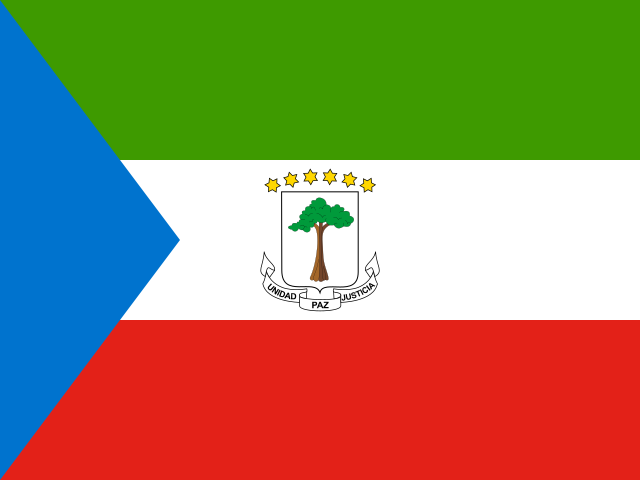 Equatorial Guinea
 Gabon
Gabon Sao Tome and Principe
Earlier Report Observations
The millet market in Middle Africa contracted from 974.4 thousand tons in 2018 to 819.6 thousand tons in 2021, a cumulative reduction of nearly 16%. This prolonged decline was underpinned by technological lag in the agricultural sector, which kept productivity and competitiveness low compared to international markets.
After a recovery to 894.4 thousand tons in 2022, the market volume fell again to 828.7 thousand tons in 2023. The drop in 2023 was driven primarily by adverse climate conditions, including droughts and floods across the region, which reduced harvests and supply. The same year saw the United Nations designate 2023 the International Year of Millet, boosting attention to the climate-resilient crop, though this did not offset the immediate production losses from extreme weather.
Table of content
- 1. Disclaimer
- 2. Terms of use of the report
- 3. Product codes in the statistical classifications used in the report
-
4. Key Market Indicators and Trends
-
4.1. Key Market Indicators
-
4.1.1. In kind
- 4.1.1.1. Production, 2018-2023
- 4.1.1.2. Imports, 2018-2024
- 4.1.1.3. Exports, 2018-2024
- 4.1.1.4. Market size, 2018-2023
-
4.1.1. In kind
- 4.2. Market Trends and Factors
-
4.1. Key Market Indicators
-
5. Production
-
5.1. Production in Middle Africa
- 5.1.1. Annual dynamics of production in Middle Africa in kind, 2018-2023, K t
-
5.2. Global production by Country, 2018-2023
- 5.2.1. Annual dynamics of production by macroregions in kind, 2018-2023, K t
- 5.2.2. Dynamics of production structure by macroregions in kind, 2018-2023
- 5.2.3. Annual dynamics of production by country in kind, 2018-2023, K t
- 5.2.4. Structure of production by countries in kind, 2018-2023
- 5.2.5. Dynamics of peoduction structure by countries in kind, 2018-2023
-
5.1. Production in Middle Africa
-
6. Imports
-
6.1. Imports (Direct Data*)
- 6.1.1. Imports - Total information
-
6.1.2. Imports in kind, t
- 6.1.2.1. Annual dynamics of product's imports to Angola in kind, 2018-2024, t
- 6.1.2.2. Dynamics of product's imports in kind to Angola by countries, 2018-2024, t
- 6.1.2.3. Structure of product's imports in kind by countries, 2018-2024
-
6.1.3. Imports in value, K $ US
- 6.1.3.1. Annual dynamics of product's imports to Angola in value, 2018-2024, K $ US
- 6.1.3.2. Dynamics of product's imports in value to Angola by countries, 2018-2024, K $ US
- 6.1.3.3. Structure of product's imports in value by countries, 2018-2024
-
6.1.4. Average price of product's imports, $ US/t
- 6.1.4.1. Annual dynamics of average price of product's imports to Angola, 2018-2024, $ US/t
- 6.1.4.2. Dynamics of average price of product's imports to Angola by countries, 2018-2024, $ US/t
-
6.2. Imports (Mirror Data)
- 6.2.1. Imports - Total information
-
6.2.2. Imports in kind, t
- 6.2.2.1. Annual dynamics of product's imports to Angola in kind, 2018-2024, t
- 6.2.2.2. Dynamics of product's imports in kind to Angola by countries, 2018-2024, t
- 6.2.2.3. Structure of product's imports in kind by countries, 2018-2024
-
6.2.3. Imports in value, K $ US
- 6.2.3.1. Annual dynamics of product's imports to Angola in value, 2018-2024, K $ US
- 6.2.3.2. Dynamics of product's imports in value to Angola by countries, 2018-2024, K $ US
- 6.2.3.3. Structure of product's imports in value by countries, 2018-2024
-
6.2.4. Average price of product's imports, $ US/t
- 6.2.4.1. Annual dynamics of average price of product's imports to Angola, 2018-2024, $ US/t
- 6.2.4.2. Dynamics of average price of product's imports to Angola by countries, 2018-2024, $ US/t
-
6.1. Imports (Direct Data*)
-
7. Exports
-
7.1. Exports (Direct Data*)
- 7.1.1. Exports - Total information
-
7.1.2. Exports in kind, t
- 7.1.2.1. Annual dynamics of product's exports from Angola in kind, 2018-2024, t
- 7.1.2.2. Dynamics of product's exports in kind from Angola by countries, 2018-2024, t
- 7.1.2.3. Structure of product's exports in kind by countries, 2018-2024
-
7.1.3. Exports in value, K $ US
- 7.1.3.1. Annual dynamics of product's exports from Angola in value, 2018-2024, K $ US
- 7.1.3.2. Dynamics of product's exports in value from Angola by countries, 2018-2024, K $ US
- 7.1.3.3. Structure of product's exports in value by countries, 2018-2024
-
7.1.4. Average price of product's exports, $ US/t
- 7.1.4.1. Annual dynamics of average price of product's exports from Angola, 2018-2024, $ US/t
- 7.1.4.2. Dynamics of average price of product's exports from Angola by countries, 2018-2024, $ US/t
-
7.2. Exports (Mirror Data)
- 7.2.1. Exports - Total information
-
7.2.2. Exports in kind, t
- 7.2.2.1. Annual dynamics of product's exports from Angola in kind, 2018-2024, t
- 7.2.2.2. Dynamics of product's exports in kind from Angola by countries, 2018-2024, t
- 7.2.2.3. Structure of product's exports in kind by countries, 2018-2024
-
7.2.3. Exports in value, K $ US
- 7.2.3.1. Annual dynamics of product's exports from Angola in value, 2018-2024, K $ US
- 7.2.3.2. Dynamics of product's exports in value from Angola by countries, 2018-2024, K $ US
- 7.2.3.3. Structure of product's exports in value by countries, 2018-2024
-
7.2.4. Average price of product's exports, $ US/t
- 7.2.4.1. Annual dynamics of average price of product's exports from Angola, 2018-2024, $ US/t
- 7.2.4.2. Dynamics of average price of product's exports from Angola by countries, 2018-2024, $ US/t
-
7.1. Exports (Direct Data*)
-
8. Trade balance
-
8.1. Trade balance (Direct Data)
- 8.1.1. In kind, t
- 8.1.2. In value, K $ US
-
8.2. Trade balance (Mirror Data)
- 8.2.1. In kind, t
- 8.2.2. In value, K $ US
-
8.1. Trade balance (Direct Data)
-
9. Top buying and selling countries, 2018-2024
-
9.1. Direct Data
- 9.1.1. Import in Value by Countries-buyers
- 9.1.2. Export in Value by Countries-suppliers
-
9.2. Mirror Data
- 9.2.1. Import in Value by Countries-buyers
- 9.2.2. Export in Value by Countries-suppliers
-
9.1. Direct Data
Production millet in Middle Africa
In kind, 2017-2020, K t
Top producers of millet, 2017-2020
World map of production of millet, 2017-2020
Millet production in Middle Africa has declined for the second year in a row. In 2020, the region produced 904.9 thousand tons of millet, marking a slight decrease of 3.0% compared to 2019. Over the period from 2017 to 2020, production increased by 2.9%, with an average annual growth rate of 1.0%. The highest production level was recorded in 2018 at 974.0 thousand tons, which saw the largest increase of 10.8%. In contrast, 2019 experienced the largest decline of 4.3%.
Annual dynamics of production in Middle Africa in kind, 2017-2020, K t
| Parameter | 2018 | 2019 | 2020 | CAGR | |
|---|---|---|---|---|---|
| 1 | Change from last year | 10.8% | (4.3%) | (3.0%) | 1.0% |
Exports millet from Middle Africa
Exports in kind, t
Market performance showed noticeable fluctuations during this period. The lowest export volume was recorded in 2019 at 5 tons, while the highest was in 2017, resulting in a 193-fold gap between these years. In 2020, millet exports from Middle Africa totaled 6 tons, representing a gain of 20.3% compared to the previous year. The largest decline occurred in 2018, with a drop of 98.2%.
Annual dynamics of product's exports from Middle Africa in kind, 2017-2020, t
| Parameter | 2018 | 2019 | 2020 | CAGR | |
|---|---|---|---|---|---|
| 1 | Change from last year | (98.2%) | (71.6%) | 20.3% | (81.6%) |
From 2017 to 2020, Nigeria was the key export partner for millet in kind, accounting for 99.0% of total flows.
Structure of product's exports in kind by countries, 2017-2020
World map of product's exports from Middle Africa in kind, 2017-2020
Exports in value, K $ US
Cross-border shipments of millet from Middle Africa declined for the third consecutive year. In 2020, exports totaled 1.8 thousand US dollars, which is 41.0% lower year-over-year. Over the period from 2017 to 2020, exports decreased by 99.8%, with an average annual decline of 87.3%.
Annual dynamics of product's exports from Middle Africa in value, 2017-2020, K $ US
| Parameter | 2018 | 2019 | 2020 | CAGR | |
|---|---|---|---|---|---|
| 1 | Change from last year | (99.1%) | (62.7%) | (41.0%) | (87.3%) |
Between 2017 and 2020, Nigeria clearly dominated as the main buyer of millet from Middle Africa in value terms, taking 99.5% of total exports.
Structure of product's exports in value by countries, 2017-2020
World map of product's exports from Middle Africa in value, 2017-2020
Imports millet to Middle Africa
Imports in kind, t
After a two-year improvement, millet imports to Middle Africa declined. In 2020, import volume reached 366 tons, which is 14.6% lower than in 2019. Between 2017 and 2020, imports increased by 17.5%, equating to an annualized rate of 5.5%. The maximum value was recorded in 2019 at 428 tons, while the largest increase occurred in 2018 with a rise of 36.5%.
Annual dynamics of product's imports to Middle Africa in kind, 2017-2020, t
| Parameter | 2018 | 2019 | 2020 | CAGR | |
|---|---|---|---|---|---|
| 1 | Change from last year | 36.5% | 0.8% | (14.6%) | 5.5% |
Throughout 2017 to 2020, Togo (55.7% of imports in kind), the United Arab Emirates (16.4% of imports in kind), and South Africa (6.5% of imports in kind) formed the key group of partners for millet imports to Middle Africa, jointly representing 78.6% of total flows.
Structure of product's imports in kind by countries, 2017-2020
World map of product's imports to Middle Africa in kind, 2017-2020
Imports in value, K $ US
The data reveals irregular changes, indicating a volatile market environment. The lowest import value was recorded in 2019 at 123.1 thousand US dollars, while the peak hit in 2018 at 265.1 thousand US dollars, showing a 2.2-fold gap. In 2020, Middle Africa imported 206.0 thousand US dollars of millet, indicating a gain of 67.3% versus the previous year. The largest decline occurred in 2019 with a drop of 53.6%, and the largest increase was in 2018 with a rise of 89.5%.
Annual dynamics of product's imports to Middle Africa in value, 2017-2020, K $ US
| Parameter | 2018 | 2019 | 2020 | CAGR | |
|---|---|---|---|---|---|
| 1 | Change from last year | 89.5% | (53.6%) | 67.3% | 13.8% |
From 2017 to 2020, Togo (41.0% of imports in value terms), South Africa (22.7% of imports in value terms), and the United Arab Emirates (17.0% of imports in value terms) were the main markets for millet imports in value terms, together accounting for 80.7% of total flows.
Structure of product's imports in value by countries, 2017-2020
World map of product's imports to Middle Africa in value, 2017-2020
Related Reports

2026-03-28
2026-03-28
2026-03-28
Millet market in Central African Republic
2026-03-28

Paddy rice market in Middle Africa
2026-03-28

Broken rice market in Middle Africa
2026-03-28

Wheat and meslin market in Middle Africa
2026-03-28
In-depth market research on this product
Global Finger Millet Market 2021–2031: Size, Share, Trends and Forecast
Global market report: size, trends and forecast to 2031 · 184 pages
Global Proso Millet Market 2021–2031: Size, Share, Trends and Forecast
Global market report: size, trends and forecast to 2031 · 184 pages
Why Choose Us?
Only Verified Data
No Hidden Costs or Separate Fees
Smarter Subscription Pricing
Contact Our Team
Submit your inquiry using the form below — our team will get back to you within 24 hours.