






"Latin America and the Caribbean" region includes following countries:
 Argentina
 Bolivia
 Brazil
 Chile
Chile Colombia
 Ecuador
 Falkland Islands (Malvinas)
 French Guiana
 Guyana
 Paraguay
 Peru
Peru Suriname
 Uruguay
 Venezuela
 Belize
 Costa Rica
 El Salvador
 Guatemala
 Honduras
 Mexico
 Nicaragua
 Panama
 Antigua and Barbuda
 the Bahamas
 Barbados
 British Virgin Islands
 Cayman Islands
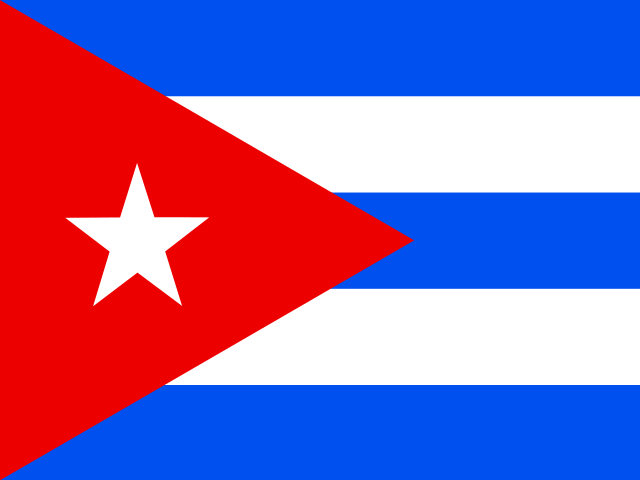 Cuba
Cuba Dominica
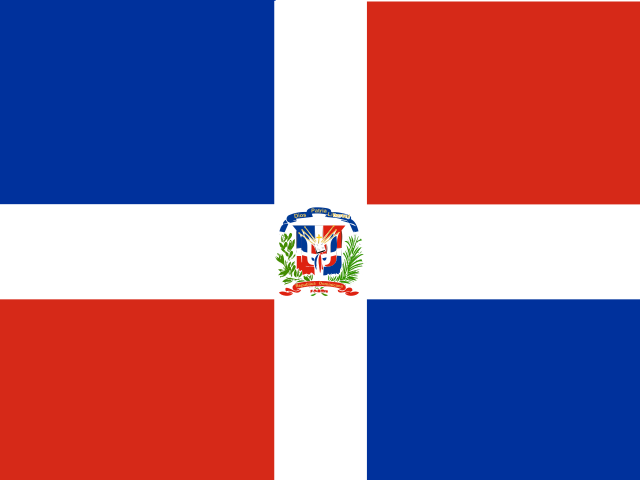 Dominican Republic
 Grenada
 Guadeloupe
 Haiti
Haiti Jamaica
 Martinique
 Montserrat
 Curacao
 Aruba
Aruba Saint Maarten (Dutch part)
 Bonaire
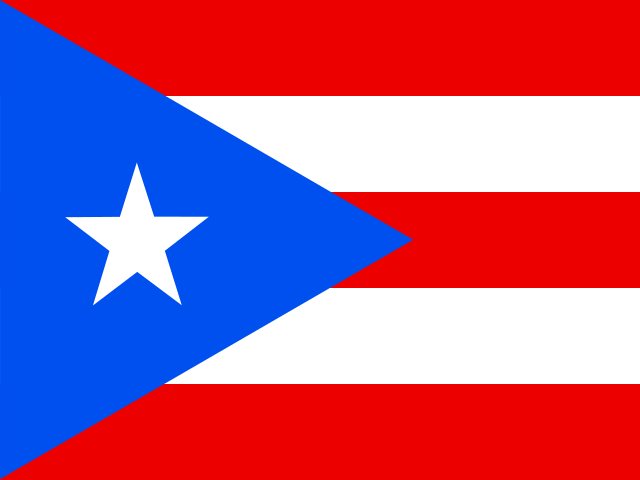 Puerto Rico
 Saint Kitts and Nevis
 Anguilla
 Saint Lucia
 Saint-Martin (French Part)
 Saint Vincent and the Grenadines
 Trinidad and Tobago
 Turks and Caicos Islands
 United States Virgin Islands
Earlier Report Observations
The Latin American milk powder market expanded from 1.72 million tonnes in 2018 to 1.79 million tonnes in 2020, with value rising from USD 5.33 billion to USD 6.61 billion. This growth was initially supported by Brazil's implementation of the Mercosur technical regulation for powder quality and traceability, standardizing regional trade. The COVID-19 pandemic in 2020 then reduced fresh milk production in Brazil, increasing reliance on powder as a substitute and boosting overall consumption.
Market volume contracted to 1.62 million tonnes in 2021 as record-high international prices encouraged export-oriented shipments from Argentina, reducing domestic availability. A recovery followed in 2022, with volume reaching 1.66 million tonnes and value peaking at USD 6.96 billion, driven by increased production in Chile and strong import demand in Brazil amid prices nearing USD 5,000 per tonne. However, 2023 saw a decline to 1.63 million tonnes and USD 6.20 billion as falling milk prices in Brazil and a consumer shift toward fresh products in Chile dampened powder demand.
Early 2024 indicators from Chile showed sustained production growth, while in Mexico, powder consumption increased due to its affordability and long shelf life compared to fresh milk, pointing toward potential market stabilization after recent fluctuations.
Table of content
- 1. Disclaimer
- 2. Terms of use of the report
- 3. Product codes in the statistical classifications used in the report
-
4. Key Market Indicators and Trends
-
4.1. Key Market Indicators
-
4.1.1. In kind
- 4.1.1.1. Production, 2018-2023
- 4.1.1.2. Imports, 2018-2024
- 4.1.1.3. Exports, 2018-2024
- 4.1.1.4. Market size, 2018-2023
-
4.1.2. In value
- 4.1.2.1. Production, 2018-2023
- 4.1.2.2. Imports, 2018-2024
- 4.1.2.3. Exports, 2018-2024
- 4.1.2.4. Market size, 2018-2023
-
4.1.1. In kind
- 4.2. Market Trends and Factors
-
4.1. Key Market Indicators
-
5. Production
-
5.1. Production in Latin America and the Caribbean
- 5.1.1. Annual dynamics of production in Latin America and the Caribbean in kind, 2018-2023, K t
-
5.2. Global production by Country, 2018-2023
- 5.2.1. Annual dynamics of production by macroregions in kind, 2018-2023, K t
- 5.2.2. Dynamics of production structure by macroregions in kind, 2018-2023
- 5.2.3. Annual dynamics of production by country in kind, 2018-2023, K t
- 5.2.4. Structure of production by countries in kind, 2018-2023
- 5.2.5. Dynamics of peoduction structure by countries in kind, 2018-2023
-
5.1. Production in Latin America and the Caribbean
-
6. Exports
-
6.1. Exports (Direct Data*)
- 6.1.1. Exports - Total information
-
6.1.2. Exports in kind, K t
- 6.1.2.1. Annual dynamics of product's exports from Argentina in kind, 2018-2024, K t
- 6.1.2.2. Dynamics of product's exports in kind from Argentina by countries, 2018-2024, K t
- 6.1.2.3. Structure of product's exports in kind by countries, 2018-2024
-
6.1.3. Exports in value, M $ US
- 6.1.3.1. Annual dynamics of product's exports from Argentina in value, 2018-2024, M $ US
- 6.1.3.2. Dynamics of product's exports in value from Argentina by countries, 2018-2024, M $ US
- 6.1.3.3. Structure of product's exports in value by countries, 2018-2024
-
6.1.4. Average price of product's exports, $ US/t
- 6.1.4.1. Annual dynamics of average price of product's exports from Argentina, 2018-2024, $ US/t
- 6.1.4.2. Dynamics of average price of product's exports from Argentina by countries, 2018-2024, $ US/t
-
6.2. Exports (Mirror Data)
- 6.2.1. Exports - Total information
-
6.2.2. Exports in kind, K t
- 6.2.2.1. Annual dynamics of product's exports from Argentina in kind, 2018-2024, K t
- 6.2.2.2. Dynamics of product's exports in kind from Argentina by countries, 2018-2024, K t
- 6.2.2.3. Structure of product's exports in kind by countries, 2018-2024
-
6.2.3. Exports in value, M $ US
- 6.2.3.1. Annual dynamics of product's exports from Argentina in value, 2018-2024, M $ US
- 6.2.3.2. Dynamics of product's exports in value from Argentina by countries, 2018-2024, M $ US
- 6.2.3.3. Structure of product's exports in value by countries, 2018-2024
-
6.2.4. Average price of product's exports, $ US/t
- 6.2.4.1. Annual dynamics of average price of product's exports from Argentina, 2018-2024, $ US/t
- 6.2.4.2. Dynamics of average price of product's exports from Argentina by countries, 2018-2024, $ US/t
-
6.1. Exports (Direct Data*)
-
7. Imports
-
7.1. Imports (Direct Data*)
- 7.1.1. Imports - Total information
-
7.1.2. Imports in kind, K t
- 7.1.2.1. Annual dynamics of product's imports to Argentina in kind, 2018-2024, K t
- 7.1.2.2. Dynamics of product's imports in kind to Argentina by countries, 2018-2024, K t
- 7.1.2.3. Structure of product's imports in kind by countries, 2018-2024
-
7.1.3. Imports in value, M $ US
- 7.1.3.1. Annual dynamics of product's imports to Argentina in value, 2018-2024, M $ US
- 7.1.3.2. Dynamics of product's imports in value to Argentina by countries, 2018-2024, M $ US
- 7.1.3.3. Structure of product's imports in value by countries, 2018-2024
-
7.1.4. Average price of product's imports, $ US/t
- 7.1.4.1. Annual dynamics of average price of product's imports to Argentina, 2018-2024, $ US/t
- 7.1.4.2. Dynamics of average price of product's imports to Argentina by countries, 2018-2024, $ US/t
-
7.2. Imports (Mirror Data)
- 7.2.1. Imports - Total information
-
7.2.2. Imports in kind, K t
- 7.2.2.1. Annual dynamics of product's imports to Argentina in kind, 2018-2024, K t
- 7.2.2.2. Dynamics of product's imports in kind to Argentina by countries, 2018-2024, K t
- 7.2.2.3. Structure of product's imports in kind by countries, 2018-2024
-
7.2.3. Imports in value, M $ US
- 7.2.3.1. Annual dynamics of product's imports to Argentina in value, 2018-2024, M $ US
- 7.2.3.2. Dynamics of product's imports in value to Argentina by countries, 2018-2024, M $ US
- 7.2.3.3. Structure of product's imports in value by countries, 2018-2024
-
7.2.4. Average price of product's imports, $ US/t
- 7.2.4.1. Annual dynamics of average price of product's imports to Argentina, 2018-2024, $ US/t
- 7.2.4.2. Dynamics of average price of product's imports to Argentina by countries, 2018-2024, $ US/t
-
7.1. Imports (Direct Data*)
-
8. Trade balance
-
8.1. Trade balance (Direct Data)
- 8.1.1. In kind, K t
- 8.1.2. In value, M $ US
-
8.2. Trade balance (Mirror Data)
- 8.2.1. In kind, K t
- 8.2.2. In value, M $ US
-
8.1. Trade balance (Direct Data)
-
9. Top buying and selling countries, 2018-2024
-
9.1. Direct Data
- 9.1.1. Import in Value by Countries-buyers
- 9.1.2. Export in Value by Countries-suppliers
-
9.2. Mirror Data
- 9.2.1. Import in Value by Countries-buyers
- 9.2.2. Export in Value by Countries-suppliers
-
9.1. Direct Data
Production milk powder in Latin America and the Caribbean
In kind, 2017-2020, K t
Top producers of milk powder, 2017-2020
World map of production of milk powder, 2017-2020
Milk powder production in Latin America and the Caribbean has grown for the third year in a row. In 2020, the region produced 1,418 thousand tons of milk powder, marking a modest increase of 3.6% compared to 2019. Looking at the period from 2017 to 2020, production rose by 8.5%, which translates to an average annual growth rate of 2.7%.
Annual dynamics of production in Latin America and the Caribbean in kind, 2017-2020, K t
| Parameter | 2018 | 2019 | 2020 | CAGR | |
|---|---|---|---|---|---|
| 1 | Change from last year | 4.0% | 0.7% | 3.6% | 2.7% |
In value, 2017-2020, M $ US
Following a two-year decline, milk powder production in Latin America and the Caribbean rebounded. In 2020, the output was valued at 5,692 million US dollars, representing a significant jump of 26.7% from 2019. Over the 2017-2020 span, production increased by 12.9%, with an average annual rate of 4.1%. The lowest value was recorded in 2019 at 4,492 million US dollars, while the largest drop occurred in 2018 with a 9.6% decrease.
Annual dynamics of production in Latin America and the Caribbean in value, 2017-2020, M $ US
| Parameter | 2018 | 2019 | 2020 | CAGR | |
|---|---|---|---|---|---|
| 1 | Change from last year | (9.6%) | (1.4%) | 26.7% | 4.1% |
Exports milk powder from Latin America and the Caribbean
Exports in kind, K t
Milk powder exports from Latin America and the Caribbean fell for the second consecutive year. In 2020, shipments totaled 284.2 thousand tons, showing a moderate decline of 4.2% from 2019. Between 2017 and 2020, exports grew by 16.4%, averaging 5.2% per year. The peak was in 2018 at 339.2 thousand tons, with the largest decrease of 12.6% in 2019 and the biggest increase of 38.9% in 2018.
Annual dynamics of product's exports from Latin America and the Caribbean in kind, 2017-2020, K t
| Parameter | 2018 | 2019 | 2020 | CAGR | |
|---|---|---|---|---|---|
| 1 | Change from last year | 38.9% | (12.6%) | (4.2%) | 5.2% |
An analysis of milk powder export volumes from 2017 to 2020 reveals a wide distribution across numerous markets. Algeria accounted for 33.2% of exports, Russia for 4.5%, and China for 4.0%, together making up 41.7% of total flows. The remaining 58.3% went to other trading partners.
Structure of product's exports in kind by countries, 2017-2020
World map of product's exports from Latin America and the Caribbean in kind, 2017-2020
Exports in value, M $ US
In 2020, milk powder exports from Latin America and the Caribbean reached 1,141 million US dollars, reflecting a strong increase of 17.3% compared to 2019. From 2017 to 2020, exports rose by 21.1%, with a compound annual growth rate of 6.6%. The largest decline was in 2019 at 14.4%, while the biggest gain was in 2018 at 20.7%.
Annual dynamics of product's exports from Latin America and the Caribbean in value, 2017-2020, M $ US
| Parameter | 2018 | 2019 | 2020 | CAGR | |
|---|---|---|---|---|---|
| 1 | Change from last year | 20.7% | (14.4%) | 17.3% | 6.6% |
From 2017 to 2020, milk powder export values from Latin America and the Caribbean were spread across a broad range of markets. Algeria held 33.0% of the value, Russia 4.3%, and China 3.9%, collectively accounting for 41.2% of total flows.
Structure of product's exports in value by countries, 2017-2020
World map of product's exports from Latin America and the Caribbean in value, 2017-2020
Imports milk powder to Latin America and the Caribbean
Imports in kind, K t
Milk powder imports into Latin America and the Caribbean decreased for the second year in a row. In 2020, the region imported 659.3 thousand tons, a slight drop of 2.1% from 2019. The highest volume was in 2018 at 699.0 thousand tons, with the largest decline of 3.7% in 2019 and the biggest increase of 5.8% in 2018.
Annual dynamics of product's imports to Latin America and the Caribbean in kind, 2017-2020, K t
| Parameter | 2018 | 2019 | 2020 | CAGR | |
|---|---|---|---|---|---|
| 1 | Change from last year | 5.8% | (3.7%) | (2.1%) | (0.1%) |
Between 2017 and 2020, the United States dominated milk powder imports into Latin America and the Caribbean, representing 53.9% of the volume. New Zealand followed with 7.3%, and the Netherlands with 2.6%. Together, these three countries accounted for 63.8% of total import flows.
Structure of product's imports in kind by countries, 2017-2020
World map of product's imports to Latin America and the Caribbean in kind, 2017-2020
Imports in value, M $ US
In 2020, Latin America and the Caribbean imported milk powder worth 2,062 million US dollars, an 11.0% increase from 2019. Over the 2017-2020 period, imports grew by 13%, with a compound annual growth rate of 4.2%. The largest decrease was in 2019 at 2.7%.
Annual dynamics of product's imports to Latin America and the Caribbean in value, 2017-2020, M $ US
| Parameter | 2018 | 2019 | 2020 | CAGR | |
|---|---|---|---|---|---|
| 1 | Change from last year | 4.6% | (2.7%) | 11.0% | 4.2% |
From 2017 to 2020, the United States was the leading source for milk powder imports into Latin America and the Caribbean in value terms, with a 46.8% share. New Zealand contributed 8.8%, and the Netherlands 3.2%, forming a key cluster that made up 58.8% of total import flows.
Structure of product's imports in value by countries, 2017-2020
World map of product's imports to Latin America and the Caribbean in value, 2017-2020
Related Reports

Milk powder market in South Korea
2026-03-30
Milk powder market in the United Kingdom
2026-03-30
Milk powder market in Northern America
2026-03-30
2026-03-30




In-depth market research on this product
Global Skimmed Milk Powder Market 2021–2031: Size, Share, Trends and Forecast
Global market report: size, trends and forecast to 2031 · 192 pages
Global Whole Milk Powder Market 2021–2031: Size, Share, Trends and Forecast
Global market report: size, trends and forecast to 2031 · 214 pages
Why Choose Us?
Only Verified Data
No Hidden Costs or Separate Fees
Smarter Subscription Pricing
Contact Our Team
Submit your inquiry using the form below — our team will get back to you within 24 hours.