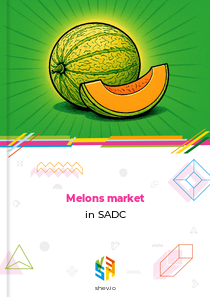







"SADC" region includes following countries:
 Angola
 Botswana
 Comoros
 Democratic Republic of the Congo
 Eswatini
 Lesotho
 Madagascar
 Malawi
 Mauritius
 Mozambique
 Namibia
 Seychelles
 South Africa
 Tanzania
 Zambia
 Zimbabwe
Earlier Report Observations
The fresh melon market in the SADC region contracted significantly between 2018 and 2023, with total market volume falling from 20 940 t to 13 283 t. This decline was underpinned by a steady reduction in domestic production, which dropped from 22 358 t to 14 821 t, coupled with a sharp, multi-year decrease in import volumes.
In the more recent period, broader agricultural and consumer trends began to shape the market environment. Global factors such as high production and transport costs, exacerbated by geopolitical conflicts, introduced cost pressures across supply chains. Simultaneously, within key markets like South Africa, a growing consumer preference for plant-based foods, health-conscious consumption, and local sourcing started to influence demand patterns for fresh produce, including melons.
Table of content
- 1. Disclaimer
- 2. Terms of use of the report
- 3. Product codes in the statistical classifications used in the report
-
4. Key Market Indicators and Trends
-
4.1. Key Market Indicators
-
4.1.1. In kind
- 4.1.1.1. Production, 2018-2023
- 4.1.1.2. Imports, 2018-2024
- 4.1.1.3. Exports, 2018-2024
- 4.1.1.4. Market size, 2018-2023
-
4.1.1. In kind
- 4.2. Market Trends and Factors
-
4.1. Key Market Indicators
-
5. Production
-
5.1. Production in SADC
- 5.1.1. Annual dynamics of production in SADC in kind, 2018-2023, t
-
5.2. Global production by Country, 2018-2023
- 5.2.1. Annual dynamics of production by macroregions in kind, 2018-2023, t
- 5.2.2. Dynamics of production structure by macroregions in kind, 2018-2023
- 5.2.3. Annual dynamics of production by country in kind, 2018-2023, t
- 5.2.4. Structure of production by countries in kind, 2018-2023
- 5.2.5. Dynamics of peoduction structure by countries in kind, 2018-2023
-
5.1. Production in SADC
-
6. Imports
-
6.1. Imports (Direct Data*)
- 6.1.1. Imports - Total information
-
6.1.2. Imports in kind, t
- 6.1.2.1. Annual dynamics of product's imports to Angola in kind, 2018-2024, t
- 6.1.2.2. Dynamics of product's imports in kind to Angola by countries, 2018-2024, t
- 6.1.2.3. Structure of product's imports in kind by countries, 2018-2024
-
6.1.3. Imports in value, K $ US
- 6.1.3.1. Annual dynamics of product's imports to Angola in value, 2018-2024, K $ US
- 6.1.3.2. Dynamics of product's imports in value to Angola by countries, 2018-2024, K $ US
- 6.1.3.3. Structure of product's imports in value by countries, 2018-2024
-
6.1.4. Average price of product's imports, $ US/t
- 6.1.4.1. Annual dynamics of average price of product's imports to Angola, 2018-2024, $ US/t
- 6.1.4.2. Dynamics of average price of product's imports to Angola by countries, 2018-2024, $ US/t
-
6.2. Imports (Mirror Data)
- 6.2.1. Imports - Total information
-
6.2.2. Imports in kind, t
- 6.2.2.1. Annual dynamics of product's imports to Angola in kind, 2018-2024, t
- 6.2.2.2. Dynamics of product's imports in kind to Angola by countries, 2018-2024, t
- 6.2.2.3. Structure of product's imports in kind by countries, 2018-2024
-
6.2.3. Imports in value, K $ US
- 6.2.3.1. Annual dynamics of product's imports to Angola in value, 2018-2024, K $ US
- 6.2.3.2. Dynamics of product's imports in value to Angola by countries, 2018-2024, K $ US
- 6.2.3.3. Structure of product's imports in value by countries, 2018-2024
-
6.2.4. Average price of product's imports, $ US/t
- 6.2.4.1. Annual dynamics of average price of product's imports to Angola, 2018-2024, $ US/t
- 6.2.4.2. Dynamics of average price of product's imports to Angola by countries, 2018-2024, $ US/t
-
6.1. Imports (Direct Data*)
-
7. Exports
-
7.1. Exports (Direct Data*)
- 7.1.1. Exports - Total information
-
7.1.2. Exports in kind, t
- 7.1.2.1. Annual dynamics of product's exports from Angola in kind, 2018-2024, t
- 7.1.2.2. Dynamics of product's exports in kind from Angola by countries, 2018-2024, t
- 7.1.2.3. Structure of product's exports in kind by countries, 2018-2024
-
7.1.3. Exports in value, K $ US
- 7.1.3.1. Annual dynamics of product's exports from Angola in value, 2018-2024, K $ US
- 7.1.3.2. Dynamics of product's exports in value from Angola by countries, 2018-2024, K $ US
- 7.1.3.3. Structure of product's exports in value by countries, 2018-2024
-
7.1.4. Average price of product's exports, $ US/t
- 7.1.4.1. Annual dynamics of average price of product's exports from Angola, 2018-2024, $ US/t
- 7.1.4.2. Dynamics of average price of product's exports from Angola by countries, 2018-2024, $ US/t
-
7.2. Exports (Mirror Data)
- 7.2.1. Exports - Total information
-
7.2.2. Exports in kind, t
- 7.2.2.1. Annual dynamics of product's exports from Angola in kind, 2018-2024, t
- 7.2.2.2. Dynamics of product's exports in kind from Angola by countries, 2018-2024, t
- 7.2.2.3. Structure of product's exports in kind by countries, 2018-2024
-
7.2.3. Exports in value, K $ US
- 7.2.3.1. Annual dynamics of product's exports from Angola in value, 2018-2024, K $ US
- 7.2.3.2. Dynamics of product's exports in value from Angola by countries, 2018-2024, K $ US
- 7.2.3.3. Structure of product's exports in value by countries, 2018-2024
-
7.2.4. Average price of product's exports, $ US/t
- 7.2.4.1. Annual dynamics of average price of product's exports from Angola, 2018-2024, $ US/t
- 7.2.4.2. Dynamics of average price of product's exports from Angola by countries, 2018-2024, $ US/t
-
7.1. Exports (Direct Data*)
-
8. Trade balance
-
8.1. Trade balance (Direct Data)
- 8.1.1. In kind, t
- 8.1.2. In value, K $ US
-
8.2. Trade balance (Mirror Data)
- 8.2.1. In kind, t
- 8.2.2. In value, K $ US
-
8.1. Trade balance (Direct Data)
-
9. Top buying and selling countries, 2018-2024
-
9.1. Direct Data
- 9.1.1. Import in Value by Countries-buyers
- 9.1.2. Export in Value by Countries-suppliers
-
9.2. Mirror Data
- 9.2.1. Import in Value by Countries-buyers
- 9.2.2. Export in Value by Countries-suppliers
-
9.1. Direct Data
Production melons in SADC
In kind, 2017-2020, t
Top producers of melons, 2017-2020
World map of production of melons, 2017-2020
Melon production in SADC has declined for the second year in a row. In 2020, SADC produced 15,683 tonnes of melons, which represents a 17.9% decrease compared to 2019. Over the period from 2017 to 2020, production fell by 28.1%, with an average annual decline of 10.4%. The highest production level was recorded in 2018 at 22,358 tonnes, when output increased by 2.5%.
Annual dynamics of production in SADC in kind, 2017-2020, t
| Parameter | 2018 | 2019 | 2020 | CAGR | |
|---|---|---|---|---|---|
| 1 | Change from last year | 2.5% | (14.5%) | (17.9%) | (10.4%) |
Exports melons from SADC
Exports in kind, t
Melon exports from SADC have declined for the second consecutive year. In 2020, export volume reached 1,341 tonnes, showing a significant drop of 51.2% compared to the previous year. Between 2017 and 2020, exports decreased by 60.1%, which translates to an average annual decline of 26.4%. The peak export volume was recorded in 2018 at 4,199 tonnes, when exports grew by 25.1%.
Annual dynamics of product's exports from SADC in kind, 2017-2020, t
| Parameter | 2018 | 2019 | 2020 | CAGR | |
|---|---|---|---|---|---|
| 1 | Change from last year | 25.1% | (34.5%) | (51.2%) | (26.4%) |
From 2017 to 2020, three main markets—the United Kingdom, the Netherlands, and the United Arab Emirates—together accounted for 49.9% of SADC's total melon exports in volume terms.
Structure of product's exports in kind by countries, 2017-2020
World map of product's exports from SADC in kind, 2017-2020
Exports in value, K $ US
SADC's melon export value has declined for the third consecutive year. In 2020, exports registered 2,720 thousand US dollars, marking a dramatic decline of 50.8% compared to the previous year. Over the period from 2017 to 2020, export value decreased by 84.3%, with an average annual decline of 46.1%.
Annual dynamics of product's exports from SADC in value, 2017-2020, K $ US
| Parameter | 2018 | 2019 | 2020 | CAGR | |
|---|---|---|---|---|---|
| 1 | Change from last year | (25.4%) | (57.3%) | (50.8%) | (46.1%) |
From 2017 to 2020, the United Kingdom and the Netherlands were the dominant destinations for SADC's melon exports in value terms, jointly taking 81.8% of total flows, while other markets accounted for the remaining share.
Structure of product's exports in value by countries, 2017-2020
World map of product's exports from SADC in value, 2017-2020
Imports melons to SADC
Imports in kind, t
Melon import volume into SADC has declined for the second consecutive year. In 2020, imports totalled 1,353 tonnes, showing a drop of 48.5% compared to the previous year. Between 2017 and 2020, imports decreased by 34.2%, equating to an average annual decline of 13.0%. The highest import volume was recorded in 2018 at 2,780 tonnes, when imports increased by 35.1%.
Annual dynamics of product's imports to SADC in kind, 2017-2020, t
| Parameter | 2018 | 2019 | 2020 | CAGR | |
|---|---|---|---|---|---|
| 1 | Change from last year | 35.1% | (5.5%) | (48.5%) | (13.0%) |
During 2017–2020, melon imports into SADC in volume terms were relatively evenly distributed. Special Categories (6.0% of imports), Egypt (5.6% of imports), and Portugal (2.3% of imports) together accounted for only 13.8% of total import flows.
Structure of product's imports in kind by countries, 2017-2020
World map of product's imports to SADC in kind, 2017-2020
Imports in value, K $ US
After two years of growth, SADC's melon import value declined. In 2020, SADC imported melons worth 2,720 thousand US dollars, which is 51.3% lower than the previous year. Between 2017 and 2020, import value decreased by 46.4%, with an average annual decline of 18.8%. The peak import value was recorded in 2019 at 3,058 thousand US dollars, while the largest increase occurred in 2018 at 7.2%.
Annual dynamics of product's imports to SADC in value, 2017-2020, K $ US
| Parameter | 2018 | 2019 | 2020 | CAGR | |
|---|---|---|---|---|---|
| 1 | Change from last year | 7.2% | 2.6% | (51.3%) | (18.8%) |
Over 2017–2020, melon imports into SADC in value terms were characterised by a broad spread across markets. Egypt (9.0% of imports), Special Categories (3.6% of imports), and Spain (3.4% of imports) together accounted for only 15.9% of total import flows.
Structure of product's imports in value by countries, 2017-2020
World map of product's imports to SADC in value, 2017-2020
Related Reports

2026-03-28
Melons market in Southern Asia
2026-03-28
2026-03-28
2026-03-28
2026-03-28

2026-03-28

Plums and sloes market in SADC
2026-03-28

Peaches and nectarines market in SADC
2026-03-28
Why Choose Us?
Only Verified Data
No Hidden Costs or Separate Fees
Smarter Subscription Pricing
Contact Our Team
Submit your inquiry using the form below — our team will get back to you within 24 hours.