






"Middle Africa" region includes following countries:
 Angola
 Cameroon
 Central African Republic
 Chad
Chad Congo
Congo Democratic Republic of the Congo
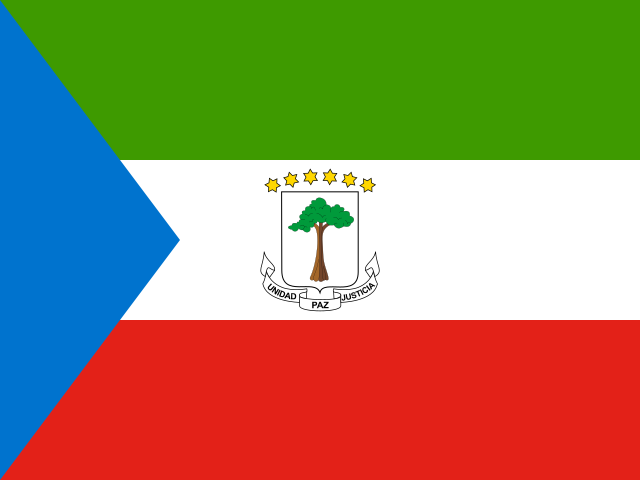 Equatorial Guinea
 Gabon
Gabon Sao Tome and Principe
Earlier Report Observations
The market for fresh melons and papayas in Middle Africa contracted from 350.2 thousand tons in 2018 to 339.0 thousand tons in 2019. This decline was primarily due to ongoing agricultural production constraints, including pest pressure, soil depletion, and insufficient knowledge of advanced agronomic practices.
From 2020 to 2022, the market expanded steadily, reaching 366.9 thousand tons. Favorable climatic conditions, such as intense heat that accelerated melon growth, and the introduction of new varieties like Jaune Canari MOZIA F1 and Piel de Sapo MONTIEL F1 supported this growth.
In 2023, the market stabilized at 366.8 thousand tons amid rising agricultural input costs and the launch of the Sustainable Cocoa Platform in Cameroon, which influenced farming practices. In 2024, the agri-food industry in Cameroon grew by 4.2%, promoting local processing, while purchasing power tensions and competition from imported melons affected consumption patterns.
Table of content
- 1. Disclaimer
- 2. Terms of use of the report
- 3. Product codes in the statistical classifications used in the report
-
4. Key Market Indicators and Trends
-
4.1. Key Market Indicators
-
4.1.1. In kind
- 4.1.1.1. Production, 2018-2023
- 4.1.1.2. Imports, 2018-2024
- 4.1.1.3. Exports, 2018-2024
- 4.1.1.4. Market size, 2018-2023
-
4.1.1. In kind
- 4.2. Market Trends and Factors
-
4.1. Key Market Indicators
-
5. Production
-
5.1. Production in Middle Africa
- 5.1.1. Annual dynamics of production in Middle Africa in kind, 2018-2023, K t
-
5.2. Global production by Country, 2018-2023
- 5.2.1. Annual dynamics of production by macroregions in kind, 2018-2023, K t
- 5.2.2. Dynamics of production structure by macroregions in kind, 2018-2023
- 5.2.3. Annual dynamics of production by country in kind, 2018-2023, K t
- 5.2.4. Structure of production by countries in kind, 2018-2023
- 5.2.5. Dynamics of peoduction structure by countries in kind, 2018-2023
-
5.1. Production in Middle Africa
-
6. Imports
-
6.1. Imports (Direct Data*)
- 6.1.1. Imports - Total information
-
6.1.2. Imports in kind, t
- 6.1.2.1. Annual dynamics of product's imports to Angola in kind, 2018-2024, t
- 6.1.2.2. Dynamics of product's imports in kind to Angola by countries, 2018-2024, t
- 6.1.2.3. Structure of product's imports in kind by countries, 2018-2024
-
6.1.3. Imports in value, K $ US
- 6.1.3.1. Annual dynamics of product's imports to Angola in value, 2018-2024, K $ US
- 6.1.3.2. Dynamics of product's imports in value to Angola by countries, 2018-2024, K $ US
- 6.1.3.3. Structure of product's imports in value by countries, 2018-2024
-
6.1.4. Average price of product's imports, $ US/t
- 6.1.4.1. Annual dynamics of average price of product's imports to Angola, 2018-2024, $ US/t
- 6.1.4.2. Dynamics of average price of product's imports to Angola by countries, 2018-2024, $ US/t
-
6.2. Imports (Mirror Data)
- 6.2.1. Imports - Total information
-
6.2.2. Imports in kind, t
- 6.2.2.1. Annual dynamics of product's imports to Angola in kind, 2018-2024, t
- 6.2.2.2. Dynamics of product's imports in kind to Angola by countries, 2018-2024, t
- 6.2.2.3. Structure of product's imports in kind by countries, 2018-2024
-
6.2.3. Imports in value, K $ US
- 6.2.3.1. Annual dynamics of product's imports to Angola in value, 2018-2024, K $ US
- 6.2.3.2. Dynamics of product's imports in value to Angola by countries, 2018-2024, K $ US
- 6.2.3.3. Structure of product's imports in value by countries, 2018-2024
-
6.2.4. Average price of product's imports, $ US/t
- 6.2.4.1. Annual dynamics of average price of product's imports to Angola, 2018-2024, $ US/t
- 6.2.4.2. Dynamics of average price of product's imports to Angola by countries, 2018-2024, $ US/t
-
6.1. Imports (Direct Data*)
-
7. Exports
-
7.1. Exports (Direct Data*)
- 7.1.1. Exports - Total information
-
7.1.2. Exports in kind, t
- 7.1.2.1. Annual dynamics of product's exports from Angola in kind, 2018-2024, t
- 7.1.2.2. Dynamics of product's exports in kind from Angola by countries, 2018-2024, t
- 7.1.2.3. Structure of product's exports in kind by countries, 2018-2024
-
7.1.3. Exports in value, K $ US
- 7.1.3.1. Annual dynamics of product's exports from Angola in value, 2018-2024, K $ US
- 7.1.3.2. Dynamics of product's exports in value from Angola by countries, 2018-2024, K $ US
- 7.1.3.3. Structure of product's exports in value by countries, 2018-2024
-
7.1.4. Average price of product's exports, $ US/t
- 7.1.4.1. Annual dynamics of average price of product's exports from Angola, 2018-2024, $ US/t
- 7.1.4.2. Dynamics of average price of product's exports from Angola by countries, 2018-2024, $ US/t
-
7.2. Exports (Mirror Data)
- 7.2.1. Exports - Total information
-
7.2.2. Exports in kind, t
- 7.2.2.1. Annual dynamics of product's exports from Angola in kind, 2018-2024, t
- 7.2.2.2. Dynamics of product's exports in kind from Angola by countries, 2018-2024, t
- 7.2.2.3. Structure of product's exports in kind by countries, 2018-2024
-
7.2.3. Exports in value, K $ US
- 7.2.3.1. Annual dynamics of product's exports from Angola in value, 2018-2024, K $ US
- 7.2.3.2. Dynamics of product's exports in value from Angola by countries, 2018-2024, K $ US
- 7.2.3.3. Structure of product's exports in value by countries, 2018-2024
-
7.2.4. Average price of product's exports, $ US/t
- 7.2.4.1. Annual dynamics of average price of product's exports from Angola, 2018-2024, $ US/t
- 7.2.4.2. Dynamics of average price of product's exports from Angola by countries, 2018-2024, $ US/t
-
7.1. Exports (Direct Data*)
-
8. Trade balance
-
8.1. Trade balance (Direct Data)
- 8.1.1. In kind, t
- 8.1.2. In value, K $ US
-
8.2. Trade balance (Mirror Data)
- 8.2.1. In kind, t
- 8.2.2. In value, K $ US
-
8.1. Trade balance (Direct Data)
-
9. Top buying and selling countries, 2018-2024
-
9.1. Direct Data
- 9.1.1. Import in Value by Countries-buyers
- 9.1.2. Export in Value by Countries-suppliers
-
9.2. Mirror Data
- 9.2.1. Import in Value by Countries-buyers
- 9.2.2. Export in Value by Countries-suppliers
-
9.1. Direct Data
Production melons and papayas in Middle Africa
In kind, 2017-2020, K t
Top producers of melons and papayas, 2017-2020
World map of production of melons and papayas, 2017-2020
In 2019, Middle Africa produced 339.1 thousand tons of melons and papayas, marking the lowest output in recent years. Production then increased by 4.0% in 2020 to reach 352.7 thousand tons. The most significant decline occurred in 2019, when production fell by 3.1%.
Annual dynamics of production in Middle Africa in kind, 2017-2020, K t
| Parameter | 2018 | 2019 | 2020 | CAGR | |
|---|---|---|---|---|---|
| 1 | Change from last year | 0.8% | (3.1%) | 4.0% | 0.5% |
Exports melons and papayas from Middle Africa
Exports in kind, t
Exports of melons and papayas from Middle Africa have grown for three consecutive years. In 2020, exports reached 464.6 tons, representing a sharp increase of 412.7% compared to 2019. Over the period from 2017 to 2020, exports surged by 3 324.9%, which translates to an average annual growth rate of 224.7%.
Annual dynamics of product's exports from Middle Africa in kind, 2017-2020, t
| Parameter | 2018 | 2019 | 2020 | CAGR | |
|---|---|---|---|---|---|
| 1 | Change from last year | 306.8% | 64.2% | 412.7% | 224.7% |
From 2017 to 2020, Portugal, Namibia, and Malta were the primary markets for Middle Africa's melon and papaya exports in volume terms. Portugal accounted for 58.5% of exports, Namibia for 12.1%, and Malta for 4.8%. Together, these three countries represented 75.3% of total export flows.
Structure of product's exports in kind by countries, 2017-2020
World map of product's exports from Middle Africa in kind, 2017-2020
Exports in value, K $ US
The export value of melons and papayas from Middle Africa showed significant volatility between 2017 and 2020. In 2017, exports hit their lowest point, while 2020 saw the peak value at 157.0 thousand US dollars—a 13.6-fold increase over the period. Compared to 2019, exports in 2020 rose dramatically by 428.2%. The most notable decline occurred in 2019, with a drop of 42.4%.
Annual dynamics of product's exports from Middle Africa in value, 2017-2020, K $ US
| Parameter | 2018 | 2019 | 2020 | CAGR | |
|---|---|---|---|---|---|
| 1 | Change from last year | 345.7% | (42.4%) | 428.2% | 138.5% |
Between 2017 and 2020, Portugal, France, and Namibia were consistently the top markets for Middle Africa's melon and papaya exports in value terms. Collectively, these three countries accounted for 68.3% of total export value.
Structure of product's exports in value by countries, 2017-2020
World map of product's exports from Middle Africa in value, 2017-2020
Imports melons and papayas to Middle Africa
Imports in kind, t
Import volumes of melons and papayas into Middle Africa experienced considerable fluctuations from 2017 to 2020. In 2018, imports peaked at 248.8 tons, then dropped sharply to their lowest point of 22.3 tons in 2019—an 11.2-fold difference. In 2020, imports recovered slightly to 23.3 tons, reflecting a modest increase of 4.2% compared to the previous year. The most substantial decline was recorded in 2019 at 91.0%, while the largest increase occurred in 2018 with a surge of 854.5%.
Annual dynamics of product's imports to Middle Africa in kind, 2017-2020, t
| Parameter | 2018 | 2019 | 2020 | CAGR | |
|---|---|---|---|---|---|
| 1 | Change from last year | 854.5% | (91.0%) | 4.2% | (3.7%) |
From 2017 to 2020, Portugal dominated imports of melons and papayas into Middle Africa in volume terms, holding 83.1% of total import flows. Other countries each contributed significantly smaller shares during this period.
Structure of product's imports in kind by countries, 2017-2020
World map of product's imports to Middle Africa in kind, 2017-2020
Imports in value, K $ US
In 2020, imports of melons and papayas into Middle Africa were valued at 44.4 thousand US dollars, showing a moderate year-on-year increase of 6.4%. Over the four-year span from 2017 to 2020, import value decreased by 46.7%, averaging an annual decline of 18.9%. The lowest import value was recorded in 2019 at 41.7 thousand US dollars, while the highest was in 2018 at 90.0 thousand US dollars. The most significant drop occurred in 2019 with a 53.7% decrease, whereas the largest rise was in 2018 with an 8.2% increase.
Annual dynamics of product's imports to Middle Africa in value, 2017-2020, K $ US
| Parameter | 2018 | 2019 | 2020 | CAGR | |
|---|---|---|---|---|---|
| 1 | Change from last year | 8.2% | (53.7%) | 6.4% | (18.9%) |
Throughout 2017–2020, Portugal, France, and Brazil were the leading sources of melon and papaya imports into Middle Africa in value terms. Portugal accounted for 38.3% of import value, France for 23.6%, and Brazil for 9.6%. Together, these three countries made up 71.5% of total import flows.
Structure of product's imports in value by countries, 2017-2020
World map of product's imports to Middle Africa in value, 2017-2020
Related Reports
Melons and papayas market in SADC
2026-03-28
Melons and papayas market in North Macedonia
2026-03-28

Hazelnuts market in Middle Africa
2026-03-28


2026-03-28

In-shell hazelnuts market in Middle Africa
2026-03-28
Why Choose Us?
Only Verified Data
No Hidden Costs or Separate Fees
Smarter Subscription Pricing
Contact Our Team
Submit your inquiry using the form below — our team will get back to you within 24 hours.