






"Middle Africa" region includes following countries:
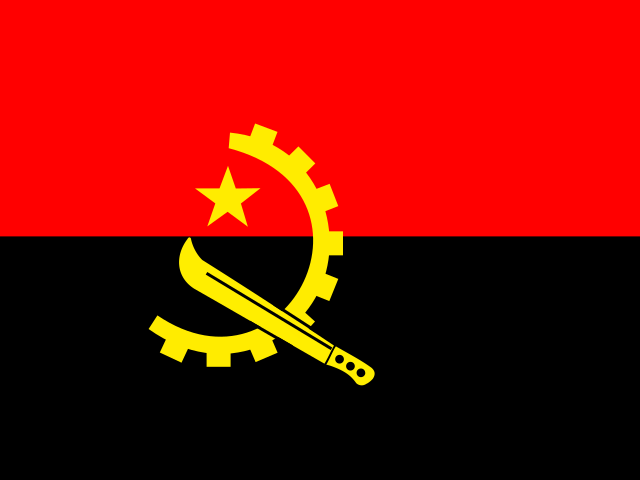 Angola
 Cameroon
 Central African Republic
 Chad
Chad Congo
Congo Democratic Republic of the Congo
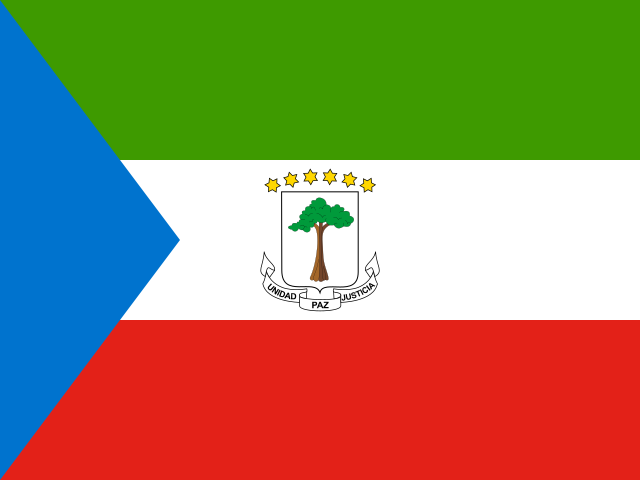 Equatorial Guinea
 Gabon
Gabon Sao Tome and Principe
Earlier Report Observations
The dried figs market in Middle Africa experienced significant volume fluctuations between 2018 and 2023. The market size reached 124 thousand kg in 2018, then declined to 108 thousand kg in 2021. A partial recovery followed in 2022, bringing the volume to 120 thousand kg, before it contracted again to 104 thousand kg in 2023.
Domestic fig production remained stable throughout this period, hovering between 93.5 thousand kg and 95.6 thousand kg annually. The observed swings in total market volume were largely attributable to volatile import figures, which fell from 30.7 thousand kg in 2018 to a low of 9.9 thousand kg by 2023.
In 2024, broader regional and global trends shaped the market environment. Growing urbanization and heightened health awareness increased demand for dried figs as a nutritious food product. Technological progress in fig drying and processing enhanced product quality, while fig production in North Africa, a key global supply region, continued to influence regional availability.
Table of content
- 1. Disclaimer
- 2. Terms of use of the report
- 3. Product codes in the statistical classifications used in the report
-
4. Key Market Indicators and Trends
-
4.1. Key Market Indicators
-
4.1.1. In kind
- 4.1.1.1. Production, 2018-2023
- 4.1.1.2. Imports, 2018-2024
- 4.1.1.3. Exports, 2018-2024
- 4.1.1.4. Market size, 2018-2023
-
4.1.1. In kind
- 4.2. Market Trends and Factors
-
4.1. Key Market Indicators
-
5. Production
-
5.1. Production in Middle Africa
- 5.1.1. Annual dynamics of production in Middle Africa in kind, 2018-2023, kg
-
5.2. Global production by Country, 2018-2023
- 5.2.1. Annual dynamics of production by macroregions in kind, 2018-2023, kg
- 5.2.2. Dynamics of production structure by macroregions in kind, 2018-2023
- 5.2.3. Annual dynamics of production by country in kind, 2018-2023, kg
- 5.2.4. Structure of production by countries in kind, 2018-2023
- 5.2.5. Dynamics of peoduction structure by countries in kind, 2018-2023
-
5.1. Production in Middle Africa
-
6. Imports
-
6.1. Imports (Direct Data*)
- 6.1.1. Imports - Total information
-
6.1.2. Imports in kind, kg
- 6.1.2.1. Annual dynamics of product's imports to Angola in kind, 2018-2024, kg
- 6.1.2.2. Dynamics of product's imports in kind to Angola by countries, 2018-2024, kg
- 6.1.2.3. Structure of product's imports in kind by countries, 2018-2024
-
6.1.3. Imports in value, K $ US
- 6.1.3.1. Annual dynamics of product's imports to Angola in value, 2018-2024, K $ US
- 6.1.3.2. Dynamics of product's imports in value to Angola by countries, 2018-2024, K $ US
- 6.1.3.3. Structure of product's imports in value by countries, 2018-2024
-
6.1.4. Average price of product's imports, $ US/kg
- 6.1.4.1. Annual dynamics of average price of product's imports to Angola, 2018-2024, $ US/kg
- 6.1.4.2. Dynamics of average price of product's imports to Angola by countries, 2018-2024, $ US/kg
-
6.2. Imports (Mirror Data)
- 6.2.1. Imports - Total information
-
6.2.2. Imports in kind, kg
- 6.2.2.1. Annual dynamics of product's imports to Angola in kind, 2018-2024, kg
- 6.2.2.2. Dynamics of product's imports in kind to Angola by countries, 2018-2024, kg
- 6.2.2.3. Structure of product's imports in kind by countries, 2018-2024
-
6.2.3. Imports in value, K $ US
- 6.2.3.1. Annual dynamics of product's imports to Angola in value, 2018-2024, K $ US
- 6.2.3.2. Dynamics of product's imports in value to Angola by countries, 2018-2024, K $ US
- 6.2.3.3. Structure of product's imports in value by countries, 2018-2024
-
6.2.4. Average price of product's imports, $ US/kg
- 6.2.4.1. Annual dynamics of average price of product's imports to Angola, 2018-2024, $ US/kg
- 6.2.4.2. Dynamics of average price of product's imports to Angola by countries, 2018-2024, $ US/kg
-
6.1. Imports (Direct Data*)
-
7. Exports
-
7.1. Exports (Direct Data*)
- 7.1.1. Exports - Total information
-
7.1.2. Exports in kind, kg
- 7.1.2.1. Annual dynamics of product's exports from Angola in kind, 2018-2024, kg
- 7.1.2.2. Dynamics of product's exports in kind from Angola by countries, 2018-2024, kg
- 7.1.2.3. Structure of product's exports in kind by countries, 2018-2024
-
7.1.3. Exports in value, K $ US
- 7.1.3.1. Annual dynamics of product's exports from Angola in value, 2018-2024, K $ US
- 7.1.3.2. Dynamics of product's exports in value from Angola by countries, 2018-2024, K $ US
- 7.1.3.3. Structure of product's exports in value by countries, 2018-2024
-
7.1.4. Average price of product's exports, $ US/kg
- 7.1.4.1. Annual dynamics of average price of product's exports from Angola, 2018-2024, $ US/kg
- 7.1.4.2. Dynamics of average price of product's exports from Angola by countries, 2018-2024, $ US/kg
-
7.2. Exports (Mirror Data)
- 7.2.1. Exports - Total information
-
7.2.2. Exports in kind, kg
- 7.2.2.1. Annual dynamics of product's exports from Angola in kind, 2018-2024, kg
- 7.2.2.2. Dynamics of product's exports in kind from Angola by countries, 2018-2024, kg
- 7.2.2.3. Structure of product's exports in kind by countries, 2018-2024
-
7.2.3. Exports in value, K $ US
- 7.2.3.1. Annual dynamics of product's exports from Angola in value, 2018-2024, K $ US
- 7.2.3.2. Dynamics of product's exports in value from Angola by countries, 2018-2024, K $ US
- 7.2.3.3. Structure of product's exports in value by countries, 2018-2024
-
7.2.4. Average price of product's exports, $ US/kg
- 7.2.4.1. Annual dynamics of average price of product's exports from Angola, 2018-2024, $ US/kg
- 7.2.4.2. Dynamics of average price of product's exports from Angola by countries, 2018-2024, $ US/kg
-
7.1. Exports (Direct Data*)
-
8. Trade balance
-
8.1. Trade balance (Direct Data)
- 8.1.1. In kind, kg
- 8.1.2. In value, K $ US
-
8.2. Trade balance (Mirror Data)
- 8.2.1. In kind, kg
- 8.2.2. In value, K $ US
-
8.1. Trade balance (Direct Data)
-
9. Top buying and selling countries, 2018-2024
-
9.1. Direct Data
- 9.1.1. Import in Value by Countries-buyers
- 9.1.2. Export in Value by Countries-suppliers
-
9.2. Mirror Data
- 9.2.1. Import in Value by Countries-buyers
- 9.2.2. Export in Value by Countries-suppliers
-
9.1. Direct Data
Production figs in Middle Africa
In kind, 2017-2020, kg
Top producers of figs, 2017-2020
World map of production of figs, 2017-2020
Fig production in Middle Africa declined after two years of growth. In 2019, production reached its peak at 95 570 kg, marking a 2.3% increase from the previous year. However, by 2020, output had fallen to 93 590 kg, representing a modest 2.1% decrease compared to 2019.
Annual dynamics of production in Middle Africa in kind, 2017-2020, kg
| Parameter | 2018 | 2019 | 2020 | CAGR | |
|---|---|---|---|---|---|
| 1 | Change from last year | 1.9% | 2.3% | (2.1%) | 0.7% |
Exports figs from Middle Africa
Exports in kind, kg
Middle Africa's fig exports showed significant growth in 2020, reaching 148 kg—a substantial 39.3% increase over the previous year. Looking at the broader period from 2017 to 2020, exports surged by an impressive 7 300%, which translates to an annualized growth rate of 319.8%.
Annual dynamics of product's exports from Middle Africa in kind, 2017-2020, kg
| Parameter | 2018 | 2019 | 2020 | CAGR | |
|---|---|---|---|---|---|
| 1 | Change from last year | n/a | n/a | 39.3% | 319.8% |
Between 2017 and 2020, the Bahamas and Cuba were the leading markets for Middle Africa's fig exports in volume terms, together accounting for 37.5% of total shipments.
Structure of product's exports in kind by countries, 2017-2020
World map of product's exports from Middle Africa in kind, 2017-2020
Exports in value, K $ US
The value of fig exports from Middle Africa experienced considerable volatility. In 2019, export values peaked, but by 2020 they had plummeted to $0.0 thousand US, reflecting a dramatic 97.0% decline from the previous year. Overall, export levels fluctuated significantly, with a 34-fold difference between the high in 2019 and the low in 2020.
Annual dynamics of product's exports from Middle Africa in value, 2017-2020, K $ US
| Parameter | 2018 | 2019 | 2020 | CAGR | |
|---|---|---|---|---|---|
| 1 | Change from last year | n/a | n/a | (97.0%) | (5.5%) |
From 2017 to 2020, Cuba and the Bahamas remained the top destinations for Middle Africa's fig exports in value terms, though their combined share was relatively modest at 6.1% of total export value.
Structure of product's exports in value by countries, 2017-2020
World map of product's exports from Middle Africa in value, 2017-2020
Imports figs to Middle Africa
Imports in kind, kg
Fig imports into Middle Africa declined for the second year in a row. In 2018, imports reached their highest point at 30 656 kg, representing a 28.0% increase from the previous year. However, by 2020, imports had dropped to {value_last_year} kg, a sharp 37.6% decrease compared to 2019. Over the period from 2017 to 2020, imports fell by 39.9%, equivalent to an annualized decline of 15.6%.
Annual dynamics of product's imports to Middle Africa in kind, 2017-2020, kg
| Parameter | 2018 | 2019 | 2020 | CAGR | |
|---|---|---|---|---|---|
| 1 | Change from last year | 28.0% | (24.7%) | (37.6%) | (15.6%) |
Between 2017 and 2020, Portugal was the dominant source for Middle Africa's fig imports in volume terms, accounting for 61.1% of the total. South Africa contributed 9.6% and Turkey 6.8%, with these three countries together making up 77.6% of all imports.
Structure of product's imports in kind by countries, 2017-2020
World map of product's imports to Middle Africa in kind, 2017-2020
Imports in value, K $ US
Fig imports into Middle Africa declined for the third consecutive year. In 2020, import value fell to {value_last_year} thousand US dollars, marking a sharp 49.2% decrease from the previous year. From 2017 to 2020, imports dropped by 70.4%, which corresponds to an annualized decline of 33.3%.
Annual dynamics of product's imports to Middle Africa in value, 2017-2020, K $ US
| Parameter | 2018 | 2019 | 2020 | CAGR | |
|---|---|---|---|---|---|
| 1 | Change from last year | (12.2%) | (33.6%) | (49.2%) | (33.3%) |
During the 2017–2020 period, Portugal dominated Middle Africa's fig imports in value terms, accounting for 77.1% of the total. The remaining share was distributed among various smaller trading partners.
Structure of product's imports in value by countries, 2017-2020
World map of product's imports to Middle Africa in value, 2017-2020
Related Reports

Figs market in Australia and New Zealand
2026-03-28
Figs market in Northern America
2026-03-28
2026-03-28
2026-03-28

Lemons and limes market in Middle Africa
2026-03-28


In-shell cashew nuts market in Middle Africa
2026-03-28

Why Choose Us?
Only Verified Data
No Hidden Costs or Separate Fees
Smarter Subscription Pricing
Contact Our Team
Submit your inquiry using the form below — our team will get back to you within 24 hours.