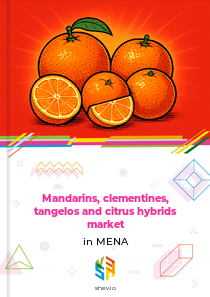







"MENA" region includes following countries:
 Algeria
 Bahrain
 Djibouti
 Egypt
Egypt Israel
 Jordan
 Iran
Iran Iraq
Iraq Qatar
Qatar Kuwait
 Lebanon
 Libya
Libya Malta
Malta Morocco
 the United Arab Emirates
 Oman
Oman Saudi Arabia
 Syria
Syria Tunisia
 Yemen
YemenEarlier Report Observations
The market volume for mandarins, clementines, and citrus hybrids in the MENA region fluctuated significantly between 2018 and 2023, ranging from 2.1 million metric tons to a peak of 3.8 million metric tons. A major surge to 3.5 million metric tons in 2019 was primarily driven by a sharp drop in exports, as ongoing regional tensions and economic challenges disrupted international trade flows, redirecting more produce to the domestic market.
Market volume rebounded to 3.6 million metric tons in 2021, again supported by constrained exports amid regional conflicts that affected agricultural supply chains. The continued expansion of e-commerce, growing over 30% annually in the region, helped sustain distribution channels and supported the market volume at 3.8 million metric tons in 2022.
In 2023, the market volume declined to 3.5 million metric tons. This contraction coincided with a regional economic slowdown to 2% growth, tightening monetary policies, and rising inflation, which reduced consumer purchasing power and demand for agricultural products like citrus fruits.
Table of content
- 1. Disclaimer
- 2. Terms of use of the report
- 3. Product codes in the statistical classifications used in the report
-
4. Key Market Indicators and Trends
-
4.1. Key Market Indicators
-
4.1.1. In kind
- 4.1.1.1. Production, 2018-2023
- 4.1.1.2. Imports, 2018-2024
- 4.1.1.3. Exports, 2018-2024
- 4.1.1.4. Market size, 2018-2023
-
4.1.1. In kind
- 4.2. Market Trends and Factors
-
4.1. Key Market Indicators
-
5. Production
-
5.1. Production in MENA
- 5.1.1. Annual dynamics of production in MENA in kind, 2018-2023, K t
-
5.2. Global production by Country, 2018-2023
- 5.2.1. Annual dynamics of production by macroregions in kind, 2018-2023, K t
- 5.2.2. Dynamics of production structure by macroregions in kind, 2018-2023
- 5.2.3. Annual dynamics of production by country in kind, 2018-2023, K t
- 5.2.4. Structure of production by countries in kind, 2018-2023
- 5.2.5. Dynamics of peoduction structure by countries in kind, 2018-2023
-
5.1. Production in MENA
-
6. Exports
-
6.1. Exports (Direct Data*)
- 6.1.1. Exports - Total information
-
6.1.2. Exports in kind, K t
- 6.1.2.1. Annual dynamics of product's exports from Algeria in kind, 2018-2024, K t
- 6.1.2.2. Dynamics of product's exports in kind from Algeria by countries, 2018-2024, K t
- 6.1.2.3. Structure of product's exports in kind by countries, 2018-2024
-
6.1.3. Exports in value, M $ US
- 6.1.3.1. Annual dynamics of product's exports from Algeria in value, 2018-2024, M $ US
- 6.1.3.2. Dynamics of product's exports in value from Algeria by countries, 2018-2024, M $ US
- 6.1.3.3. Structure of product's exports in value by countries, 2018-2024
-
6.1.4. Average price of product's exports, $ US/t
- 6.1.4.1. Annual dynamics of average price of product's exports from Algeria, 2018-2024, $ US/t
- 6.1.4.2. Dynamics of average price of product's exports from Algeria by countries, 2018-2024, $ US/t
-
6.2. Exports (Mirror Data)
- 6.2.1. Exports - Total information
-
6.2.2. Exports in kind, K t
- 6.2.2.1. Annual dynamics of product's exports from Algeria in kind, 2018-2024, K t
- 6.2.2.2. Dynamics of product's exports in kind from Algeria by countries, 2018-2024, K t
- 6.2.2.3. Structure of product's exports in kind by countries, 2018-2024
-
6.2.3. Exports in value, M $ US
- 6.2.3.1. Annual dynamics of product's exports from Algeria in value, 2018-2024, M $ US
- 6.2.3.2. Dynamics of product's exports in value from Algeria by countries, 2018-2024, M $ US
- 6.2.3.3. Structure of product's exports in value by countries, 2018-2024
-
6.2.4. Average price of product's exports, $ US/t
- 6.2.4.1. Annual dynamics of average price of product's exports from Algeria, 2018-2024, $ US/t
- 6.2.4.2. Dynamics of average price of product's exports from Algeria by countries, 2018-2024, $ US/t
-
6.1. Exports (Direct Data*)
-
7. Imports
-
7.1. Imports (Direct Data*)
- 7.1.1. Imports - Total information
-
7.1.2. Imports in kind, K t
- 7.1.2.1. Annual dynamics of product's imports to Algeria in kind, 2018-2024, K t
- 7.1.2.2. Dynamics of product's imports in kind to Algeria by countries, 2018-2024, K t
- 7.1.2.3. Structure of product's imports in kind by countries, 2018-2024
-
7.1.3. Imports in value, M $ US
- 7.1.3.1. Annual dynamics of product's imports to Algeria in value, 2018-2024, M $ US
- 7.1.3.2. Dynamics of product's imports in value to Algeria by countries, 2018-2024, M $ US
- 7.1.3.3. Structure of product's imports in value by countries, 2018-2024
-
7.1.4. Average price of product's imports, $ US/t
- 7.1.4.1. Annual dynamics of average price of product's imports to Algeria, 2018-2024, $ US/t
- 7.1.4.2. Dynamics of average price of product's imports to Algeria by countries, 2018-2024, $ US/t
-
7.2. Imports (Mirror Data)
- 7.2.1. Imports - Total information
-
7.2.2. Imports in kind, K t
- 7.2.2.1. Annual dynamics of product's imports to Algeria in kind, 2018-2024, K t
- 7.2.2.2. Dynamics of product's imports in kind to Algeria by countries, 2018-2024, K t
- 7.2.2.3. Structure of product's imports in kind by countries, 2018-2024
-
7.2.3. Imports in value, M $ US
- 7.2.3.1. Annual dynamics of product's imports to Algeria in value, 2018-2024, M $ US
- 7.2.3.2. Dynamics of product's imports in value to Algeria by countries, 2018-2024, M $ US
- 7.2.3.3. Structure of product's imports in value by countries, 2018-2024
-
7.2.4. Average price of product's imports, $ US/t
- 7.2.4.1. Annual dynamics of average price of product's imports to Algeria, 2018-2024, $ US/t
- 7.2.4.2. Dynamics of average price of product's imports to Algeria by countries, 2018-2024, $ US/t
-
7.1. Imports (Direct Data*)
-
8. Trade balance
-
8.1. Trade balance (Direct Data)
- 8.1.1. In kind, K t
- 8.1.2. In value, M $ US
-
8.2. Trade balance (Mirror Data)
- 8.2.1. In kind, K t
- 8.2.2. In value, M $ US
-
8.1. Trade balance (Direct Data)
-
9. Top buying and selling countries, 2018-2024
-
9.1. Direct Data
- 9.1.1. Import in Value by Countries-buyers
- 9.1.2. Export in Value by Countries-suppliers
-
9.2. Mirror Data
- 9.2.1. Import in Value by Countries-buyers
- 9.2.2. Export in Value by Countries-suppliers
-
9.1. Direct Data
Production mandarins, clementines, tangelos and citrus hybrids in MENA
In kind, 2017-2020, K t
Top producers of mandarins, clementines, tangelos and citrus hybrids, 2017-2020
World map of production of mandarins, clementines, tangelos and citrus hybrids, 2017-2020
After two years of growth, MENA's production of mandarins, clementines, tangelos, and citrus hybrids declined. In 2019, production reached its peak at 3 886 K t, marking a 9.9% increase. However, by 2020, production fell to 3 494 K t, representing a significant decrease of 10.1% compared to the previous year.
Annual dynamics of production in MENA in kind, 2017-2020, K t
| Parameter | 2018 | 2019 | 2020 | CAGR | |
|---|---|---|---|---|---|
| 1 | Change from last year | 1.5% | 9.9% | (10.1%) | 0.1% |
Exports mandarins, clementines, tangelos and citrus hybrids from MENA
Exports in kind, K t
The export market showed an unstable trend during this period. In 2019, exports experienced their largest decline of 61.3%. The following year, in 2020, exports rebounded sharply to 1 729 K t, a 140.6% increase compared to 2019. The highest export volume was recorded in 2018 at 1 858 K t, which was a 176.0% increase from the previous year. Overall, from 2017 to 2018, exports fluctuated with a peak-to-trough amplitude of 2.8 times.
Annual dynamics of product's exports from MENA in kind, 2017-2020, K t
| Parameter | 2018 | 2019 | 2020 | CAGR | |
|---|---|---|---|---|---|
| 1 | Change from last year | 176.0% | (61.3%) | 140.6% | 37.0% |
From 2017 to 2020, Russia, France, and Canada were the main markets for exports in kind. Russia accounted for 29.5% of exports, France for 16.9%, and Canada for 9.4%. Together, these three countries represented 55.9% of total export flows.
Structure of product's exports in kind by countries, 2017-2020
World map of product's exports from MENA in kind, 2017-2020
Exports in value, M $ US
Foreign supplies of mandarins, clementines, tangelos, and citrus hybrids from MENA increased for the third consecutive year. In 2020, exports totaled 715.4 M $ US, a solid advance of 12.0% compared to 2019. Between 2017 and 2020, exports grew by 40.8%, equating to an annualized rate of 12.1%.
Annual dynamics of product's exports from MENA in value, 2017-2020, M $ US
| Parameter | 2018 | 2019 | 2020 | CAGR | |
|---|---|---|---|---|---|
| 1 | Change from last year | 18.0% | 6.6% | 12.0% | 12.1% |
From 2017 to 2020, Russia, France, and Canada consistently remained the main destinations for exports in value terms. Russia accounted for 23.5% of exports, France for 19.0%, and Canada for 10.0%. Together, these three countries represented 52.6% of total export flows.
Structure of product's exports in value by countries, 2017-2020
World map of product's exports from MENA in value, 2017-2020
Imports mandarins, clementines, tangelos and citrus hybrids to MENA
Imports in kind, K t
In 2020, imports of mandarins, clementines, tangelos, and citrus hybrids into MENA stood at 425 K t, a sharp rise of 26.5% compared to the previous year. The largest decline occurred in 2019, with a 20.9% decrease, while the largest increase was in 2018, at 44.3%. Over the period from 2017 to 2020, imports increased by 44.4%, with a compound annual growth rate of 13.0%.
Annual dynamics of product's imports to MENA in kind, 2017-2020, K t
| Parameter | 2018 | 2019 | 2020 | CAGR | |
|---|---|---|---|---|---|
| 1 | Change from last year | 44.3% | (20.9%) | 26.5% | 13.0% |
From 2017 to 2020, Turkey, Pakistan, and South Africa stood out as the main markets for imports in kind. Turkey accounted for 41.9% of imports, Pakistan for 21.5%, and South Africa for 7.3%. Together, these three countries represented 70.6% of total import flows.
Structure of product's imports in kind by countries, 2017-2020
World map of product's imports to MENA in kind, 2017-2020
Imports in value, M $ US
In 2020, shipments of mandarins, clementines, tangelos, and citrus hybrids into MENA from abroad amounted to 287.5 M $ US, an uptick of 48.6% compared to 2019. The largest decline was recorded in 2019, at 11.7%. Between 2017 and 2020, imports increased by 90.8%, equating to an annualized rate of 24.0%.
Annual dynamics of product's imports to MENA in value, 2017-2020, M $ US
| Parameter | 2018 | 2019 | 2020 | CAGR | |
|---|---|---|---|---|---|
| 1 | Change from last year | 45.4% | (11.7%) | 48.6% | 24.0% |
From 2017 to 2020, Turkey, Pakistan, and South Africa stood out as the main markets for imports in value terms. Turkey accounted for 24.3% of imports, Pakistan for 17.7%, and South Africa for 12.9%. Together, these three countries represented 55.0% of total import flows.
Structure of product's imports in value by countries, 2017-2020
World map of product's imports to MENA in value, 2017-2020
Related Reports


Watermelons and melons market in MENA
2026-03-28

Melons and papayas market in MENA
2026-03-28

2026-03-28
In-shell walnuts market in MENA
2026-03-28
Why Choose Us?
Only Verified Data
No Hidden Costs or Separate Fees
Smarter Subscription Pricing
Contact Our Team
Submit your inquiry using the form below — our team will get back to you within 24 hours.