






"Middle Africa" region includes following countries:
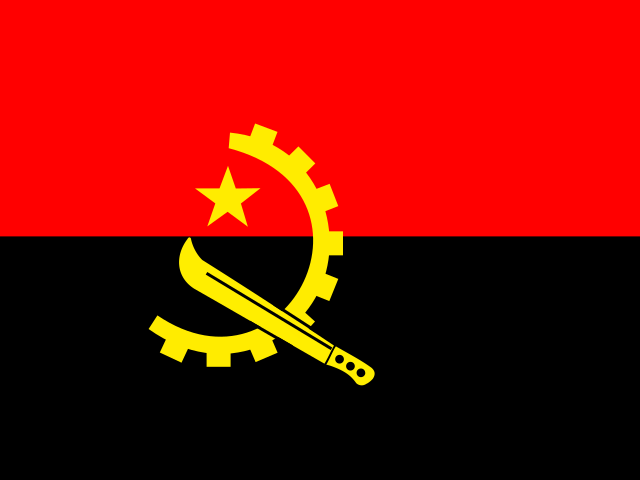 Angola
 Cameroon
 Central African Republic
 Chad
Chad Congo
Congo Democratic Republic of the Congo
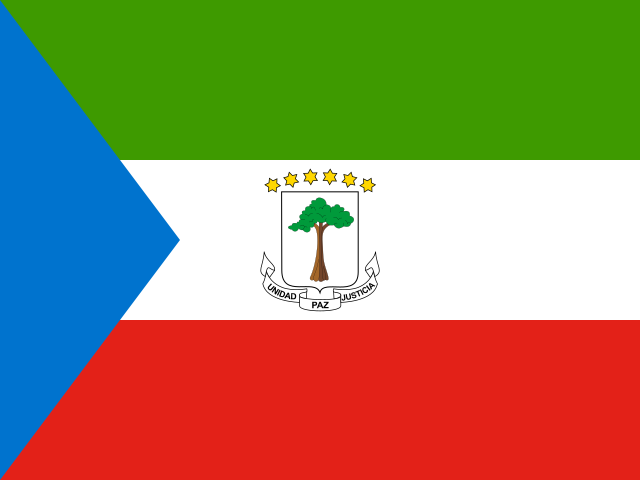 Equatorial Guinea
 Gabon
Gabon Sao Tome and Principe
Earlier Report Observations
The maize market volume in Middle Africa remained stable around 8 000 thousand tons between 2018 and 2020. During this period, the Cameroonian government, supported by the African Development Bank, implemented a three-year emergency plan to support agriculture, which included a 30% subsidy on fertilizer prices and the provision of high-quality seeds. This initiative laid the foundation for improved yields and production resilience.
From 2021, the market volume began a sustained growth, reaching 8 544 thousand tons by 2023. A key driver was the delivery of 17 936 tons of fertilizers from Russia in 2022 to alleviate shortages linked to the war in Ukraine and global inflation. Concurrently, the TAAT program intensified the diffusion of climate-adapted, high-yield hybrid maize seeds, boosting farm-level productivity. Furthermore, the mandatory implementation of 29 agro-food standards in 2022, including norms for whole maize flour, helped improve product quality and market structure.
Table of content
- 1. Disclaimer
- 2. Terms of use of the report
- 3. Product codes in the statistical classifications used in the report
-
4. Key Market Indicators and Trends
-
4.1. Key Market Indicators
-
4.1.1. In kind
- 4.1.1.1. Production, 2018-2023
- 4.1.1.2. Imports, 2018-2024
- 4.1.1.3. Exports, 2018-2024
- 4.1.1.4. Market size, 2018-2023
-
4.1.1. In kind
- 4.2. Market Trends and Factors
-
4.1. Key Market Indicators
-
5. Production
-
5.1. Production in Middle Africa
- 5.1.1. Annual dynamics of production in Middle Africa in kind, 2018-2023, K t
-
5.2. Global production by Country, 2018-2023
- 5.2.1. Annual dynamics of production by macroregions in kind, 2018-2023, K t
- 5.2.2. Dynamics of production structure by macroregions in kind, 2018-2023
- 5.2.3. Annual dynamics of production by country in kind, 2018-2023, K t
- 5.2.4. Structure of production by countries in kind, 2018-2023
- 5.2.5. Dynamics of peoduction structure by countries in kind, 2018-2023
-
5.1. Production in Middle Africa
-
6. Imports
-
6.1. Imports (Direct Data*)
- 6.1.1. Imports - Total information
-
6.1.2. Imports in kind, K t
- 6.1.2.1. Annual dynamics of product's imports to Angola in kind, 2018-2024, K t
- 6.1.2.2. Dynamics of product's imports in kind to Angola by countries, 2018-2024, K t
- 6.1.2.3. Structure of product's imports in kind by countries, 2018-2024
-
6.1.3. Imports in value, K $ US
- 6.1.3.1. Annual dynamics of product's imports to Angola in value, 2018-2024, K $ US
- 6.1.3.2. Dynamics of product's imports in value to Angola by countries, 2018-2024, K $ US
- 6.1.3.3. Structure of product's imports in value by countries, 2018-2024
-
6.1.4. Average price of product's imports, $ US/t
- 6.1.4.1. Annual dynamics of average price of product's imports to Angola, 2018-2024, $ US/t
- 6.1.4.2. Dynamics of average price of product's imports to Angola by countries, 2018-2024, $ US/t
-
6.2. Imports (Mirror Data)
- 6.2.1. Imports - Total information
-
6.2.2. Imports in kind, K t
- 6.2.2.1. Annual dynamics of product's imports to Angola in kind, 2018-2024, K t
- 6.2.2.2. Dynamics of product's imports in kind to Angola by countries, 2018-2024, K t
- 6.2.2.3. Structure of product's imports in kind by countries, 2018-2024
-
6.2.3. Imports in value, K $ US
- 6.2.3.1. Annual dynamics of product's imports to Angola in value, 2018-2024, K $ US
- 6.2.3.2. Dynamics of product's imports in value to Angola by countries, 2018-2024, K $ US
- 6.2.3.3. Structure of product's imports in value by countries, 2018-2024
-
6.2.4. Average price of product's imports, $ US/t
- 6.2.4.1. Annual dynamics of average price of product's imports to Angola, 2018-2024, $ US/t
- 6.2.4.2. Dynamics of average price of product's imports to Angola by countries, 2018-2024, $ US/t
-
6.1. Imports (Direct Data*)
-
7. Exports
-
7.1. Exports (Direct Data*)
- 7.1.1. Exports - Total information
-
7.1.2. Exports in kind, K t
- 7.1.2.1. Annual dynamics of product's exports from Angola in kind, 2018-2024, K t
- 7.1.2.2. Dynamics of product's exports in kind from Angola by countries, 2018-2024, K t
- 7.1.2.3. Structure of product's exports in kind by countries, 2018-2024
-
7.1.3. Exports in value, K $ US
- 7.1.3.1. Annual dynamics of product's exports from Angola in value, 2018-2024, K $ US
- 7.1.3.2. Dynamics of product's exports in value from Angola by countries, 2018-2024, K $ US
- 7.1.3.3. Structure of product's exports in value by countries, 2018-2024
-
7.1.4. Average price of product's exports, $ US/t
- 7.1.4.1. Annual dynamics of average price of product's exports from Angola, 2018-2024, $ US/t
- 7.1.4.2. Dynamics of average price of product's exports from Angola by countries, 2018-2024, $ US/t
-
7.2. Exports (Mirror Data)
- 7.2.1. Exports - Total information
-
7.2.2. Exports in kind, K t
- 7.2.2.1. Annual dynamics of product's exports from Angola in kind, 2018-2024, K t
- 7.2.2.2. Dynamics of product's exports in kind from Angola by countries, 2018-2024, K t
- 7.2.2.3. Structure of product's exports in kind by countries, 2018-2024
-
7.2.3. Exports in value, K $ US
- 7.2.3.1. Annual dynamics of product's exports from Angola in value, 2018-2024, K $ US
- 7.2.3.2. Dynamics of product's exports in value from Angola by countries, 2018-2024, K $ US
- 7.2.3.3. Structure of product's exports in value by countries, 2018-2024
-
7.2.4. Average price of product's exports, $ US/t
- 7.2.4.1. Annual dynamics of average price of product's exports from Angola, 2018-2024, $ US/t
- 7.2.4.2. Dynamics of average price of product's exports from Angola by countries, 2018-2024, $ US/t
-
7.1. Exports (Direct Data*)
-
8. Trade balance
-
8.1. Trade balance (Direct Data)
- 8.1.1. In kind, K t
- 8.1.2. In value, K $ US
-
8.2. Trade balance (Mirror Data)
- 8.2.1. In kind, K t
- 8.2.2. In value, K $ US
-
8.1. Trade balance (Direct Data)
-
9. Top buying and selling countries, 2018-2024
-
9.1. Direct Data
- 9.1.1. Import in Value by Countries-buyers
- 9.1.2. Export in Value by Countries-suppliers
-
9.2. Mirror Data
- 9.2.1. Import in Value by Countries-buyers
- 9.2.2. Export in Value by Countries-suppliers
-
9.1. Direct Data
Production maize in Middle Africa
In kind, 2017-2020, K t
Top producers of maize, 2017-2020
World map of production of maize, 2017-2020
In 2020, Middle Africa produced 7,916 thousand tonnes of maize, representing a 2.1% increase compared to the previous year. Over the period from 2017 to 2020, production grew by 8.6%, with an average annual growth rate of 2.8%. The highest production level was recorded in 2018 at 7,947 thousand tonnes. In 2019, production saw its largest decline of 2.4%, while the largest increase occurred in 2018 with a 9.1% rise.
Annual dynamics of production in Middle Africa in kind, 2017-2020, K t
| Parameter | 2018 | 2019 | 2020 | CAGR | |
|---|---|---|---|---|---|
| 1 | Change from last year | 9.1% | (2.4%) | 2.1% | 2.8% |
Exports maize from Middle Africa
Exports in kind, K t
The market showed an unstable trend throughout the period. Exports reached their minimum in 2018 at 0.0 thousand tonnes and peaked in 2017, with a 14.4-fold difference between these years. In 2020, Middle Africa exported 0.1 thousand tonnes of maize, marking a sharp decrease of 71.9% compared to 2019. The largest decline was recorded in 2018 at 93.1%, while the largest increase occurred in 2019 with a 611.2% surge.
Annual dynamics of product's exports from Middle Africa in kind, 2017-2020, K t
| Parameter | 2018 | 2019 | 2020 | CAGR | |
|---|---|---|---|---|---|
| 1 | Change from last year | (93.1%) | 611.2% | (71.9%) | (48.2%) |
From 2017 to 2020, the top buyers of maize from Middle Africa were Nigeria, accounting for 25.9% of exports in kind; Zambia, with 19.9%; and Namibia, at 18.3%. Together, these three countries represented 64.2% of total exports in kind.
Structure of product's exports in kind by countries, 2017-2020
World map of product's exports from Middle Africa in kind, 2017-2020
Exports in value, K $ US
The data reveals irregular changes, indicating a volatile market environment. Export volumes reached their minimum in 2018 at 37 thousand US dollars and peaked in 2019, with an 18-fold difference between these years. In 2020, exported maize volumes from Middle Africa totalled 116 thousand US dollars, which is 82.7% lower compared to 2019. The maximum value was recorded in 2019 at 670 thousand US dollars. The largest decline occurred in 2018 with a 94.4% drop, while the largest increase was in 2019 with a 1,693.2% rise.
Annual dynamics of product's exports from Middle Africa in value, 2017-2020, K $ US
| Parameter | 2018 | 2019 | 2020 | CAGR | |
|---|---|---|---|---|---|
| 1 | Change from last year | (94.4%) | 1 693.2% | (82.7%) | (44.2%) |
From 2017 to 2020, the main destinations for exports in value terms were Namibia, accounting for 45.7% of exports; Zambia, with 27.7%; and Nigeria, at 17.3%. Together, these three countries represented 90.7% of total export flows.
Structure of product's exports in value by countries, 2017-2020
World map of product's exports from Middle Africa in value, 2017-2020
Imports maize to Middle Africa
Imports in kind, K t
There were noticeable fluctuations in market performance during the period. Imports reached their minimum in 2018 at 73.8 thousand tonnes and peaked in 2019, with a 1.8-fold difference between these years. In 2020, Middle Africa's maize import volume reached 121.5 thousand tonnes, representing a 10.9% decrease compared to the previous year. The maximum value was recorded in 2019 at 136.4 thousand tonnes. The largest decline occurred in 2018 with a 34.2% drop, while the largest increase was in 2019 with an 84.9% rise.
Annual dynamics of product's imports to Middle Africa in kind, 2017-2020, K t
| Parameter | 2018 | 2019 | 2020 | CAGR | |
|---|---|---|---|---|---|
| 1 | Change from last year | (34.2%) | 84.9% | (10.9%) | 2.7% |
From 2017 to 2020, imports in kind of maize to Middle Africa were largely concentrated on Argentina, which accounted for 77.1% of total flows; other countries together formed the residual share.
Structure of product's imports in kind by countries, 2017-2020
World map of product's imports to Middle Africa in kind, 2017-2020
Imports in value, K $ US
After a two-year gain, imported maize volumes in Middle Africa declined. In 2020, imports came to 43,282 thousand US dollars, indicating a decline of 4.7% compared to 2019. Between 2017 and 2020, imports increased by 28.1%, equating to an 8.6% annualized rate. The maximum value was recorded in 2019 at 45,407 thousand US dollars. The largest increase occurred in 2019 with a 30.8% rise.
Annual dynamics of product's imports to Middle Africa in value, 2017-2020, K $ US
| Parameter | 2018 | 2019 | 2020 | CAGR | |
|---|---|---|---|---|---|
| 1 | Change from last year | 2.7% | 30.8% | (4.7%) | 8.6% |
From 2017 to 2020, the biggest contributors to imports in value terms were Argentina, accounting for 63.8% of imports; South Africa, with 8.7%; and Brazil, at 6.5%. Together, these three countries jointly accounted for 79.0% of total import flows.
Structure of product's imports in value by countries, 2017-2020
World map of product's imports to Middle Africa in value, 2017-2020
Related Reports

2026-03-28
2026-03-28
2026-03-28
2026-03-28

Paddy rice market in Middle Africa
2026-03-28
Brown rice market in Middle Africa
2026-03-28


Sorghum market in Middle Africa
2026-03-28
Why Choose Us?
Only Verified Data
No Hidden Costs or Separate Fees
Smarter Subscription Pricing
Contact Our Team
Submit your inquiry using the form below — our team will get back to you within 24 hours.