






"Latin America and the Caribbean" region includes following countries:
 Argentina
 Bolivia
 Brazil
 Chile
Chile Colombia
 Ecuador
 Falkland Islands (Malvinas)
 French Guiana
 Guyana
 Paraguay
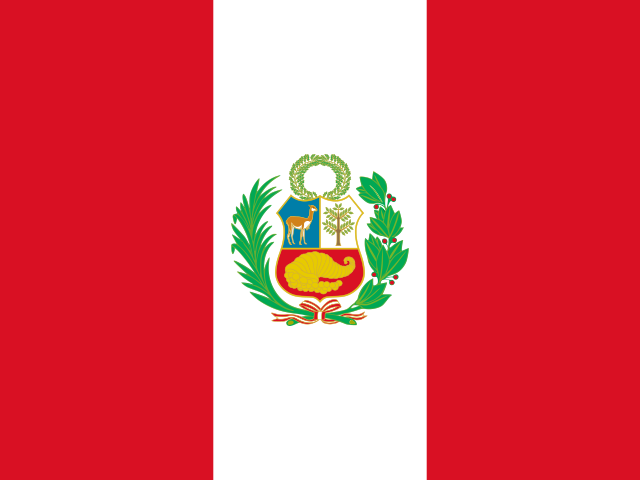 Peru
Peru Suriname
 Uruguay
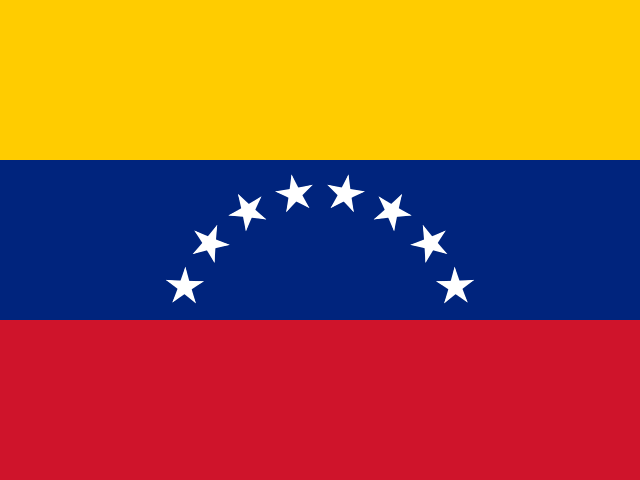 Venezuela
 Belize
 Costa Rica
 El Salvador
 Guatemala
 Honduras
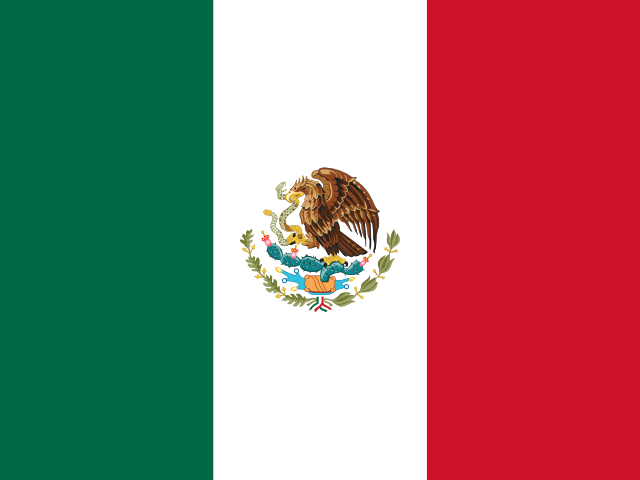 Mexico
 Nicaragua
 Panama
 Antigua and Barbuda
 the Bahamas
 Barbados
 British Virgin Islands
 Cayman Islands
 Cuba
Cuba Dominica
 Dominican Republic
 Grenada
 Guadeloupe
 Haiti
Haiti Jamaica
 Martinique
 Montserrat
 Curacao
 Aruba
Aruba Saint Maarten (Dutch part)
 Bonaire
 Puerto Rico
 Saint Kitts and Nevis
 Anguilla
 Saint Lucia
 Saint-Martin (French Part)
 Saint Vincent and the Grenadines
 Trinidad and Tobago
 Turks and Caicos Islands
 United States Virgin Islands
Earlier Report Observations
The market volume for lactose and lactose syrup in Latin America and the Caribbean expanded significantly from around 58 000 tonnes in 2018 to over 88 000 tonnes in 2023. This growth was primarily fueled by rising imports, which increased from 58 000 tonnes to 88 000 tonnes over the period. The development of dairy production clusters across several countries enhanced regional milk output, providing a foundation for lactose availability. Concurrently, ongoing urbanization and higher disposable incomes boosted demand for dairy products and derivatives, supporting market expansion.
Market volume experienced notable fluctuations, declining in 2020 and 2022. The 2020 drop coincided with the rising popularity of lactose-free products, driven by greater health awareness, which reduced demand for conventional lactose-containing items. Additionally, a spike in exports that year diverted supply from the domestic market. In 2022, increased prevalence of lactose intolerance in key markets like Brazil and Chile further dampened consumption, contributing to another contraction. Climate factors such as El Niño events also periodically affected milk production and regional supply chains.
Recovery and growth resumed in 2021 and 2023. Technological advances in enzymes and precision fermentation improved the quality of lactose-free products, stimulating innovation in the dairy sector. The reopening of Pomar's production and storage plant in Cajicá, Colombia, with a substantial investment, added local processing capacity in 2023. Significant regional investments in dairy processing infrastructure, alongside the stable presence of major multinational and state-owned companies, provided a basis for market resilience and expansion throughout the period.
Table of content
- 1. Disclaimer
- 2. Terms of use of the report
- 3. Product codes in the statistical classifications used in the report
-
4. Key Market Indicators and Trends
-
4.1. Key Market Indicators
-
4.1.1. In kind
- 4.1.1.1. Production, 2018-2023
- 4.1.1.2. Imports, 2018-2024
- 4.1.1.3. Exports, 2018-2024
- 4.1.1.4. Market size, 2018-2023
-
4.1.1. In kind
- 4.2. Market Trends and Factors
-
4.1. Key Market Indicators
-
5. Production
-
5.1. Production in Latin America and the Caribbean
- 5.1.1. Annual dynamics of production in Latin America and the Caribbean in kind, 2018-2023, t
-
5.2. Global production by Country, 2018-2023
- 5.2.1. Annual dynamics of production by macroregions in kind, 2018-2023, t
- 5.2.2. Dynamics of production structure by macroregions in kind, 2018-2023
- 5.2.3. Annual dynamics of production by country in kind, 2018-2023, t
- 5.2.4. Structure of production by countries in kind, 2018-2023
- 5.2.5. Dynamics of peoduction structure by countries in kind, 2018-2023
-
5.1. Production in Latin America and the Caribbean
-
6. Exports
-
6.1. Exports (Direct Data*)
- 6.1.1. Exports - Total information
-
6.1.2. Exports in kind, t
- 6.1.2.1. Annual dynamics of product's exports from Argentina in kind, 2018-2024, t
- 6.1.2.2. Dynamics of product's exports in kind from Argentina by countries, 2018-2024, t
- 6.1.2.3. Structure of product's exports in kind by countries, 2018-2024
-
6.1.3. Exports in value, M $ US
- 6.1.3.1. Annual dynamics of product's exports from Argentina in value, 2018-2024, M $ US
- 6.1.3.2. Dynamics of product's exports in value from Argentina by countries, 2018-2024, M $ US
- 6.1.3.3. Structure of product's exports in value by countries, 2018-2024
-
6.1.4. Average price of product's exports, $ US/t
- 6.1.4.1. Annual dynamics of average price of product's exports from Argentina, 2018-2024, $ US/t
- 6.1.4.2. Dynamics of average price of product's exports from Argentina by countries, 2018-2024, $ US/t
-
6.2. Exports (Mirror Data)
- 6.2.1. Exports - Total information
-
6.2.2. Exports in kind, t
- 6.2.2.1. Annual dynamics of product's exports from Argentina in kind, 2018-2024, t
- 6.2.2.2. Dynamics of product's exports in kind from Argentina by countries, 2018-2024, t
- 6.2.2.3. Structure of product's exports in kind by countries, 2018-2024
-
6.2.3. Exports in value, M $ US
- 6.2.3.1. Annual dynamics of product's exports from Argentina in value, 2018-2024, M $ US
- 6.2.3.2. Dynamics of product's exports in value from Argentina by countries, 2018-2024, M $ US
- 6.2.3.3. Structure of product's exports in value by countries, 2018-2024
-
6.2.4. Average price of product's exports, $ US/t
- 6.2.4.1. Annual dynamics of average price of product's exports from Argentina, 2018-2024, $ US/t
- 6.2.4.2. Dynamics of average price of product's exports from Argentina by countries, 2018-2024, $ US/t
-
6.1. Exports (Direct Data*)
-
7. Imports
-
7.1. Imports (Direct Data*)
- 7.1.1. Imports - Total information
-
7.1.2. Imports in kind, t
- 7.1.2.1. Annual dynamics of product's imports to Argentina in kind, 2018-2024, t
- 7.1.2.2. Dynamics of product's imports in kind to Argentina by countries, 2018-2024, t
- 7.1.2.3. Structure of product's imports in kind by countries, 2018-2024
-
7.1.3. Imports in value, M $ US
- 7.1.3.1. Annual dynamics of product's imports to Argentina in value, 2018-2024, M $ US
- 7.1.3.2. Dynamics of product's imports in value to Argentina by countries, 2018-2024, M $ US
- 7.1.3.3. Structure of product's imports in value by countries, 2018-2024
-
7.1.4. Average price of product's imports, $ US/t
- 7.1.4.1. Annual dynamics of average price of product's imports to Argentina, 2018-2024, $ US/t
- 7.1.4.2. Dynamics of average price of product's imports to Argentina by countries, 2018-2024, $ US/t
-
7.2. Imports (Mirror Data)
- 7.2.1. Imports - Total information
-
7.2.2. Imports in kind, t
- 7.2.2.1. Annual dynamics of product's imports to Argentina in kind, 2018-2024, t
- 7.2.2.2. Dynamics of product's imports in kind to Argentina by countries, 2018-2024, t
- 7.2.2.3. Structure of product's imports in kind by countries, 2018-2024
-
7.2.3. Imports in value, M $ US
- 7.2.3.1. Annual dynamics of product's imports to Argentina in value, 2018-2024, M $ US
- 7.2.3.2. Dynamics of product's imports in value to Argentina by countries, 2018-2024, M $ US
- 7.2.3.3. Structure of product's imports in value by countries, 2018-2024
-
7.2.4. Average price of product's imports, $ US/t
- 7.2.4.1. Annual dynamics of average price of product's imports to Argentina, 2018-2024, $ US/t
- 7.2.4.2. Dynamics of average price of product's imports to Argentina by countries, 2018-2024, $ US/t
-
7.1. Imports (Direct Data*)
-
8. Trade balance
-
8.1. Trade balance (Direct Data)
- 8.1.1. In kind, t
- 8.1.2. In value, M $ US
-
8.2. Trade balance (Mirror Data)
- 8.2.1. In kind, t
- 8.2.2. In value, M $ US
-
8.1. Trade balance (Direct Data)
-
9. Top buying and selling countries, 2018-2024
-
9.1. Direct Data
- 9.1.1. Import in Value by Countries-buyers
- 9.1.2. Export in Value by Countries-suppliers
-
9.2. Mirror Data
- 9.2.1. Import in Value by Countries-buyers
- 9.2.2. Export in Value by Countries-suppliers
-
9.1. Direct Data
Production lactose and lactose syrup in Latin America and the Caribbean
In kind, 2017-2020, t
Top producers of lactose and lactose syrup, 2017-2020
World map of production of lactose and lactose syrup, 2017-2020
In Latin America and the Caribbean, production of lactose and lactose syrup reached 1 211 tonnes in 2020, marking a 4.8% increase from the previous year. Over the period from 2017 to 2020, production grew by 9.2%, which translates to an average annual growth rate of 3.0%. The most significant production decline occurred in 2019, with a drop of 2.9%, while the largest increase was recorded in 2018, at 7.3%.
Annual dynamics of production in Latin America and the Caribbean in kind, 2017-2020, t
| Parameter | 2018 | 2019 | 2020 | CAGR | |
|---|---|---|---|---|---|
| 1 | Change from last year | 7.3% | (2.9%) | 4.8% | 3.0% |
Exports lactose and lactose syrup from Latin America and the Caribbean
Exports in kind, t
The market exhibited volatility during the observed period. Export levels from Latin America and the Caribbean showed substantial fluctuations, with a 13.5-fold difference between the low of 571 tonnes in 2019 and the high of 7 737 tonnes in 2020. In 2020, exports surged by 1,254.3% compared to 2019. The most significant decline was recorded in 2019, at 59.9%.
Annual dynamics of product's exports from Latin America and the Caribbean in kind, 2017-2020, t
| Parameter | 2018 | 2019 | 2020 | CAGR | |
|---|---|---|---|---|---|
| 1 | Change from last year | (15.9%) | (59.9%) | 1 254.3% | 65.9% |
From 2017 to 2020, the United States remained the dominant export partner for lactose and lactose syrup from Latin America and the Caribbean, accounting for 78.6% of total export flows. Other markets contributed to a long tail of smaller shares.
Structure of product's exports in kind by countries, 2017-2020
World map of product's exports from Latin America and the Caribbean in kind, 2017-2020
Exports in value, M $ US
After two consecutive years of decline, the value of lactose and lactose syrup exports from Latin America and the Caribbean increased in 2020. Exports reached 1.7 million US dollars that year, representing a 41.8% gain compared to 2019. However, over the full period from 2017 to 2020, exports decreased by 34.7%, with a compound annual growth rate of -13.2%. The lowest value was recorded in 2019 at 1.2 million US dollars, with the largest decline of 52.3% also occurring in that year.
Annual dynamics of product's exports from Latin America and the Caribbean in value, 2017-2020, M $ US
| Parameter | 2018 | 2019 | 2020 | CAGR | |
|---|---|---|---|---|---|
| 1 | Change from last year | (3.6%) | (52.3%) | 41.8% | (13.2%) |
Between 2017 and 2020, the main cluster of markets for exports in value terms consisted of the United States (41.8% of exports), Nigeria (2.2%), and China (1.8%). Together, these three countries accounted for 45.9% of total export flows.
Structure of product's exports in value by countries, 2017-2020
World map of product's exports from Latin America and the Caribbean in value, 2017-2020
Imports lactose and lactose syrup to Latin America and the Caribbean
Imports in kind, t
Import volumes of lactose and lactose syrup in Latin America and the Caribbean increased for the second consecutive year in 2020, reaching 74 934 tonnes, which is 4.6% higher than in 2019. From 2017 to 2020, imports grew by 24.5%, equivalent to an average annual rate of 7.6%. The lowest import volume was recorded in 2018 at 58 206 tonnes, with the largest decline of 3.3% also in that year. The most significant increase occurred in 2019, at 23.1%.
Annual dynamics of product's imports to Latin America and the Caribbean in kind, 2017-2020, t
| Parameter | 2018 | 2019 | 2020 | CAGR | |
|---|---|---|---|---|---|
| 1 | Change from last year | (3.3%) | 23.1% | 4.6% | 7.6% |
During the 2017–2020 period, the largest suppliers of lactose and lactose syrup to Latin America and the Caribbean were the United States (63.9% of imports in kind), the Netherlands (12.6%), and Germany (9.1%). Together, these three countries formed 85.6% of total imports in kind.
Structure of product's imports in kind by countries, 2017-2020
World map of product's imports to Latin America and the Caribbean in kind, 2017-2020
Imports in value, M $ US
In 2020, the value of imported lactose and lactose syrup in Latin America and the Caribbean was recorded at 112.3 million US dollars, reflecting a slight year-on-year drop of 1.5%. Over the period from 2017 to 2020, imports increased by 8.9%, with a compound annual growth rate of 2.9%. The minimum value was 99.9 million US dollars in 2018, while the maximum was 114.0 million US dollars in 2019. The largest decline of 3.1% occurred in 2018, and the largest increase of 14.1% was recorded in 2019.
Annual dynamics of product's imports to Latin America and the Caribbean in value, 2017-2020, M $ US
| Parameter | 2018 | 2019 | 2020 | CAGR | |
|---|---|---|---|---|---|
| 1 | Change from last year | (3.1%) | 14.1% | (1.5%) | 2.9% |
From 2017 to 2020, the United States (57.6% of imports in value terms), the Netherlands (14.6%), and Germany (11.4%) consistently served as the main sources for imports in value terms. Collectively, they accounted for 83.7% of total import flows.
Structure of product's imports in value by countries, 2017-2020
World map of product's imports to Latin America and the Caribbean in value, 2017-2020
Related Reports

Lactose and lactose syrup market in Belarus
2026-03-29
Lactose and lactose syrup market in Finland
2026-03-29
Lactose and lactose syrup market in Poland
2026-03-29




In-depth market research on this product
Global Lactose Market 2021–2031: Size, Share, Trends and Forecast
Global market report: size, trends and forecast to 2031 · 198 pages
Why Choose Us?
Only Verified Data
No Hidden Costs or Separate Fees
Smarter Subscription Pricing
Contact Our Team
Submit your inquiry using the form below — our team will get back to you within 24 hours.