






"Sub-Saharan Africa" region includes following countries:
 Cabo Verde
 Benin
Benin Gambia
 Ghana
Ghana Guinea
 Côte d'Ivoire
 Liberia
 Mali
Mali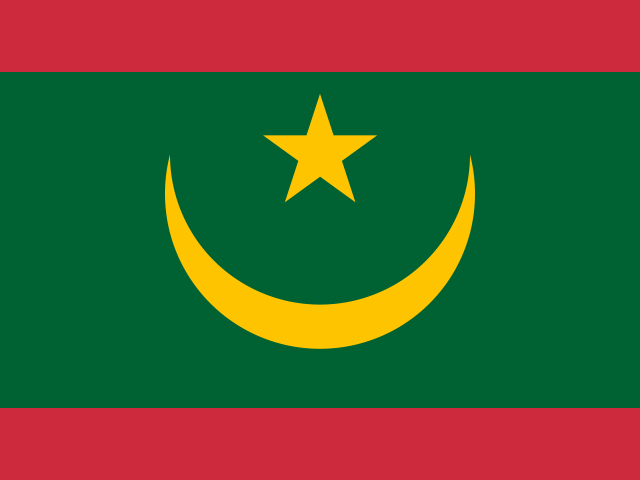 Mauritania
 Niger
Niger Nigeria
 Guinea-Bissau
 Saint Helena, Ascension and Tristan da Cunha
 Senegal
 Sierra Leone
 Togo
Togo Burkina Faso
 British Indian Ocean Territory
 Burundi
 Comoros
 Mayotte
 Ethiopia
 Eritrea
 French Southern Territories
 Djibouti
 Kenya
Kenya Madagascar
 Malawi
 Mauritius
 Mozambique
 Reunion
 Rwanda
 Seychelles
 Somalia
 Zimbabwe
 South Sudan
 Uganda
 Tanzania
 Zambia
 Angola
 Cameroon
 Central African Republic
 Chad
Chad Congo
Congo Democratic Republic of the Congo
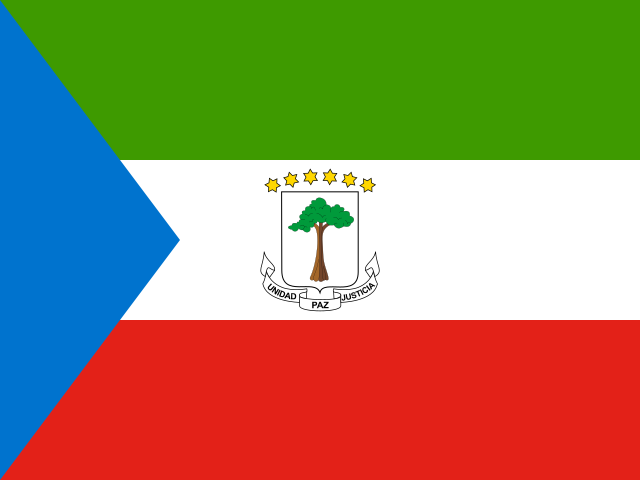 Equatorial Guinea
 Gabon
Gabon Sao Tome and Principe
 Botswana
 Lesotho
 Namibia
 South Africa
 Eswatini
Earlier Report Observations
The market for homogenised jams, jellies, marmalades, purées and pastes in Sub-Saharan Africa showed significant movement between 2018 and 2023. Market volume contracted to 3 516 t in 2019 from 4 350 t the previous year, then entered a period of expansion, reaching a peak of 5 026 t in 2022 before a modest correction to 4 604 t in 2023. Domestic production followed a clear upward trajectory from 2020 onwards, rising from 2 702 t to 3 045 t in 2023.
By the latter part of the period, evolving consumer demand for more natural and less sweet products began reshaping the market, encouraging manufacturers to reformulate with reduced sugar and local tropical fruits. This shift coincided with the progressive adoption of stricter labeling regulations, which mandated clear disclosure of sugar content and fruit origin as part of broader public health initiatives.
Concurrently, policies supporting local agriculture and agro-processing bolstered domestic production capabilities. Global supply chain disruptions from geopolitical and logistic factors further incentivized greater self-reliance, while the expansion of modern retail and e-commerce channels improved access to a wider range of products, including premium and organic varieties.
Table of content
- 1. Disclaimer
- 2. Terms of use of the report
- 3. Product codes in the statistical classifications used in the report
-
4. Key Market Indicators and Trends
-
4.1. Key Market Indicators
-
4.1.1. In kind
- 4.1.1.1. Production, 2018-2023
- 4.1.1.2. Imports, 2018-2024
- 4.1.1.3. Exports, 2018-2024
- 4.1.1.4. Market size, 2018-2023
-
4.1.1. In kind
- 4.2. Market Trends and Factors
-
4.1. Key Market Indicators
-
5. Production
-
5.1. Production in Sub-Saharan Africa
- 5.1.1. Annual dynamics of production in Sub-Saharan Africa in kind, 2018-2023, t
-
5.2. Global production by Country, 2018-2023
- 5.2.1. Annual dynamics of production by macroregions in kind, 2018-2023, t
- 5.2.2. Dynamics of production structure by macroregions in kind, 2018-2023
- 5.2.3. Annual dynamics of production by country in kind, 2018-2023, t
- 5.2.4. Structure of production by countries in kind, 2018-2023
- 5.2.5. Dynamics of peoduction structure by countries in kind, 2018-2023
-
5.1. Production in Sub-Saharan Africa
-
6. Imports
-
6.1. Imports (Direct Data*)
- 6.1.1. Imports - Total information
-
6.1.2. Imports in kind, t
- 6.1.2.1. Annual dynamics of product's imports to Cabo Verde in kind, 2018-2024, t
- 6.1.2.2. Dynamics of product's imports in kind to Cabo Verde by countries, 2018-2024, t
- 6.1.2.3. Structure of product's imports in kind by countries, 2018-2024
-
6.1.3. Imports in value, K $ US
- 6.1.3.1. Annual dynamics of product's imports to Cabo Verde in value, 2018-2024, K $ US
- 6.1.3.2. Dynamics of product's imports in value to Cabo Verde by countries, 2018-2024, K $ US
- 6.1.3.3. Structure of product's imports in value by countries, 2018-2024
-
6.1.4. Average price of product's imports, $ US/t
- 6.1.4.1. Annual dynamics of average price of product's imports to Cabo Verde, 2018-2024, $ US/t
- 6.1.4.2. Dynamics of average price of product's imports to Cabo Verde by countries, 2018-2024, $ US/t
-
6.2. Imports (Mirror Data)
- 6.2.1. Imports - Total information
-
6.2.2. Imports in kind, t
- 6.2.2.1. Annual dynamics of product's imports to Cabo Verde in kind, 2018-2024, t
- 6.2.2.2. Dynamics of product's imports in kind to Cabo Verde by countries, 2018-2024, t
- 6.2.2.3. Structure of product's imports in kind by countries, 2018-2024
-
6.2.3. Imports in value, K $ US
- 6.2.3.1. Annual dynamics of product's imports to Cabo Verde in value, 2018-2024, K $ US
- 6.2.3.2. Dynamics of product's imports in value to Cabo Verde by countries, 2018-2024, K $ US
- 6.2.3.3. Structure of product's imports in value by countries, 2018-2024
-
6.2.4. Average price of product's imports, $ US/t
- 6.2.4.1. Annual dynamics of average price of product's imports to Cabo Verde, 2018-2024, $ US/t
- 6.2.4.2. Dynamics of average price of product's imports to Cabo Verde by countries, 2018-2024, $ US/t
-
6.1. Imports (Direct Data*)
-
7. Exports
-
7.1. Exports (Direct Data*)
- 7.1.1. Exports - Total information
-
7.1.2. Exports in kind, t
- 7.1.2.1. Annual dynamics of product's exports from Cabo Verde in kind, 2018-2024, t
- 7.1.2.2. Dynamics of product's exports in kind from Cabo Verde by countries, 2018-2024, t
- 7.1.2.3. Structure of product's exports in kind by countries, 2018-2024
-
7.1.3. Exports in value, K $ US
- 7.1.3.1. Annual dynamics of product's exports from Cabo Verde in value, 2018-2024, K $ US
- 7.1.3.2. Dynamics of product's exports in value from Cabo Verde by countries, 2018-2024, K $ US
- 7.1.3.3. Structure of product's exports in value by countries, 2018-2024
-
7.1.4. Average price of product's exports, $ US/t
- 7.1.4.1. Annual dynamics of average price of product's exports from Cabo Verde, 2018-2024, $ US/t
- 7.1.4.2. Dynamics of average price of product's exports from Cabo Verde by countries, 2018-2024, $ US/t
-
7.2. Exports (Mirror Data)
- 7.2.1. Exports - Total information
-
7.2.2. Exports in kind, t
- 7.2.2.1. Annual dynamics of product's exports from Cabo Verde in kind, 2018-2024, t
- 7.2.2.2. Dynamics of product's exports in kind from Cabo Verde by countries, 2018-2024, t
- 7.2.2.3. Structure of product's exports in kind by countries, 2018-2024
-
7.2.3. Exports in value, K $ US
- 7.2.3.1. Annual dynamics of product's exports from Cabo Verde in value, 2018-2024, K $ US
- 7.2.3.2. Dynamics of product's exports in value from Cabo Verde by countries, 2018-2024, K $ US
- 7.2.3.3. Structure of product's exports in value by countries, 2018-2024
-
7.2.4. Average price of product's exports, $ US/t
- 7.2.4.1. Annual dynamics of average price of product's exports from Cabo Verde, 2018-2024, $ US/t
- 7.2.4.2. Dynamics of average price of product's exports from Cabo Verde by countries, 2018-2024, $ US/t
-
7.1. Exports (Direct Data*)
-
8. Trade balance
-
8.1. Trade balance (Direct Data)
- 8.1.1. In kind, t
- 8.1.2. In value, K $ US
-
8.2. Trade balance (Mirror Data)
- 8.2.1. In kind, t
- 8.2.2. In value, K $ US
-
8.1. Trade balance (Direct Data)
-
9. Top buying and selling countries, 2018-2024
-
9.1. Direct Data
- 9.1.1. Import in Value by Countries-buyers
- 9.1.2. Export in Value by Countries-suppliers
-
9.2. Mirror Data
- 9.2.1. Import in Value by Countries-buyers
- 9.2.2. Export in Value by Countries-suppliers
-
9.1. Direct Data
Production homogenised jams, jellies, marmalades, purées and pastes in Sub-Saharan Africa
In kind, 2017-2020, t
Top producers of homogenised jams, jellies, marmalades, purées and pastes, 2017-2020
World map of production of homogenised jams, jellies, marmalades, purées and pastes, 2017-2020
In Sub-Saharan Africa, production of homogenised jams, jellies, marmalades, purées and pastes reached 2,702 tonnes in 2020, marking a 10.5% increase compared to the previous year. Looking at the period from 2017 to 2020, production grew by 27.8%, which translates to an annualised growth rate of 8.5%. The most significant production decline occurred in 2019, with a drop of 2.9%, while the largest increase was recorded in 2018, at 19.2%.
Annual dynamics of production in Sub-Saharan Africa in kind, 2017-2020, t
| Parameter | 2018 | 2019 | 2020 | CAGR | |
|---|---|---|---|---|---|
| 1 | Change from last year | 19.2% | (2.9%) | 10.5% | 8.5% |
Exports homogenised jams, jellies, marmalades, purées and pastes from Sub-Saharan Africa
Exports in kind, t
The export data for Sub-Saharan Africa shows irregular fluctuations, pointing to a volatile market environment. In 2020, the region exported 510 tonnes of homogenised jams, jellies, marmalades, purées and pastes, which represents a 17.4% decrease from the previous year. The lowest export volume was recorded in 2018 at 42 tonnes, with the largest decline that year reaching 94.0%. Conversely, the most substantial increase occurred in 2019, soaring by 1,361.3%. From 2017 to 2018, the export figures exhibited a peak-to-trough amplitude of 17 times.
Annual dynamics of product's exports from Sub-Saharan Africa in kind, 2017-2020, t
| Parameter | 2018 | 2019 | 2020 | CAGR | |
|---|---|---|---|---|---|
| 1 | Change from last year | (94.0%) | 1 361.3% | (17.4%) | (10.3%) |
Between 2017 and 2020, France, Italy, and the Netherlands remained the top destinations for Sub-Saharan Africa's exports of homogenised jams, jellies, marmalades, purées and pastes in volume terms. France accounted for 1.8% of exports, Italy for 1.6%, and the Netherlands for 0.7%, combining to make up 4.1% of total export flows.
Structure of product's exports in kind by countries, 2017-2020
World map of product's exports from Sub-Saharan Africa in kind, 2017-2020
Exports in value, K $ US
In 2020, Sub-Saharan Africa's export value of homogenised jams, jellies, marmalades, purées and pastes amounted to 1,407 thousand US dollars, reflecting a 12.0% decrease from 2019. Over the period from 2017 to 2020, exports declined by 25.4%, equating to an annualised rate of 9.3%. The largest decline was observed in 2018, at 15.8%, while the largest increase occurred in 2019, with a modest rise of 0.8%.
Annual dynamics of product's exports from Sub-Saharan Africa in value, 2017-2020, K $ US
| Parameter | 2018 | 2019 | 2020 | CAGR | |
|---|---|---|---|---|---|
| 1 | Change from last year | (15.8%) | 0.8% | (12.0%) | (9.3%) |
From 2017 to 2020, France and Italy consistently held leading positions in the structure of Sub-Saharan Africa's exports by value. Together, they accounted for 5.1% of total export flows during this period.
Structure of product's exports in value by countries, 2017-2020
World map of product's exports from Sub-Saharan Africa in value, 2017-2020
Imports homogenised jams, jellies, marmalades, purées and pastes to Sub-Saharan Africa
Imports in kind, t
Imports of homogenised jams, jellies, marmalades, purées and pastes into Sub-Saharan Africa declined for the third consecutive year. In 2020, imports stood at 1,408 tonnes, showing a significant drop of 16.6% compared to the previous year. Over the 2017-2020 period, imports decreased by 33%, with a compound annual growth rate (CAGR) of -12.5%.
Annual dynamics of product's imports to Sub-Saharan Africa in kind, 2017-2020, t
| Parameter | 2018 | 2019 | 2020 | CAGR | |
|---|---|---|---|---|---|
| 1 | Change from last year | (10.9%) | (9.9%) | (16.6%) | (12.5%) |
The import market for homogenised jams, jellies, marmalades, purées and pastes in Sub-Saharan Africa was diverse from 2017 to 2020. France, India, and Egypt were the largest sources, with France contributing 21.4% of imports, India 9.5%, and Egypt 7.7%. Combined, these three countries accounted for 38.6% of total import flows, while the remaining 61.4% was distributed among numerous other countries.
Structure of product's imports in kind by countries, 2017-2020
World map of product's imports to Sub-Saharan Africa in kind, 2017-2020
Imports in value, K $ US
Cross-border shipments of homogenised jams, jellies, marmalades, purées and pastes into Sub-Saharan Africa fell for the third year in a row. In 2020, the region imported a total of 3,285 thousand US dollars worth of these products, indicating a moderate decline of 9.1% year-over-year. Between 2017 and 2020, imports decreased by 30%, which corresponds to an annualised rate of 11.2%.
Annual dynamics of product's imports to Sub-Saharan Africa in value, 2017-2020, K $ US
| Parameter | 2018 | 2019 | 2020 | CAGR | |
|---|---|---|---|---|---|
| 1 | Change from last year | (8.4%) | (15.9%) | (9.1%) | (11.2%) |
During the 2017-2020 period, imports of homogenised jams, jellies, marmalades, purées and pastes into Sub-Saharan Africa came from a wide range of markets. Even the largest suppliers—France, Portugal, and India—collectively represented only 46.1% of total imports in value terms.
Structure of product's imports in value by countries, 2017-2020
World map of product's imports to Sub-Saharan Africa in value, 2017-2020
Related Reports




Vegetable puree market in Sub-Saharan Africa
2026-03-29
Why Choose Us?
Only Verified Data
No Hidden Costs or Separate Fees
Smarter Subscription Pricing
Contact Our Team
Submit your inquiry using the form below — our team will get back to you within 24 hours.