






"Sub-Saharan Africa" region includes following countries:
 Cabo Verde
 Benin
Benin Gambia
 Ghana
Ghana Guinea
 Côte d'Ivoire
 Liberia
 Mali
Mali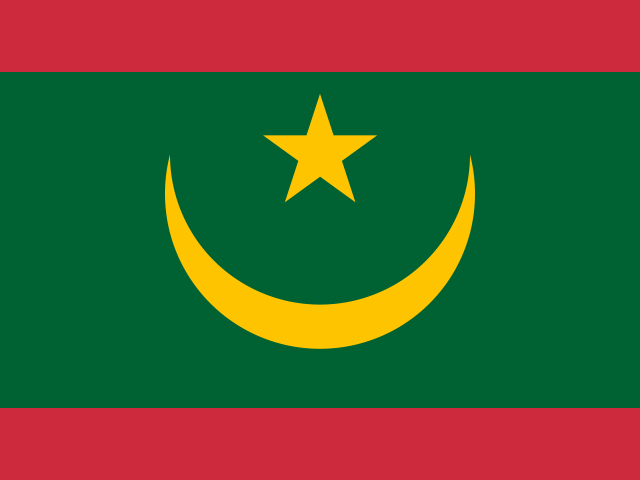 Mauritania
 Niger
Niger Nigeria
 Guinea-Bissau
 Saint Helena, Ascension and Tristan da Cunha
 Senegal
 Sierra Leone
 Togo
Togo Burkina Faso
 British Indian Ocean Territory
 Burundi
 Comoros
 Mayotte
 Ethiopia
 Eritrea
 French Southern Territories
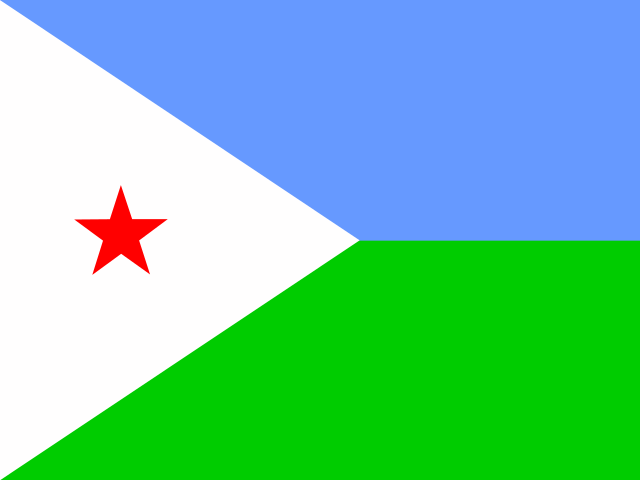 Djibouti
 Kenya
Kenya Madagascar
 Malawi
 Mauritius
 Mozambique
 Reunion
 Rwanda
 Seychelles
 Somalia
 Zimbabwe
 South Sudan
 Uganda
 Tanzania
 Zambia
 Angola
 Cameroon
 Central African Republic
 Chad
Chad Congo
Congo Democratic Republic of the Congo
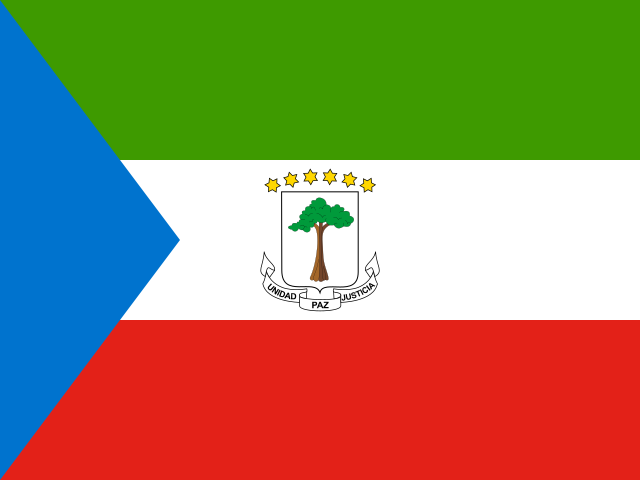 Equatorial Guinea
 Gabon
Gabon Sao Tome and Principe
 Botswana
 Lesotho
 Namibia
 South Africa
 Eswatini
Earlier Report Observations
Between 2018 and 2023, the goat meat market in Sub-Saharan Africa expanded in volume from 1 114 тыс. т to 1 305 тыс. т. This growth was initiated by the reopening of the state-owned Kenya Meat Commission, which facilitated export activities, and the introduction of hybrid goat breeds that improved meat quality and production efficiency. The establishment of major private players like Kiamaiko Meats, which ensured export-grade quality and traceability, further supported market access and production scale.
The market's expansion continued despite emerging challenges. While feed availability issues during dry seasons presented obstacles, rising consumer demand driven by nutritional awareness and the cultural significance of goat meat sustained growth. The adoption of artificial insemination technology across the period improved herd genetics and production efficiency, helping to increase output. Geopolitical tensions in the Middle East, which disrupted critical air freight routes for fresh exports from 2021, increased logistical costs but did not halt the overall production increase.
In the final years of the period, the market's growth was underpinned by the scaling of farming operations through expanded farmer groups and training programs. Quality assurance measures, such as unique identification marks for animals, bolstered breed authenticity and market trust. Strong and sustained consumer preference for goat meat, valued for its health benefits, ensured robust domestic demand, even as export logistics faced ongoing pressures from international conflicts.
Table of content
- 1. Disclaimer
- 2. Terms of use of the report
- 3. Product codes in the statistical classifications used in the report
-
4. Key Market Indicators and Trends
-
4.1. Key Market Indicators
-
4.1.1. In kind
- 4.1.1.1. Production, 2018-2023
- 4.1.1.2. Imports, 2018-2024
- 4.1.1.3. Exports, 2018-2024
- 4.1.1.4. Market size, 2018-2023
-
4.1.2. In value
- 4.1.2.1. Production, 2018-2023
- 4.1.2.2. Imports, 2018-2024
- 4.1.2.3. Exports, 2018-2024
- 4.1.2.4. Market size, 2018-2023
-
4.1.1. In kind
- 4.2. Market Trends and Factors
-
4.1. Key Market Indicators
-
5. Production
-
5.1. Production in Sub-Saharan Africa
- 5.1.1. Annual dynamics of production in Sub-Saharan Africa in kind, 2018-2023, K t
-
5.2. Global production by Country, 2018-2023
- 5.2.1. Annual dynamics of production by macroregions in kind, 2018-2023, K t
- 5.2.2. Dynamics of production structure by macroregions in kind, 2018-2023
- 5.2.3. Annual dynamics of production by country in kind, 2018-2023, K t
- 5.2.4. Structure of production by countries in kind, 2018-2023
- 5.2.5. Dynamics of peoduction structure by countries in kind, 2018-2023
-
5.1. Production in Sub-Saharan Africa
-
6. Imports
-
6.1. Imports (Direct Data*)
- 6.1.1. Imports - Total information
-
6.1.2. Imports in kind, t
- 6.1.2.1. Annual dynamics of product's imports to Cabo Verde in kind, 2018-2024, t
- 6.1.2.2. Dynamics of product's imports in kind to Cabo Verde by countries, 2018-2024, t
- 6.1.2.3. Structure of product's imports in kind by countries, 2018-2024
-
6.1.3. Imports in value, M $ US
- 6.1.3.1. Annual dynamics of product's imports to Cabo Verde in value, 2018-2024, M $ US
- 6.1.3.2. Dynamics of product's imports in value to Cabo Verde by countries, 2018-2024, M $ US
- 6.1.3.3. Structure of product's imports in value by countries, 2018-2024
-
6.1.4. Average price of product's imports, $ US/kg
- 6.1.4.1. Annual dynamics of average price of product's imports to Cabo Verde, 2018-2024, $ US/kg
- 6.1.4.2. Dynamics of average price of product's imports to Cabo Verde by countries, 2018-2024, $ US/kg
-
6.2. Imports (Mirror Data)
- 6.2.1. Imports - Total information
-
6.2.2. Imports in kind, t
- 6.2.2.1. Annual dynamics of product's imports to Cabo Verde in kind, 2018-2024, t
- 6.2.2.2. Dynamics of product's imports in kind to Cabo Verde by countries, 2018-2024, t
- 6.2.2.3. Structure of product's imports in kind by countries, 2018-2024
-
6.2.3. Imports in value, M $ US
- 6.2.3.1. Annual dynamics of product's imports to Cabo Verde in value, 2018-2024, M $ US
- 6.2.3.2. Dynamics of product's imports in value to Cabo Verde by countries, 2018-2024, M $ US
- 6.2.3.3. Structure of product's imports in value by countries, 2018-2024
-
6.2.4. Average price of product's imports, $ US/kg
- 6.2.4.1. Annual dynamics of average price of product's imports to Cabo Verde, 2018-2024, $ US/kg
- 6.2.4.2. Dynamics of average price of product's imports to Cabo Verde by countries, 2018-2024, $ US/kg
-
6.1. Imports (Direct Data*)
-
7. Exports
-
7.1. Exports (Direct Data*)
- 7.1.1. Exports - Total information
-
7.1.2. Exports in kind, t
- 7.1.2.1. Annual dynamics of product's exports from Cabo Verde in kind, 2018-2024, t
- 7.1.2.2. Dynamics of product's exports in kind from Cabo Verde by countries, 2018-2024, t
- 7.1.2.3. Structure of product's exports in kind by countries, 2018-2024
-
7.1.3. Exports in value, M $ US
- 7.1.3.1. Annual dynamics of product's exports from Cabo Verde in value, 2018-2024, M $ US
- 7.1.3.2. Dynamics of product's exports in value from Cabo Verde by countries, 2018-2024, M $ US
- 7.1.3.3. Structure of product's exports in value by countries, 2018-2024
-
7.1.4. Average price of product's exports, $ US/kg
- 7.1.4.1. Annual dynamics of average price of product's exports from Cabo Verde, 2018-2024, $ US/kg
- 7.1.4.2. Dynamics of average price of product's exports from Cabo Verde by countries, 2018-2024, $ US/kg
-
7.2. Exports (Mirror Data)
- 7.2.1. Exports - Total information
-
7.2.2. Exports in kind, t
- 7.2.2.1. Annual dynamics of product's exports from Cabo Verde in kind, 2018-2024, t
- 7.2.2.2. Dynamics of product's exports in kind from Cabo Verde by countries, 2018-2024, t
- 7.2.2.3. Structure of product's exports in kind by countries, 2018-2024
-
7.2.3. Exports in value, M $ US
- 7.2.3.1. Annual dynamics of product's exports from Cabo Verde in value, 2018-2024, M $ US
- 7.2.3.2. Dynamics of product's exports in value from Cabo Verde by countries, 2018-2024, M $ US
- 7.2.3.3. Structure of product's exports in value by countries, 2018-2024
-
7.2.4. Average price of product's exports, $ US/kg
- 7.2.4.1. Annual dynamics of average price of product's exports from Cabo Verde, 2018-2024, $ US/kg
- 7.2.4.2. Dynamics of average price of product's exports from Cabo Verde by countries, 2018-2024, $ US/kg
-
7.1. Exports (Direct Data*)
-
8. Trade balance
-
8.1. Trade balance (Direct Data)
- 8.1.1. In kind, t
- 8.1.2. In value, M $ US
-
8.2. Trade balance (Mirror Data)
- 8.2.1. In kind, t
- 8.2.2. In value, M $ US
-
8.1. Trade balance (Direct Data)
-
9. Top buying and selling countries, 2018-2024
-
9.1. Direct Data
- 9.1.1. Import in Value by Countries-buyers
- 9.1.2. Export in Value by Countries-suppliers
-
9.2. Mirror Data
- 9.2.1. Import in Value by Countries-buyers
- 9.2.2. Export in Value by Countries-suppliers
-
9.1. Direct Data
Production goat meat in Sub-Saharan Africa
In kind, 2017-2020, K t
Top producers of goat meat, 2017-2020
World map of production of goat meat, 2017-2020
Goat meat production in Sub-Saharan Africa has grown for the third year in a row. In 2020, the region produced 1 229 thousand tonnes of goat meat, showing a slight increase of 1.2% from the previous year. Looking at the period from 2017 to 2020, production rose by 14.8%, which translates to an average annual growth rate of 4.7%.
Annual dynamics of production in Sub-Saharan Africa in kind, 2017-2020, K t
| Parameter | 2018 | 2019 | 2020 | CAGR | |
|---|---|---|---|---|---|
| 1 | Change from last year | 6.2% | 6.9% | 1.2% | 4.7% |
In value, 2017-2020, M $ US
Following two years of growth, goat meat production in Sub-Saharan Africa saw a decline in value. In 2020, the output was valued at 6 351 million US dollars, down 3.5% compared to 2019. Over the 2017-2020 period, production value increased by 8.5%, with a compound annual growth rate of 2.8%. The peak value was recorded in 2019 at 6 584 million US dollars, while the largest year-on-year increase occurred in 2018 at 7.5%.
Annual dynamics of production in Sub-Saharan Africa in value, 2017-2020, M $ US
| Parameter | 2018 | 2019 | 2020 | CAGR | |
|---|---|---|---|---|---|
| 1 | Change from last year | 7.5% | 4.7% | (3.5%) | 2.8% |
Exports goat meat from Sub-Saharan Africa
Exports in kind, t
After two years of growth, Sub-Saharan Africa's goat meat export volume decreased. In 2020, exports totaled 21 413 tonnes, marking a modest decline of 4.4% from the previous year. The highest volume was recorded in 2019 at 22 404 tonnes, with the largest increase seen in 2018 at 1.9%.
Annual dynamics of product's exports from Sub-Saharan Africa in kind, 2017-2020, t
| Parameter | 2018 | 2019 | 2020 | CAGR | |
|---|---|---|---|---|---|
| 1 | Change from last year | 1.9% | 1.0% | (4.4%) | (0.5%) |
From 2017 to 2020, goat meat exports from Sub-Saharan Africa were primarily directed toward the United Arab Emirates and Saudi Arabia. Together, these two destinations accounted for 89.6% of total export flows, while other markets played a more minor role.
Structure of product's exports in kind by countries, 2017-2020
World map of product's exports from Sub-Saharan Africa in kind, 2017-2020
Exports in value, M $ US
Goat meat exports from Sub-Saharan Africa declined for the second consecutive year. In 2020, export value amounted to 110.7 million US dollars, reflecting a moderate decrease of 8.9% compared to the previous year. Over the 2017-2020 period, exports fell by 7%, with an average annual decline of 2.4%. The highest value was recorded in 2018 at 122.8 million US dollars, which also saw the largest increase that year at 3.2%.
Annual dynamics of product's exports from Sub-Saharan Africa in value, 2017-2020, M $ US
| Parameter | 2018 | 2019 | 2020 | CAGR | |
|---|---|---|---|---|---|
| 1 | Change from last year | 3.2% | (1.1%) | (8.9%) | (2.4%) |
Throughout 2017-2020, the export value structure for goat meat from Sub-Saharan Africa was dominated by the United Arab Emirates and Saudi Arabia. These two countries together represented 91.4% of total export value, with other markets contributing only a small share.
Structure of product's exports in value by countries, 2017-2020
World map of product's exports from Sub-Saharan Africa in value, 2017-2020
Imports goat meat to Sub-Saharan Africa
Imports in kind, t
After two years of growth, goat meat import volumes into Sub-Saharan Africa declined. In 2020, the region imported 537 tonnes of goat meat, which is 4.9% lower than in 2019. Between 2017 and 2020, imports surged by 63.6%, equivalent to an average annual growth rate of 17.8%. The peak volume was recorded in 2019 at 537 tonnes, with the largest increase occurring in 2018 at 68.3%.
Annual dynamics of product's imports to Sub-Saharan Africa in kind, 2017-2020, t
| Parameter | 2018 | 2019 | 2020 | CAGR | |
|---|---|---|---|---|---|
| 1 | Change from last year | 68.3% | 2.2% | (4.9%) | 17.8% |
From 2017 to 2020, the main suppliers of goat meat to Sub-Saharan Africa in volume terms were Spain (24.0% of imports), Argentina (7.2%), and Australia (6.9%). However, their combined share was only 38.1% of total imports, indicating a diversified supplier base across the region.
Structure of product's imports in kind by countries, 2017-2020
World map of product's imports to Sub-Saharan Africa in kind, 2017-2020
Imports in value, M $ US
Goat meat import values into Sub-Saharan Africa increased for the third consecutive year. In 2020, imports reached 2.9 million US dollars, up 5.3% from 2019. Over the 2017-2020 period, import value grew by 93.6%, with an average annual increase of 24.6%.
Annual dynamics of product's imports to Sub-Saharan Africa in value, 2017-2020, M $ US
| Parameter | 2018 | 2019 | 2020 | CAGR | |
|---|---|---|---|---|---|
| 1 | Change from last year | 59.0% | 15.7% | 5.3% | 24.6% |
In 2017-2020, the partner structure for goat meat imports into Sub-Saharan Africa in value terms was quite diverse. Spain (22.7% of import value), Australia (9.3%), and Argentina (4.7%) together accounted for just 36.7% of total flows, highlighting a broad range of suppliers.
Structure of product's imports in value by countries, 2017-2020
World map of product's imports to Sub-Saharan Africa in value, 2017-2020
Related Reports





Why Choose Us?
Only Verified Data
No Hidden Costs or Separate Fees
Smarter Subscription Pricing
Contact Our Team
Submit your inquiry using the form below — our team will get back to you within 24 hours.