






"Sub-Saharan Africa" region includes following countries:
 Cabo Verde
 Benin
Benin Gambia
 Ghana
Ghana Guinea
 Côte d'Ivoire
 Liberia
 Mali
Mali Mauritania
 Niger
Niger Nigeria
 Guinea-Bissau
 Saint Helena, Ascension and Tristan da Cunha
 Senegal
 Sierra Leone
 Togo
Togo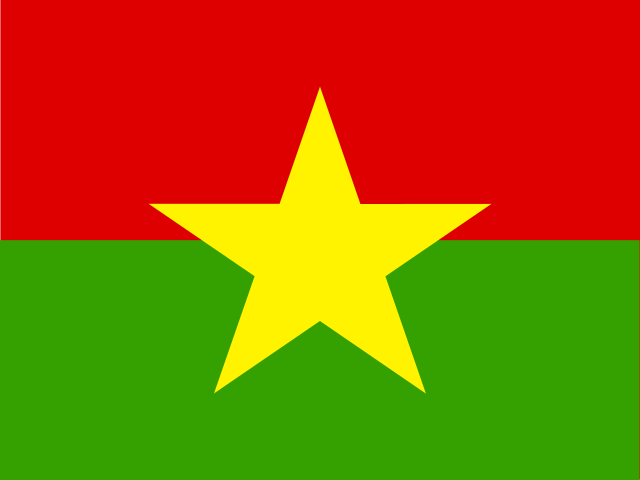 Burkina Faso
 British Indian Ocean Territory
 Burundi
 Comoros
 Mayotte
 Ethiopia
 Eritrea
 French Southern Territories
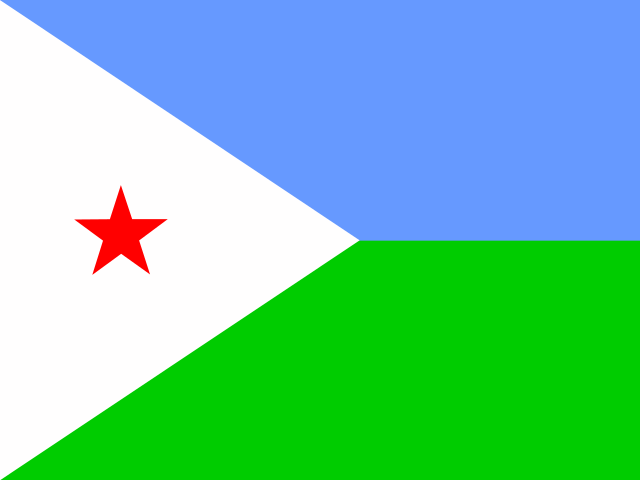 Djibouti
 Kenya
Kenya Madagascar
 Malawi
 Mauritius
 Mozambique
 Reunion
 Rwanda
 Seychelles
 Somalia
 Zimbabwe
 South Sudan
 Uganda
 Tanzania
 Zambia
 Angola
 Cameroon
 Central African Republic
 Chad
Chad Congo
Congo Democratic Republic of the Congo
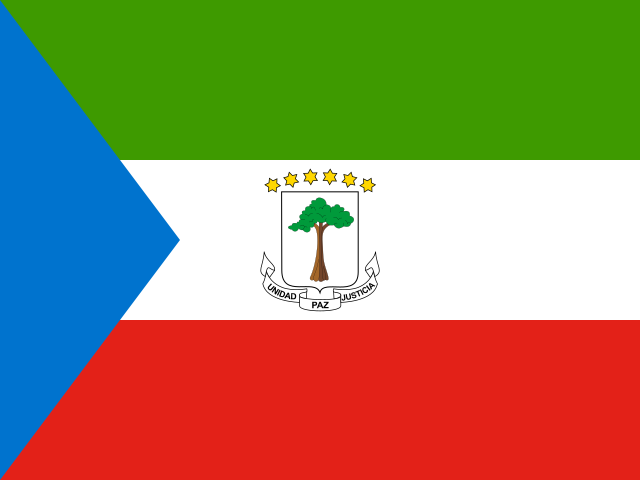 Equatorial Guinea
 Gabon
Gabon Sao Tome and Principe
 Botswana
 Lesotho
 Namibia
 South Africa
 Eswatini
Earlier Report Observations
From 2018 to 2019, the introduction of an anti-dumping levy on fresh garlic from China by South African authorities aimed to protect domestic growers from low-priced imports. This measure contributed to a reduction in import volumes and supported local production, helping to maintain the total market volume at a stable level of around 427 to 429 thousand tons.
The COVID-19 pandemic severely disrupted supply chains in 2020 and 2021. Factory closures in China, logistical delays at South African ports due to lockdowns, and a weaker local currency increased import costs and constrained availability. Coupled with an earlier local harvest, these factors led to a significant drop in domestic production to 255 thousand tons in 2021 and a contraction of the total market volume to 351 thousand tons. During this period, consumer preference also shifted toward fresh, locally sourced garlic due to health and quality concerns.
A recovery began in 2022, with production rising to 296 thousand tons and the market volume expanding to 397 thousand tons, supported by sustained consumer demand linked to health trends and ongoing efforts by local growers to improve cultivation. However, the market volume eased to 381 thousand tons in 2023, coinciding with a decrease in both imports and production.
Table of content
- 1. Disclaimer
- 2. Terms of use of the report
- 3. Product codes in the statistical classifications used in the report
-
4. Key Market Indicators and Trends
-
4.1. Key Market Indicators
-
4.1.1. In kind
- 4.1.1.1. Production, 2018-2023
- 4.1.1.2. Imports, 2018-2024
- 4.1.1.3. Exports, 2018-2024
- 4.1.1.4. Market size, 2018-2023
-
4.1.1. In kind
- 4.2. Market Trends and Factors
-
4.1. Key Market Indicators
-
5. Production
-
5.1. Production in Sub-Saharan Africa
- 5.1.1. Annual dynamics of production in Sub-Saharan Africa in kind, 2018-2023, K t
-
5.2. Global production by Country, 2018-2023
- 5.2.1. Annual dynamics of production by macroregions in kind, 2018-2023, K t
- 5.2.2. Dynamics of production structure by macroregions in kind, 2018-2023
- 5.2.3. Annual dynamics of production by country in kind, 2018-2023, K t
- 5.2.4. Structure of production by countries in kind, 2018-2023
- 5.2.5. Dynamics of peoduction structure by countries in kind, 2018-2023
-
5.1. Production in Sub-Saharan Africa
-
6. Imports
-
6.1. Imports (Direct Data*)
- 6.1.1. Imports - Total information
-
6.1.2. Imports in kind, K t
- 6.1.2.1. Annual dynamics of product's imports to Cabo Verde in kind, 2018-2024, K t
- 6.1.2.2. Dynamics of product's imports in kind to Cabo Verde by countries, 2018-2024, K t
- 6.1.2.3. Structure of product's imports in kind by countries, 2018-2024
-
6.1.3. Imports in value, K $ US
- 6.1.3.1. Annual dynamics of product's imports to Cabo Verde in value, 2018-2024, K $ US
- 6.1.3.2. Dynamics of product's imports in value to Cabo Verde by countries, 2018-2024, K $ US
- 6.1.3.3. Structure of product's imports in value by countries, 2018-2024
-
6.1.4. Average price of product's imports, $ US/t
- 6.1.4.1. Annual dynamics of average price of product's imports to Cabo Verde, 2018-2024, $ US/t
- 6.1.4.2. Dynamics of average price of product's imports to Cabo Verde by countries, 2018-2024, $ US/t
-
6.2. Imports (Mirror Data)
- 6.2.1. Imports - Total information
-
6.2.2. Imports in kind, K t
- 6.2.2.1. Annual dynamics of product's imports to Cabo Verde in kind, 2018-2024, K t
- 6.2.2.2. Dynamics of product's imports in kind to Cabo Verde by countries, 2018-2024, K t
- 6.2.2.3. Structure of product's imports in kind by countries, 2018-2024
-
6.2.3. Imports in value, K $ US
- 6.2.3.1. Annual dynamics of product's imports to Cabo Verde in value, 2018-2024, K $ US
- 6.2.3.2. Dynamics of product's imports in value to Cabo Verde by countries, 2018-2024, K $ US
- 6.2.3.3. Structure of product's imports in value by countries, 2018-2024
-
6.2.4. Average price of product's imports, $ US/t
- 6.2.4.1. Annual dynamics of average price of product's imports to Cabo Verde, 2018-2024, $ US/t
- 6.2.4.2. Dynamics of average price of product's imports to Cabo Verde by countries, 2018-2024, $ US/t
-
6.1. Imports (Direct Data*)
-
7. Exports
-
7.1. Exports (Direct Data*)
- 7.1.1. Exports - Total information
-
7.1.2. Exports in kind, K t
- 7.1.2.1. Annual dynamics of product's exports from Cabo Verde in kind, 2018-2024, K t
- 7.1.2.2. Dynamics of product's exports in kind from Cabo Verde by countries, 2018-2024, K t
- 7.1.2.3. Structure of product's exports in kind by countries, 2018-2024
-
7.1.3. Exports in value, K $ US
- 7.1.3.1. Annual dynamics of product's exports from Cabo Verde in value, 2018-2024, K $ US
- 7.1.3.2. Dynamics of product's exports in value from Cabo Verde by countries, 2018-2024, K $ US
- 7.1.3.3. Structure of product's exports in value by countries, 2018-2024
-
7.1.4. Average price of product's exports, $ US/t
- 7.1.4.1. Annual dynamics of average price of product's exports from Cabo Verde, 2018-2024, $ US/t
- 7.1.4.2. Dynamics of average price of product's exports from Cabo Verde by countries, 2018-2024, $ US/t
-
7.2. Exports (Mirror Data)
- 7.2.1. Exports - Total information
-
7.2.2. Exports in kind, K t
- 7.2.2.1. Annual dynamics of product's exports from Cabo Verde in kind, 2018-2024, K t
- 7.2.2.2. Dynamics of product's exports in kind from Cabo Verde by countries, 2018-2024, K t
- 7.2.2.3. Structure of product's exports in kind by countries, 2018-2024
-
7.2.3. Exports in value, K $ US
- 7.2.3.1. Annual dynamics of product's exports from Cabo Verde in value, 2018-2024, K $ US
- 7.2.3.2. Dynamics of product's exports in value from Cabo Verde by countries, 2018-2024, K $ US
- 7.2.3.3. Structure of product's exports in value by countries, 2018-2024
-
7.2.4. Average price of product's exports, $ US/t
- 7.2.4.1. Annual dynamics of average price of product's exports from Cabo Verde, 2018-2024, $ US/t
- 7.2.4.2. Dynamics of average price of product's exports from Cabo Verde by countries, 2018-2024, $ US/t
-
7.1. Exports (Direct Data*)
-
8. Trade balance
-
8.1. Trade balance (Direct Data)
- 8.1.1. In kind, K t
- 8.1.2. In value, K $ US
-
8.2. Trade balance (Mirror Data)
- 8.2.1. In kind, K t
- 8.2.2. In value, K $ US
-
8.1. Trade balance (Direct Data)
-
9. Top buying and selling countries, 2018-2024
-
9.1. Direct Data
- 9.1.1. Import in Value by Countries-buyers
- 9.1.2. Export in Value by Countries-suppliers
-
9.2. Mirror Data
- 9.2.1. Import in Value by Countries-buyers
- 9.2.2. Export in Value by Countries-suppliers
-
9.1. Direct Data
Production garlic in Sub-Saharan Africa
In kind, 2017-2020, K t
Top producers of garlic, 2017-2020
World map of production of garlic, 2017-2020
After two consecutive years of growth, garlic production in Sub-Saharan Africa experienced a decline. In 2020, the region produced 294.6 thousand tons of garlic, which represents a 17.7% decrease compared to 2019. Looking at the broader period from 2017 to 2020, production actually increased by 24.4%, translating to an average annual growth rate of 7.5%. The peak production was recorded in 2019 at 358.1 thousand tons, while the most significant year-over-year increase occurred in 2018 with a jump of 49.2%.
Annual dynamics of production in Sub-Saharan Africa in kind, 2017-2020, K t
| Parameter | 2018 | 2019 | 2020 | CAGR | |
|---|---|---|---|---|---|
| 1 | Change from last year | 49.2% | 1.3% | (17.7%) | 7.5% |
Exports garlic from Sub-Saharan Africa
Exports in kind, t
Garlic exports from Sub-Saharan Africa showed notable fluctuations during this period. The lowest point was in 2017, followed by a peak in 2018, with exports in 2018 being 2.5 times higher than in 2017. In 2020, exports reached 1 949 tons, marking a moderate increase of 9.9% compared to 2019. The highest export volume was recorded in 2018 at 2 417 tons. The most substantial decline occurred in 2019 with a drop of 26.6%, while the largest increase was in 2018 with a surge of 150.6%.
Annual dynamics of product's exports from Sub-Saharan Africa in kind, 2017-2020, t
| Parameter | 2018 | 2019 | 2020 | CAGR | |
|---|---|---|---|---|---|
| 1 | Change from last year | 150.6% | (26.6%) | 9.9% | 26.4% |
From 2017 to 2020, Sudan, the Netherlands, and France were the key export partners for Sub-Saharan Africa in terms of volume. Sudan accounted for 8.8% of exports, the Netherlands for 1.2%, and France for 1.0%. Together, these three countries represented 11.0% of total export flows.
Structure of product's exports in kind by countries, 2017-2020
World map of product's exports from Sub-Saharan Africa in kind, 2017-2020
Exports in value, K $ US
Following two years of decline, the value of garlic exports from Sub-Saharan Africa rebounded. In 2020, exports totaled 3 508 thousand US dollars, reflecting a notable increase of 18.1% compared to 2019. Over the period from 2017 to 2020, however, export value decreased by 10.1%, with a compound annual growth rate of -3.5%. The lowest value was recorded in 2019 at 2 970 thousand US dollars. The most significant decline occurred in 2018 with a drop of 17.6%.
Annual dynamics of product's exports from Sub-Saharan Africa in value, 2017-2020, K $ US
| Parameter | 2018 | 2019 | 2020 | CAGR | |
|---|---|---|---|---|---|
| 1 | Change from last year | (17.6%) | (7.7%) | 18.1% | (3.5%) |
From 2017 to 2020, Sudan, the Netherlands, and France remained the primary destinations for Sub-Saharan Africa's garlic exports in value terms. Sudan accounted for 6.8% of export value, the Netherlands for 3.7%, and France for 3.0%. Collectively, these three countries represented 13.5% of total export flows.
Structure of product's exports in value by countries, 2017-2020
World map of product's exports from Sub-Saharan Africa in value, 2017-2020
Imports garlic to Sub-Saharan Africa
Imports in kind, t
In 2020, Sub-Saharan Africa imported approximately 93 355 tons of garlic, reflecting a sharp increase of 29.2% compared to the previous year. Over the period from 2017 to 2020, imports grew by 28.7%, equating to an average annual growth rate of 8.8%. The lowest import volume was recorded in 2019 at 72 253 tons, which also saw the largest decline of 4.7% during that year.
Annual dynamics of product's imports to Sub-Saharan Africa in kind, 2017-2020, t
| Parameter | 2018 | 2019 | 2020 | CAGR | |
|---|---|---|---|---|---|
| 1 | Change from last year | 4.5% | (4.7%) | 29.2% | 8.8% |
From 2017 to 2020, China dominated Sub-Saharan Africa's garlic imports in volume, accounting for 75.9% of total imports. The remaining volume was distributed among numerous other countries, each with smaller individual shares.
Structure of product's imports in kind by countries, 2017-2020
World map of product's imports to Sub-Saharan Africa in kind, 2017-2020
Imports in value, K $ US
In 2020, the value of garlic imports into Sub-Saharan Africa totaled 66 733 thousand US dollars, showing a steep year-over-year increase of 39.8%. Over the period from 2017 to 2020, import value rose by 34.4%, with a compound annual growth rate of 10.3%. The lowest value was recorded in 2019 at 47 723 thousand US dollars, which also experienced the largest decline of 5.3% that year.
Annual dynamics of product's imports to Sub-Saharan Africa in value, 2017-2020, K $ US
| Parameter | 2018 | 2019 | 2020 | CAGR | |
|---|---|---|---|---|---|
| 1 | Change from last year | 1.5% | (5.3%) | 39.8% | 10.3% |
From 2017 to 2020, China held a dominant position in Sub-Saharan Africa's garlic imports in value terms, accounting for 72.7% of total flows. The remaining share was divided among various smaller destinations.
Structure of product's imports in value by countries, 2017-2020
World map of product's imports to Sub-Saharan Africa in value, 2017-2020
Related Reports





Why Choose Us?
Only Verified Data
No Hidden Costs or Separate Fees
Smarter Subscription Pricing
Contact Our Team
Submit your inquiry using the form below — our team will get back to you within 24 hours.